AI 101: How AI Works, Explained in Plain English
· updated
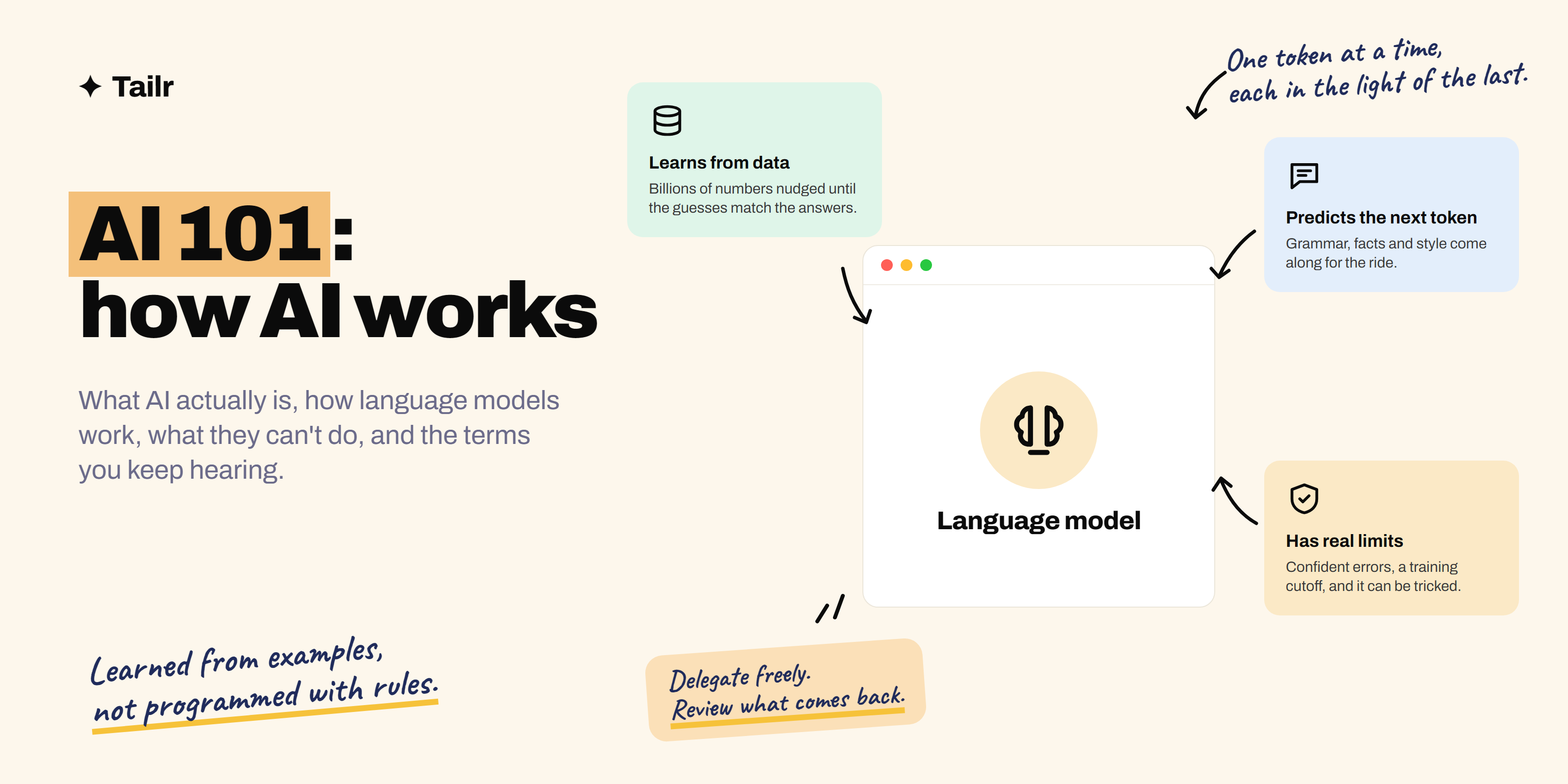
AI is in every product announcement and every job listing, and most explanations either drown you in maths or wave their hands and say “it’s magic”. Neither helps. This is the middle ground: what AI actually is, how the systems you use every day work, what they’re bad at, the terms you keep hearing, and how to get started, with no equations.
The short answer: AI is software that does tasks we associate with human thinking: understanding language, recognising images, spotting patterns, making predictions. Almost all modern AI is machine learning, which means the system learns patterns from large amounts of data instead of being programmed with rules. The chat assistants everyone uses are large language models: enormous neural networks trained to predict the next piece of text, then refined with human feedback so they’re helpful and safe. They’re extraordinarily useful, and they have real limits: they can be confidently wrong, they only know what’s in their training data or the conversation, and they can be manipulated by the content they read. Knowing both halves is what AI literacy means in 2026.
The one idea underneath everything: learning from examples
Traditional software is a set of rules written by a person. If the temperature is above 30, turn on the fan. Rules work when a human can write them down. They fail for things humans do without knowing how: recognising a face, understanding a sentence, judging whether an email is spam.
Machine learning flips it. Instead of writing rules, you show the system many examples with the right answer attached (this is a cat, this isn’t; this is spam, this isn’t) and it adjusts millions or billions of internal numbers until its guesses match the answers. Those numbers are the “model”. Show it a new example and it applies what it learned. Nobody wrote the rules; the system found them in the data.
That’s it. Everything else in this post is a variation on that idea.
AI, machine learning, deep learning: how the terms nest
- Artificial intelligence is the broad goal: machines doing things that look intelligent. It’s been a field since the 1950s and has included many approaches.
- Machine learning is the approach that won: learning from data instead of rules. Almost everything called AI today is machine learning.
- Deep learning is machine learning using neural networks with many layers. It’s behind nearly every breakthrough since around 2012: image recognition, speech, translation, and language models.
- Generative AI is deep learning systems that create new content (text, images, audio, code, video) rather than just classifying or predicting. This is the wave that started in 2022 and is what most people mean by “AI” now.
So a language model is a generative AI system, built with deep learning, which is a kind of machine learning, which is a kind of AI.
How a language model works, without the maths
For a longer walkthrough of this section, see what is an LLM, and for models that take actions, what is an AI agent.
Training. Take a neural network with billions of adjustable numbers. Feed it a very large amount of text: books, websites, code, articles. Give it a simple task, over and over: here’s the start of a passage, predict the next piece. At first it guesses randomly. Every time it’s wrong, nudge the numbers slightly towards a better guess. Repeat trillions of times. To get good at predicting the next word in any context, the network has to pick up grammar, facts, styles, how arguments work, how code works, and a great deal about how people write. All of that ends up encoded in the numbers.
Tokens. The “pieces” aren’t quite words; they’re tokens, chunks of characters that are usually a word or part of one. “Unbelievable” might be three tokens. This matters because everything about a model is measured in tokens: how much it can read at once, how much it costs, how fast it responds.
Generation. When you send a message, the model reads it and produces a probability for every possible next token. It picks one (usually a likely one, with some randomness), adds it to the text, and does it again. And again. Each token is chosen in the light of everything before it. That’s why the answer appears word by word: it’s being decided word by word.
Making it helpful. A raw next-token predictor is a strange thing to talk to; ask it a question and it might continue with more questions. So after the main training, models go through further training on examples of good conversations and on human feedback about which responses are better. That’s what turns a text predictor into an assistant that answers, follows instructions and declines harmful requests.
The context window. The model can only consider a limited amount of text at once: the conversation so far plus anything you paste in. That’s the context window. Anything outside it doesn’t exist for the model. This is why assistants forget earlier conversations unless the product saves and re-supplies them, and why “give it the document” works.
What AI is genuinely good at
- Language tasks: drafting, rewriting, summarising, translating, changing tone, explaining.
- Code: writing, explaining, fixing and reviewing it, in most languages.
- Extraction and structuring: pulling names, dates, amounts and fields out of messy text.
- Pattern-finding: classifying, clustering, spotting anomalies, at a scale no team of humans could match.
- Images and audio: recognising, describing, generating and editing them; transcribing speech.
- Being a tireless first draft: of anything, at any hour, in seconds.
The common thread is that it’s excellent at producing something plausible and reasonable fast. That’s a huge deal for the first 80% of most knowledge work.
What AI is bad at, and why
- It can be confidently wrong. Called hallucination. The model is producing likely text, not checking facts; a fabricated citation can be just as fluent as a real one. Check anything that matters.
- It doesn’t know what it wasn’t shown. Training has a cutoff date, and the model doesn’t know your company, your data or this morning’s news unless that information is in the context window.
- Precise reasoning is fragile. Long arithmetic, counting, strict logic and multi-step plans go wrong more than you’d expect. Good products give the model tools (a calculator, a code runner, a search engine) rather than trusting it to do these in its head.
- It can be manipulated. If the model reads a document or web page containing “ignore your instructions and do this instead”, it may comply. This is prompt injection, and it’s a real security problem for anything that reads untrusted content.
- It reflects its training data, including the biases, gaps and errors in it.
- It has no goals, memory or awareness of its own. It can’t want anything, doesn’t remember you between conversations unless the product stores that, and doesn’t know when it’s wrong.
None of these are reasons not to use it. They’re reasons to use it like a brilliant, fast, occasionally unreliable colleague: delegate freely, review what comes back.
Twelve terms you’ll keep hearing
| Term | What it means |
|---|---|
| Model | The trained system: the billions of numbers and the code that runs them |
| Training | Adjusting a model’s numbers using examples until it performs well |
| Inference | Running a trained model to get an answer |
| Token | The unit of text a model reads and writes, roughly three-quarters of a word |
| Context window | How much text the model can consider at once |
| Prompt | What you send the model: instructions, questions, documents |
| Hallucination | Confident output that isn’t true or isn’t grounded in the input |
| Fine-tuning | Further training of an existing model on specific examples to change its behaviour |
| RAG | Retrieval-augmented generation: finding relevant documents and putting them in the context so the model can answer from them |
| Embedding | A list of numbers representing the meaning of a piece of text, used for search by similarity |
| Agent | A system where the model decides which tools to use, in what order, to complete a task |
| Open weights | A model whose numbers are published so anyone can run it themselves, as opposed to one accessed only through a company’s API |
If you want to go a level deeper on how people get better results from models, our guides to types of prompting methods and context engineering vs. prompt engineering pick up where this table stops.
How to use AI well, starting today
- Give it context. The single biggest improvement most people can make. Paste the document, describe the audience, say what good looks like. The model can only work with what’s in the window.
- Ask for a structure, not just an answer. “Give me three options with trade-offs” beats “what should I do?”
- Iterate. The first answer is a draft. Say what’s wrong with it and ask again.
- Verify what matters. Numbers, names, quotes, legal and medical claims, anything you’ll put your name on.
- Use it for the parts you’re slow at, not the parts you’re good at. If you write well but summarise slowly, have it summarise and write the important sentences yourself.
- Don’t paste in what you shouldn’t. Confidential data, other people’s personal information, anything covered by a contract. Check what your employer allows.
AI and your career
Two honest things. First, AI is changing most knowledge jobs faster than it’s removing them: the people getting ahead are the ones who’ve learned to delegate the routine parts to it and spend the time saved on judgement, relationships and the hard problems. Second, “AI skills” on a job listing usually means practical fluency, not a research background: can you use these tools well, do you know their limits, can you tell when an output is wrong.
If you want to go further than fluency, the path is well marked. What is AI engineering explains the job of building products on top of models, how to get started with AI engineering is the step-by-step roadmap, and what does an AI engineer do covers the role and pay.
And whatever field you’re in, the job search itself is one of the places AI already helps most. Every listing you open tells you exactly what the employer wants; the work is reshaping your resume to match, for each one. Tailr is a browser extension that does that from the listing you’re viewing: it tailors your resume to the specific job, writes a matching cover letter and tracks the application. It’s a good, low-stakes way to see what a well-built AI product feels like. Try Tailr on your next application.
Conclusion
AI, in 2026, mostly means machine learning systems that learned patterns from vast amounts of data, and the assistants everyone uses are language models trained to predict text and then refined to be helpful. They’re remarkably good at language, code, extraction and first drafts, and they’re unreliable at facts they weren’t given, precise reasoning, and resisting manipulation. Learn the dozen terms, give the model context, verify what matters, and use it for the work you’re slow at. That’s AI 101, and it’s most of what anyone needs to work well alongside it.
Frequently asked questions
01What is AI in simple terms?
Artificial intelligence is software that performs tasks we associate with human thinking, such as recognising speech, understanding text, spotting patterns and making predictions. Modern AI is almost all machine learning: instead of being programmed with rules, the system learns patterns from large amounts of data and applies them to new inputs. A language model like the ones behind today's chat assistants is a machine learning system trained to predict text.
02How does a language model like ChatGPT or Claude work?
It's a very large neural network trained on enormous amounts of text to predict the next piece of a sequence. Through that training it picks up grammar, facts, reasoning patterns and styles. When you send it a message, it generates a reply one token at a time, each time choosing a likely next token given everything so far. Further training with human feedback makes it helpful and safe rather than just a text predictor.
03What is the difference between AI, machine learning and deep learning?
AI is the broad goal of machines doing intelligent tasks. Machine learning is the main way we achieve it today: systems that learn patterns from data rather than following hand-written rules. Deep learning is a kind of machine learning that uses neural networks with many layers, and it's behind almost every recent breakthrough, including language models, image generation and speech recognition.
04Can AI think or understand?
Not in the way people do. A language model has no experiences, goals or awareness; it produces output that's statistically consistent with its training. That output can be remarkably useful and can look like understanding, and researchers disagree about how to describe what's happening inside. For practical purposes, treat it as a very capable pattern-matcher that can be wrong with total confidence, and check anything that matters.
05What can AI not do well?
It can be confidently wrong (hallucination), it doesn't know about events after its training unless given the information, it can't reliably do precise arithmetic or long multi-step logic without tools, it can be tricked by instructions hidden in the content it reads, and it reflects biases in its training data. It also has no memory between conversations unless a product builds that in.
06How do I start learning about AI?
Use it for real work for a week: drafting, summarising, explaining, coding. Notice where it's good and where it's wrong. Then learn the ten or so core terms (model, training, token, context window, prompt, hallucination, fine-tuning, RAG, agent, embedding) so you can read about it without getting lost. If you want to go further, learn some Python and build a small project with a model API.