Get past the ATS without stuffing your resume with keywords.
Applicant tracking systems search for the words in the posting. Tailr finds where you genuinely have that experience and rewrites those lines to say so — in the posting’s language, in your file, with your formatting untouched.
Free to start. Works on any job posting you open.
An ATS isn’t a robot judge. It’s a search box.
Most of the fear around applicant tracking systems is misplaced. An ATS doesn’t reject you. A recruiter opens it, types the terms from their posting — “Python,” “stakeholder management,” “SQL” — and reads whoever comes up. If your resume describes the same work in different words, you don’t come up. That’s the whole mechanism.
Which is why keyword stuffing backfires. A white-text block of terms at the bottom, or a “skills” section listing forty tools, might get you into the search results. Then a human opens the file, can’t find the evidence behind any of it, and closes it. The words have to sit inside real bullet points, attached to things you did.
See exactly which requirements you cover.
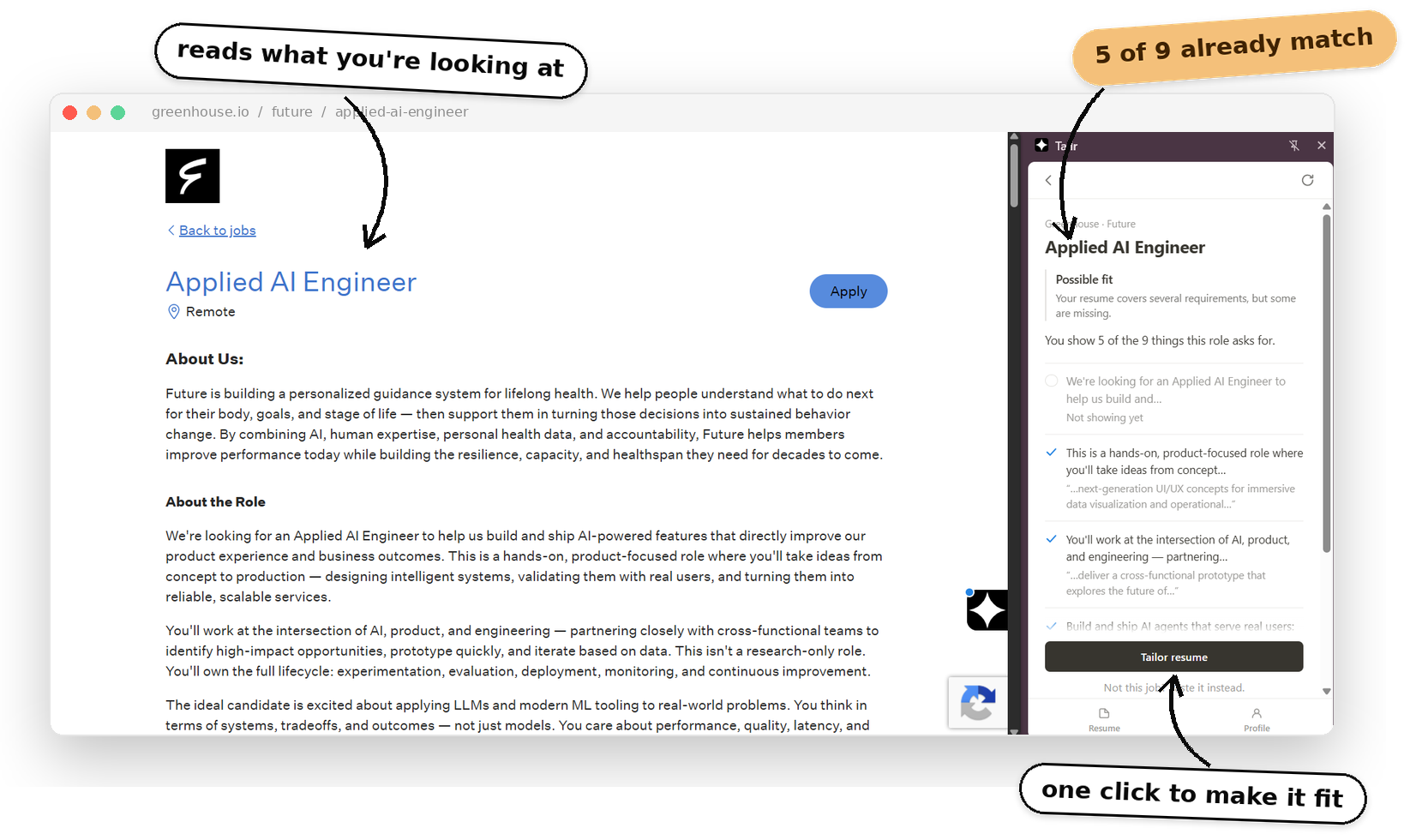
Tailr pulls the requirements out of the posting and checks each one against your resume before you change anything. Then it suggests rewrites only where you already have the experience but aren’t using the posting’s words for it.
What you can’t honestly claim stays unchecked. Sometimes that means the role isn’t a fit, and it’s better to know that in thirty seconds than after a week of silence.
Before
You show 2 of the 5 things this role asks for.
- Product-focused role with LLMs
- Cross-functional prototyping
- RAG pipelines with vector DBs
- Evaluation and monitoring in production
- Conversational AI applications
After tailoring
You show 4 of the 5 things this role asks for.
- Product-focused role with LLMs
- Cross-functional prototyping
- RAG pipelines with vector DBs
- Evaluation and monitoring in production
- Conversational AI applications
The other half of ATS-friendly is the file itself.
Plenty of resumes have the right words and still parse badly: text in tables, two-column layouts, headers the system can’t read. A lot of resume tools make this worse by exporting your work into their own template.
Tailr edits the .docx you uploaded and hands the same .docx back. Same fonts, same spacing, same sections in the same order. If your resume parsed cleanly before, it parses cleanly after, because only the words changed.
Match the posting. Keep your integrity.
Install Tailr, upload your resume once, and open a posting. You’ll see which requirements you cover before you decide to apply.