200 Resume Action Verbs and Power Words, Grouped by Skill
· updated
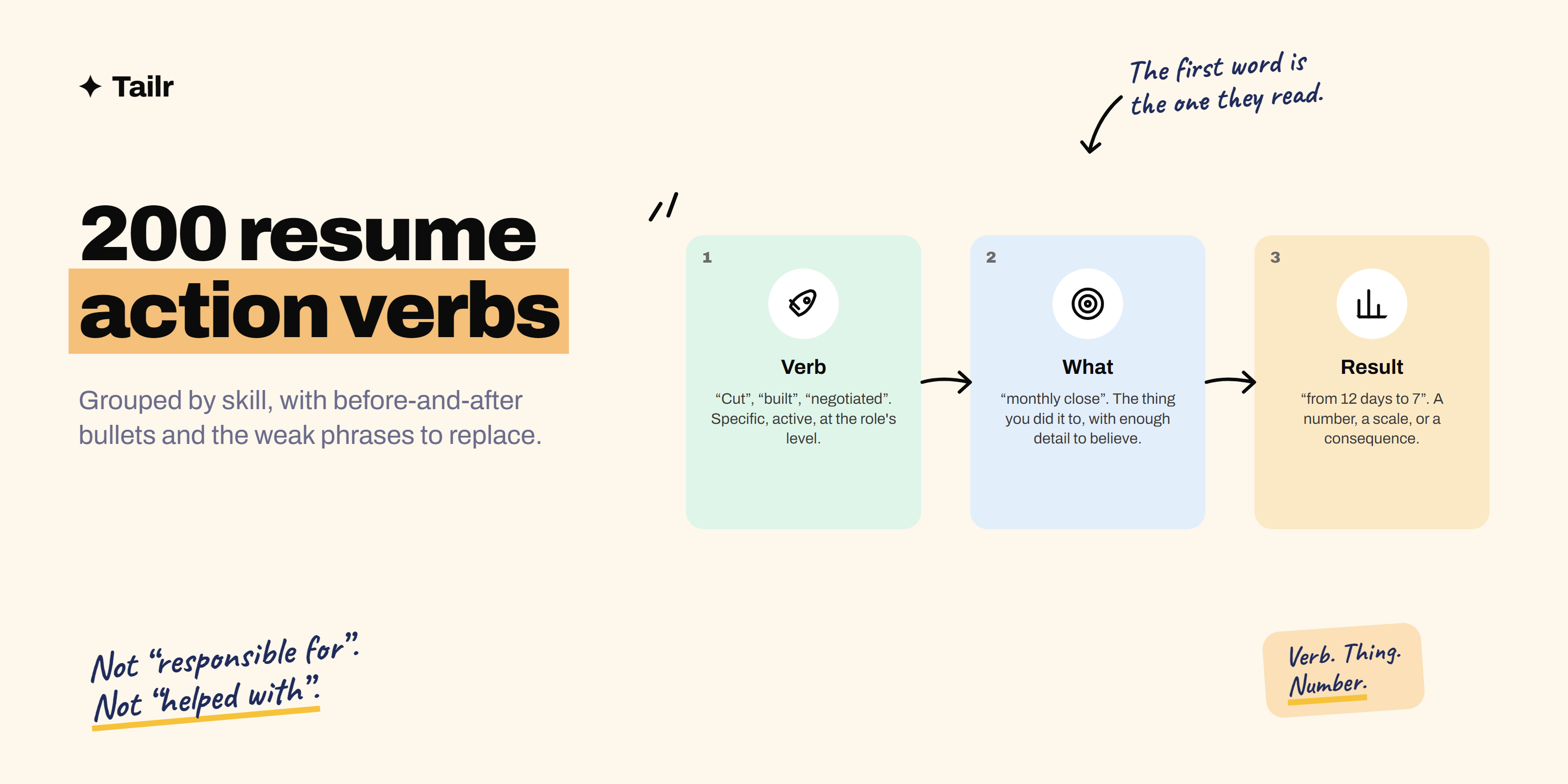
The first word of every resume bullet is the one a recruiter actually reads. “Responsible for” tells them nothing; “Cut” makes them look for the number. This is a list of 200 action verbs grouped by the kind of work they describe, with before-and-after bullets showing how to pair a verb with a result, the phrases to replace, and how to pick verbs that match the job listing.
The short answer: Start every bullet with a specific verb that says what you did, follow it with what you did it to, and end with a number that shows it mattered: “Cut monthly close from 12 days to 7 by rebuilding the intercompany reconciliation.” Replace duty phrases (“responsible for”), vague helpers (“helped with”, “worked on”) and padding (“utilised”, “spearheaded”) with a verb from the group that fits: leadership, results, improvement, building, analysis, communication, sales, technical, organisation, teamwork, finance, problem-solving, customer work, teaching, or writing and design. Match the verbs to the listing’s own language where it fits, and don’t start two bullets in the same job with the same one.
How a bullet works
Verb + what + result. Three parts, one line.
- Verb: what you did. Specific and active.
- What: the thing you did it to, with enough detail to be believable.
- Result: a number, a scale, or a consequence.
Before: “Responsible for managing the company’s social media accounts.”
After: “Grew the company’s LinkedIn following from 2,000 to 18,000 in a year, generating 40% of inbound demo requests.”
Before: “Helped with the migration to the new CRM.”
After: “Migrated 30,000 contacts from Pipedrive to HubSpot with zero data loss, and trained 25 sales reps on the new workflows.”
Before: “Worked on improving test coverage.”
After: “Raised unit test coverage on the payments service from 40% to 85%, cutting production incidents by half over two quarters.”
The verb makes the rest possible. “Responsible for” has nowhere to go; “Grew” demands a from-and-to.
Phrases to replace
| Weak | Why | Replace with |
|---|---|---|
| Responsible for, duties included, tasked with | Describes the job, not what you did | The verb for what you actually did |
| Helped, assisted with, supported | Hides your contribution | Say what your part was: built, wrote, ran |
| Worked on, was involved in, participated in | Vague to the point of meaninglessness | Name the action |
| Utilised, leveraged | Padding for “used” | Used, or a more specific verb |
| Spearheaded, synergised, championed | Overused; reads as inflation | Led, started, introduced |
| Successfully, effectively, efficiently | Adverbs claiming a result instead of showing it | Cut the adverb; add the number |
| Hardworking, passionate, results-driven, detail-oriented | Adjectives about you; unprovable | Nothing; show it in the bullets |
The 200 verbs, by skill
Leadership and management
Led, directed, managed, oversaw, coordinated, supervised, headed, ran, chaired, mobilised, delegated, mentored, coached, guided, appointed, restructured, unified, steered, presided, championed (sparingly).
Results and achievement
Increased, grew, doubled, tripled, exceeded, delivered, achieved, generated, surpassed, boosted, lifted, raised, expanded, accelerated, maximised, secured, won, captured, attained, outperformed.
Improvement and efficiency
Cut, reduced, streamlined, simplified, optimised, consolidated, automated, standardised, eliminated, halved, shortened, sped up, refined, overhauled, modernised, upgraded, revamped, rebuilt, resolved, tightened.
Building and creating
Built, designed, developed, created, launched, established, founded, engineered, architected, implemented, introduced, initiated, pioneered, produced, assembled, constructed, formed, devised, shaped, prototyped.
Analysis and research
Analysed, assessed, evaluated, measured, modelled, forecast, identified, investigated, examined, diagnosed, quantified, tested, benchmarked, audited, mapped, surveyed, tracked, interpreted, validated, uncovered.
Communication and influence
Presented, persuaded, negotiated, briefed, communicated, advocated, articulated, convinced, aligned, facilitated, mediated, addressed, clarified, conveyed, promoted, pitched, represented, reported, translated (technical to plain), influenced.
Sales and growth
Closed, sold, acquired, converted, upsold, renewed, retained, prospected, qualified, expanded (accounts), landed, signed, booked, penetrated (a market), positioned, grew (pipeline), sourced, cultivated, partnered, referred.
Technical and engineering
Coded, programmed, deployed, integrated, migrated, configured, debugged, refactored, scaled, secured, containerised, provisioned, instrumented, monitored, patched, shipped, maintained, administered, orchestrated, automated.
Organisation and project management
Planned, scheduled, organised, prioritised, coordinated, executed, tracked, budgeted, allocated, sequenced, scoped, estimated, delivered (on time), monitored, controlled, documented, arranged, systematised, catalogued, logged.
Teamwork and support
Collaborated, partnered, contributed, supported, assisted (with a specific), backed, enabled, facilitated, joined, cooperated, teamed, coordinated, liaised, served, volunteered, participated (with a specific), shared, paired, co-authored, co-led.
Finance and accounting
Budgeted, forecast, reconciled, audited, reduced (cost), saved, allocated, invoiced, collected, recovered, priced, valued, projected, balanced, closed (the books), reported, filed, controlled, financed, hedged.
Problem-solving and decisions
Solved, resolved, fixed, diagnosed, troubleshot, decided, determined, prevented, mitigated, recovered, restored, stabilised, remedied, corrected, rescued, de-risked, addressed, handled, navigated, settled.
Customer and service
Served, supported, resolved (tickets), onboarded, retained, advised, consulted, guided, assisted (customers), responded, escalated, de-escalated, satisfied, delighted (sparingly), answered, fielded, followed up, renewed, referred, advocated (for customers).
Teaching and training
Taught, trained, coached, mentored, instructed, educated, onboarded, developed (people), upskilled, tutored, explained, demonstrated, guided, prepared, certified, assessed, evaluated, designed (curriculum), delivered (sessions), facilitated (workshops).
Writing, design and content
Wrote, authored, edited, drafted, designed, illustrated, published, produced, composed, documented, translated, summarised, scripted, storyboarded, branded, visualised, formatted, proofread, curated, localised.
Picking the verb that fits the listing
The job listing uses verbs too, and they tell you which of your bullets to lead with and how to phrase them. If the listing says “own”, “drive” and “lead”, your top bullets should show ownership: led, built, launched. If it says “support”, “coordinate” and “maintain”, the honest verbs are coordinated, maintained, streamlined, and inflating them to “spearheaded” reads wrong for the role.
Two rules:
- Match the level. A listing for an individual contributor role doesn’t want five bullets starting with “led”. A listing for a manager doesn’t want five starting with “assisted”.
- Use their verb when it’s accurate. If the listing says “optimise conversion funnels” and you did that, “Optimised the checkout funnel, lifting conversion 8%” uses their word and your number. The human reading it matches faster.
Five worked examples
Software engineer
- Before: “Worked on the backend of the payments system.”
- After: “Rebuilt the settlement service in Java and Kafka to process 2M transactions a day at 99.99% uptime, replacing a nightly batch that failed twice a month.”
Marketing
- Before: “Responsible for email marketing campaigns.”
- After: “Redesigned the onboarding email sequence and A/B tested subject lines, lifting open rate from 22% to 41% and trial-to-paid conversion by 15%.”
Operations
- Before: “Helped improve warehouse processes.”
- After: “Redesigned slotting for a 120-person warehouse, cutting per-order pick time 18% and raising order accuracy to 99.6%.”
Fresher
- Before: “Participated in a group project on machine learning.”
- After: “Built the data pipeline and evaluation for a four-person ML project predicting equipment failure, reaching 0.87 AUC on held-out data; the project was adopted by the sponsoring lab.”
Customer success
- Before: “Managed customer accounts and handled renewals.”
- After: “Owned a 45-account mid-market portfolio ($2.1M ARR) at 94% gross and 112% net retention, and cut average onboarding from 60 to 35 days.”
Mistakes
- Same verb, five bullets. “Managed” five times reads as a duty list. Vary within the group.
- Verb without a result. “Led a team” is a job title. “Led a team of six to ship the migration two weeks early” is a bullet.
- Inflation. “Spearheaded” for something you helped with will come apart in the interview.
- Past tense for current job. Use present tense for what you do now (“Lead a team of six”), past for previous roles.
- Adverbs instead of numbers. “Successfully launched” is weaker than “Launched to 12,000 users in the first month.”
- Verbs the listing wouldn’t use. Matching the role’s level matters more than sounding impressive.
Where Tailr fits
Choosing the right verbs for each bullet is part of tailoring a resume to a listing: the verbs, the bullets you lead with, and the numbers you emphasise should all shift with what the role asks for. Tailr does this from the job listing you’re viewing: it tailors your resume to that role, rewording bullets to match the listing’s language and priorities without inventing anything, and generates a matching cover letter. How to tailor your resume to a job description covers the method, and resume keywords covers the nouns the search looks for. Try Tailr on the next listing you open.
Conclusion
A resume bullet is a verb, a thing, and a number. Pick the verb from the group that describes what you actually did, at the level the listing is hiring for, and let it pull the result out of you. Replace “responsible for”, “helped with” and “utilised” wherever they appear, don’t repeat a verb within a job, and never use one you couldn’t defend in the interview. The 200 above cover almost every bullet you’ll write; the number after it is what makes the bullet work.
Frequently asked questions
01What are resume action verbs?
Strong, specific verbs that start a resume bullet and say what you actually did: led, built, cut, negotiated, redesigned, launched. They replace weak openers like 'responsible for', 'helped with' and 'worked on', which describe a duty rather than an action, and they make it natural to attach a result. Recruiters skim the first word of each bullet, so the verb carries a lot of weight.
02What are the best action verbs for a resume?
The best verb is the one that precisely describes what you did and matches what the job listing is asking for. For leadership: led, directed, coached, mobilised. For results: increased, cut, delivered, exceeded. For building: designed, built, launched, engineered. For analysis: analysed, modelled, identified, forecast. There's no universal top ten; pick from the group that fits the bullet and the role.
03Which words should I avoid on a resume?
Duty phrases: 'responsible for', 'duties included', 'tasked with'. Vague helpers: 'helped', 'assisted with', 'worked on', 'was involved in', 'participated in'. Padding: 'utilised', 'leveraged', 'spearheaded', 'synergised'. Adjectives about yourself: 'hardworking', 'passionate', 'results-driven', 'detail-oriented'. Replace each with a specific verb and a number.
04How do I use action verbs with numbers?
Verb, then the specific thing, then the measurable result: 'Cut monthly close from 12 days to 7 by rebuilding the intercompany reconciliation.' The verb says what you did, the middle says to what, and the number proves it mattered. If you don't have a precise number, use a defensible range or scale: 'for a team of eight', 'across 40 accounts', 'roughly a third faster'.
05Should I use the same action verb more than once?
Try not to start two bullets in the same job with the same verb, and never three. Repeating 'managed' or 'led' five times reads as a list of duties. Vary within the group: led, directed, coordinated, oversaw, ran. The variety is a side effect of describing each bullet precisely, not a goal in itself.
06Do action verbs help with ATS?
Indirectly. Applicant tracking systems search for nouns (skills, tools, job titles), not verbs, so 'spearheaded' versus 'led' doesn't change whether you're found. What action verbs do is make the bullet clear and specific when a recruiter reads it, and they force you to attach the nouns and numbers that do get searched. Use the listing's verbs where they fit naturally; it helps the human, not the parser.