How to Tailor Your Resume to a Job Description
· updated
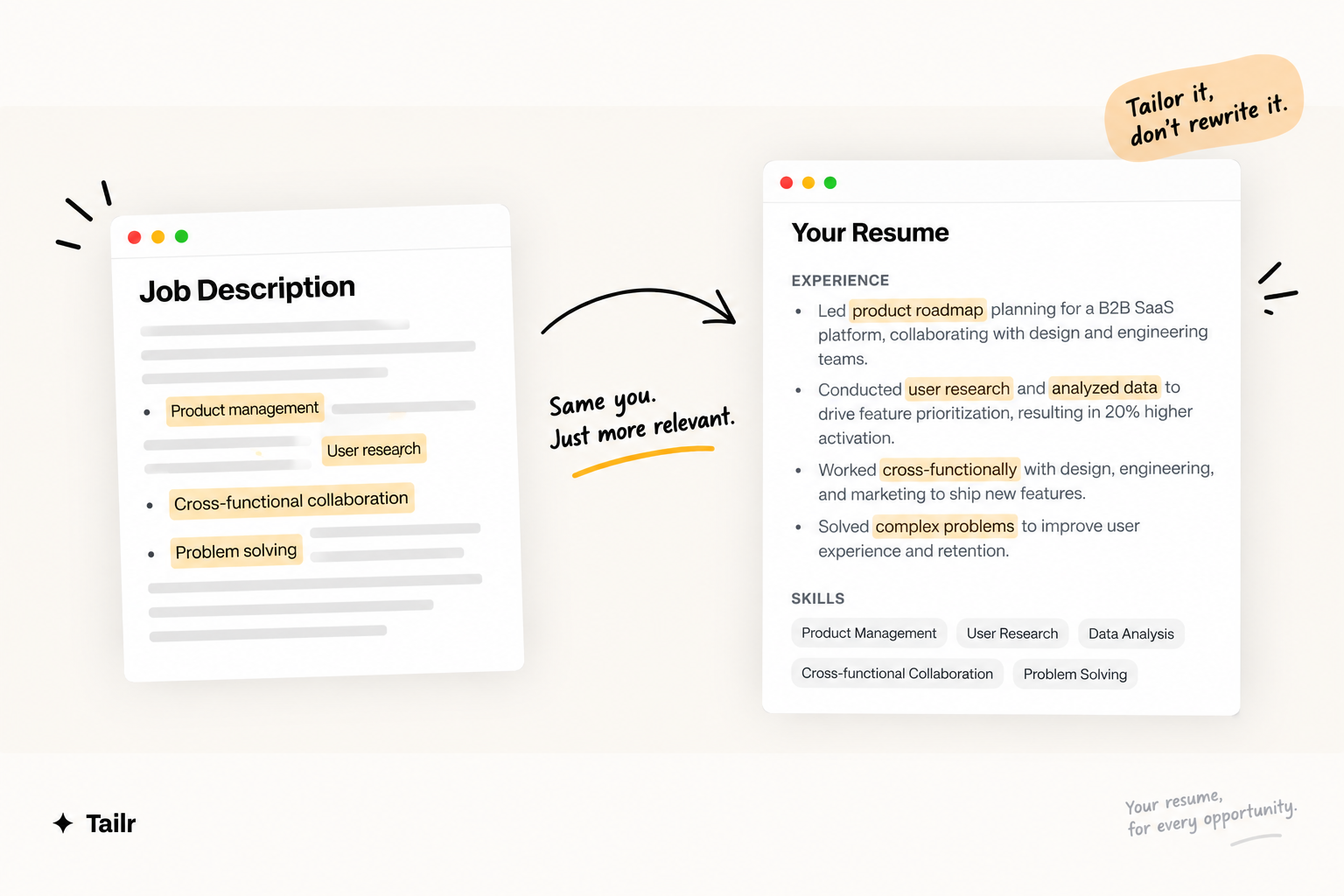
The short answer: To tailor your resume to a job description:
- Read the job description twice and mark what comes up more than once: the core responsibilities, the tools and skills, and the outcomes the company cares about.
- For each important requirement, find where you’ve done something similar, what you actually did, and what changed because of it.
- Put the most relevant evidence in the top third of the page: your summary, most recent role and skills section.
- Use the listing’s language where it accurately describes your work, but keep your own voice.
- Make every bullet say what you did, how, and why it mattered.
- Do one final honest check against the listing before you send it.
Tailr, a Chrome extension, does steps 1 to 5 from the job listing you’re viewing, using only your real experience.
Tailoring your resume is not about turning yourself into someone else. It is about making it easy for a hiring manager to see that the work you have already done connects to the job in front of them.
Most job descriptions are read quickly. Your resume should answer the important question just as quickly: can this person do this job? A few thoughtful edits can make that answer much clearer.
Start with the job description, not your resume
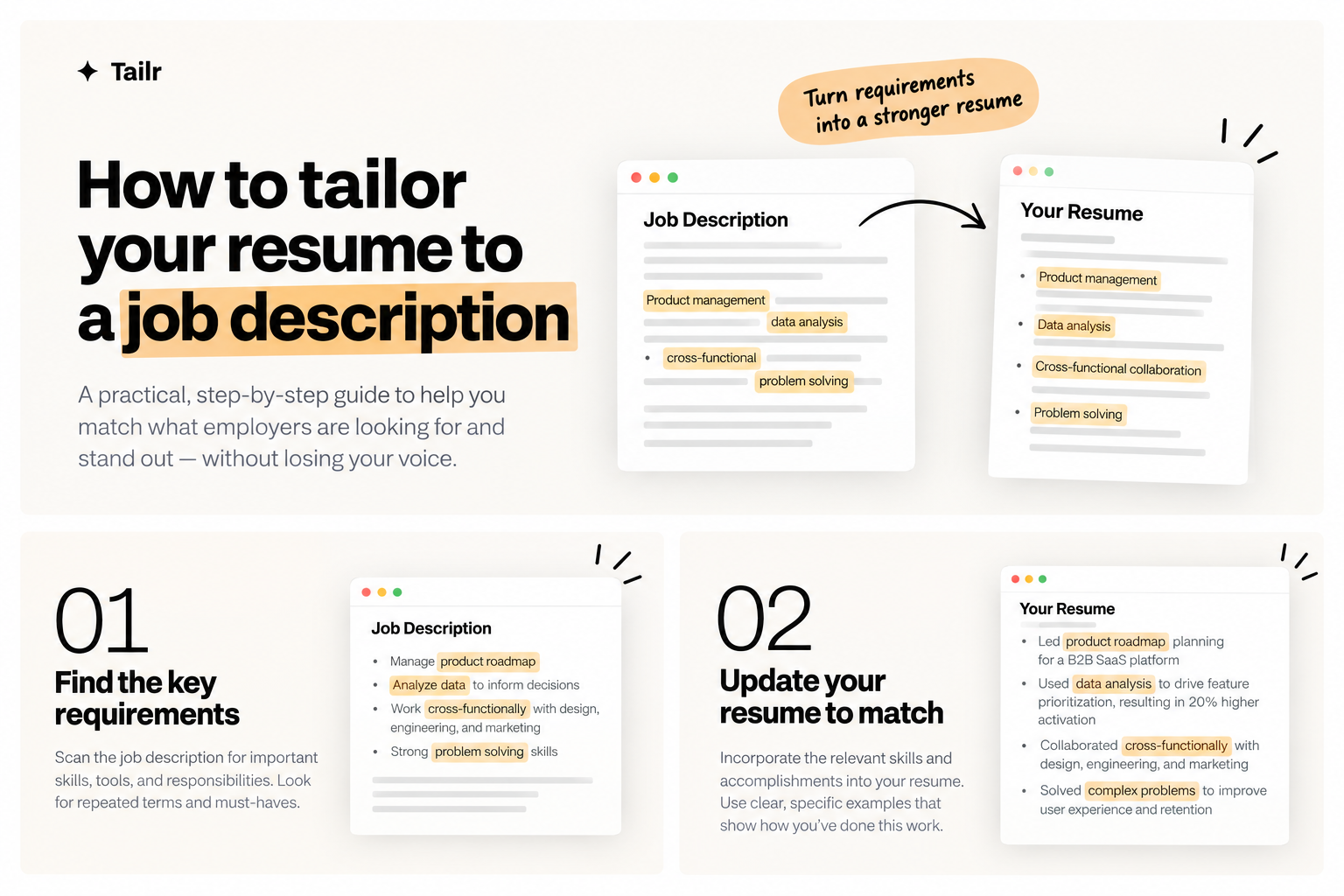
Read the posting once without editing anything. On the second pass, underline the parts that come up more than once:
- The core responsibilities, such as managing projects, working with customers, or analysing data.
- The tools, skills, or subject areas the role needs.
- The outcomes the company cares about, such as growth, efficiency, retention, or better customer experiences.
You are looking for the job’s centre of gravity. If a product role repeats “user research,” “roadmap,” and “cross-functional,” those are not throwaway words. They tell you what this team needs help with first.
Match the evidence you already have
Now open your base resume and look for proof that you have done related work. Do not begin by copying phrases from the posting. Begin with the work you can stand behind.
For each important requirement, ask yourself:
- Where have I done something similar?
- What did I actually do?
- What changed because of it?
That last question matters. “Worked on customer research” is vague. “Interviewed 18 customers and used the findings to simplify onboarding” gives a reader something real to hold on to.
Put the most relevant experience where it will be seen
You probably do not need to rewrite every bullet. Start with the top third of the page: your summary, most recent role, and skills section. That is where a reader will form their first impression.
If the role asks for stakeholder management, lead with the bullet where you aligned a team, ran a project, or made a decision across functions. If it asks for analysis, surface the example where you used data to choose what to do next.
The goal is not to make every line say the same thing. It is to put the best evidence first.
Use their language, but keep your voice
Job descriptions give you useful vocabulary. If you have experience with “customer onboarding,” it is often clearer to write that than a looser phrase such as “helping new users get started.” Use the terms that accurately describe your work.
But do not force a keyword into every sentence. A resume still needs to sound like a person describing real work. Specific details, strong verbs, and honest results will do more for you than a crowded skills list.
Make every bullet earn its place
A good bullet usually has three parts: what you did, how you did it, and why it mattered. You do not need all three in every line, but this is a useful way to spot weak bullets.
Instead of:
Responsible for product roadmap and collaboration.
Try:
Led quarterly roadmap planning with design and engineering, helping the team focus on the highest-impact customer requests.
The second version is still simple. It just gives the reader more confidence about your contribution.
Do one final honest check
Before you send the application, read the resume next to the job description one more time. Check that the most important requirements are easy to find, your examples are accurate, and the document still sounds like you.
Tailoring works best when it is focused. You are not trying to pass a test with the right magic words. You are helping the right person recognise the fit that is already there.
Tailor from the job listing, without the copy-paste
Doing this by hand takes 20 minutes or more per application. Tailr is a Chrome extension that does it from the job listing you’re viewing: it reads the posting, suggests rewrites drawn only from your real experience for you to accept or skip, writes a matching cover letter, and tracks the application. If you want to keep it honest, how to tailor your resume without lying covers where the line is.
Try TailrRelated guides
Frequently asked questions
01What is an ATS score?
An ATS score is an estimate of how closely a resume matches a particular job description. It can be useful for spotting missing relevant skills or language, but it is not an official score that guarantees an interview or a decision from an employer.
02How is an ATS score calculated?
Different tools calculate it differently. They usually compare the skills, responsibilities, job titles, and keywords in your resume with the job description, then look at basics such as readable formatting and complete sections. Employers do not all use the same system, so treat the score as a guide, not a target to game.
03How do I make my resume match a job description?
Identify the role’s most important requirements, then move your strongest relevant examples higher on the page. Use the employer’s language only where it truthfully describes your experience, and show the result of your work with clear, specific bullets.
04Should I add every keyword from the job description to my resume?
No. Add relevant terms only when you can support them with real experience. Repeating keywords without evidence makes a resume harder to read and can create problems when you are asked about them in an interview.
05What is the best tool to tailor a resume to a job description?
The best tool is one that helps you identify relevant experience without inventing it or taking control away from you. Tailr works directly on the job posting, helping you tailor your existing resume to the role while you review every change before you apply.
06Can Tailr help improve my ATS score?
Tailr can help you bring relevant experience and accurate job-description language into clearer view, which may improve how well your resume matches a role. It does not promise a particular ATS score or an interview, because each employer and applicant-tracking system evaluates resumes differently.