How to Tailor Your Resume Without Lying
· updated
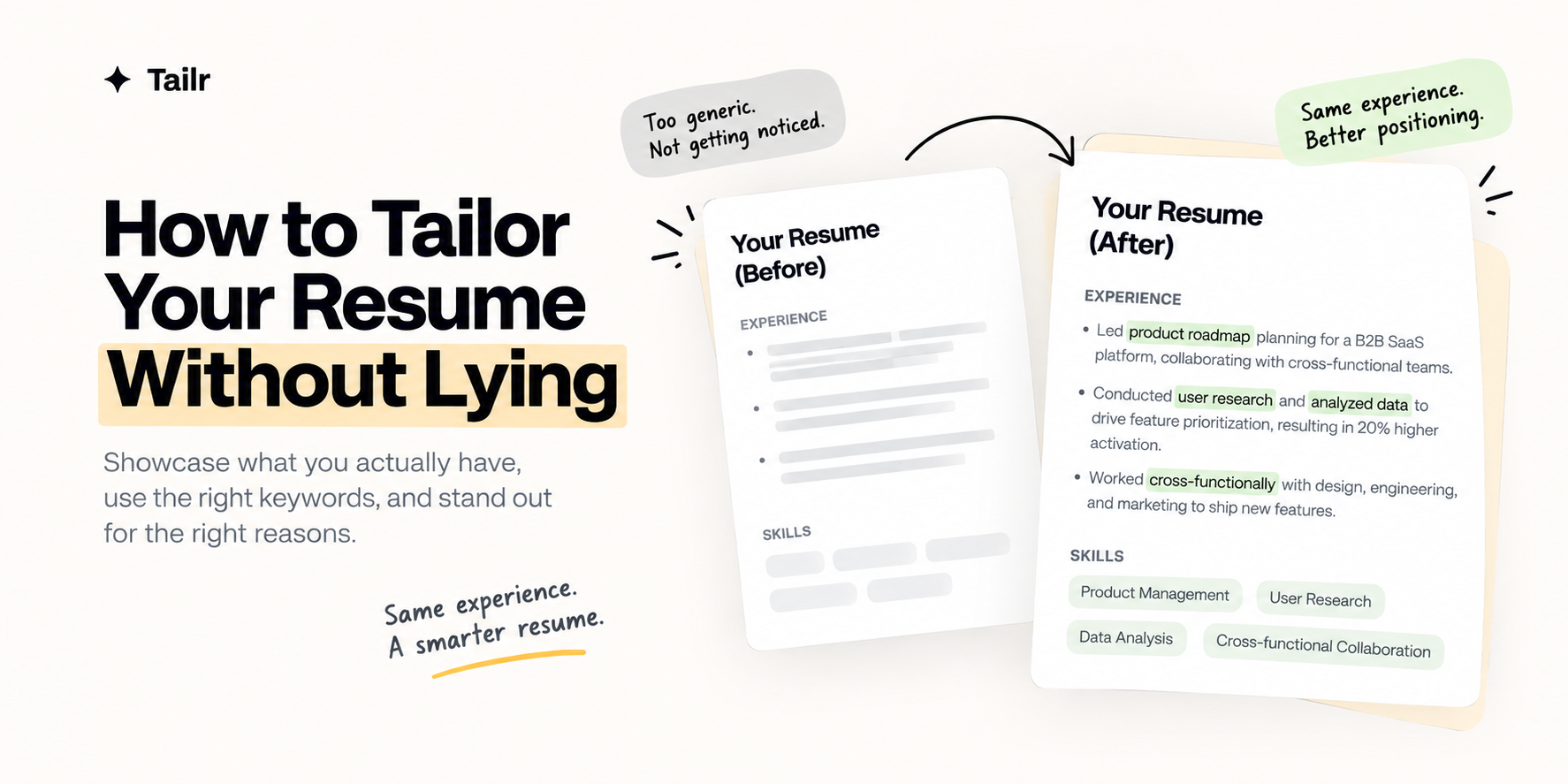
The short answer: To tailor your resume without lying, change the emphasis and wording, never the facts:
- Start with the job description and find where your real experience overlaps.
- Make the relevant keywords visible, but only the ones that genuinely apply.
- Replace vague words like “helped” and “worked on” with what you actually did.
- Show ownership and leadership where it’s accurate.
- Give the most space to your most relevant experience.
- Use real results and metrics, and never invent one.
- For requirements you don’t meet, show transferable experience instead of claiming the skill.
- If you use AI, tell it not to invent anything, and check every change.
Tailr does this from the job listing you’re viewing, working only from your real resume.
Tailoring your resume can make it much clearer how your experience matches a specific job. It shouldn’t require you to invent skills or rewrite your career history. The goal is to highlight relevant experience, use the right terminology, and describe your real impact in a way that lines up with what the employer is looking for.
A job description can contain dozens of requirements, from technical skills and tools to communication, leadership, and ownership. Your resume may already show many of them. But if they’re buried under generic language, a recruiter may not spot the connection.
There’s a meaningful difference between saying you “worked on a project” and explaining that you “took ownership of the project from requirements through launch.” If the second version accurately describes your contribution, you’re not exaggerating. You’re just communicating your role more clearly.
Good resume tailoring is about better positioning, not fabrication. Here’s how to do it.
1. Start with the job description
Before you change anything on your resume, understand what the employer actually wants.
Look for:
- Required and preferred skills
- Key responsibilities
- Tools and technologies
- Industry-specific knowledge
- Leadership expectations
- Communication and collaboration requirements
- Repeated keywords and phrases
Pay particular attention to anything that comes up more than once. If a company keeps mentioning stakeholder management, product strategy, data analysis, or cross-functional collaboration, those are probably central to the role.
Your first job is to find where your existing experience genuinely overlaps with those requirements. If you want a fuller walkthrough of this step, read how to tailor your resume to a job description.
2. Make relevant keywords visible
Keywords help recruiters and applicant tracking systems (ATS) work out whether your resume is relevant to a role.
That doesn’t mean copying the job description word for word.
Instead, pick out the important keywords that genuinely apply to your experience and use them naturally throughout your resume.
Say a job description asks for:
Product strategy · User research · Data analysis · Cross-functional collaboration
If you’ve actually done these things, make sure your resume says so clearly.
Instead of:
Worked with different teams to improve the product.
You could write:
Partnered cross-functionally with design and engineering teams to improve the product based on user feedback and performance data.
The second version gives more context and uses relevant terminology without adding experience that didn’t happen.
3. Replace vague language with specific language
Words like helped, worked on, assisted, and did aren’t wrong, but they make your contribution hard to picture.
Look at what you actually did and describe it more precisely.
Instead of:
Helped with a product launch.
Consider:
Supported the end-to-end product launch by coordinating requirements, launch assets, and stakeholder communication.
Instead of:
Did analysis of customer feedback.
Consider:
Analyzed customer feedback to identify recurring issues and inform product improvements.
Instead of:
Worked on a dashboard.
Consider:
Built a dashboard to monitor product performance and track key metrics.
The stronger version should always stay faithful to your original work.
4. Show ownership and leadership
Leadership doesn’t always mean managing people.
You can demonstrate leadership through ownership, decision-making, initiative, collaboration, and execution.
Look through your experience for times when you:
- Took ownership of an initiative
- Led a project end to end
- Coordinated multiple teams
- Managed stakeholders
- Made decisions independently
- Mentored or supported teammates
- Drove a project from idea to execution
- Solved an ambiguous problem
- Improved an existing process
For example:
Helped improve the onboarding experience.
can become:
Took ownership of the onboarding experience from problem identification through implementation.
Only use words like “led,” “owned,” or “drove” when they accurately describe your role.
A strong resume isn’t one where every bullet sounds impressive. It’s one that makes your actual contribution clear.
5. Focus on relevant experience
You don’t need to give every experience on your resume equal attention.
If you’re applying for a product role, your product discovery, analytics, experimentation, stakeholder management, and cross-functional work will matter more than an unrelated responsibility from an earlier job.
You don’t have to remove everything else. Instead, consider:
- Giving more space to relevant projects
- Moving relevant skills higher
- Rewriting relevant bullets
- Removing repetitive information
- Trimming detail from less relevant experiences
Tailoring is usually about changing emphasis, not changing facts.
6. Use real results and metrics
Whenever you have a genuine result, make it visible.
Compare:
Improved the onboarding process.
with:
Redesigned the onboarding flow, increasing activation by 18%.
The second gives the reader a much clearer picture of the outcome.
Useful evidence can include:
- Revenue
- Conversion rate
- Activation
- Retention
- Time saved
- Users affected
- Projects delivered
- Processes improved
- Cost reductions
- Performance improvements
But never invent a metric.
If you don’t have an exact number, describe the outcome accurately rather than making one up. “Reduced the number of support tickets about onboarding” is honest and still useful. “Reduced support tickets by 40%” is only useful if it’s true.
7. What if you don’t have every requirement?
You don’t need to match every requirement in a job description.
If you don’t have a particular skill or tool, don’t add it just because it appears in the posting.
Instead, look for transferable experience.
You might not have used the exact analytics platform the employer lists, but you may have worked with a different one. You may not have formally managed a team, but you may have led cross-functional projects.
Make those genuine connections clear.
The goal isn’t to make your resume look identical to the job description. It’s to make the relevant parts of your experience easier to find.
8. Use AI to tailor your resume
AI can make resume tailoring a lot faster, especially when you’re applying to several roles.
The key is to give it strict boundaries. Here’s a prompt that does that:
Tailor my resume to the job description below.

Identify the most important requirements and keywords, then rewrite only the parts of my resume that genuinely match them.

Do not invent skills, tools, experience, achievements, metrics, titles, or responsibilities. Highlight relevant leadership, ownership, collaboration, and end-to-end work only when supported by my resume.

Keep the final resume concise, professional, and truthful.

Resume:
[PASTE RESUME]

Job Description:
[PASTE JOB DESCRIPTION]
This lets you use AI for clarity and relevance without letting it turn missing experience into fabricated qualifications. Still read every change it makes. You’re the one who has to stand behind the result in an interview.
9. Or let Tailr do the copying and pasting
If you’re applying to a lot of jobs, copying job descriptions into an AI tool over and over gets tedious fast.
Tailr is a Chrome extension that lets you tailor your resume directly from the job you’re looking at. You can generate a cover letter and track your applications from the same place.
Instead of:
Find a job → copy description → open AI tool → paste resume → edit → write cover letter → track application
you keep the whole process close to where you’re already searching:
Find a job → tailor your resume → generate your cover letter → apply → track the application
You still review every change before you apply. Tailr works from your real resume, so it helps you position what you have rather than making things up.
Try TailrFinal resume checklist
Before you send your tailored resume, check that:
- The most relevant keywords are included naturally
- Your experience clearly connects to the job requirements
- Leadership and ownership are visible where they apply
- Your bullets use specific, meaningful language
- Relevant achievements and genuine metrics are included
- Less relevant information doesn’t dominate the page
- Every claim is accurate
- You can confidently explain every bullet in an interview
The honest version is the stronger version
Tailoring your resume isn’t about making yourself look more qualified than you are. It’s about making the qualifications you already have easier for a recruiter, and an ATS, to recognize.
Use the job description to understand what matters, highlight your genuine experience, communicate ownership and impact clearly, and treat AI as an editing tool rather than a source of qualifications.
The best tailored resume isn’t the one that sounds the most impressive. It’s the one that makes the strongest, clearest case using the experience you actually have.
Frequently asked questions
01Is it okay to tailor your resume for every job?
Yes. Tailoring your resume means emphasizing the experience most relevant to each position. Your underlying experience should stay accurate. You are changing what you lead with and how you describe it, not what actually happened.
02How do I tailor my resume without lying?
Only include skills, responsibilities, achievements, and metrics you can back up with real experience. Change the wording and the emphasis, not the facts. A good test is whether you could confidently explain every bullet in an interview.
03Should I copy keywords from the job description?
Use relevant keywords when they accurately describe your experience, and work them into your bullets naturally. Do not add keywords for skills or tools you have never used, even if they appear in the posting.
04How many keywords should I include on my resume?
There is no fixed number. Focus on the important requirements that genuinely match your background and use them where they fit, rather than repeating the same terms to hit a target. Recruiters notice keyword stuffing, and it makes a resume harder to read.
05Can AI tailor my resume for me?
Yes. AI can identify relevant requirements, suggest stronger wording, and help you restructure your resume. Give it clear boundaries so it does not invent anything, then review every change to make sure it accurately represents your experience.
06Should I change my job title when tailoring my resume?
No. Do not change an official job title just to match the title in a job description. You can clarify what you actually did in your bullet points while keeping your real title, which is what a background check will confirm.