What Is an LLM? Large Language Models Explained Simply
· updated
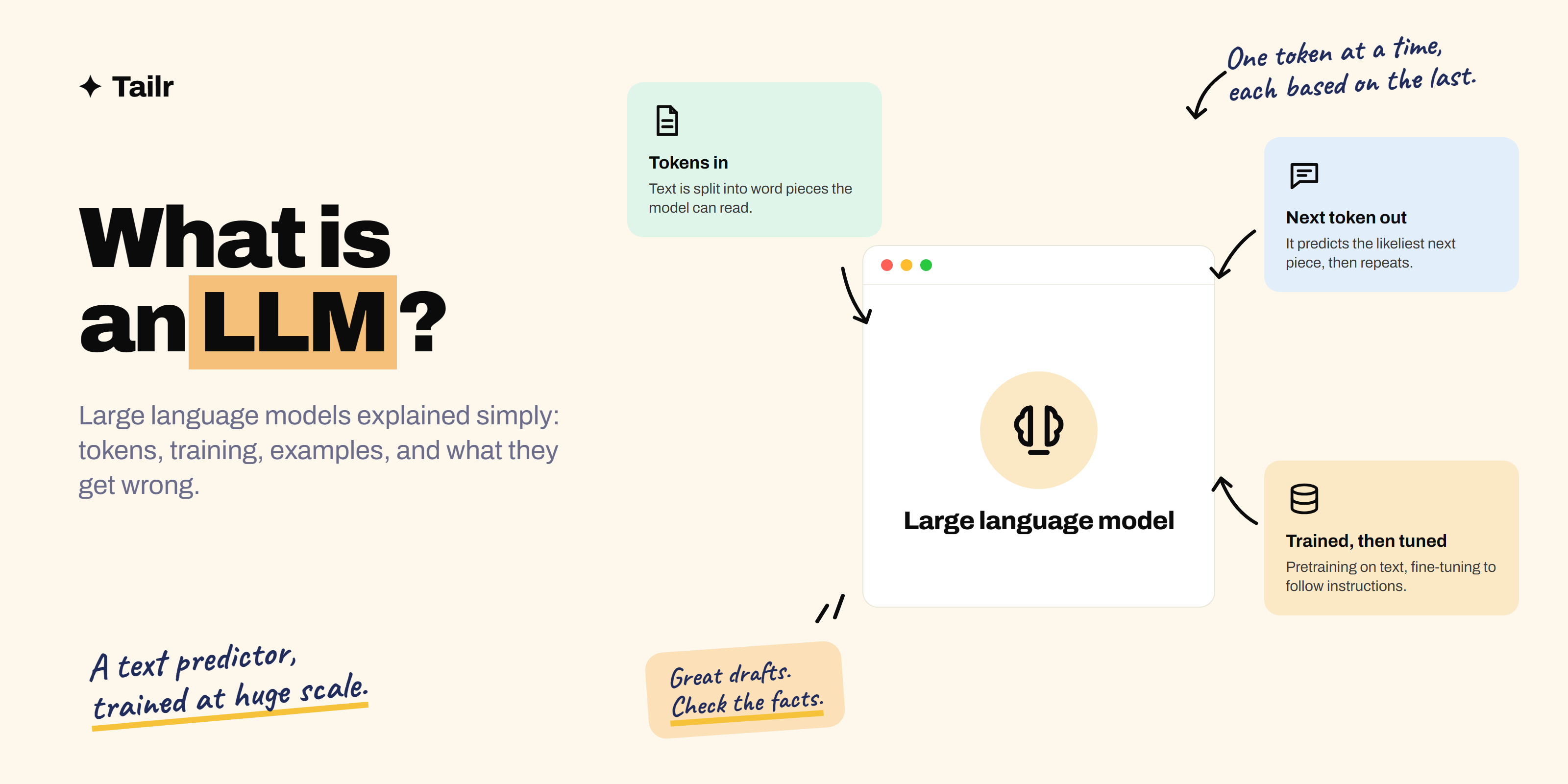
You’ve probably used a large language model this week without calling it that. Every time you ask Claude, ChatGPT or Gemini a question, an LLM is reading your words and writing the reply. This guide explains what an LLM actually is, how it works step by step (no maths), which ones exist, what they’re good and bad at, and how to use one well, especially if you’re job hunting.
The short answer: An LLM (large language model) is an AI model trained on a huge amount of text to predict the next word, or more exactly the next token. Doing that one thing at enormous scale teaches it grammar, facts, reasoning patterns and writing styles, so it can answer questions, write and edit text, summarise documents, translate, and write code. Well-known LLMs include Anthropic’s Claude, OpenAI’s GPT models (used in ChatGPT), Google’s Gemini, Meta’s Llama, and open-weight models from Mistral, Qwen and DeepSeek. They’re powerful but they can be confidently wrong, so you check anything that matters.
What “large language model” means, word by word
- Large: the model has billions (sometimes trillions) of parameters, the internal numbers it adjusts while learning. It’s also trained on a very large amount of text: books, websites, code, articles.
- Language: it works with text. Many modern LLMs can also read images, PDFs and audio (these are called multimodal models), but text is the core.
- Model: a mathematical system that takes an input and produces an output. Here the input is your text and the output is the text most likely to follow it.
So an LLM is a very big text-predicting system. The surprise of the last few years is how much ability comes out of that one simple goal.
How an LLM works, step by step
1. Your text is split into tokens
An LLM doesn’t read letters or whole words. It reads tokens, chunks of text that are usually a word or part of a word. “Tailoring” might be split into “tail” and “oring”. A rough rule for English: 100 tokens is about 75 words. Token counts matter because models have limits on how many they can read at once, and API pricing is per token.
2. The model predicts the next token
Given everything so far, the model scores every possible next token and picks one (usually one of the most likely). Then it adds that token to the text and repeats. A 300-word answer is a few hundred of these predictions in a row. That’s why replies appear word by word.
3. Attention decides what matters
Inside, LLMs use an architecture called the transformer, introduced by Google researchers in the 2017 paper “Attention Is All You Need”. Its key idea, attention, lets the model weigh every earlier token when choosing the next one. In “The recruiter emailed Priya because she had applied”, attention is what links “she” to Priya.
4. Pretraining teaches language and knowledge
The model starts knowing nothing. During pretraining, it’s shown enormous amounts of text with the next token hidden, guesses, and has its parameters nudged whenever it’s wrong. Repeat that trillions of times and it absorbs spelling, grammar, facts, common reasoning steps and how code is written.
5. Fine-tuning makes it helpful
A pretrained model only continues text; it doesn’t follow instructions. So it’s then fine-tuned on examples of good answers and trained with human (and AI) feedback about which responses are better. This is where it learns to answer questions, follow a format, refuse harmful requests and admit uncertainty.
6. Your prompt and context steer the answer
Everything you give the model in one conversation, your message, earlier messages, uploaded files, is its context. The context window is how much it can hold at once; current models handle hundreds of thousands of tokens, enough for several long documents. The model doesn’t remember you between conversations unless the app adds a memory feature.
Examples of LLMs in 2026
| Model family | Made by | Where you use it | Open weights? |
|---|---|---|---|
| Claude (Opus, Sonnet, Haiku) | Anthropic | claude.ai, Claude Code, API | No |
| GPT | OpenAI | ChatGPT, API | Mostly no (some open-weight releases) |
| Gemini | Gemini app, Google Workspace, API | No (Gemma is the open sibling) | |
| Llama | Meta | Meta AI, download and run yourself | Yes |
| Mistral | Mistral AI | Le Chat, API, download | Some models |
| Qwen, DeepSeek | Alibaba, DeepSeek | Apps, API, download | Yes |
Open weights means you can download the model and run it on your own hardware. Closed models are only available through the company’s app or API. For how to choose between them for a project, see the best AI model for your next project.
LLM vs AI vs chatbot: the terms people mix up
- AI is the whole field. Image recognition, spam filters and recommendation engines are AI too.
- Machine learning is the part of AI where systems learn from examples instead of hand-written rules.
- Deep learning is machine learning with large neural networks. LLMs are deep learning models.
- LLM is the model itself: the text predictor.
- Chatbot or assistant (ChatGPT, Claude.ai, Gemini) is the product built around an LLM, adding a chat window, memory, file upload, web search and other tools.
- Agent is an LLM that can take actions in a loop: search, run code, edit files, check the result, try again. Claude Code is an example. See what is an AI agent.
If you want the bigger picture of how these nest, AI 101 covers it in plain English.
What LLMs are good at
- Drafting and editing: emails, cover letters, reports, first drafts of anything.
- Summarising: a 40-page PDF into a one-page brief, a long thread into decisions and action items.
- Explaining: “explain this error / clause / concept like I’m new to it.”
- Coding: writing, explaining and fixing code; building small apps from a description.
- Transforming: turning notes into a table, a resume into bullet points, English into Spanish.
- Brainstorming: 20 project ideas, 10 interview questions for a role, five angles for a post.
What LLMs are bad at, and why
- Being right every time. They generate plausible text, not verified text. When they don’t know, they can still produce a confident, wrong answer (a hallucination). Fake citations and invented statistics are the classic examples.
- Recent events. Knowledge stops at a training cutoff. Unless the app connects to web search, it won’t know what happened after.
- Exact counting and arithmetic on long inputs, though tools and code execution now cover most of this.
- Knowing about you. It only knows what’s in the context. Ask it to “tailor my resume” without giving it the resume and the job description, and it will invent things.
- Keeping secrets. Don’t paste passwords, API keys or confidential company data into a tool unless your employer has approved it.
The practical rule: use an LLM as a fast, well-read assistant whose work you review, not as an oracle.
How to get better answers from an LLM
- Give it context. Who you are, who the output is for, and paste the source material. “Here’s the job description and my resume” beats “write me a resume”.
- Say what good looks like. Length, format, tone, what to avoid. “Five bullets, each starting with a verb, no buzzwords.”
- Show an example of the style you want, if you have one.
- Ask it to check itself. “List any claim here you’re not sure about.”
- Iterate. Treat the first answer as a draft. “Shorter.” “Less formal.” “Only use facts from my resume.”
Types of prompting methods goes deeper on techniques like few-shot and chain-of-thought prompting.
LLMs and your job search
LLMs are now part of how people get hired, on both sides of the table. Recruiters use them to write listings and screen applications; candidates use them to prepare. Good uses for you:
- Decode a listing: paste a job description and ask which skills are required versus nice to have.
- Tailor your resume: rewrite your real bullets so they match the listing’s language, without inventing experience. Tailr does this from the job listing you’re viewing.
- Practise interviews: ask for likely questions for the role, answer them, and ask for blunt feedback.
- Build portfolio projects: a weekend with Claude can produce a deployed project you can talk about. See weekend projects to build with Claude to get hired.
If you’re curious about building with LLMs as a job, what is AI engineering explains the role that grew up around them.
Tailor your resume with an LLM, without the copy-paste
Tailoring is one of the most useful things an LLM can do for a job seeker, and the most tedious to do by hand: copy the listing, copy your resume, write the prompt, paste the result back into a document, repeat for every application. Tailr is a Chrome extension that does it from the job listing you’re already looking at: it rewrites your resume for that role using only what’s in your real experience, drafts a cover letter, and tracks the application so you know where you’ve applied.
Try TailrRelated guides
- How to Get Started With AI Engineering: A Beginner’s Roadmap
- What Does an AI Engineer Do? Role, Skills, Salary and Path
- Top 30 AI Engineer Interview Questions and Answers
- What Is RAG? Retrieval-Augmented Generation Explained Simply
Conclusion
An LLM is a text predictor trained at huge scale, and that turns out to be enough to write, summarise, explain and code surprisingly well. It learns language in pretraining, learns to be helpful in fine-tuning, and answers you one token at a time based on the context you give it. Give it good context, check what matters, and it becomes one of the most useful tools you have, at work and in your job search.
Frequently asked questions
01What does LLM stand for?
LLM stands for large language model. It's a type of AI model trained on a huge amount of text to predict the next piece of text, which lets it answer questions, write, summarise, translate and write code. Claude, ChatGPT's GPT models, Gemini and Llama are all LLMs.
02How does an LLM work in simple terms?
An LLM splits text into small chunks called tokens, then predicts which token is most likely to come next, one token at a time, using billions of internal numbers (parameters) learned during training. It was first trained on a large body of text to learn language and facts, then tuned with human feedback to follow instructions and be helpful.
03Is ChatGPT an LLM?
ChatGPT is a chat app built on top of OpenAI's GPT large language models. The app adds a chat interface, memory, file uploads and tools such as web search, while the LLM underneath does the reading and writing. The same is true of Claude.ai (built on Anthropic's Claude models) and Gemini (built on Google's Gemini models).
04What is the difference between AI and an LLM?
AI is the whole field of making computers do tasks that normally need human intelligence. An LLM is one specific kind of AI: a deep learning model trained on text. Image generators, recommendation systems and self-driving software are also AI, but they aren't LLMs.
05Can LLMs be wrong?
Yes. LLMs can state false things confidently, which is often called hallucination, because they generate plausible text rather than looking facts up. They also have a training cutoff, so they may not know recent events unless they're connected to web search. Check any fact, number, quote or source that matters before you rely on it.
06Do I need to learn LLMs for my career?
You don't need to know how to build one, but knowing how to use one well is now a basic workplace skill, like using a spreadsheet. Engineers, product managers, marketers and analysts are increasingly expected to prompt, check and build small tools with LLMs, and AI engineering roles are built entirely around them.