Weekend Projects to Build With Claude to Get Hired (By Role)
· updated
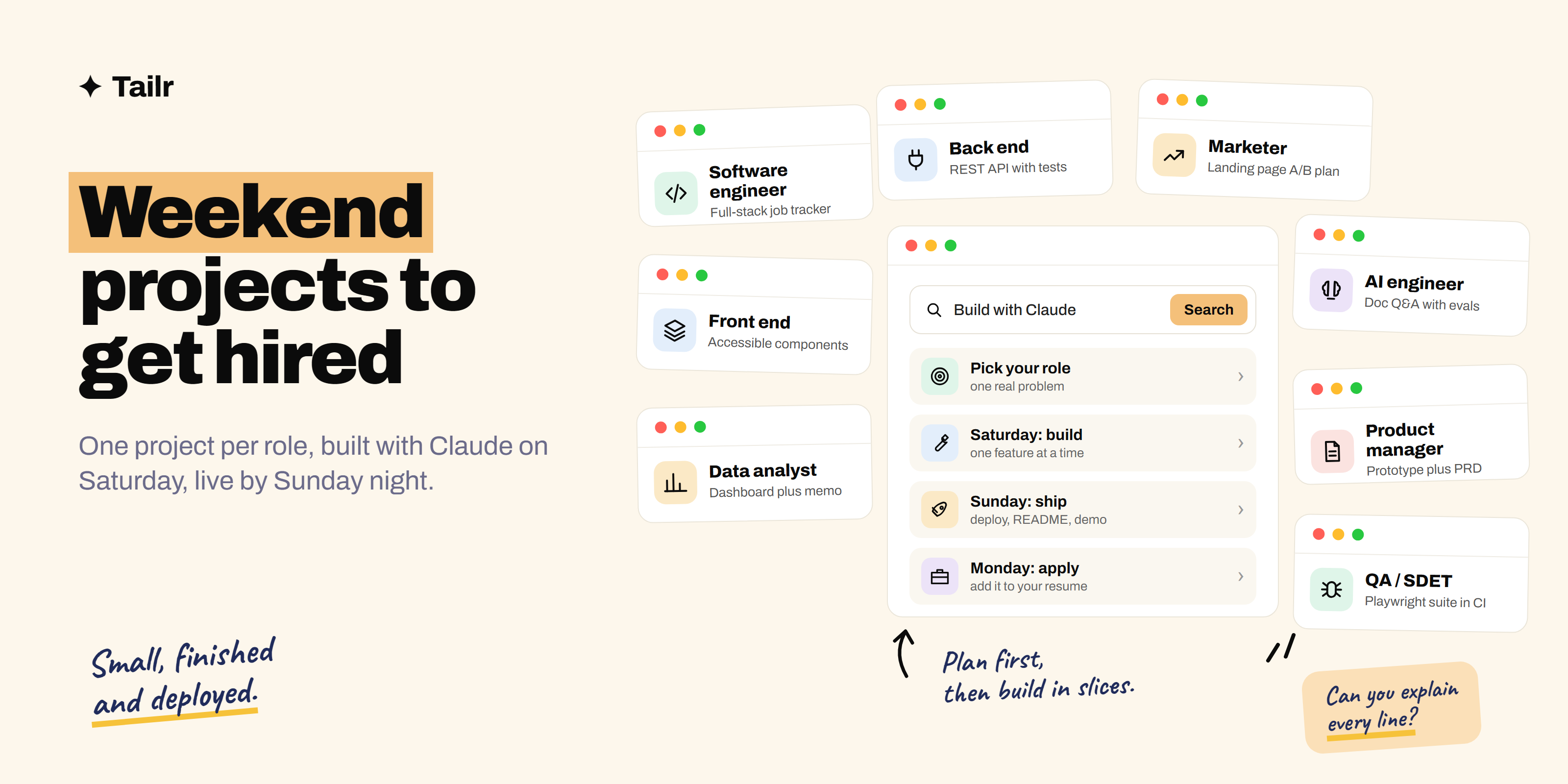
A resume says you can do something. A project proves it. The good news is that you no longer need a month to build one: with Claude doing the heavy lifting on code, a focused weekend is enough to ship a real, deployed project you can put on your resume on Monday. This guide gives you one project per role, the exact prompt to start with, what the finished project must include, and how to upgrade it so it stands out.
The short answer: Pick one project matched to the role you want, keep it to one problem and one or two screens, build it with Claude on Saturday, and deploy it with a README and demo on Sunday. Good weekend projects by role:
- Software engineer: a full-stack job tracker.
- Front-end developer: a UI component showcase.
- Back-end developer: a REST API with tests.
- Data analyst: a data dashboard with a written analysis.
- Data scientist: a prediction model with an honest evaluation.
- AI engineer: a document Q&A app with evals.
- Product manager: a prototype plus PRD.
- Designer: a redesign case study.
- QA engineer: a test automation suite.
- DevOps: a containerised app with CI/CD.
- Marketer: a landing page with an A/B test plan.
Whatever you build, it needs a live link, a README, and your own explanation of the decisions.
What makes a weekend project worth building
Before the list, the rules that separate a portfolio project from a tutorial clone:
- It solves a real problem. “A to-do app” is a tutorial. “A tracker for the 40 jobs I’m applying to, with follow-up reminders” is a project. Even better: a problem the company you’re applying to actually has.
- It’s small and finished. One core feature that works beats five that half work. Cut scope ruthlessly.
- It’s live. A recruiter won’t clone your repo. They’ll click a link. Deploy it (see how to deploy a website on GitHub Pages or how to deploy on Vercel for free).
- It has a README that sells it. What it does, a screenshot, the live link, how to run it, the tech used, and what you’d do next.
- You can explain it. Claude writes the code; you own the decisions. Be ready to explain every choice in an interview.
The weekend plan
Friday evening (1 hour): pick the project, write down the one problem it solves and who it’s for, and list the must-have features. Ask Claude to challenge the scope.
Saturday (6–8 hours): build. Start with a planning prompt, then build one feature at a time, running and testing after each.
Sunday (4–6 hours): fix bugs, add tests or polish, deploy, write the README, record a 60-second demo (a screen recording is fine), and add it to your resume and LinkedIn.
How to prompt Claude for a project
Every prompt below follows the same shape, which works for any project:
- Role and goal: what you’re building and why (it’s a portfolio project for a specific role).
- Users and problem: who uses it and what it fixes.
- Features: the must-haves, and what’s out of scope.
- Tech constraints: stack, free hosting, no paid services.
- Process: ask it to plan first, then build step by step, and explain as it goes.
Use Claude.ai if you’re newer to coding (it can build working previews as Artifacts), or Claude Code if you’re comfortable in a terminal (it edits files, runs tests and commits in your project folder; see how to use Claude Code). Best AI coding tools for developers compares the options.
Projects by role
1. Software engineer: full-stack job application tracker
What it proves: you can build front end, back end, database, auth, tests and deployment together.
I'm building a portfolio project to apply for junior software engineer roles.
Build a job application tracker web app. Users sign in, add applications
(company, role, link, status, date applied, notes), move them through stages
(applied, interview, offer, rejected), and see a follow-up reminder for anything
with no update in 7 days.

Stack: Next.js with TypeScript, a free hosted Postgres database, deployable free
on Vercel. Include unit tests for the status logic.

First give me a plan: data model, pages, and the order you'll build in.
Wait for my OK, then build one step at a time and explain each decision briefly.
Must include: sign-in, create/edit/delete, the stage view, at least five tests, a live URL, and a README with a screenshot.
How to improve it: add a “paste a job link” feature that fills in the company and title; add a chart of applications per week; write a short “architecture decisions” section in the README (why Postgres, why that auth approach).
2. Front-end developer: accessible component showcase
What it proves: clean UI, responsive layout, accessibility, attention to detail.
Portfolio project for front-end developer roles. Build a small component library
showcase site: button, input, modal, tabs, toast and data table components, each
with a live demo and usage notes. Everything must be keyboard accessible, meet
WCAG AA contrast, and work at 375px width.

Stack: React + TypeScript + Vite, deployable on GitHub Pages. Plan first, then
build one component at a time. After each one, list how you handled focus
management and screen readers.
Must include: keyboard navigation that works, a mobile layout, and a Lighthouse accessibility score you mention in the README.
How to improve it: add dark/light theme tokens, add Storybook or visual tests, or recreate one real component from a company you’re applying to and explain what you’d improve.
3. Back-end developer: REST API with tests and docs
What it proves: API design, data modelling, validation, testing, documentation.
Portfolio project for back-end developer roles. Build a REST API for a
book-club app: users, clubs, books, reading schedules and comments.
Include input validation, pagination, proper HTTP status codes, rate limiting,
and auto-generated OpenAPI docs.

Stack: Python with FastAPI, SQLite for local and Postgres for production,
pytest for tests (aim for 80% coverage), Dockerfile included.
Plan the endpoints and data model first, then build and test each resource.
Must include: a public docs page, tests running in GitHub Actions, and a README explaining the endpoint design.
How to improve it: add caching and show before/after response times; add auth with scopes; write about one trade-off you made.
4. Data analyst: dashboard plus written analysis
What it proves: SQL, cleaning messy data, choosing the right chart, turning numbers into a recommendation.
Portfolio project for data analyst roles. Here's a public dataset: [paste link or
describe it]. Help me: 1) clean it and document every cleaning step,
2) write the SQL to answer these three business questions: [list them],
3) build an interactive dashboard with Streamlit (deployable free on Streamlit
Community Cloud), 4) draft a one-page findings memo for a non-technical manager
with one clear recommendation.
Explain each query so I can defend it in an interview.
Good free datasets: government open-data portals (data.gov, data.gov.uk, data.gov.in), Kaggle, and city transport or housing data.
Must include: the SQL in the repo, the live dashboard, and the memo. The memo is what most candidates skip, and it’s what hiring managers want to see.
How to improve it: pick a dataset from the industry you’re applying to (a fintech applicant analysing transaction data), and add a “what I’d investigate next” section.
5. Data scientist: prediction model with an honest evaluation
What it proves: framing a problem, feature engineering, choosing metrics, and not fooling yourself.
Portfolio project for data scientist roles. Using [dataset], build a model that
predicts [target]. Start with a simple baseline, then one better model.
Explain the train/test split, check for data leakage, choose metrics suited to
the problem (explain why), and show where the model fails.
Wrap it in a small Streamlit app where someone can enter inputs and see a
prediction with a confidence note. Use a Jupyter notebook for the analysis.
Must include: the baseline comparison, the metric reasoning, and a “limitations” section.
How to improve it: add model explainability (feature importance or SHAP), or monitor how the model would drift over time.
6. AI engineer: document Q&A app with evals
What it proves: retrieval, prompting, structured output, and, crucially, evaluation.
Portfolio project for AI engineer roles. Build an app where a user uploads PDFs
(e.g. a company's public policies) and asks questions. Answers must cite the
page they came from, and say "I don't know" when the answer isn't in the docs.
Use the Claude API, a simple vector store, and a small Python back end.
Also build an eval set of 25 questions with expected answers and a script that
scores the app, so I can show accuracy before and after improvements.
Must include: citations, the eval script and its results table in the README, and a note on cost per query.
How to improve it: show a before/after from changing chunk size or prompts, add guardrails for off-topic questions. How to get started with AI engineering has more project ideas.
7. Product manager: prototype plus PRD
What it proves: product thinking, prioritisation, and that you can work with builders.
I'm applying for product manager roles at [company]. Help me pick one real
problem their users have (based on public reviews and their product), then:
1) write a one-page PRD: problem, target user, evidence, success metrics,
scope, what's out of scope, risks;
2) build a clickable prototype of the core flow as a simple web app I can deploy;
3) list three questions I'd want to validate with user interviews.
Push back if my problem framing is weak.
Must include: the PRD, the live prototype, and the metrics. See what is a product requirement document for the format.
How to improve it: show five real user conversations or survey responses and how they changed the design; add a launch plan.
8. UX/UI designer: redesign case study site
What it proves: process, not just visuals.
I'm a designer applying for UX roles. I'm redesigning the onboarding flow of
[app]. Help me structure a case study: problem, research (I'll paste my notes),
key insights, design decisions with alternatives I rejected, final screens,
and measurable impact I'd expect. Then build the case study as a fast,
accessible one-page site with my screenshots, deployable on Vercel.
Must include: before/after screens, the reasoning for each decision, and at least one rejected alternative.
How to improve it: run a quick usability test with five people and include the results.
9. QA engineer or SDET: test automation suite
What it proves: test strategy, automation, and CI.
Portfolio project for QA automation roles. Write an automated test suite for
a public demo web app (e.g. a practice e-commerce site). Include: a test plan,
UI tests with Playwright in TypeScript using the page object model, API tests,
test data handling, and a GitHub Actions workflow that runs on every push and
publishes an HTML report. Explain how you chose what to automate.
Must include: the test plan, the CI badge, and the published report.
How to improve it: add visual regression or accessibility checks, and a short write-up of bugs you found.
10. DevOps or cloud engineer: containerised app with CI/CD
What it proves: automation, infrastructure as code, and reliability thinking.
Portfolio project for DevOps roles. Take a simple two-service app (web + API),
containerise both with Docker, write a GitHub Actions pipeline that lints,
tests, builds images and deploys to a free tier host, and add health checks and
basic monitoring. Include infrastructure as code where the free tier allows.
Document how to roll back a bad deploy.
Must include: the pipeline, a diagram of the setup, and the rollback runbook.
How to improve it: add alerting, or write a mock incident postmortem.
11. Marketer or growth: landing page with an experiment plan
What it proves: positioning, copy, and data-driven thinking.
I'm applying for growth marketing roles. Pick a real product I like: [product].
Write a positioning statement and two versions of a landing page for one
audience segment, build both as simple pages I can deploy free, and write an
A/B test plan: hypothesis, metric, sample size estimate, and what I'd do with
each result. Also draft three cold emails to that audience.
Must include: both page versions live, the test plan, and your reasoning.
How to improve it: actually run a small test (even with a few hundred visitors from a community post) and report the results honestly.
Projects at a glance
| Role | Weekend project | The thing that makes it stand out |
|---|---|---|
| Software engineer | Full-stack job tracker | Tests and a live URL |
| Front-end developer | Accessible component showcase | Keyboard and screen reader support |
| Back-end developer | REST API with docs | CI running tests, design write-up |
| Data analyst | Dashboard plus memo | The one-page recommendation |
| Data scientist | Model with honest evaluation | Baseline and limitations |
| AI engineer | Document Q&A with evals | The eval results table |
| Product manager | Prototype plus PRD | Metrics and scope cuts |
| Designer | Redesign case study | Rejected alternatives |
| QA / SDET | Automation suite | CI report |
| DevOps | Containerised app with CI/CD | Rollback runbook |
| Marketer | Landing pages plus test plan | Real results |
How to get the most out of Claude on the weekend
- Plan before code. Ask for a plan and agree on it. It saves hours of rework.
- Build in slices. One feature, run it, fix it, commit. Then the next.
- Paste errors in full. The full error message and what you did before it.
- Ask “why”. After each step: “Explain what you just did and why, like I’ll be asked in an interview.”
- Keep a decisions log. A running note of choices and trade-offs. It becomes your README and your interview answers.
- Commit often so you can undo. Never paste API keys into prompts or code; use environment variables.
For more ways to use Claude across the job hunt, see how to use Claude for your job search.
Turn the project into interviews
A project only helps if people see it. Pin it on GitHub, add it to your portfolio (here’s how to build a portfolio to get hired in 2026), add it to your resume as a project with one line on impact, and mention it when you cold email a hiring manager.
Then tailor. The same project reads differently to a fintech back-end team and a health-tech data team, so the bullet describing it should change with each application. Tailr does that from the job listing you’re viewing: it rewrites your resume, projects included, to match the role using only what you’ve actually done, drafts the cover letter, and tracks each application.
Try TailrConclusion
You don’t need a big idea or a month of evenings. Pick the project for your target role, keep it small, build it with Claude on Saturday, and spend Sunday making it live, documented and explainable. One finished, deployed project with a clear README will do more for your applications than ten tutorials, and by next weekend you can build the upgrade.
Frequently asked questions
01Can I build a portfolio project with Claude in one weekend?
Yes, if you keep the scope small: one clear problem, one or two main screens or outputs, and real data. Spend Saturday building with Claude, and Sunday testing, deploying, writing the README and recording a short demo. A small finished project that's live beats a big unfinished one.
02Will employers care that I used Claude to build my project?
Most employers now expect people to use AI tools. What they care about is whether you understand what you built. Be open about it in the README, and make sure you can explain every part, the decisions you made, and what you'd change. If you can't explain a piece of code, ask Claude to walk you through it until you can.
03What project should I build for a software engineering job?
Build a small full-stack app that solves a real problem, such as a job application tracker with sign-in, a database, tests and a live URL. It shows front end, back end, data modelling, testing and deployment in one project, which covers most of what a junior developer interview will ask about.
04What project should a product manager build?
Build a clickable prototype of one feature for a real product, paired with a one-page PRD: the problem, the users, success metrics, and what you'd cut. The prototype proves you can work with builders; the PRD proves product thinking, which is what PM interviews test.
05What makes a portfolio project stand out to recruiters?
A live link, a clear README with a screenshot, a real problem (ideally connected to the company or industry you're applying to), and evidence of judgment: tests, a short write-up of trade-offs, and what you'd do next. Recruiters spend seconds, so the first screen and the first two lines of the README matter most.
06Should I use Claude.ai or Claude Code for a weekend project?
Use Claude.ai if you're new to coding: it can plan the project, write the code, and build working previews as Artifacts. Use Claude Code if you're comfortable with a terminal: it works directly in your project folder, runs commands and tests, and edits many files at once, which is faster for anything bigger than a single page.