What Is a Product Requirement Document (PRD)?
· updated
Before a team builds anything, someone has to write down what they’re building and why. In most software companies that document is the PRD. It’s one of the first things new product managers are asked to write, and one of the easiest to get wrong, usually by making it too long, too vague, or all about the solution.
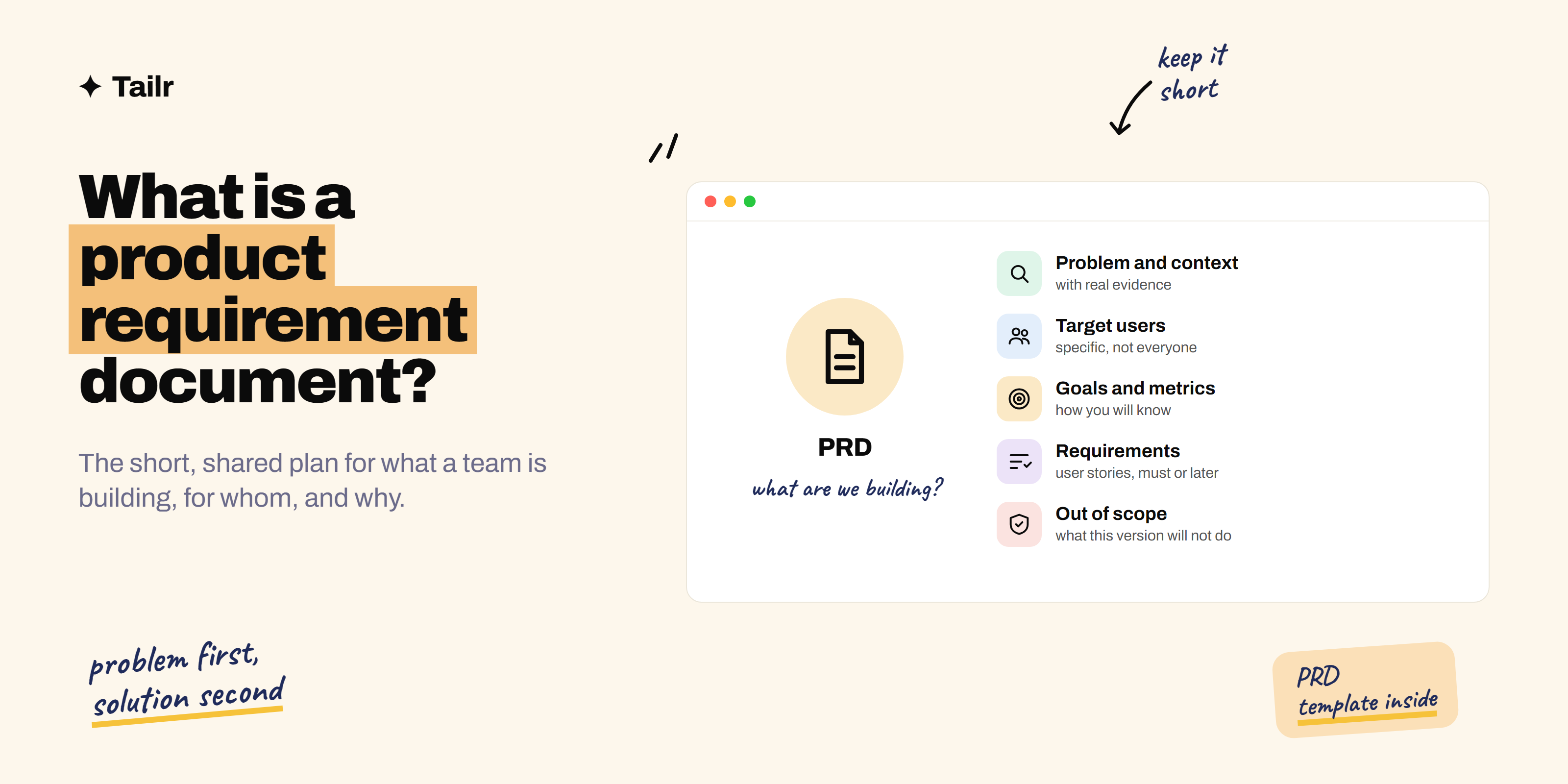
The short answer: a product requirement document (PRD) is a written plan that explains what a product or feature should do, who it’s for, and why it matters. It usually covers:
- The problem.
- Target users.
- Goals and success metrics.
- Requirements or user stories.
- What’s out of scope.
- Open questions.
The product manager writes it with input from engineering and design, and it gives the whole team a shared reference before and during the build. Good PRDs are short, focus on the problem more than the solution, and get updated as the team learns.
Why PRDs matter
Without a written plan, everyone on the team carries a slightly different picture in their head. The designer thinks the feature is for new users; the engineer assumes it’s for admins; sales has promised a customer something else. These differences surface late, when they’re expensive to fix.
A PRD fixes that by getting the key decisions on paper early:
- Alignment. Everyone reads the same problem statement and goals.
- Focus. The out-of-scope list stops the feature from growing.
- Better decisions. Writing forces the PM to think through edge cases and trade-offs.
- A record. Months later, anyone can see why the team built what it built.
What goes in a PRD
There’s no single official format, but most good PRDs have these sections.
1. Problem and context
What problem are you solving, for whom, and how do you know it’s real? Include evidence: customer quotes, support tickets, data. This is the most important section. If the problem is wrong, nothing else matters.
2. Target users
Who this is for, specifically. “Small business owners who send more than 20 invoices a month” is better than “users”.
3. Goals and success metrics
What will be true if this works, and how will you measure it? For example: “Reduce time to send an invoice from five minutes to under one. Increase invoices sent per active user by 20% within three months.”
4. Requirements or user stories
What the product must do, written from the user’s point of view. A common format is “As a [user], I want to [do something] so that [benefit].” Mark each as must-have, nice-to-have, or later.
5. Out of scope
What you’re deliberately not doing in this version. This is where a lot of arguments get settled in advance.
6. Design and technical considerations
Links to designs, known technical constraints, dependencies on other teams, and any performance, security, or accessibility requirements.
7. Open questions and risks
What you don’t know yet, and what could go wrong. Better to list them than pretend they’re not there.
8. Timeline and milestones
A rough plan: when design is done, when a first version ships, when you’ll review the metrics.
A simple PRD template
You can copy this into any doc tool:
| Section | What to write |
|---|---|
| Title and owner | Feature name, PM, date, status |
| Problem | The problem, who has it, and the evidence |
| Target users | The specific users this is for |
| Goals | What success looks like, with metrics |
| Requirements | User stories, marked must, should, or later |
| Out of scope | What this version won’t do |
| Design | Links to designs and key flows |
| Technical notes | Constraints, dependencies, risks |
| Open questions | What’s still unknown, and who’s finding out |
| Timeline | Key milestones |
A short example
Here’s what a one-page PRD for a small feature might look like:
Feature: Save a job search filter
Problem: Users run the same job search every day by re-entering five filters. In interviews, 7 of 10 active users said this was their most repeated task. Support gets about 40 requests a month for saved searches.
Users: Active job seekers who search at least three times a week.
Goals: 30% of weekly active users save at least one search within two months. Searches per user go up 15%.
Must-have: Save current filters with a name. See saved searches on the search page. Run a saved search in one click. Delete a saved search.
Out of scope: Email alerts for new results, sharing searches, more than ten saved searches.
Open questions: Should saved searches sync across devices on day one?
It fits on one screen, and an engineer or designer could start working from it.
Tips for writing a good PRD
- Lead with the problem, not the solution. If you describe exactly how every screen works, you’ve taken away the designer’s and engineer’s best contribution.
- Be specific about success. “Improve onboarding” isn’t a goal. “Raise week-one activation from 30% to 40%” is.
- Write the out-of-scope list early. It’s the section that saves the most time later.
- Keep it short. If people won’t read it, it doesn’t align anyone.
- Review it with the team before it’s final. Engineers will spot technical risks; designers will spot user problems.
- Keep it alive. Update it when decisions change, and note why.
PRD vs other product documents
- MRD (market requirements document): the market opportunity and customer needs. Why the business should do this. Comes before the PRD.
- PRD: what the product will do to meet that need.
- Technical design doc or spec: how engineering will build it. Written by engineers after the PRD.
- One-pager or brief: a lighter version of a PRD, often used at startups and for small features.
In agile teams, the PRD is usually short and living, and the detailed requirements are broken into user stories in the backlog. Before building, many teams test the riskiest part of the idea first with an MVP.
PRDs and your career
Writing a clear PRD is one of the core skills of the product manager role. If you’re applying for PM jobs, expect to be asked to talk through a spec you wrote, or even write one as a take-home exercise.
On your resume, show the outcome of the document, not just that you wrote it. “Wrote PRDs for new features” says little. “Wrote the PRD for saved searches, cutting scope to four must-haves; shipped in five weeks and 34% of weekly users adopted it” says a lot. Each PM listing leans differently, so it helps to adjust which examples you lead with. Tailr tailors your resume from the job listing you’re viewing, drafts a cover letter, and tracks the application. For doing it by hand, see how to tailor your resume to a job description.
Conclusion
A product requirement document is a short, shared plan that explains what a team is building, who it’s for, why it matters, and how success will be measured. The best PRDs focus on the problem, state clear goals, list what’s out of scope, and stay up to date as the team learns. Get the problem section right and the rest gets much easier.
Try Tailr to tailor your resume to the next product role you open.
Frequently asked questions
01What is a PRD in simple terms?
A PRD, or product requirement document, is a written plan for a product or feature. It explains the problem being solved, who it's for, what the product needs to do, how success will be measured, and what's out of scope, so everyone building it shares the same understanding before work starts.
02Who writes the PRD?
The product manager usually writes the PRD, with input from engineering, design, and other stakeholders such as sales, support, or legal. The PM owns the problem, goals and requirements; engineers and designers add technical and experience details and flag risks before the document is agreed.
03What should a PRD include?
A good PRD includes the problem and context, the target users, goals and success metrics, user stories or requirements, what's out of scope, key design and technical considerations, open questions, and a rough timeline or milestones. Short and clear beats long and complete.
04How long should a PRD be?
Usually one to five pages. A small feature might need a single page; a new product could need more. If a PRD is too long for engineers and designers to read in one sitting, it's probably describing the solution in too much detail instead of the problem and goals.
05What is the difference between a PRD and an MRD?
A market requirements document, or MRD, describes the market opportunity: who the customers are, what they need, and why the business should pursue it. A PRD comes after and describes what the product will do to meet that need. The MRD answers why; the PRD answers what.
06Are PRDs still used in agile teams?
Yes, but they're lighter. Agile teams rarely write long, fixed specifications up front. Instead they keep a short, living PRD that states the problem, goals and scope, and break the requirements into user stories in the backlog, updating the document as they learn.