What Does a Product Manager Actually Do?
· updated
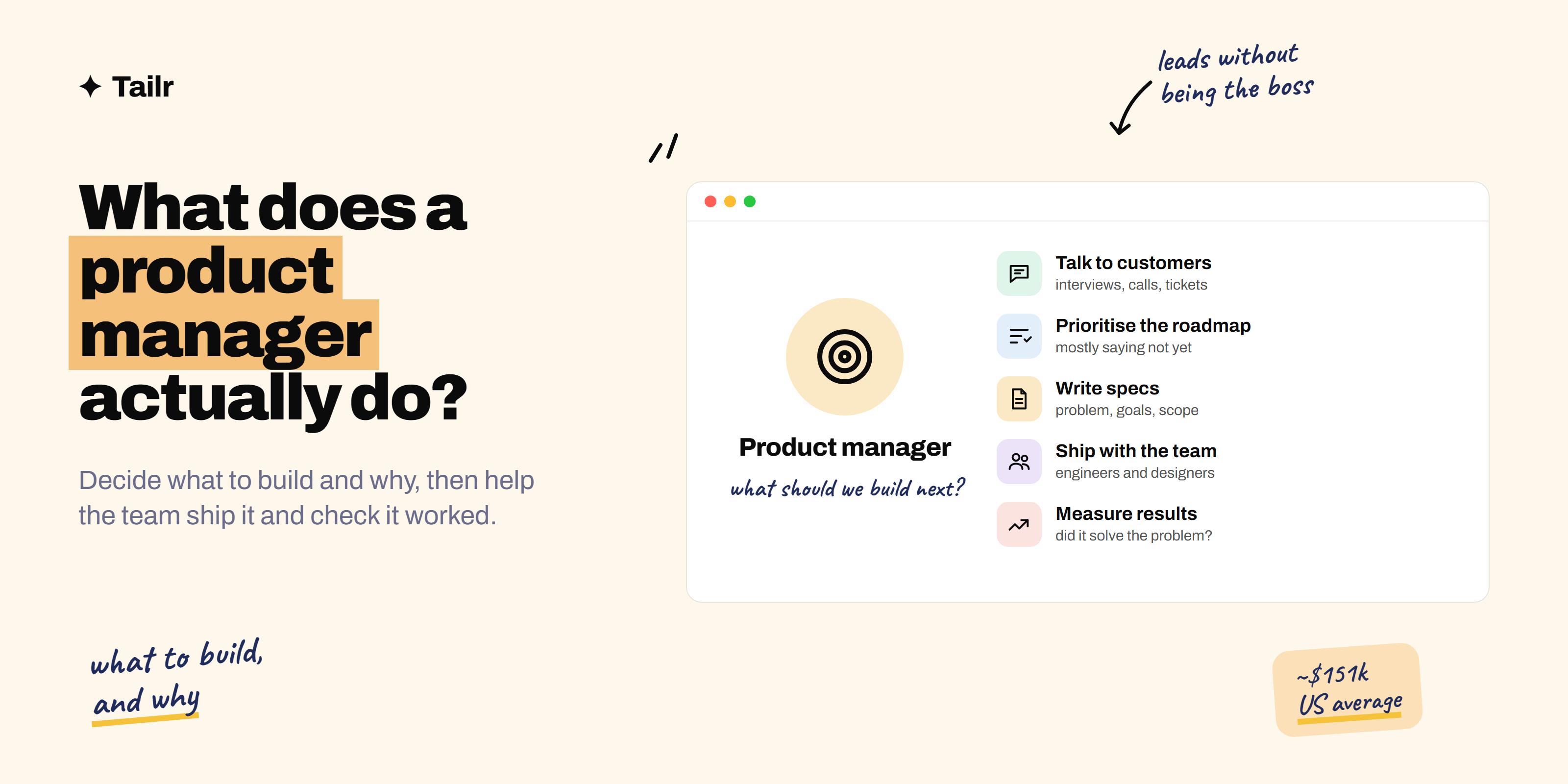
“Product manager” is one of the most popular jobs in tech and one of the hardest to explain. PMs don’t write the code, don’t draw the designs, and usually don’t manage anyone. So what are they doing all day? This post walks through the actual work, what a normal week looks like, what it pays, and how people get in.
The short answer: a product manager decides what a product team should build next and makes sure it gets built well. That means:
- Understanding customers and their problems.
- Choosing which problems are worth solving.
- Writing down what to build and why.
- Working daily with engineers and designers to ship it.
- Measuring whether it worked.
PMs are accountable for the product’s results but rarely have authority over the people building it, so most of the job is communication and judgment. In the US the average PM salary is around $151,000 in 2026.
The core job: decide what to build, and why
Every product team has more ideas than time. Sales wants a feature a big customer asked for. Support wants the top bug fixed. The CEO has a new idea from a conference. Engineers want to pay down technical debt. Someone has to decide what goes first, and that person is the product manager.
A good PM makes that call based on three things:
- The customer. What problem do users actually have, how often, and how painful is it?
- The business. What does the company need right now: growth, retention, revenue, entering a new market?
- The team. What can this team realistically build, and what does each option cost?
The decision then has to be explained well enough that everyone else agrees with it, or at least understands it. That’s why “why” matters as much as “what”.
What product managers actually do, day to day
1. Talk to customers
PMs spend real time with users: interviews, watching people use the product, reading support tickets, joining sales calls. The goal is to understand the problem well enough to spot a better solution than the one the customer asked for.
2. Look at data
Which features do people use? Where do they drop off? What happened after the last release? PMs live in analytics tools and dashboards, and many write basic SQL. Data shows what people do; conversations explain why.
3. Prioritise and own the roadmap
The roadmap is the PM’s plan for what the team will work on over the coming weeks and months. Owning it mostly means saying no, or “not yet”, to good ideas so the team can focus on the best ones.
4. Write specs
Before building starts, the PM writes down the problem, who it’s for, what success looks like, and what’s in and out of scope. This is often called a product requirements document; we’ve covered it in detail in what is a product requirement document.
5. Work with engineering and design
PMs are in the room, or the channel, every day while the team builds: answering questions, making trade-offs when something turns out harder than expected, reviewing designs, and cutting scope to hit a date.
6. Launch and measure
When a feature ships, the PM coordinates with marketing, sales, and support so customers hear about it, then watches the numbers to see if it solved the problem. If it didn’t, that’s the next thing on the roadmap.
A typical week
- Monday: team planning. Agree what the team is working on this sprint. Answer open questions from engineers.
- Tuesday: two customer interviews about a workflow people keep complaining about. Write up what you heard.
- Wednesday: review designs for the next feature with the designer. Cut one screen that isn’t needed for the first version.
- Thursday: roadmap review with your manager and the sales lead, who wants a feature moved up. Explain why it’s not first, using data.
- Friday: check the numbers on last month’s launch. Adoption is lower than hoped. Draft a short doc on why, and what to try next.
A lot of the job is meetings and writing. The best PMs protect time for thinking and talking to customers, because those are the parts nobody else will do.
What a product manager doesn’t do
It helps to be clear about the edges of the role:
- PMs don’t manage engineers. Engineering managers do. PMs lead through influence.
- PMs don’t decide how to build it. Engineers own the technical approach; PMs own the problem and the goal.
- PMs aren’t project managers. Project managers focus on schedules, budgets, and delivery. There’s overlap, but the PM’s main job is choosing the right thing to build. See product manager vs. project manager for the full comparison.
- PMs don’t run the product org’s systems. At larger companies that’s often a product operations team; see what a product operations manager does.
Types of product manager
The title covers a wide range of jobs:
| Type | Focus | Background that helps |
|---|---|---|
| Core or feature PM | A product area customers use directly | Any, often design or engineering |
| Growth PM | Sign-ups, activation, retention, experiments | Analytics, marketing |
| Technical or platform PM | APIs, infrastructure, internal platforms | Software engineering |
| Data or AI PM | Models, data products, ranking and recommendations | Data science, ML |
| B2B or enterprise PM | Products sold to businesses | Sales, consulting, customer success |
Job listings often don’t say which type they are in the title. Read the responsibilities: “experiments and funnels” means growth; “APIs and developer experience” means technical.
Skills that matter most
- Writing. Specs, updates, and decisions are written. Clear writing is clear thinking.
- Prioritisation. Picking the one thing that matters most, and saying no to the rest.
- Data fluency. Reading dashboards, running simple queries, designing an experiment.
- Customer curiosity. Asking “why” until you find the real problem.
- Technical understanding. Enough to have a real conversation about trade-offs.
- Influence. Getting engineers, designers, sales and leadership to agree without being their boss.
The tools change, but a typical stack includes a roadmapping tool, an analytics platform, a tracker like Jira or Linear, and Figma for design reviews. Our roundup of the best tools for product managers covers them.
What product managers earn
According to Glassdoor’s 2026 data, the average product manager salary in the US is about $151,000 a year, with the top 10% earning over $240,000. Associate PMs start lower; senior and group PMs at large tech companies can earn well above $250,000 in total compensation once equity is included. Pay outside the US is lower in absolute terms but PM is usually among the better-paid non-engineering roles in any tech market.
How people become product managers
Coming from outside tech? How to switch careers into tech and non-coding jobs in tech cover the wider picture.
There’s no single path. The common ones:
- From engineering. Strong technical credibility; the step is learning customer and business thinking.
- From design or UX research. Strong user understanding; the step is prioritisation and business goals.
- From analytics. Strong with data; the step is leading a team and owning decisions.
- From customer success, support, or sales. Deep customer knowledge; the step is technical and prioritisation skills.
- Associate product manager programmes. Some large companies hire graduates directly into structured APM programmes.
Most people move into product management inside a company they already work at, where they’ve built trust. If you’re applying externally, you need evidence: a feature you drove, a side project you shipped, or a well-argued write-up of a product decision.
Tailoring your resume for PM roles
PM hiring managers want outcomes and decisions, not activities. A bullet like:
Managed the roadmap for the onboarding team.
becomes much stronger as:
Reprioritised the onboarding roadmap around the step where 40% of new users dropped off; the redesign shipped in six weeks and raised activation from 31% to 44%.
It shows the decision, why you made it, and what happened. Each PM listing also leans differently, growth, technical, or B2B, so the same experience should be framed differently for each. Tailr tailors your resume from the job listing you’re viewing, drafts a cover letter, and tracks the application. For the method, see how to tailor your resume to a job description.
Related guides
- 10 Terms You Should Know Before a Product Management Interview
- RICE, MoSCoW and Kano: Prioritization Frameworks for PM Interviews
- DAU, MAU, Retention and Churn: Product Metrics Interviewers Expect
- Product Sense Interview Questions: How to Answer With Examples
- What Is a Product Roadmap? Types, Examples and How to Build One
Conclusion
A product manager decides what to build and why, then helps the team build it well and checks whether it worked. The work is talking to customers, reading data, prioritising, writing specs, and working closely with engineers and designers, all without formal authority. It’s a well-paid role that rewards judgment and communication more than any one technical skill.
If you like solving problems through other people and don’t mind being accountable for the result, it’s a great job. Start by getting close to product decisions in your current role, and write down the results.
Try Tailr to tailor your resume to the next product manager listing you open.
Frequently asked questions
01What does a product manager do in simple terms?
A product manager decides what a team should build next and why. They talk to customers, look at data, weigh ideas against the company's goals, and then work with engineers and designers to ship the right thing and check whether it worked. They're accountable for the product's results, not for writing the code or drawing the designs.
02Is product manager a technical role?
It depends on the product. PMs for developer tools, APIs, or infrastructure usually need a technical background. Most consumer and business software PM roles don't require you to code, but you do need to understand how software is built well enough to discuss trade-offs with engineers and spot when something is harder than it looks.
03How much does a product manager make?
In the US in 2026, Glassdoor puts the average product manager salary at about $151,000 a year, with top earners above $240,000. Pay varies a lot by level and company: associate PMs start lower, and senior PMs at large tech companies can earn well over $250,000 in total compensation including equity.
04What skills does a product manager need?
Clear writing and communication, the ability to prioritise ruthlessly, comfort with data, curiosity about customers, and enough technical understanding to work closely with engineers. Just as important is influence without authority, because PMs rarely manage the engineers and designers they work with.
05Do product managers manage people?
Usually not at the start. Most product managers lead a cross-functional team without being anyone's manager: engineers report to engineering managers and designers to design leads. PMs manage other PMs only once they move into group product manager, director, or head of product roles.
06How do I become a product manager with no experience?
The most common route is moving internally from an adjacent role such as engineering, design, analytics, customer success, or support. Associate product manager programmes are another entry point. Either way, build evidence of product thinking: a shipped side project, a feature you drove, or a clear write-up of a product decision and its outcome.