What Does a Product Operations Manager Do?
· updated
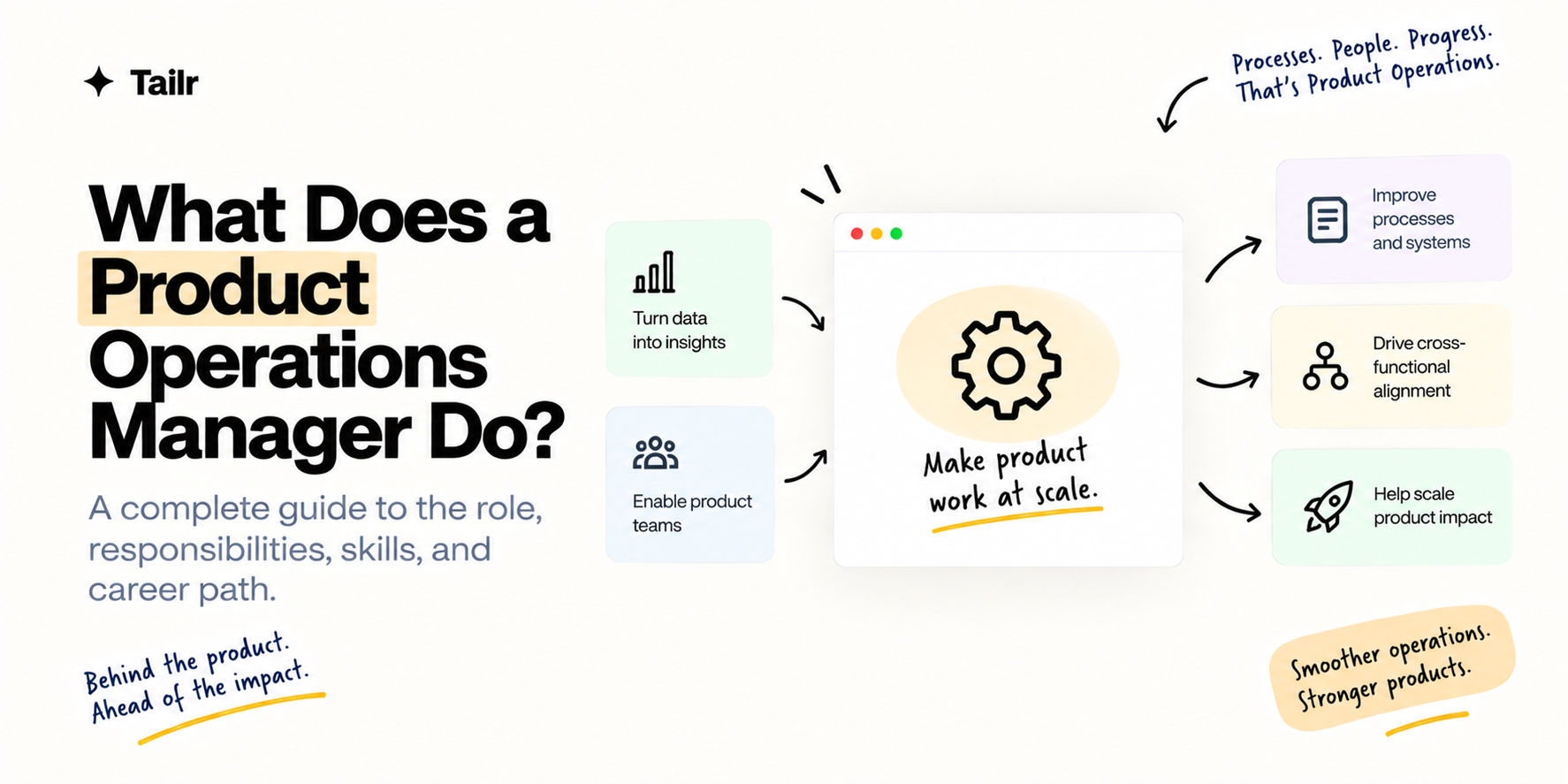
Product operations is one of the newer titles in software companies and one of the least consistently defined. Ask five companies what their product operations manager does and you’ll get five answers, ranging from “runs our planning process” to “owns every dashboard the product org looks at” to “launches our product in new cities”. This post explains what the role usually means, where it varies, what it pays, and how to get into it.
The short answer: a product operations manager (often shortened to product ops) builds and runs the systems that let a product team work well at scale. The role has three parts:
- Data: making sure the product organisation has reliable data and metrics.
- Research: making customer and market research easy to do and easy to find.
- Process: designing the processes for planning, prioritising, launching, and reporting.
Product operations managers don’t decide what gets built. They make it faster and more consistent for the product managers who do. The role pays around $133,000 to $159,000 on average in the US in 2026, and most people come into it from analytics, business operations, program management, or product management.
Why the role exists
Small product teams don’t need product operations. With three product managers, everyone knows which dashboard to trust, who talked to which customer last week, and when planning happens.
Somewhere between ten and thirty product managers, that stops being true. Different teams define “active user” differently. Two PMs interview the same customer in the same month without knowing. Quarterly planning takes six weeks because every team runs it differently. Leadership asks a simple question (“how many customers are affected by this bug?”) and gets four answers.
Product operations is the function companies create to fix this. Melissa Perri and Denise Tilles, who wrote the standard book on the subject, describe it as the discipline of helping a product management function scale well: surrounding product managers with the inputs they need to set strategy, prioritise, and streamline how they work. The role became common at software companies during the 2019 to 2023 growth years and has stuck because the scaling problems it solves don’t go away.
The three pillars of product operations
Perri and Tilles organise the work into three pillars, and most product operations job descriptions map onto them.
1. Business and data insights
Product ops makes sure the product organisation has the numbers it needs and that everyone means the same thing by them.
In practice: defining product metrics consistently across teams, building and maintaining the dashboards product managers and leadership actually use, automating recurring reports so PMs don’t rebuild them by hand every month, and connecting product data to business data (revenue, churn, support tickets) so questions like “which features do our highest-value customers rely on?” have an answer.
A concrete example: a product operations manager notices that three teams report “weekly active users” using three different definitions. They get the teams to agree one definition, rebuild the dashboards on it, and document it. It’s unglamorous and it changes every conversation the product org has afterwards.
2. Customer and market insights
Product ops makes it easy to talk to customers and easy to find out what customers have already said.
In practice: running the logistics of user research (recruiting participants, scheduling, incentives, tooling), maintaining a research repository so insights don’t vanish into one PM’s notes, pulling together customer feedback from support, sales, and community into a form product teams can use, and keeping competitor and market intelligence current.
The point isn’t to do the research for product managers. It’s to remove the friction that stops them doing it. When recruiting a customer for an interview takes a form and two days instead of a week of Slack messages, PMs talk to customers more.
3. Process and governance
Product ops designs how product work happens across teams.
In practice: running the planning cadence (quarterly planning, roadmap reviews, OKR setting), standardising templates for product requirements and launch plans, running launch readiness and go-to-market coordination, managing the product tool stack, onboarding new product managers, and producing the reporting that leadership uses to see across the whole portfolio.
The risk here is over-process. Good product operations managers add the minimum structure that helps and remove structure that doesn’t. The best measure is whether product managers say the process saves them time.
A typical week
- Monday: portfolio review prep. Pull the roadmap status from every team into the one-page view the VP of Product reads. Chase two teams whose updates are late.
- Tuesday: sit with an analytics engineer to fix a metric that’s been double-counting trial users. Update the definition in the metrics glossary.
- Wednesday: run the monthly customer research sync. Six PMs share what they heard. Tag and file the insights in the research repository.
- Thursday: launch readiness meeting for a feature shipping next week. Confirm support docs, sales enablement, and release notes are on track. Draft the internal announcement.
- Friday: quarterly planning is in three weeks. Send the timeline and templates. Pull last quarter’s retro notes to fix the two things everyone complained about.
Product operations managers spend a lot of time in the seams between teams, which is where most of the friction in a product org lives.
One title, two very different jobs
A warning about the title. At some companies, especially marketplaces and consumer businesses like Uber, “product operations” means something different: operations teams that launch and run a product in the real world, in specific markets or cities, working on pricing, supply, incentives, and local execution. That’s closer to general management or business operations than to the role described here.
If a job listing talks about markets, launches in new regions, or operational metrics like supply and demand, it’s the second kind. If it talks about product managers, planning, tooling, research, and metrics definitions, it’s the first. Both are real jobs; make sure you know which one you’re applying for.
Product operations vs the roles around it
| Role | Decides what to build | Owns the process and tooling | Owns the data and research systems | Typical reporting line |
|---|---|---|---|---|
| Product operations manager | No | Yes | Yes | Head of product or product ops lead |
| Product manager | Yes | Follows it | Uses it | Product |
| Technical program manager | No | For engineering delivery | No | Engineering |
| Business operations | No | For the company broadly | Company-wide metrics | Finance or COO |
| Chief of staff to a product leader | No | For the leader’s org | Sometimes | The product leader |
| Product analyst | No | No | Data analysis, not infrastructure | Product or data |
The comparison people ask about most is product ops versus product management, and it’s worth its own discussion; we’ve written it up in product manager vs. product operations manager. The short version: PMs decide, product ops enables. For engineering-side delivery coordination, the equivalent role is the technical program manager.
Skills and tools
Skills:
- Data fluency: SQL, spreadsheet modelling, building a dashboard that people trust.
- Process design: knowing when a template helps and when it’s bureaucracy.
- Project management: running a planning cycle with twenty teams and a deadline.
- Writing: most of the role’s output is documents that others act on.
- Product sense: enough to understand what PMs are trying to do and why a process gets in the way.
- Influence without authority: product ops doesn’t manage the PMs it supports.
Tools you’ll be expected to know or learn:
- Work tracking: Jira, Linear, Asana.
- Roadmapping: Productboard, Aha, Airfocus.
- Product analytics: Amplitude, Mixpanel, Pendo.
- Business intelligence: Looker, Tableau, Metabase.
- Research: Dovetail, UserTesting, or whatever the company uses as a repository.
- Documentation: Notion, Confluence, Google Docs.
What product operations managers earn
US figures for 2026:
- Glassdoor average: about $133,000.
- ZipRecruiter average: about $159,000.
- Typical band: the 25th to 75th percentile sits around $122,000 to $182,000 in total compensation.
- Senior and lead roles at large tech companies go meaningfully higher, and some product operations leaders are paid in line with senior product managers.
- Location: San Francisco pays roughly 20% above the national average; large tech companies pay around 30% more than startups for equivalent roles.
Product ops usually pays a little below product management at the same level, reflecting that it’s an enabling function rather than the one accountable for product outcomes. The gap narrows at senior levels.
How to get into product operations
Most postings ask for three to seven years of experience. The common routes in:
- Analytics or data. You already own the numbers; the step is learning to build the process and research side.
- Business operations or strategy. You’re used to cross-functional process work; the step is learning product.
- Program or project management. You can run a planning cycle; the step is data and product depth.
- Product management. You’ve felt the friction first-hand and want to fix it. Some PMs move into product ops to lead the function; others use it as a route into product at a company that’s hard to join as a PM directly.
- Customer success or support with a data bent. You know the customer feedback side; the step is analytics and process.
There’s no standard qualification. What convinces hiring managers is evidence that you’ve built a system other people relied on: a metrics framework, a research process, a planning cadence, and that it made a measurable difference to how a team worked.
Tailoring your resume for a product operations role
Product ops screeners look for systems you built, cross-functional reach, and measurable effects on how teams work. Analysts tend to show only the analysis; project managers tend to show only the coordination.
An analyst’s bullet might read:
Built dashboards for the product team in Looker.
Rewritten for a product operations posting:
Defined the product org’s core metrics with eight PMs, rebuilt the leadership dashboard in Looker on the shared definitions, and cut the monthly reporting cycle from five days to one.
Same work. The second version shows the cross-functional agreement, the system, and the effect.
Each product ops listing leans differently: one is mostly data, another is mostly planning process, a third is mostly research operations. That’s where Tailr helps. Open the listing, and it rewrites your resume to bring forward the experience that matches that specific posting, drafts a cover letter, and tracks the application. It works only from what’s on your resume. Our guides on tailoring your resume to a job description and tailoring without lying explain the method.
Conclusion
A product operations manager builds the system a product organisation runs on: trustworthy data, accessible customer research, and planning and launch processes that scale. They don’t decide what to build. They make it easier for the people who do to decide well and execute consistently. The role exists because product teams break past a certain size, and it pays around a mid-level product salary with a path to product management, product ops leadership, or chief of staff work.
If you like making systems work, are comfortable with data, and get satisfaction from other people’s teams running better, it’s a strong option. When you find a listing, make sure your resume shows the systems you built and what changed because of them.
Try Tailr to tailor your resume to the next product operations listing you open.
Frequently asked questions
01What does a product operations manager do?
A product operations manager builds and runs the systems a product team needs to work well: consistent metrics and dashboards, a way to gather and share customer research, and the processes for planning, prioritising, and launching. They don't decide what to build; they make it easier for product managers to make that decision well and to execute it consistently across teams.
02Is product operations the same as product management?
No. Product managers decide what to build and why, own the roadmap, and are judged on product outcomes. Product operations managers build the supporting system: the data, the research infrastructure, the planning cadence, the tooling. One is about the product; the other is about how product work gets done. Small companies often combine them, but at scale they're separate roles.
03How much does a product operations manager make?
In the US in 2026, Glassdoor puts the average around $133,000 and ZipRecruiter around $159,000, with a typical 25th to 75th percentile band of roughly $122,000 to $182,000 in total compensation. Senior and lead product operations roles at large tech companies go higher. San Francisco pays about 20% above the national average.
04What skills do you need for product operations?
Data fluency (SQL, analytics tools, building dashboards), process design, project management, clear writing, and enough product sense to know which processes help and which get in the way. Tool skills are usually expected: Jira or Linear, Productboard or Aha, Amplitude or Pendo, Looker or Tableau. Most product operations managers come from analytics, business operations, program management, or product management itself.
05Why do companies hire product operations managers?
Because product teams stop working well past a certain size. With three product managers, everyone knows the numbers and the customers. With thirty, definitions drift, research gets duplicated, planning takes weeks, and leadership can't see what's happening. Product operations exists to fix those scaling problems so product managers can spend their time on product decisions.
06Is product operations a good career path?
Yes, and a flexible one. Product operations managers commonly move into product management, into leading a product operations function, into chief of staff roles for a product leader, or into business operations. The role gives an unusually wide view of how a company's product organisation works, which is valuable in all of those directions.