What Is a Technical Program Manager (TPM)?
· updated
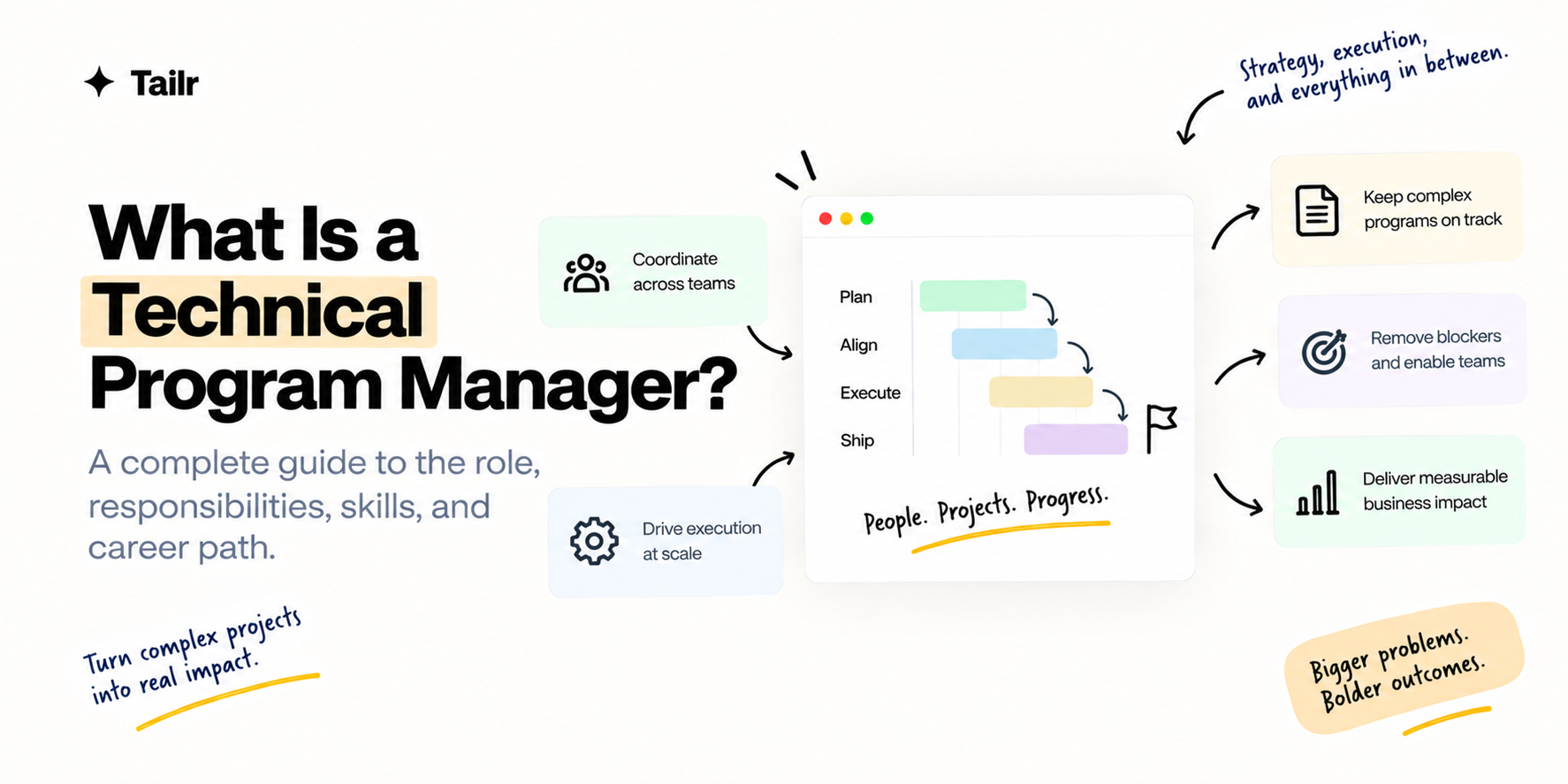
Technical program manager is one of the most common titles at large tech companies and one of the hardest to explain to someone who hasn’t worked alongside one. It’s not a product manager, though the two get confused constantly. It’s not a project manager, though it overlaps. And it’s not an engineering manager, though TPMs spend most of their day with engineers. Here’s what the job actually is.
The short answer: a technical program manager (TPM) is responsible for delivering large technical initiatives that span many engineering teams. A program is a set of related projects with a shared goal, like migrating a company to a new data platform, launching a product that touches ten backend services, or building the infrastructure for a new model. The TPM:
- Turns that goal into a plan.
- Maps the dependencies between teams.
- Tracks risks.
- Runs the status and escalation rhythm.
- Makes or brokers the technical trade-offs needed to ship.
TPMs don’t usually write production code or manage engineers, but they’re expected to understand the engineering well enough to challenge estimates and weigh in on architecture. The role exists mainly at companies with hundreds or thousands of engineers, and at Amazon, Google, and Meta it pays a median of roughly $305,000 to $401,000 in total compensation.
Program versus project
The word “program” is doing a lot of work in the title, so it’s worth defining.
A project has a defined scope, a start, and an end: build this feature, migrate this database, ship this release. One team can usually own it.
A program is a collection of related projects that only deliver value together. Launching a new payment method might involve the payments team, the fraud team, the mobile team, the web team, the data team, compliance, and support, each with their own project, all of which have to land in a particular order by a particular date. Nobody on any single team owns the whole thing.
That gap is what TPMs fill. The role appeared at companies like Microsoft and Amazon as engineering organisations grew past the size where a single engineering manager could hold the whole picture, and it’s now a standard job family at most large tech companies.
What technical program managers actually do
Turn a goal into a plan
A TPM starts with an objective from leadership (“support the new regulation by Q2”, “cut infrastructure cost by 30%”) and works out what it actually requires: which teams, which systems, what has to change, and in what order. The output is a program plan with workstreams, owners, milestones, and a critical path.
Map and manage dependencies
This is the core skill. In a program touching eight teams, team C can’t start until team A ships an API, team F’s work is blocked on a decision team B hasn’t made, and team H didn’t know they were involved at all. The TPM finds these dependencies before they bite, sequences the work, and keeps the map current as things change.
Track and reduce risk
TPMs maintain the honest version of the status. They spot that a team’s estimate assumes a library that isn’t ready, or that two workstreams both need the same three specialists in the same month. Then they either fix it (re-sequence, find capacity, cut scope) or escalate it clearly and early to whoever can.
Run the operating rhythm
Weekly status, milestone reviews, cross-team syncs, executive updates, launch readiness. TPMs run these meetings and write the documents that come out of them. A good TPM’s status report is the single source of truth for a program; leadership reads it instead of asking twenty people.
Make and broker technical trade-offs
When the plan collides with reality, someone has to decide: cut this feature, delay that team, accept this technical debt, ship in two phases. TPMs often make the smaller calls themselves and frame the bigger ones for engineering leadership, with the options and consequences laid out. This is where the “technical” in the title matters: a TPM who can’t follow an architecture discussion can’t frame the trade-off.
Communicate across the company
TPMs translate between engineering teams who speak different dialects, and between engineering and leadership, product, legal, finance, and operations. A lot of the job is writing: plans, status, decision documents, post-mortems.
TPM vs the roles it gets confused with
| Role | Owns | Technical depth needed | Manages people | Typical org |
|---|---|---|---|---|
| Technical program manager | Cross-team delivery of a technical program | High | No | Engineering |
| Product manager | What to build and why; the roadmap | Medium | No | Product |
| Project manager | One bounded project’s schedule and scope | Low to medium | No | Varies |
| Engineering manager | A team’s people, performance, and output | High | Yes | Engineering |
| Technical product manager | A technical product (API, platform) and its roadmap | High | No | Product |
| Product operations manager | The systems the product org runs on | Low to medium | No | Product |
TPM vs product manager is the comparison people ask about most. The PM decides what and why; the TPM decides how and when, across teams. PMs sit closer to customers and strategy; TPMs sit closer to engineers and execution. At Amazon, Google, and Meta the two are distinct job families with distinct interview loops.
TPM vs project manager: scope and depth. Project managers usually run one project and aren’t expected to argue with an engineer’s estimate. TPMs run programs of many projects and are expected to know when an estimate is wrong.
TPM vs engineering manager: engineering managers own people and a team’s long-term health. TPMs own a program’s delivery and have no direct reports. The two work closely, and at some companies engineering managers do program work when there’s no TPM.
If you’re comparing execution-focused roles on the product side, the closest cousin is the product operations manager, which does similar systems work for product teams rather than engineering programs.
Where TPMs work
The role is most established at large tech companies: Amazon, Google, Meta, Microsoft, Apple, and their peers all have TPM job families with defined levels. It’s common at mid-size software companies once engineering passes a few hundred people, at cloud and infrastructure providers, at hardware and semiconductor companies (where programs have physical supply chains as well as software), and increasingly at AI labs coordinating large model training and infrastructure programs.
Startups rarely hire TPMs early. Below a couple of hundred engineers, program work is usually absorbed by engineering managers and senior engineers. If you’re looking at smaller companies, the equivalent responsibilities often sit under a “head of engineering operations” or “chief of staff to the CTO” title.
A typical week
- Monday: update the program dashboard from each team’s status; notice one workstream slipped a week and trace why (a dependency on the identity team that nobody flagged).
- Tuesday: cross-team sync with eight leads; agree a re-sequence that keeps the launch date; write it up.
- Wednesday: architecture review for the new service; ask whether the proposed design will handle the migration cut-over; capture two risks.
- Thursday: executive update. One page: where we are, what’s at risk, what decision we need. Get the decision.
- Friday: launch readiness for a milestone in three weeks; chase the security review; draft the post-mortem template for after.
TPMs spend most of their time in meetings and documents. The engineers do the building; the TPM makes sure the building adds up to the program.
Skills that matter
Technical:
- Systems understanding: how services, data, infrastructure, and deployments fit together, well enough to spot when a plan is physically impossible.
- Ability to read a design doc or a piece of code and ask the right question.
- Familiarity with how engineering teams work: sprints, code review, release processes, on-call.
- Usually a background in software engineering, though some come through technical project management, QA, or systems roles.
Program management:
- Planning and sequencing under uncertainty.
- Risk identification: finding the problem before it’s a problem.
- Running meetings that produce decisions.
- Writing status that people trust and read.
Interpersonal:
- Influence without authority. TPMs don’t manage anyone and still have to get eight teams to change their plans.
- Escalating early and calmly, without blame.
- Holding the line on the plan while staying genuinely open to a better one.
What technical program managers earn
US figures for 2026:
- ZipRecruiter average: about $146,000, with most TPMs between $129,000 (25th percentile) and $167,000 (75th percentile).
- Early career: roughly $110,000 to $135,000 at companies outside big tech.
- Big tech, total compensation including base, stock, and bonus, from Levels.fyi: Amazon median about $305,000 (ranging from $155,000 at L4 to $623,000 at L8); Google median about $335,000 (from $182,000 at L3 to $819,000 at L8); Meta median about $401,000 (from $158,000 at IC3 to $893,000 at IC8).
- Senior and principal TPMs at large companies commonly earn $180,000 to $400,000 in base alone, with equity on top.
The spread between a TPM at a mid-size company and one at Meta is enormous. Levels matter more than the title, and the interview loops at large companies are calibrated to place you at a specific level.
How to become a TPM
Two main routes:
From software engineering. The most common path at large tech companies. Engineers who find themselves naturally coordinating across teams, writing the plan, and running the launch often move into TPM roles. You keep the technical credibility and add the program skills.
From project or program management. Technical project managers, QA leads, release managers, and systems engineers move into TPM roles by deepening their technical understanding. The gap to close is usually system design.
Either way, TPM interviews at large tech companies typically cover: program management scenarios (how would you run this migration?), system design or technical depth, behavioural questions about influence and conflict, and a deep dive on a program you’ve delivered. Prepare a program story with numbers: how many teams, what was at risk, what you changed, what shipped.
Tailoring your resume for a TPM role
TPM screeners look for scale (teams, systems, timeline), evidence of technical depth, and results. Engineers applying tend to show the code and hide the coordination; project managers tend to show the coordination and hide the technical.
An engineer’s bullet might read:
Led the migration of the order service to the new event platform.
Rewritten for a TPM posting:
Ran the order service migration program across 6 teams and 14 services: built the dependency plan, resolved a critical-path conflict with the identity team, and delivered cut-over two weeks early with zero customer-facing incidents.
Same work, reframed around the program: scale, dependencies, risk, and result.
Every TPM listing emphasises something different: infrastructure and migrations at one company, hardware programs at another, launch coordination at a third. That’s where Tailr helps. Open the listing, and it rewrites your resume to lead with the experience that matches that specific posting, drafts a cover letter, and keeps track of the application. It only works from what’s on your resume, which matters because TPM interviews will dig into every program you claim. Our guides on tailoring your resume to a job description and tailoring without lying go through the method.
Conclusion
A technical program manager delivers large technical initiatives across many engineering teams: turning a goal into a plan, mapping dependencies, tracking risk, running the operating rhythm, and brokering the trade-offs needed to ship. The role exists because programs spanning eight teams don’t deliver themselves, and it pays very well at large tech companies for people who can combine technical depth with the ability to move an organisation without managing it.
If you’re an engineer who keeps ending up as the one holding the plan, or a project manager who wants to go deeper technically, it’s worth a serious look. When you find the right listing, make sure your resume shows the program: the scale, the risk, and what shipped.
Try Tailr to tailor your resume to the next TPM listing you open.
Frequently asked questions
01What does a technical program manager do?
A technical program manager (TPM) drives large, cross-team engineering programs from plan to delivery. They break the program into workstreams, map dependencies between teams, build the schedule, track risks, run the status and escalation rhythm, and make or broker the technical trade-offs needed to keep the program on track. They don't usually write production code or manage engineers directly.
02What is the difference between a technical program manager and a product manager?
A product manager decides what to build and why, owning the roadmap and the product outcome. A technical program manager owns how a large technical initiative gets delivered across many engineering teams: the plan, the dependencies, the risks, and the coordination. PMs sit closer to customers and strategy; TPMs sit closer to engineering and execution. Most large tech companies employ both.
03What is the difference between a technical program manager and a project manager?
Scope and technical depth. A project manager typically runs one bounded project with a defined scope and end date. A TPM runs a program, which is a set of related projects across several teams, and is expected to understand the engineering well enough to spot risks, question estimates, and weigh in on architecture trade-offs. At many tech companies, TPM is the more senior and more technical of the two.
04How much does a technical program manager make?
In the US in 2026, ZipRecruiter puts the average around $146,000, with most TPMs between $129,000 and $167,000. At large tech companies total compensation is much higher: Levels.fyi reports median TPM packages of about $305,000 at Amazon, $335,000 at Google, and $401,000 at Meta, including stock and bonus, with senior levels well above that.
05Do technical program managers need to code?
Not usually as part of the job, but most have coded before. TPM interviews at large tech companies often include a technical round covering system design or reading code, and the job requires enough depth to challenge an engineer's estimate or understand why two services can't ship in the order the plan assumes. Many TPMs are former software engineers; others come from technical project management or engineering-adjacent roles.
06Which companies hire technical program managers?
Amazon, Google, Meta, Microsoft, Apple, and most other large tech companies have TPM job families, and the role is common at mid-size software companies, cloud and infrastructure providers, hardware companies, and increasingly at AI labs running large model and infrastructure programs. Smaller startups rarely hire TPMs until engineering grows past a few hundred people.