Product Manager vs. Product Operations Manager
· updated
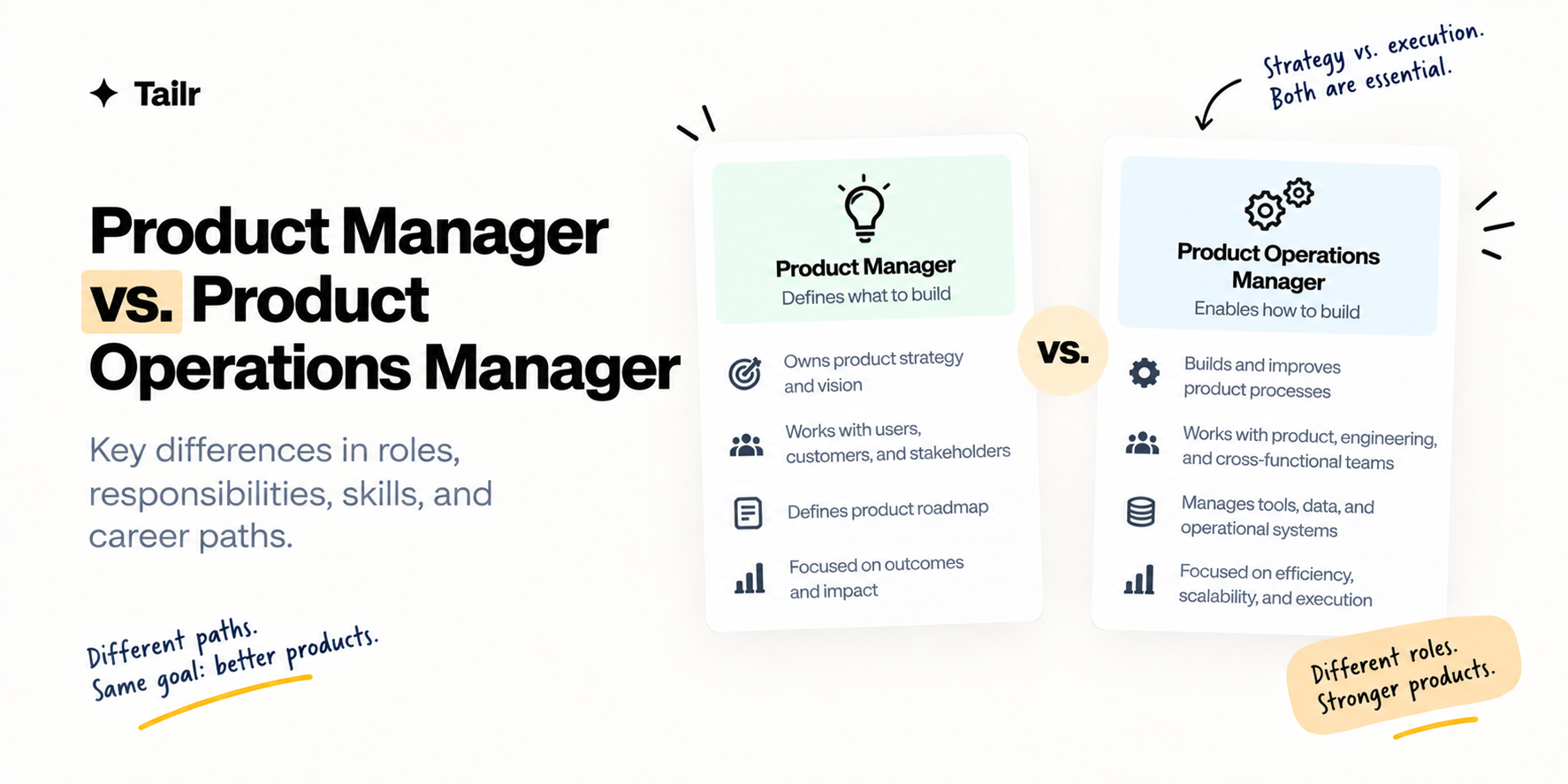
The two titles share a word and often a floor of the office, and people outside product teams regularly assume one is a junior version of the other. It isn’t. A product manager and a product operations manager do different jobs, are measured on different things, and suit different people. Here’s how they compare and how to choose between them.
The short answer: a product manager (PM) decides what to build and why. They own the roadmap for a product or feature area, gather customer and market input, write requirements, work with design and engineering to ship, and are accountable for whether the product succeeds. A product operations manager (product ops) builds the system the whole product organisation runs on: consistent metrics and dashboards, a way to gather and share customer research, the planning and launch processes, and the tool stack. PMs are judged on product outcomes; product ops is judged on whether the product team works better. PMs earn more on average, about $151,000 versus $133,000 in the US in 2026, though the gap narrows at senior levels.
If you want a deeper look at either role on its own, we’ve covered what a product operations manager does separately. This post is the comparison.
Side by side
| Product manager | Product operations manager | |
|---|---|---|
| Core question | What should we build, and why? | How does product work get done well? |
| Scope | One product or feature area | The whole product organisation |
| Owns | Roadmap, requirements, launch decisions | Metrics definitions, research infrastructure, planning process, tools |
| Measured on | Product outcomes: adoption, revenue, retention | Team effectiveness: planning speed, data trust, research reuse |
| Main relationships | Engineering, design, customers | PMs, analytics, research, leadership |
| Customer contact | Direct and frequent | Indirect, via research systems |
| Reports to | Group PM or head of product | Head of product ops or senior product leader |
| Typical background | Engineering, design, consulting, business, or an associate PM programme | Analytics, business ops, program management, or product management |
| US average pay (2026, Glassdoor) | About $151,000 | About $133,000 |
What a product manager owns
A PM is responsible for a slice of the product and for the decisions about it. Over a typical quarter they’ll:
- Talk to customers and study usage data to understand what’s not working.
- Decide, with their leadership, what the team builds next and what it doesn’t.
- Write the requirements, user stories, or product brief that design and engineering work from.
- Sit in the middle of the build: unblocking, answering questions, making trade-offs when scope and time collide.
- Coordinate the launch with marketing, sales, and support.
- Track whether the thing they shipped worked, and decide what to do about it.
The job is about judgement under uncertainty. Nobody hands a PM the right answer; the PM’s value is picking well and being accountable for it.
What a product operations manager owns
A product operations manager is responsible for the conditions the PMs work in. Over the same quarter they’ll:
- Make sure every team’s metrics mean the same thing and that the dashboards leadership looks at are right.
- Run the machinery of customer research: recruiting, tooling, and a repository where insights are findable months later.
- Run quarterly planning: the timeline, the templates, the review sessions, the roll-up for leadership.
- Own the launch readiness process so every launch checks the same boxes.
- Manage the product tool stack (Jira or Linear, Productboard, Amplitude, Looker) and onboard new PMs into it.
- Produce the portfolio-level reporting that lets a VP see across twenty teams.
The job is about systems. Product ops rarely makes a product decision; it makes hundreds of product decisions easier and faster.
One launch, two jobs
The clearest way to see the difference is to follow one feature to launch.
Say a company is shipping a new approvals workflow for its expense product.
The PM decided to build it, after interviews with finance teams showed approvals were the top complaint. They wrote the brief, argued for it in planning, worked with design on the flow, made the call to cut a nice-to-have when engineering ran late, and set the success metric: 40% of customers using approvals within 90 days.
The product ops manager made sure the interviews were easy to recruit and that their notes went into the research repository, where a second PM found them and avoided duplicating the work. They ran the planning cycle where the feature got prioritised. They ran the launch readiness check that caught the missing support article a week before launch. And they built the dashboard the PM will use to track that 40% number, using the same definition of “customer” every other dashboard uses.
Both were essential. Only one of them decided anything about the feature.
Skills each role needs
Product manager:
- Product sense: forming a view on what users need and defending it.
- Prioritisation: saying no to good ideas.
- Communication: writing briefs, running meetings, aligning people who disagree.
- Enough technical fluency to make trade-offs with engineers.
- Comfort being accountable for outcomes you don’t fully control.
Product operations manager:
- Data fluency: SQL, analytics tools, building dashboards people trust.
- Process design: adding the minimum structure that helps and removing what doesn’t.
- Project management: running a cycle across many teams on a deadline.
- Writing: most output is documents and templates others use.
- Influence without authority: product ops doesn’t manage the PMs it supports.
There’s overlap, especially in communication and product understanding. The difference is where the centre of gravity sits: judgement for PMs, systems for product ops.
What each role pays
US figures for 2026, mainly from Glassdoor:
Product manager: average about $151,000, from about $127,000 at entry level to $229,000 for senior PMs. At large tech companies, total compensation including equity is far higher: Levels.fyi medians run around $274,000 for a Google L4 PM and $371,000 for L5.
Product operations manager: average about $133,000 on Glassdoor, with ZipRecruiter reporting closer to $159,000. The typical 25th to 75th percentile band is around $122,000 to $182,000 in total compensation. Senior product ops leads and heads of product operations can match senior PM pay.
The gap exists because PMs carry accountability for product outcomes, and companies pay for that. But product ops is not a junior role; it’s a parallel one, and at senior levels the two converge.
How the roles work together
At companies that get it right, product ops and PMs are allies. PMs get more time for customers and decisions because someone else is running the planning machinery and fixing the dashboards. Product ops gets its authority from PMs saying “this process saved me time”.
Where it goes wrong, product ops becomes a reporting layer that creates work for PMs without giving anything back, or PMs treat product ops as an admin team. Both failures usually trace to product ops being measured on outputs (how many templates, how many reports) rather than on whether product teams work better. If you’re interviewing for either role, ask how the two teams interact; the answer tells you a lot about the company.
Which role should you choose?
Choose product manager if:
- You want to make the call on what gets built, and live with the result.
- You get energy from customers and from arguing for a point of view.
- You’re comfortable being accountable for things outside your control.
- You want the more established career ladder and higher average pay.
Choose product operations manager if:
- You like making systems work and get satisfaction from other teams running better.
- You’re stronger on data and process than on product intuition, at least for now.
- You’d rather influence many teams a little than one team a lot.
- You’re coming from analytics, business operations, or program management and want a path into product.
Moving between them is common in both directions. Product ops to PM is the more frequent move, and a good one: product ops gives you the data and process context PM interviews probe, and you’ll have watched many PMs make decisions well and badly. PM to product ops usually happens when someone wants to lead the function or wants breadth across the whole organisation rather than depth in one area.
If you’re aiming at smaller companies, expect the roles to blur; our guide to the best websites for startup jobs covers where those roles get posted.
Tailoring your resume for each role
The same experience needs to be framed differently for the two roles, and most applicants send one resume to both.
Take a bullet from someone who ran a planning process while also owning a small feature area:
Coordinated quarterly planning across product teams and managed the reporting feature roadmap.
For a product ops application, lead with the system and its effect:
Designed and ran quarterly planning for 14 product teams, cutting the cycle from six weeks to three and producing the portfolio roll-up the CPO used in board updates.
For a product manager application, lead with the decisions and the outcome:
Owned the reporting feature area; prioritised and shipped scheduled exports after customer interviews showed it as the top request, lifting weekly report usage 35%.
Both are true. Each brings forward what that role’s screener is looking for. This is what Tailr does when you open a listing: it reads the posting, rewrites your resume to lead with the matching experience, drafts a cover letter, and tracks the application, working only from what’s really on your resume. Our guides on tailoring your resume to a job description and tailoring without lying cover the method.
Conclusion
A product manager decides what to build and is accountable for whether it works. A product operations manager builds the data, research, and process systems that make those decisions faster and more consistent across the whole product organisation. One is about judgement, the other about systems, and a scaling product team needs both.
Choose based on where you get satisfaction: making the call, or making the machine run. And when you apply, make sure your resume tells the story that role is looking for, not the other one’s.
Try Tailr to tailor your resume to the next product listing you open.
Frequently asked questions
01What is the difference between a product manager and a product operations manager?
A product manager decides what to build and why, owns the roadmap for their product area, and is accountable for its outcomes. A product operations manager builds the systems the whole product organisation runs on: consistent metrics, research infrastructure, planning and launch processes, and tooling. The PM is about the product; product ops is about how product work gets done.
02Does a product operations manager report to a product manager?
Usually not. Product operations managers typically report to a head of product operations or directly to a senior product leader such as a VP or Chief Product Officer, and they support many product managers rather than working for one. In small companies the roles may be combined or the product ops person may sit alongside a single product lead.
03Who earns more, a product manager or a product operations manager?
Product managers, on average. In the US in 2026, Glassdoor puts the average product manager at about $151,000 and the average product operations manager at about $133,000, with senior PMs around $229,000. The gap reflects that PMs are accountable for product outcomes. It narrows at senior levels, and product operations leaders can be paid in line with senior PMs.
04Can a product operations manager become a product manager?
Yes, and it's a common move. Product ops gives you close exposure to how PMs work, what data they use, and how decisions get made, which is exactly what PM interviews probe. Highlight any moment you shaped a product decision with data or research, not just enabled one, and practise the product sense and prioritisation questions that PM loops rely on.
05Do small companies need both roles?
Rarely. Below roughly ten product managers, the product ops work (metrics, research logistics, planning) is usually absorbed by PMs, a product leader, or an analyst. Dedicated product operations roles become worthwhile when coordination across many product teams starts costing more than a salary, which typically happens somewhere between ten and thirty PMs.
06Which role is better for someone from a data or operations background?
Product operations is usually the more natural fit and the easier door. It rewards data fluency, process design, and cross-functional coordination directly, without requiring the product-sense track record that PM hiring looks for. Many people use a product ops role to build that track record and move into product management later.