Best Websites for Startup Jobs in 2026
· updated
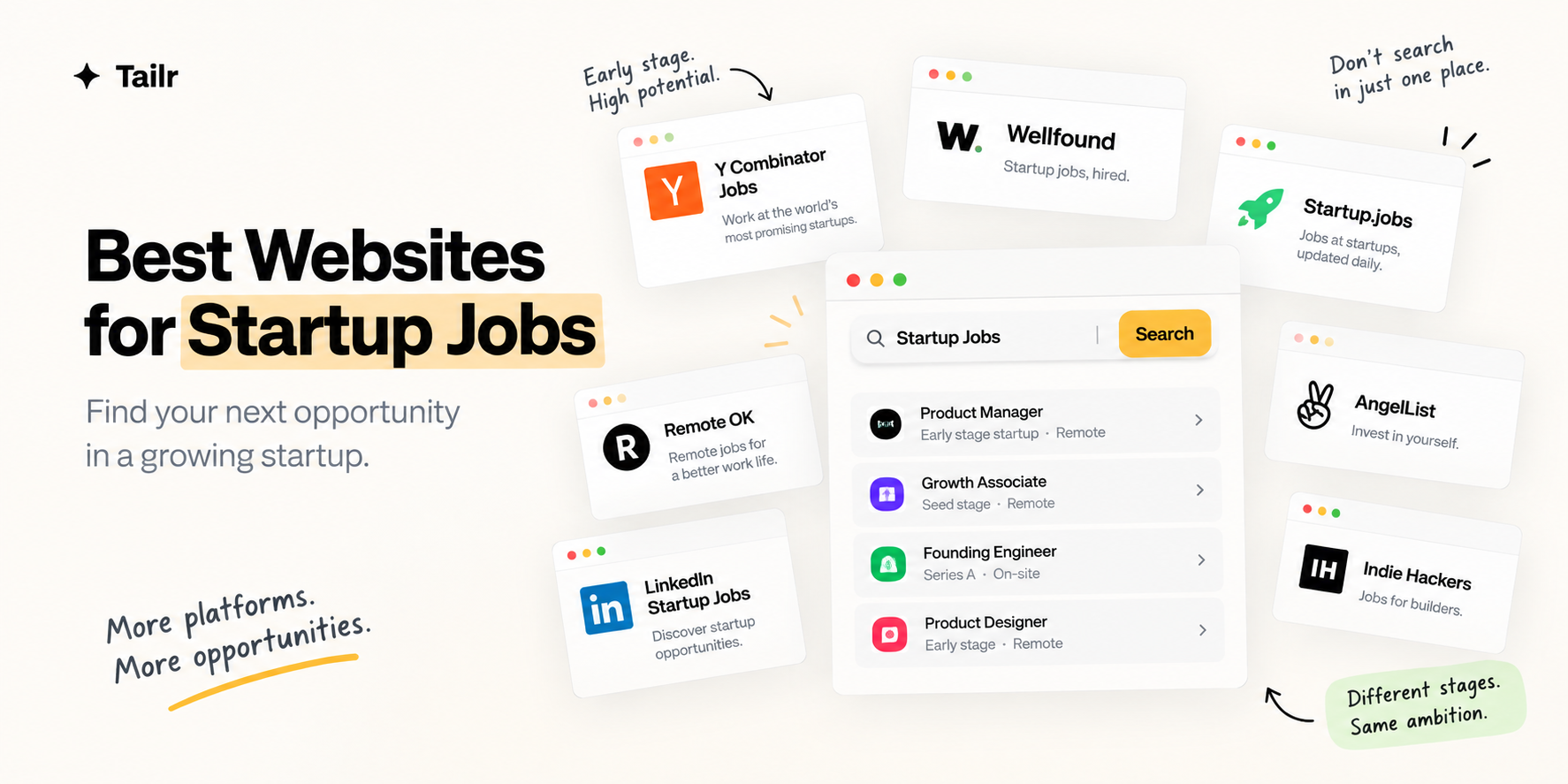
Finding a startup job works differently from searching for a traditional corporate role. Startups post openings on dedicated startup job boards, their own career pages, professional networks, and even founder communities, so knowing where to look saves a lot of time.
The short answer: the best websites for startup jobs in 2026 are:
- Wellfound (wellfound.com)
- Y Combinator Jobs (ycombinator.com/jobs)
- Startup Jobs (startup.jobs)
- Built In (builtin.com)
- Hacker News “Who is hiring?” threads (news.ycombinator.com)
- LinkedIn Jobs (linkedin.com/jobs)
- Remote OK (remoteok.com)
- Welcome to the Jungle (welcometothejungle.com)
Add the career pages of any specific startups you want to work for, and tailor each application to the listing; Tailr does that from the job page you’re viewing.
Whether you’re after an early-stage company, a remote startup role, a founding position, or simply somewhere smaller and faster-moving, here’s what each platform is good for and how to choose between them.
Why use startup job websites?
Large job boards can be useful, but they aren’t the easiest way to discover startup opportunities. Startup listings get buried under thousands of corporate roles, and the filters rarely tell you anything about company stage or equity.
Startup-focused platforms make it easier to find companies by:
- Company stage (pre-seed, seed, Series A, and so on)
- Location and remote availability
- Role and function
- Industry
- Compensation, including salary and equity, on some listings
They also help you discover smaller companies you’d never come across through a general search.
You don’t need to use every platform on this list. Pick the ones that match the type of startup and role you’re looking for.
1. Wellfound
Website: wellfound.com
Wellfound (formerly AngelList Talent) is the most recognizable startup-focused job platform. It lists more than 130,000 remote and local startup jobs and lets you search by job title and location.
The platform covers a wide range of startup roles, including engineering, product, design, marketing, sales, finance, and operations. Many listings show salary, equity, company size, workplace type, and startup stage up front, which saves you a lot of guesswork.
Why use it: Wellfound is the best option when you want to search specifically within the startup ecosystem rather than sorting through a general job board. You can filter by stage to find early-stage startups and narrow down to remote opportunities.
Best for: Startup-focused roles across product, engineering, design, marketing, sales, and operations.
2. Y Combinator Jobs
Website: ycombinator.com/jobs
Y Combinator’s official job board is built specifically for roles at YC-backed startups.
It features thousands of startup jobs across engineering, product, design, recruiting, sales, science, and other functions. You can create a single profile and apply to multiple startup roles through it, and browse by location, including remote roles and hubs such as San Francisco, New York, London, and Bengaluru.
Why use it: If you’re specifically interested in companies that have gone through Y Combinator, this gives you a focused way to discover them without searching the entire job market. YC companies also tend to be well documented, so you can research each one before you apply.
Best for: People looking specifically for jobs at Y Combinator-backed startups.
3. Startup Jobs
Website: startup.jobs
Startup Jobs is a job board built entirely around startup hiring.
Instead of mixing startup listings with every type of company, it focuses on opportunities across engineering, product, design, marketing, sales, and operations. You can browse roles by location, job type, experience level, and other characteristics.
Why use it: If your search is simply “I want to work at a startup,” this is the kind of board worth checking, because the entire site is centred on startup opportunities.
Best for: General startup job searches across different functions and experience levels.
4. Built In
Website: builtin.com
Built In focuses heavily on technology companies and tech-related careers, which makes it useful whether you’re looking at startups, scale-ups, or larger technology companies.
You’ll find roles across engineering, product, data, AI, design, marketing, sales, and other functions, and it has strong coverage of specific US tech hubs such as Austin, Boston, Chicago, Los Angeles, New York, and Seattle.
Why use it: You don’t have to limit yourself to very early-stage startups. If you’re interested in startups but also want access to the broader technology job market as your search widens, Built In covers both.
Best for: Technology, product, engineering, AI, data, and design roles.
5. Hacker News “Who is hiring?”
Website: news.ycombinator.com
Hacker News isn’t a traditional job board, but its recurring “Ask HN: Who is hiring?” threads are worth knowing about if you’re looking for startup or technical roles. A new thread is posted on the first weekday of every month.
Companies and hiring teams post open positions directly in the thread, usually with the location, remote policy, tech stack, and the type of candidate they’re looking for. The format is much simpler than a job board, and that’s part of its appeal. You’ll come across companies and roles that never make it into the usual job-search experience.
Why use it: It’s particularly useful for technical candidates who want to hear about roles directly from the founders and engineers doing the hiring. You can often email the person who wrote the post.
Best for: Software engineers, technical professionals, and anyone interested in early-stage startups.
6. LinkedIn Jobs
Website: linkedin.com/jobs
LinkedIn isn’t a startup-specific job board, but it’s too important to leave out.
Startups use LinkedIn to advertise roles, build their employer presence, and find candidates. You can also use it to research the company and the people working there before you apply, which makes it particularly useful because the job search and networking happen in the same place.
Try searching for terms such as:
- Founding Engineer
- Founding Product Manager
- Product Manager
- Growth Product Manager
- Product Designer
- Startup Operations
- Growth Associate
You can also search for a specific company and check its open roles, or filter by company size to focus on smaller teams.
Best for: Startup discovery, networking, and finding roles posted by companies of all sizes.
7. Remote OK
Website: remoteok.com
If working remotely is one of your main requirements, Remote OK is worth checking.
Unlike the platforms above, Remote OK is remote-focused rather than startup-exclusive. That means you’ll find opportunities from all kinds of companies, including plenty of startups, and it’s particularly strong for technical and digital roles.
Why use it: Instead of searching startup websites and filtering for remote jobs, you can start with the remote requirement and then identify interesting companies from there.
Best for: Remote roles, particularly technology and digital jobs.
8. Welcome to the Jungle
Website: welcometothejungle.com
Welcome to the Jungle is worth exploring if you’re interested in startups and technology companies, particularly in European markets such as France, the UK, Germany, and Spain.
The platform combines job listings with detailed company profiles, including team photos, interviews, and descriptions of how each company works. That makes it useful when you want to understand the company behind the listing before you apply.
Best for: Technology, startup, and scale-up roles, particularly in Europe.
9. Startup career pages
Sometimes the best place to find a startup job isn’t a job board at all.
If there are specific startups you’d like to work for, go directly to their websites and check their careers or jobs page. This is especially useful for startups you’ve discovered through:
- Product Hunt
- Y Combinator’s company directory
- Startup communities and Slack or Discord groups
- Tech news and newsletters
- Founder networks
- Industry research
A startup may post a role on its own careers page and never syndicate it to a job board, especially when the team is small. So if there’s a company you genuinely want to join, don’t stop at the job boards.
Best for: Targeting specific startups.
Which startup job website should you use?
You don’t need to create accounts on every website. Choose platforms based on what you’re actually looking for.
| If you’re looking for… | Try… |
|---|---|
| Startup jobs in general | Wellfound, Startup Jobs |
| Y Combinator startups | Y Combinator Jobs |
| Technology startups | Wellfound, Built In, LinkedIn |
| Remote opportunities | Wellfound, Remote OK |
| Technical startup roles | Hacker News, Wellfound |
| European startup roles | Welcome to the Jungle |
| A specific startup | Company career page |
| Networking and job discovery |
Using two or three focused platforms is usually more useful than checking every job board every day.
How to find startup jobs more efficiently
Once you know where to look, keep your search simple.
Start with the role you’re interested in, then narrow it down by company stage, location, experience level, or remote preference. Set up alerts where the platform offers them so new listings come to you.
When you find a position that looks relevant, read the job description carefully before applying. Look at:
- The core responsibilities
- Required skills
- Tools and technologies
- Experience requirements
- Location and work arrangement
- What the company is actually building
Then make sure your application reflects the parts of your experience that are genuinely relevant. Startups often hire for a specific problem, so a resume that clearly connects your experience to that problem stands out.
You don’t need to rewrite your entire career history for every job. You just need to make the most relevant experience easy to find. If you want a step-by-step process, read how to tailor your resume to a job description.
Should you apply directly through startup job boards?
Yes, if the listing provides an application route.
It’s still worth checking the company’s own website before applying, particularly if you’re genuinely interested in the company. The careers page may give you extra context about the team, other open positions, or the application process.
For smaller startups, it also helps to look up the founders and hiring team on LinkedIn to understand the company and its hiring context before applying. A short, specific note to the founder can go a long way at a ten-person company.
Whatever you do, keep your application honest. Startups check references and ask detailed questions in interviews, so stick to experience you can back up. Here’s how to tailor your resume without lying.
Tailor your resume once you’ve found the right startup job
Finding the right startup job is only the beginning.
Once you’ve found a role you’re interested in, your resume should make the connection between what the company needs and what you’ve already done as clear as possible.
That’s where Tailr comes in. Tailr is a Chrome extension that lets you tailor your resume directly from the job listing you’re viewing, whether that’s on Wellfound, LinkedIn, or a company’s own careers page. You can also generate a cover letter and track your applications from the same place.
Find a job → tailor your resume → generate a cover letter → apply → track your application
You still review every change before you apply. Tailr works from your real resume, so it helps you position what you have rather than making things up.
Try TailrRelated guides
- Best Way to Find Jobs in 2026
- Best Sites for Your Next Job Search in 2026
- Top 10 Places to Find Jobs Online in 2026
- Best Job Boards for Tech Jobs in 2026
Conclusion
Startup jobs can be found in more places than traditional job boards.
If you’re specifically looking for startups, start with Wellfound, Y Combinator Jobs, and Startup Jobs. For technology-focused opportunities, add Built In and LinkedIn. If you’re looking for remote or technical roles, Remote OK and Hacker News are worth checking as well. And if there’s a particular startup you’d love to join, go directly to its careers page.
The goal isn’t to search every website or apply to every opening. Find the companies and roles that actually fit what you’re looking for, then make your application relevant to them.
Frequently asked questions
01What are the best websites for startup jobs?
Wellfound, Y Combinator Jobs, Startup Jobs, Built In, LinkedIn, Hacker News, and Remote OK are the most useful places to start. The right platform depends on the type of startup, role, location, and work arrangement you are looking for.
02Where can I find jobs at early-stage startups?
Wellfound and Y Combinator Jobs are the best starting points for early-stage roles because both let you filter by company stage or funding. Startup-focused job boards and company career pages can also surface smaller companies that never appear on general job boards.
03Where can I find remote startup jobs?
Wellfound and Remote OK are the best places to start when remote work is a priority. Wellfound lets you filter startup listings by remote availability, and Remote OK is built entirely around remote roles. Always check the timezone and location requirements on each individual listing.
04Are startup job boards free for job seekers?
Yes. Wellfound, Y Combinator Jobs, Startup Jobs, Built In, Hacker News, Remote OK, and LinkedIn all let candidates browse and apply for jobs without paying. Some offer optional paid features, so check the current terms of each platform because these can change.
05Should I use LinkedIn to find startup jobs?
Yes. LinkedIn is not startup-specific, but most startups use it for hiring. It is also the easiest place to research founders, employees, and hiring managers before you apply, so the job search and networking happen in the same place.
06Should I tailor my resume for a startup job?
Yes. Startups often hire for a specific problem, so compare your resume with the job description and make the relevant experience, skills, and results easy to find. Tailoring should reflect experience you genuinely have rather than adding skills or achievements you do not.