Best Job Boards for Tech Jobs in 2026
· updated
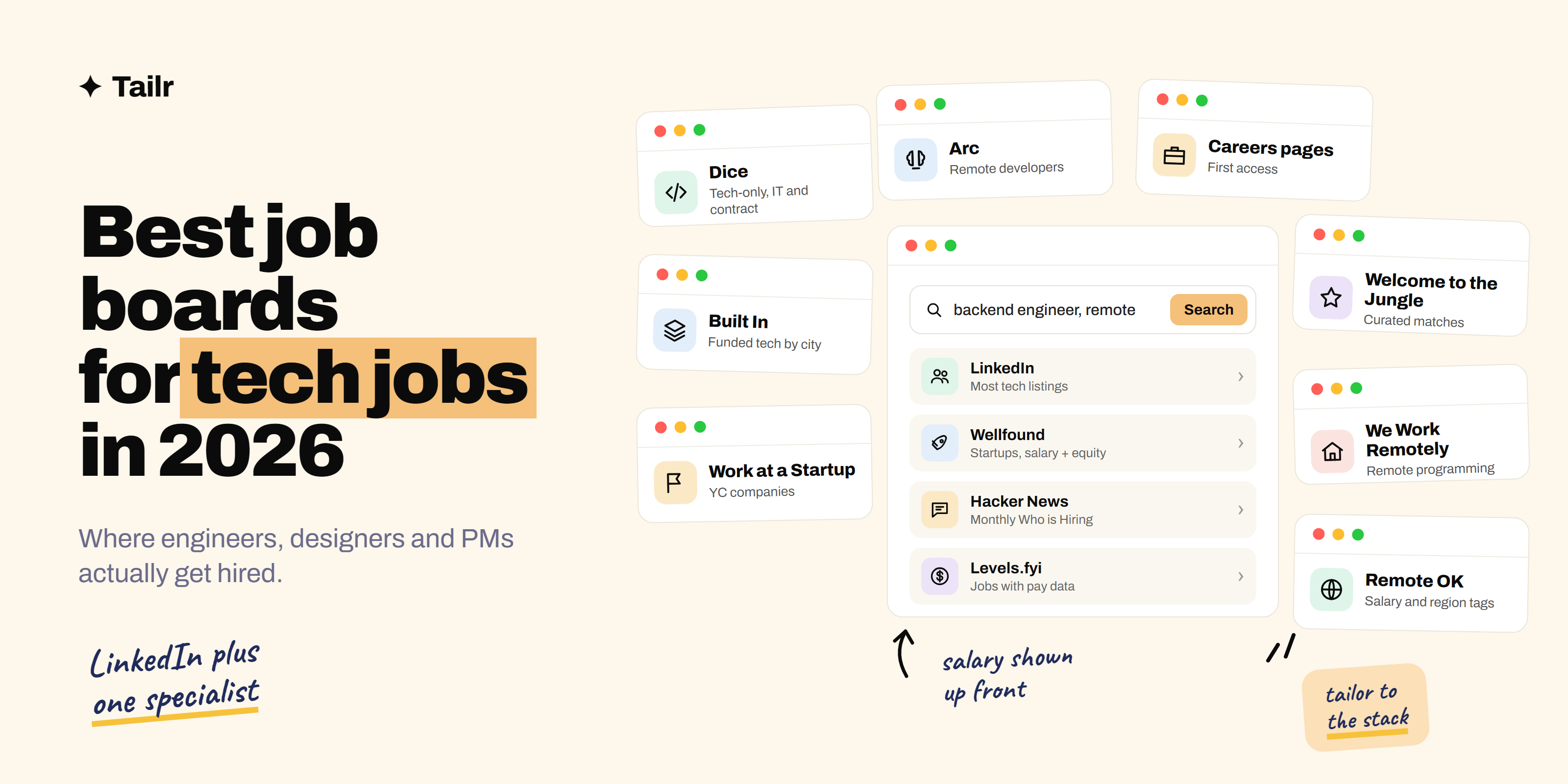
Tech job searches have a noise problem. General boards bury engineering roles under thousands of unrelated listings, recruiters repost the same role five times, and popular postings collect hundreds of applicants in days. The right tech job boards cut through that: better filters for stack and seniority, more transparent pay, and often a direct line to the person hiring. These are the best ones in 2026, what each is good for, and how to combine them.
The short answer: Use LinkedIn for the largest volume of tech listings, then add one or two specialists:
- Wellfound and Y Combinator’s Work at a Startup: startup roles.
- Built In: funded tech companies by city.
- Dice: IT, contract and enterprise roles.
- Levels.fyi: pay transparency.
- Hacker News’ monthly Who is Hiring thread: direct access to founders and engineering leads.
- Welcome to the Jungle: curated, well-matched roles.
- We Work Remotely, Remote OK and Arc: remote tech jobs.
Set alerts on two or three, apply early, and tailor every application to the listing’s stack. Tailr does the tailoring from the job page you’re viewing.
What makes a good tech job board
- Filters that fit tech roles: stack, seniority, remote, contract vs. full-time.
- Real, current listings, not reposts from agencies or roles that closed months ago.
- Pay transparency: salary and equity ranges on the listing.
- Direct access: applying to the company, or better, to the hiring manager.
- The right companies for you: big tech, startups, enterprise or agencies, depending on what you want.
1. LinkedIn
Website: linkedin.com/jobs
The largest source of tech listings anywhere, from big tech to seed-stage startups. Filter by title, experience level, remote and date posted, and set alerts for exact titles like “Backend Engineer” or “Data Analyst”. The noise is high and applicant counts are the highest of any board, but the listings are real and the company research is built in.
Why use it: volume, plus the ability to find and message the hiring manager or an engineer on the team.
Best for: everyone in tech, as the base board. How to tailor a resume for LinkedIn jobs covers applying well there.
2. Wellfound
Website: wellfound.com
The biggest startup job platform (formerly AngelList Talent), with a large share of engineering, product, design and data roles. Most listings show salary and equity ranges, company stage and team size, and you can often apply straight to founders with one profile.
Why use it: startup roles with pay visible before you apply.
Best for: engineers, PMs and designers who want to work at startups. Best websites for startup jobs covers it in more depth.
3. Y Combinator’s Work at a Startup
Website: workatastartup.com
Y Combinator’s own job board for roles at YC-backed companies. You make one profile, browse companies by stage and role, and message founders directly. Many of the companies are small, so you’re often talking to the person who’ll be your manager.
Why use it: direct founder access at vetted startups, with salary and equity usually shown.
Best for: engineers who want early-stage startup roles.
4. Built In
Website: builtin.com
A tech job board and company directory focused on funded tech companies, with city-specific hubs for major US tech markets as well as remote roles. Company profiles cover tech stack, benefits and culture, and many listings show salary ranges.
Why use it: research and listings in one place, filtered to real tech companies rather than every employer with an IT department.
Best for: engineers, data, product and design people targeting growth-stage and established tech companies, especially in the US.
5. Dice
Website: dice.com
A tech-only job board since 1990, with filters by skill, employment type (full-time, contract, contract-to-hire) and remote. It’s strongest for IT, infrastructure, cybersecurity, data, and enterprise and consulting roles, and has a lot of contract work.
Why use it: a tech-only board where your skills are the main filter, with deep coverage of contract and enterprise roles.
Best for: IT professionals, security and infrastructure engineers, and contractors.
6. Hacker News “Who is Hiring?”
Website: news.ycombinator.com
A thread posted on the first weekday of each month where companies, many of them startups, post roles directly in the comments, usually with location, remote status, stack and a contact. There’s also a “Who wants to be hired?” thread where you can post your own profile.
Why use it: posts come straight from founders and engineering leads, with no recruiter in between. Emailing the poster with a short, specific note works well here.
Best for: software engineers, especially those interested in startups and remote roles.
7. Levels.fyi Jobs
Website: levels.fyi/jobs
Levels.fyi started as a compensation and levelling database for tech companies and now has a job board alongside it. You can see what a role is likely to pay at that level, compare offers, and filter listings with that context.
Why use it: pay transparency. You know what a level pays at a company before you apply, which also helps in negotiation later.
Best for: mid-level and senior engineers comparing big tech and well-funded companies.
8. Welcome to the Jungle
Website: welcometothejungle.com
A job platform that absorbed Otta, the curated tech job board. You set preferences (role, stack, salary, company size, values) and it recommends matching roles, mostly at vetted, venture-backed companies. Company pages include team photos, interviews and benefits.
Why use it: curated matches instead of endless scrolling, with good company insight.
Best for: tech workers in the US, UK and Europe who want a shortlist rather than a firehose.
9. Remote tech job boards
Website: weworkremotely.com, remoteok.com, arc.dev
- We Work Remotely, the largest remote-only board, with a strong programming category.
- Remote OK, tech- and startup-heavy, with salary and location tags.
- Arc, focused on remote developer roles, including full-time and freelance work with companies hiring internationally.
Why use them: genuinely remote roles with eligibility stated up front.
Best for: developers who want remote work. Best remote job boards compares twelve of them.
10. Company careers pages and the ATS search trick
Website: the company’s /careers page
Every role is listed on the company’s own site first. Most tech companies host their job pages on applicant tracking systems, so a Google search like site:boards.greenhouse.io "backend engineer" remote or site:jobs.ashbyhq.com "data engineer" surfaces roles across thousands of companies at once, including some that aren’t on the big boards.
Why use it: first access, and your application lands directly in the company’s system.
Best for: anyone with a target list of companies.
Regional boards worth adding
If you’re searching outside the US, add a local board. In India, Naukri (naukri.com) has the largest volume and Instahyre (instahyre.com) focuses on tech and startup roles. In the UK and Europe, Welcome to the Jungle and local LinkedIn searches cover most tech roles. Local boards often list roles at mid-sized companies that never advertise internationally.
Tech job boards compared
| Board | Focus | Salary shown | Direct contact | Best for |
|---|---|---|---|---|
| All tech, all sizes | Sometimes | Via messaging | Volume, networking | |
| Wellfound | Startups | Usually, with equity | Often founders | Startup roles |
| Work at a Startup | YC startups | Usually | Founders | Early-stage engineering |
| Built In | Funded tech companies | Often | No | US tech hubs, research |
| Dice | Tech-only, IT and contract | Sometimes | Recruiters | IT, security, contract |
| Hacker News | Startups, remote | Sometimes | Poster directly | Engineers, direct outreach |
| Levels.fyi | Big tech and funded cos | Yes, with pay data | No | Mid/senior, comparing offers |
| Welcome to the Jungle | Curated tech | Often | No | Shortlist of matches |
| Remote boards | Remote tech | Often | Varies | Remote developers |
| Careers pages | Target companies | Varies by location | No | First access |
How to search efficiently
- Pick LinkedIn plus one or two specialists. Wellfound or Work at a Startup for startups, Built In or Levels.fyi for established companies, Dice for IT and contract, a remote board if you want remote.
- Set alerts for exact titles and your stack, such as “React”, “Go”, “dbt” or “Kubernetes”.
- Apply in the first few days. Popular tech roles get hundreds of applicants within a week.
- Tailor for the stack. A listing asking for Python, Airflow and AWS should see those tools in your top bullets, in the context where you used them, not just in a skills list. Tailr does this from the listing you’re viewing, pulling your matching experience to the top.
- Lead with impact. Latency cut, cost saved, users served, revenue or time saved. Numbers beat duties.
- Reach out after applying. A short note to the hiring manager or an engineer on the team, mentioning one relevant result.
Resume keywords and how to tailor your resume to a job description go deeper on matching a listing.
Where Tailr fits
Tech listings are specific: this stack, this scale, this kind of problem. A generic resume misses most of that. Tailr is a browser extension that tailors your resume to the tech listing you’re viewing, on LinkedIn, Wellfound, a company careers page or most job sites. It puts the tools, projects and results that match the role first, and uses the listing’s terms where they’re true, without adding skills you don’t have. It also drafts a cover letter and tracks your applications across boards. Try Tailr on the next tech job you open.
Related guides
- Best Way to Find Jobs in 2026
- Best Sites for Your Next Job Search in 2026
- Top 10 Places to Find Jobs Online in 2026
Conclusion
The best job boards for tech jobs are LinkedIn for volume, Wellfound and Work at a Startup for startups, Built In and Levels.fyi for established tech companies and pay transparency, Dice for IT and contract roles, Hacker News for direct founder contact, and remote boards if you want to work remotely. Use two or three, set alerts for your stack, apply early and tailor every resume to the listing. That’s what gets a tech application read.
Frequently asked questions
01What is the best job board for tech jobs?
LinkedIn has the most tech listings overall, so it's the one board almost everyone should use. Pair it with a specialist: Wellfound or Work at a Startup for startups, Built In for funded tech companies by city, Dice for tech-only listings, or Levels.fyi if pay transparency matters most. Two or three boards is plenty.
02Which job board is best for software engineers?
For software engineers, LinkedIn plus one or two of Wellfound, Work at a Startup, Levels.fyi and Hacker News' monthly Who is Hiring thread covers most opportunities. Hacker News and Work at a Startup are especially good because you often reach founders or engineering leads directly.
03Where can I find entry-level tech jobs?
LinkedIn and Indeed with the entry-level filter, Wellfound (many startups hire juniors), Built In's company listings, and university career portals are good starting points. Company careers pages and new-grad programs at larger companies often open in late summer and autumn, so set alerts early.
04Is Dice still worth using in 2026?
Yes, especially for IT, contract and enterprise roles. Dice has focused on tech jobs since 1990, lets you filter by skills and employment type, and is strong for roles like systems administration, cybersecurity, data and consulting. It's less useful for early-stage startup jobs.
05Which tech job boards show salaries?
Wellfound shows salary and equity ranges on most listings, Levels.fyi pairs its job listings with real compensation data, and Built In often shows salary ranges too. In many US states and some other countries, pay transparency laws also require ranges on listings, so LinkedIn and Indeed increasingly show them as well.
06How do I stand out when applying for tech jobs?
Tailor your resume to each listing's stack and responsibilities, lead with measurable impact (latency cut, revenue, users, time saved), link to real work like GitHub or a portfolio, and apply within the first few days of posting. Reaching out to the hiring manager or an engineer on the team after applying also helps a lot.