Best Remote Job Boards in 2026
· updated
Remote roles attract several times more applicants than local ones, and a lot of what’s posted as “remote” is remote within one country, one time zone, or one afternoon a week. The right job board fixes both problems: it filters for genuinely remote work, tells you whether you’re actually eligible, and keeps the scams out. These are the twelve worth using in 2026, what each is good for, and how to combine them.
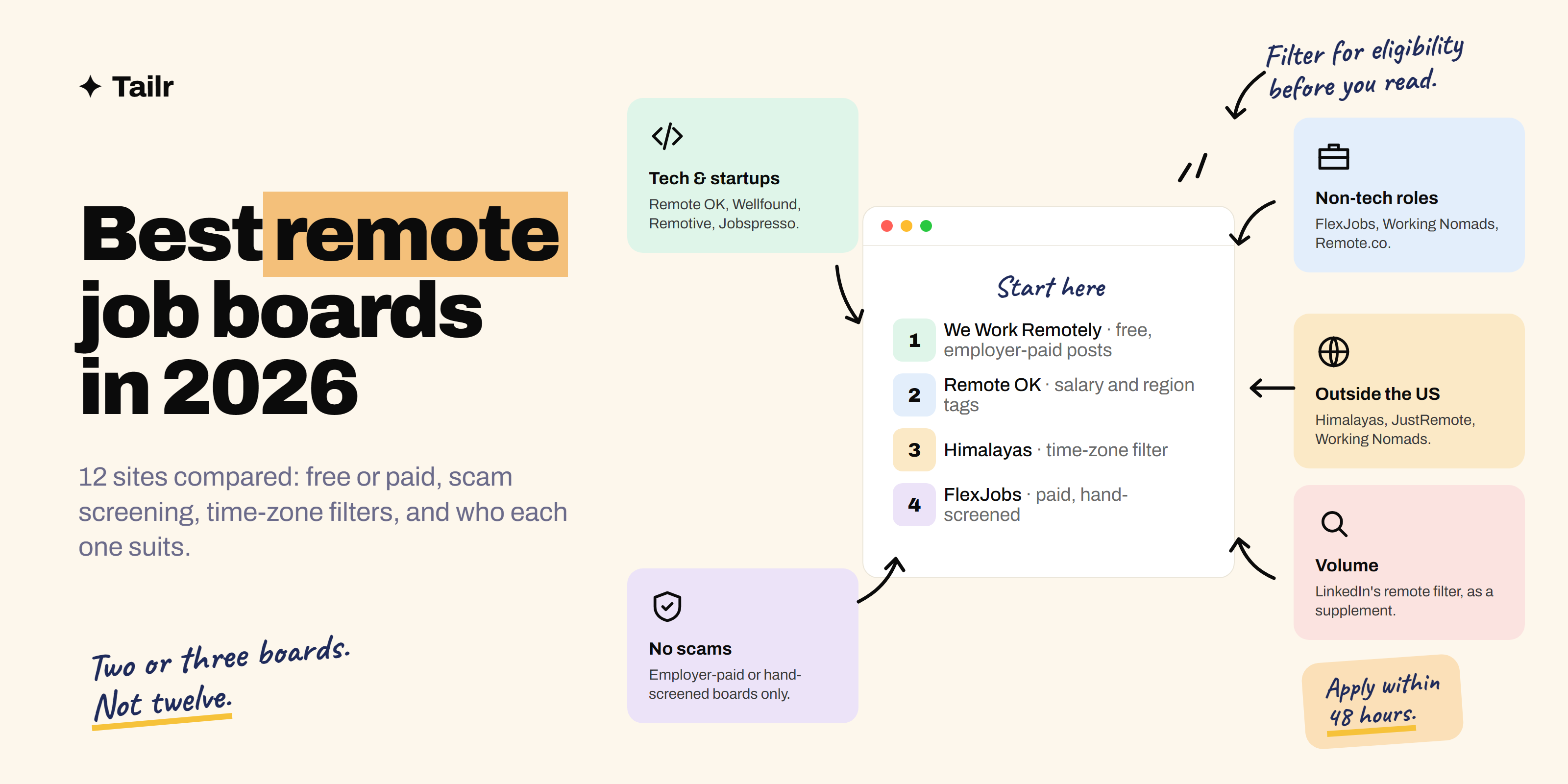
The short answer: the best remote job boards, and what each is for:
- We Work Remotely and Remote OK: the two highest-traffic remote-only boards, free to search.
- Himalayas: time-zone and eligibility filters.
- Remotive or Working Nomads: a second stream of tech and worldwide roles.
- FlexJobs: screened listings, worth paying for if you want non-tech roles or have been burned by scams.
- Wellfound: remote startup roles.
- LinkedIn’s remote filter: volume.
Set alerts on two or three boards, apply within 48 hours of a posting, and tailor every application, because a remote listing’s applicant count makes the generic resume invisible. Tailr tailors it from the listing you’re viewing.
What makes a remote job board good
- Genuinely remote listings, with the restrictions stated: worldwide, country-only, or time-zone-bound.
- Employer-paid posting or hand screening, which keeps scams and stale listings out.
- Useful filters: time zone, country, salary, role type, company size.
- Freshness. Many remote roles fill within 48 hours. A board with alerts and a clear posting date matters.
- Enough volume in your field. Tech is easy; marketing, operations, support and finance need boards that cover them.
1. We Work Remotely
Website: weworkremotely.com
The largest remote-only job board by traffic, running since 2013. Employers pay a few hundred dollars per post, which keeps the listings serious, and there’s no account or paywall for job seekers. Categories cover programming, design, customer support, marketing, sales, product, finance and management, and each listing states the region it’s open to.
Why use it: the best free starting point. High volume, low junk, clear regional restrictions, and an RSS feed and email alerts so you see new roles the day they appear.
Best for: anyone, in any function, as the first board to set alerts on.
2. Remote OK
Website: remoteok.com
A remote-only board with a strong tech and startup skew, though it lists non-tech roles too. Listings show posting date, salary range (self-reported by employers) and often the location restriction as a tag, so you can filter for “worldwide” and skip the ones you can’t apply for. Employers pay to post.
Why use it: fast, filterable, and honest about eligibility. Salary tags mean you can skip roles that won’t pay what you need before you spend time on them.
Best for: engineers, designers, product and marketing people at startups and remote-first companies.
3. Himalayas
Website: himalayas.app
The best of the newer boards, with a large volume of live roles and the most useful filters of the group: time zone overlap, country eligibility, salary, and company. Each company has a profile with its remote policy, benefits and tech stack. Free for job seekers.
Why use it: the time-zone filter alone saves hours. It tells you whether you’re actually eligible before you read the listing, which most boards don’t.
Best for: anyone outside the US and Europe who’s tired of applying for “remote” roles that turn out to be US-only.
4. Remotive
Website: remotive.com
A remote job board and community, tech-leaning, with roles in engineering, product, design, marketing, sales and support. Listings are categorised by region (worldwide, US, Europe, and so on) and the board is curated rather than open-post.
Why use it: a second stream alongside We Work Remotely with less overlap than you’d expect, and the community side (a Slack group, a newsletter) is useful for people new to remote work.
Best for: tech and tech-adjacent roles, especially at European and worldwide companies.
5. Working Nomads
Website: workingnomads.com
Aggregates remote roles from many sources and tags each by region. Free to search; a paid tier adds instant alerts. Categories are broad: development, design, marketing, management, sales, support, finance, legal, HR, writing.
Why use it: coverage of non-tech functions is better than most remote boards, and the worldwide filter is reliable.
Best for: non-tech roles, and people who want everything in one place with region tags.
6. FlexJobs
Website: flexjobs.com
The main paid board, and the one to use if scams or fake listings have wasted your time. Every listing is hand-screened; the catalogue covers remote, hybrid and flexible roles across fifty-plus categories, including a lot of non-tech work (customer service, education, healthcare admin, writing, accounting). The subscription is modest and there’s usually a trial.
Why use it: screening. Nothing on it is a scam, and the non-tech coverage is the widest of any remote board.
Best for: non-tech remote roles, career changers, and anyone who’d rather pay a little than filter junk.
7. Wellfound
Website: wellfound.com
The startup job platform (formerly AngelList Talent), with a large share of remote roles and a remote filter. Listings show salary, equity, company stage and size, and many companies let you apply with one profile. Free.
Why use it: remote roles at startups, with compensation and stage visible before you apply. Best websites for startup jobs covers it in more depth alongside the other startup boards.
Best for: startup roles across engineering, product, design, marketing, sales and operations.
8. Remote.co
Website: remote.co
A curated remote board from the FlexJobs group, free to search, with a smaller but clean set of listings and a large library of articles on remote companies and how they work. Categories include developer, customer service, marketing, writing, project management, HR and more.
Why use it: quality over volume, and the company profiles are useful research before an interview.
Best for: a low-noise second source, especially for support, writing and operations roles.
9. JustRemote
Website: justremote.co
A remote board with a “remote work location” filter on every listing (worldwide, or a specific region), covering development, design, marketing, product, sales, support, writing, HR and finance. Free to search; a paid feature surfaces roles that aren’t advertised on public boards.
Why use it: the location filter is explicit and the non-tech categories are well populated.
Best for: non-US applicants who want the eligibility question answered up front.
10. NoDesk
Website: nodesk.co
A long-running remote board and resource site with a curated list of remote-first companies, a job board tagged by category and region, and guides to remote work. Free.
Why use it: the company directory. Finding remote-first companies and applying on their own careers pages is often faster than waiting for a board listing.
Best for: researching which companies are remote by default, then applying directly.
11. Jobspresso
Website: jobspresso.co
A curated remote board where each listing is reviewed before it goes up, covering tech, marketing, customer support, writing and design. Free for job seekers; you can also post a resume for employers to search.
Why use it: curation and a manageable volume. It’s a good board to check daily rather than drown in.
Best for: tech, marketing and support roles at remote-first companies.
12. LinkedIn (remote filter)
Website: linkedin.com/jobs
Not a remote board, but the largest volume of remote listings anywhere once you filter by “Remote” and set alerts for specific titles. The noise is high and the applicant counts are the highest of any source, but the listings are real and the company research is built in.
Why use it: volume, and the ability to find and message the hiring manager or a current employee after you apply.
Best for: anyone, as a supplement to a remote-only board, never as the only source.
Remote job boards compared
| Board | Cost | Scam screening | Region filter | Strongest for |
|---|---|---|---|---|
| We Work Remotely | Free | Employer-paid posting | Yes | All functions, first alerts |
| Remote OK | Free | Employer-paid posting | Yes, with salary tags | Tech and startups |
| Himalayas | Free | Curated | Time zone and country | Non-US applicants |
| Remotive | Free | Curated | Yes | Tech, Europe, worldwide |
| Working Nomads | Free (paid alerts) | Aggregated | Yes | Non-tech breadth |
| FlexJobs | Paid | Hand-screened | Yes | Non-tech, no scams |
| Wellfound | Free | Company-verified | Yes | Startups |
| Remote.co | Free | Curated | Partial | Low-noise second source |
| JustRemote | Free (paid extras) | Curated | Explicit | Non-US applicants |
| NoDesk | Free | Curated | Yes | Company research |
| Jobspresso | Free | Reviewed | Partial | Tech and marketing |
| Free | None | Remote flag only | Volume and networking |
How to search efficiently
- Pick two or three boards, not twelve. We Work Remotely plus Remote OK plus one that fits your situation (Himalayas if you’re outside the US, FlexJobs if you’re non-tech, Wellfound if you want startups).
- Set alerts for two or three exact titles. New remote roles fill fast; being in the first day of applicants matters more than on local roles.
- Filter for eligibility before reading. Worldwide, your country, or your time zone. Skip anything that doesn’t say.
- Apply on the company’s own site when you can. Boards link out; the direct application is often tracked better and is scam-proof.
- Tailor every application. A remote listing gets several times the applicants of a local one. The resume that matches the listing’s language and priorities is the one that survives the first screen; the generic one doesn’t. Tailr tailors your resume from the remote listing you’re viewing, so matching every application takes minutes.
- Show remote readiness. Written communication, asynchronous work, tools (Slack, Notion, Linear, Loom), and any time you’ve worked across time zones. Put it in the summary and the bullets.
- Check the company exists. A website, real employees on LinkedIn, a posting on their own careers page. Never pay for anything.
Where Tailr fits
Remote roles are the most competitive listings there are, and the difference between the fifteenth applicant and the four-hundredth is usually whether the resume looks like it was written for that job. Tailr tailors your resume to the specific listing you’re viewing, on any of the boards above, so the skills, tools and remote-work evidence the listing asks for are the ones your resume leads with, and generates a matching cover letter. It also tracks the applications, which matters when you’re applying across several boards. How to tailor your resume to a job description explains the method, and top AI tools for job search covers the rest of the toolkit. Try Tailr on the next remote listing you open.
Related guides
- Best Way to Find Jobs in 2026
- Best Sites for Your Next Job Search in 2026
- Top 10 Places to Find Jobs Online in 2026
- Best Job Boards for Tech Jobs in 2026
Conclusion
The best remote job boards are the ones that show you real, current, genuinely remote roles you’re eligible for, without scams: We Work Remotely and Remote OK for most people, Himalayas for eligibility filters, FlexJobs for screened non-tech roles, Wellfound for startups, and LinkedIn for volume. Set alerts on two or three, filter for eligibility first, apply within 48 hours, and tailor every application, because on a remote listing that’s what gets you read.
Frequently asked questions
01What is the best website for remote jobs?
For most people, We Work Remotely and Remote OK are the two to start with: the highest traffic of any remote-only boards, free to search, and paid for employers to post, which keeps out most junk. Himalayas is the best of the newer boards, with time-zone filters that show whether you're eligible. FlexJobs is worth paying for if you've been burned by scams or want non-tech roles. Use two or three, not ten.
02Are remote job boards free?
Most are free for job seekers; employers pay to post. We Work Remotely, Remote OK, Himalayas, Remotive, Working Nomads, Wellfound and the LinkedIn remote filter cost nothing. FlexJobs is the main paid one, and the subscription buys hand-screened listings with no scams, which some people find worth it for non-tech roles.
03How do I avoid remote job scams?
Apply through the company's own careers page rather than a link in a message, never pay for equipment, training or a background check, be suspicious of interviews conducted entirely over chat, and check the company exists with real employees on LinkedIn. Boards that charge employers to post (We Work Remotely, Remote OK) or hand-screen listings (FlexJobs) have far fewer scams than free-to-post boards and social media.
04Can I get a remote job from India or another country?
Yes, but read the listing carefully. Many 'remote' roles are limited to one country or a set of time zones for legal, payroll or overlap reasons. Boards that show time-zone and location eligibility up front (Himalayas, Remote OK, Working Nomads) save a lot of wasted applications. Filter for 'worldwide' or 'anywhere', and expect companies that hire globally to use an employer-of-record service or contractor arrangements.
05How do I stand out when applying for remote jobs?
Remote roles get several times more applications than local ones, so the generic resume doesn't survive the first screen. Tailor the resume and cover letter to each listing, show evidence of working asynchronously (written communication, self-management, tools like Slack, Notion, Linear), and apply within the first day or two of a posting, because many roles fill within 48 hours.
06Is LinkedIn good for remote jobs?
It has the largest volume of remote listings anywhere, but also the most noise and the most applicants per role. Use the remote filter plus alerts for specific titles, and treat it as one source alongside a remote-only board. Its real strength is finding the hiring manager or a current employee to message after you apply.