Product Sense Interview Questions: How to Answer With Examples
· updated
The product sense interview is where many product manager candidates win or lose the offer. There’s no right answer to “design an app for dog owners” or “how would you improve Spotify”, which makes it feel open-ended and hard to prepare for. But interviewers are scoring a fairly predictable set of skills, and there’s a structure that lets you show all of them. This guide covers the common questions, a step-by-step framework, a full worked example and the mistakes to avoid.
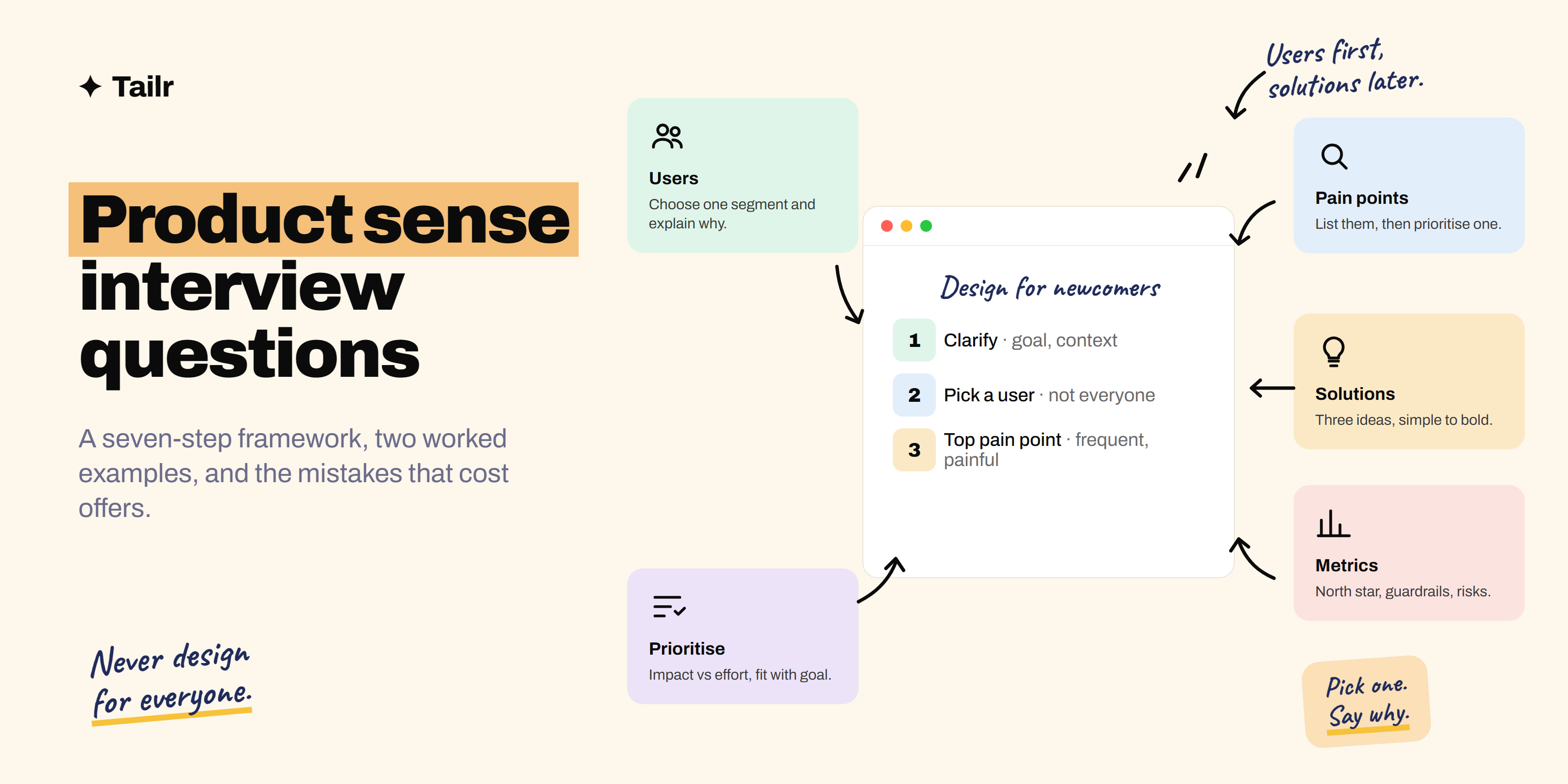
The short answer: product sense questions test whether you can figure out what to build for users. Answer them in seven steps:
- Clarify the goal, the product’s context and any constraints.
- Pick a user segment and explain why that segment.
- Identify pain points for that user and prioritise the most important one.
- Brainstorm solutions: three or more, from simple to bold.
- Prioritise one solution with clear reasoning (impact vs effort, fit with the goal).
- Describe the experience: the core flow a user would go through.
- Define success metrics and name the main risks.
Think out loud, check in with the interviewer at each step, and be decisive.
What interviewers are scoring
Product sense interviews usually assess:
- User empathy: do you think about real people and their real problems?
- Structured thinking: can you take a vague prompt and make it manageable?
- Creativity: can you come up with ideas beyond the obvious?
- Prioritisation and judgement: can you choose, and explain why?
- Communication: is your reasoning easy to follow?
- Success metrics: do you know how you’d tell if it worked?
A strong answer touches all six. A weak answer usually jumps straight to a solution and skips users and prioritisation.
Types of product sense questions
1. Design a product
- Design a product for elderly people who live alone.
- Design an app to help university students find part-time jobs.
- Design a fridge for the future.
- Build a product to help people make friends in a new city.
- Design a better experience for people waiting at a hospital.
2. Improve an existing product
- How would you improve Google Maps?
- How would you improve LinkedIn for job seekers?
- What feature would you add to WhatsApp?
- How would you improve the airport experience?
- How would you increase engagement in a fitness app?
3. Favourite product
- What’s your favourite product, and why?
- Tell me about a product you think is badly designed.
- Which app do you use every day, and how would you improve it?
4. Strategy-flavoured product questions
- Should Netflix launch a social feature?
- Should Uber build a product for teenagers?
- How would you grow a food delivery app in smaller cities?
The framework, step by step
Step 1: Clarify (about 5 minutes)
Ask a few focused questions, then state your assumptions.
- What’s the goal? Growth, engagement, revenue, or a new market?
- What’s the context? Are we a startup or a big company? Is this a new product or a feature in an existing one?
- Any constraints? Platform, region, timeline?
If the interviewer says “up to you”, make a reasonable choice and say it out loud: “I’ll assume we’re a big tech company with an existing maps product and the goal is to increase weekly engagement.”
Step 2: Pick a user segment (about 5 minutes)
List three or four user groups, then choose one with a reason.
For “design a product for people moving to a new city”:
- Students moving for university
- Young professionals relocating for work
- Families with children
- Retirees moving closer to family
“I’ll focus on young professionals relocating for work, because they move often, have little time to build a social life outside work, and are willing to pay for convenience.”
Choosing a segment is one of the biggest signals of product thinking. “Everyone” is never the right answer.
Step 3: Identify and prioritise pain points (about 5 minutes)
Walk through the user’s journey and list their problems. Then choose the most important one based on how often it happens and how painful it is.
For young professionals in a new city:
- Finding a place to live quickly from far away
- Not knowing which neighbourhoods suit them
- Setting up admin (bank, phone, registration)
- Feeling lonely and not knowing anyone outside work
- Not knowing where to find good everyday services
“I’ll focus on loneliness and making friends outside work, because it’s frequent, painful, under-served by existing products, and strongly linked to whether people stay in the city.”
Step 4: Brainstorm solutions (about 5 minutes)
Give three or more ideas with different levels of ambition:
- Small-group dinners: weekly dinners matching six newcomers with similar interests.
- Interest-based activity feed: local activities (running clubs, board game nights) filtered for newcomers.
- A “neighbourhood buddy” programme: match newcomers with a long-time resident for a coffee in their first month.
- Company partnerships: employers offer the product as part of relocation packages.
Step 5: Prioritise (about 5 minutes)
Compare your ideas on a few clear criteria. A quick table works well:
| Idea | Impact on loneliness | Effort | Fits goal? |
|---|---|---|---|
| Small-group dinners | High | Medium | Yes |
| Activity feed | Medium | Low | Yes |
| Neighbourhood buddy | High | High (trust and safety) | Yes |
| Company partnerships | Indirect | Medium | Distribution, not product |
“I’d start with small-group dinners: high impact, repeatable, and they create real friendships rather than one-off events. The activity feed is a good second step. Company partnerships are a great distribution channel later.”
For more on how to prioritise, see RICE, MoSCoW and Kano: prioritization frameworks for PM interviews.
Step 6: Describe the experience (about 5–10 minutes)
Walk through the core flow, focusing on the minimum version first:
- User signs up, picks their neighbourhood and three interests.
- Every Monday, they get an invite to a Thursday dinner with five other newcomers nearby.
- They confirm; the app books the table and shares a short intro of each guest.
- After the dinner, each person can “keep in touch” with others, and mutual matches are connected.
- Over time, the app suggests follow-up activities with people they matched with.
Mention one or two details that show you’ve thought about real users: safety (verified profiles, public venues), cancellations, and what happens if someone doesn’t enjoy their group. You might call this first version an MVP.
Step 7: Metrics and risks (about 5 minutes)
- North star: monthly newcomers who’ve made at least one ongoing connection (two or more meetups with the same person).
- Supporting metrics: dinner attendance rate, “keep in touch” match rate, repeat attendance, retention after 30 and 90 days.
- Guardrails: safety reports, no-show rate.
- Risks: not enough users in one area for good matching (start with one or two cities), safety concerns (verification, public venues), and awkward dinners (light structure like conversation prompts).
For how to pick metrics like these, see what is a north star metric and DAU, MAU, retention and churn explained.
Wrap up (1 minute)
Summarise in three sentences: who, what problem, what solution and how you’d measure it. Then mention what you’d do next.
Answering “what’s your favourite product?”
This sounds easy but trips people up because they gush about a famous app without analysis. Use a mini-version of the framework:
- What it is and who it’s for.
- The problem it solves, and how people solved it before.
- Why it works: two or three specific design or business decisions that make it good.
- What you’d improve, for a specific user, with a reason.
- How you’d measure that improvement.
Pick something you genuinely use and know well. A less obvious product can be more memorable than the same three famous apps everyone mentions.
Answering “how would you improve X?”
- Clarify the goal: improve for whom, and for what business outcome?
- Describe the product’s current users and its core value.
- Pick a segment and their biggest pain points with the current product.
- Suggest solutions, prioritise one, describe it, and define metrics.
The trap is listing ten features. Interviewers want one well-reasoned improvement, not a wish list.
A second worked example, in brief: improve Google Maps
To show how the framework works on an “improve” question, here’s a condensed answer.
Clarify: “I’ll assume the goal is to increase weekly engagement among existing users, and we’re the Maps team at Google.”
Users: daily commuters, tourists, delivery and ride-share drivers, people exploring their own city. “I’ll focus on people exploring their own city, like finding somewhere to eat this weekend, because that’s frequent, social and an area where Maps competes with many other apps.”
Pain points:
- Too many options and reviews; hard to decide.
- Hard to plan with friends: links get shared in chat, opinions get lost.
- Results feel generic, not suited to personal taste.
“I’ll prioritise group planning, because deciding with friends is common, frustrating today, and keeps people coming back to Maps instead of switching to chat.”
Solutions:
- A shared shortlist where friends add places and vote.
- A “plan” view combining a shortlist, a time and directions for everyone.
- Personal taste profiles that rank places for a group.
Prioritise: “I’d build the shared shortlist with voting first. It’s simple, it builds on existing saved lists, and it solves the core problem. Plans and taste matching can come after.”
Experience: create a list, share a link in any chat, friends add places and vote with a tap, and the top choice gets one-tap directions for everyone.
Metrics: north star of weekly users who make a group decision in Maps; supporting metrics of shortlists created, friends invited per list, and the share of lists that end in a visit; guardrail of notification opt-outs.
Risks: friends without Maps accounts (allow voting from a web link), and spammy notifications (keep them minimal and user-controlled).
That’s a complete answer in about 30 minutes of interview time, and it shows every skill on the scorecard.
Common mistakes
- Jumping to solutions before understanding users.
- Designing for everyone instead of a specific segment.
- Not prioritising: listing ideas without choosing one.
- Forgetting metrics: if you can’t say how you’d measure success, the answer feels unfinished.
- Going silent: the interviewer can’t score thinking they can’t hear.
- Ignoring hints: if the interviewer nudges you in a direction, follow it.
- Being rigid: frameworks are scaffolding; adapt them to the question.
How to practise
- Do 10 to 15 full questions out loud with a timer, covering design, improve and favourite-product types.
- Practise with a partner who interrupts and asks follow-up questions.
- Write one-page summaries after each practice; your answers will get sharper.
- Analyse everyday products in spare moments: who is it for, what problem, what would I change?
- Learn the vocabulary in 10 terms you should know before a product management interview, and read what does a product manager actually do so your answers sound grounded in the real job.
Get to the product sense round
Product sense rounds usually come after a resume screen and a recruiter call. PM listings differ a lot: consumer roles stress user empathy and growth, B2B roles stress customer discovery and roadmaps, platform roles stress technical depth. Your resume should lead with the experience that matches each one.
Tailr is a Chrome extension that tailors your resume to the job listing you’re viewing, writes a matching cover letter and tracks every application, so you reach more product sense rounds.
Try TailrConclusion
Product sense interviews test whether you can turn a vague prompt into a clear product decision. Clarify, pick a specific user, prioritise their biggest pain point, brainstorm and choose a solution, describe it simply, and define how you’d measure success. Think out loud, be decisive, and practise with real questions until the structure feels natural rather than rehearsed.
Frequently asked questions
01What is a product sense interview?
A product sense interview tests how you think about building products people want. You'll be asked to design a new product, improve an existing one, or discuss a product you love. Interviewers assess how well you understand users, identify real problems, generate creative solutions, prioritise and define success.
02How do you answer product sense interview questions?
Use a structure: clarify the goal and constraints, choose a specific user segment, list and prioritise their pain points, brainstorm several solutions, pick one with clear reasoning, describe the core experience, and define success metrics and risks. Think out loud and check in with the interviewer along the way.
03What are examples of product sense questions?
Common examples include: design a product for elderly people living alone; how would you improve Google Maps; what's your favourite product and why; design an app to help people find a job; how would you improve the airport experience; and should Netflix launch a social feature. Most fall into design, improve or favourite-product types.
04What is the difference between product sense and product design questions?
They're often used interchangeably. Product sense is the broader skill of understanding users and building the right thing; product design questions are the most common way to test it, asking you to design or improve a product. Some companies use 'product design' to mean visual and UX design, so check the interview description.
05How long should a product sense answer take?
Most product sense questions take 30 to 45 minutes. A rough split is 5 minutes clarifying, 5 to 10 on users and pain points, 10 on solutions and prioritisation, 5 to 10 describing the chosen solution, and 5 on metrics and risks, leaving time for the interviewer's follow-up questions.
06How do I practise for product sense interviews?
Practise out loud with a timer, ideally with a partner who can push back. Pick everyday products and run through the framework, write down one-page answers afterwards, and study apps you use by asking who they're for, what problem they solve and what you'd change. Ten to fifteen full practice questions is a good target.