10 Terms You Should Know Before a Product Management Interview
· updated
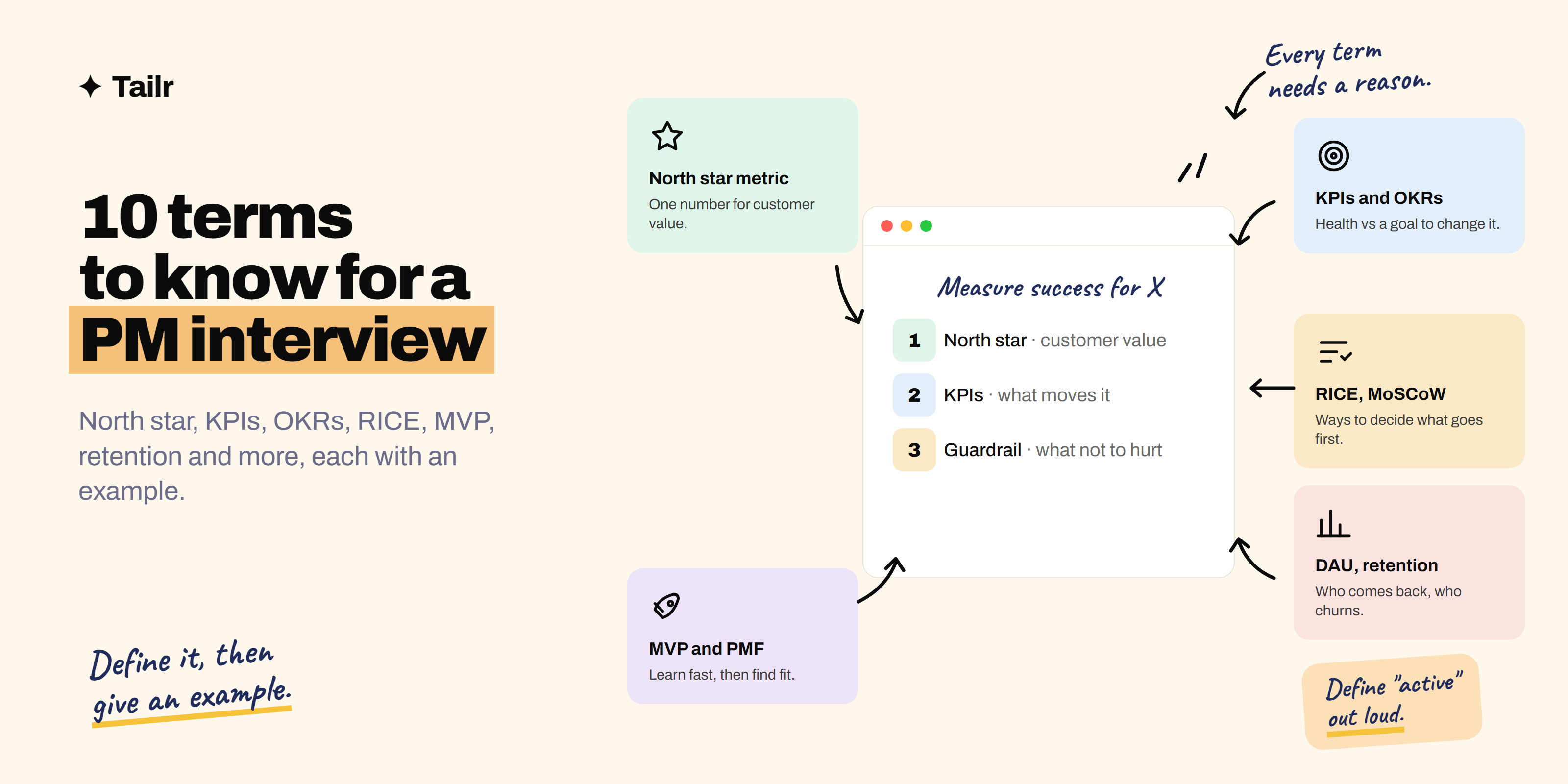
Product management interviews have their own vocabulary. Interviewers drop terms like “north star”, “RICE” and “retention curve” into questions and expect you to pick them up and run. You don’t need an MBA to keep up. You need about ten terms, understood well enough to use them with an example.
The short answer: these are the 10 terms you should know before a product management interview:
- North star metric: the one number that best measures the value customers get from your product.
- KPIs (key performance indicators): the handful of metrics that show whether you’re on track.
- OKRs (objectives and key results): a goal-setting method pairing an ambitious objective with measurable results.
- Prioritization frameworks (RICE, MoSCoW, Kano): structured ways to decide what to build first.
- MVP (minimum viable product): the smallest version of a product that tests your riskiest assumption.
- Product-market fit: when a product satisfies a strong market demand and users would be upset to lose it.
- User stories and acceptance criteria: how requirements are written for the team, from the user’s point of view.
- DAU and MAU: daily and monthly active users, and the stickiness ratio between them.
- Retention and churn: how many users keep coming back, and how many leave.
- A/B testing: comparing two versions with real users to see which performs better.
Below, each term gets a plain definition, an example and the way it shows up in interviews.
Why vocabulary matters in a PM interview
PM interviews test judgement, not memory. But vocabulary is the shorthand for judgement. When an interviewer asks “how would you measure success for this feature?”, they’re expecting you to talk about a north star, a few supporting KPIs and probably retention. When they ask “how would you decide between these three ideas?”, a named framework shows you’ve got a repeatable way of thinking.
The mistake is using terms as decoration. Every term below comes with a “how to use it” note so that, in the interview, the word is always followed by a reason or an example.
1. North star metric
Definition: the single metric that best captures the core value your product delivers to customers, and that predicts long-term business success.
Examples often cited: nights booked for Airbnb, time spent listening for Spotify, and messages sent within teams for Slack.
How it comes up: “What should the north star be for a food delivery app?” A strong answer picks something that reflects real customer value, like orders delivered on time per week, rather than a vanity number like app downloads, then explains the smaller metrics that feed into it.
Go deeper: what is a north star metric?
2. KPIs (key performance indicators)
Definition: the small set of metrics a team watches to judge whether it’s hitting its goals. Every KPI is a metric, but not every metric is a KPI. A KPI is one you’ve decided matters enough to act on.
Example: for a subscription app, KPIs might be trial-to-paid conversion, monthly churn, and average revenue per user.
How it comes up: almost every metrics question. Name two or three KPIs, say why each matters and what would make you worried.
Go deeper: what are KPIs?
3. OKRs (objectives and key results)
Definition: a goal-setting framework. The objective is qualitative and inspiring (“make onboarding effortless”). The key results are measurable outcomes that prove you got there (“raise day-7 activation from 35% to 45%”).
How it comes up: “How do you set goals for your team?” or “Tell me about a goal you missed.” Interviewers often ask how OKRs and KPIs differ. The quick version: KPIs measure ongoing health, OKRs drive a specific change.
Go deeper: OKRs vs KPIs: what’s the difference?
4. Prioritization frameworks (RICE, MoSCoW, Kano)
Definition: structured ways to decide what to build first when you can’t build everything.
- RICE scores ideas by Reach × Impact × Confidence ÷ Effort.
- MoSCoW sorts work into Must have, Should have, Could have and Won’t have (this time).
- Kano groups features by how they affect satisfaction: basic expectations, performance features and delighters.
How it comes up: “You have three features and time for one. What do you do?” Name a framework, apply it to the actual options, and admit where the numbers are guesses.
Go deeper: RICE, MoSCoW and Kano: prioritization frameworks for PM interviews
5. MVP (minimum viable product)
Definition: the smallest version of a product that lets you learn whether your riskiest assumption is true, with real users. “Minimum” is about scope; “viable” means it still has to work and deliver value.
Example: before building a full meal-kit app, a team takes orders through a simple form and packs boxes by hand to see if people reorder.
How it comes up: “How would you launch this in a new market?” Talk about what you’d learn first and the cheapest way to learn it. More in what is an MVP.
6. Product-market fit (PMF)
Definition: the point where a product satisfies a strong demand in a specific market. Signs include retention that flattens out instead of dropping to zero, word-of-mouth growth, and users who’d be “very disappointed” if they couldn’t use it any more.
How it comes up: “How would you know if this product has product-market fit?” Mention retention curves and qualitative signals together. More in what is product-market fit.
7. User stories and acceptance criteria
Definition: a user story describes a requirement from the user’s point of view: “As a [type of user], I want [goal] so that [reason].” Acceptance criteria are the testable conditions that make the story “done”.
Example:
As a returning shopper, I want to reorder a past purchase in one tap so that I don’t have to search for it again.
Acceptance criteria: the “Reorder” button appears on every past order; out-of-stock items are flagged before checkout; the cart shows the current price, not the old one.
How it comes up: execution questions and take-home assignments. User stories often live inside a product requirement document.
8. DAU and MAU
Definition: daily active users and monthly active users, the number of unique people who did something meaningful in your product in a day or a month. The ratio DAU ÷ MAU is called stickiness: it tells you what share of your monthly users show up on a typical day.
Example: 200,000 DAU and 1,000,000 MAU gives 20% stickiness, meaning the average monthly user shows up about six days a month.
How it comes up: “Which metrics would you track?” Always define “active”. Opening the app is a weaker definition than completing a core action.
Go deeper: DAU, MAU, retention and churn explained
9. Retention and churn
Definition: retention is the share of users (or customers) who keep using the product over time. Churn is the share who stop. If monthly customer retention is 95%, monthly churn is 5%.
How it comes up: “Retention dropped 10% last week. What do you do?” This is a classic diagnosis question: check whether the data is right, then segment by platform, region, user type and acquisition channel, and look for a release or external event that lines up.
10. A/B testing
Definition: showing two versions of something (A, the control, and B, the change) to randomly split groups of users, then comparing a chosen metric to see which performs better.
Example: half of new users see a three-step onboarding, half see a five-step one; you compare day-7 activation.
How it comes up: “How would you test whether this change worked?” Mention the primary metric, a guardrail metric you don’t want to hurt, running long enough to get a reliable result, and not peeking and stopping early.
Bonus terms worth a quick look
- Roadmap: a plan of what the team intends to build over time, usually themed by problem rather than a feature list with dates.
- Backlog: the prioritised list of work waiting to be done.
- Funnel: the steps users take toward a goal (visit, sign up, activate, pay) and where they drop off.
- Activation: the moment a new user first gets real value, often called the “aha moment”.
- TAM, SAM, SOM: total, serviceable and obtainable market size, used in market-sizing questions.
- Technical debt: shortcuts in code that speed things up now and slow the team down later.
- Go-to-market (GTM): the plan for launching and selling a product. Our post on B2B vs B2C vs D2C explains why GTM looks so different across business types.
- Jobs to be done: a way of framing user needs as the “job” someone hires the product to do.
How these terms show up in real PM questions
| Interview question | Terms you’d naturally use |
|---|---|
| “How would you measure success for Instagram Stories?” | North star, KPIs, DAU/MAU, retention, guardrail metrics |
| “Our sign-ups are up but revenue is flat. Why?” | Funnel, activation, conversion, churn |
| “Pick one feature to build next quarter.” | RICE or MoSCoW, OKRs, effort, confidence |
| “Design a product for first-time job seekers.” | User stories, MVP, jobs to be done, success metrics |
| “How would you know if a launch worked?” | A/B testing, primary and guardrail metrics, retention |
A worked example: using the terms in one answer
Here’s how several of these terms fit together in a single answer to a common question: “You’re the PM for a language-learning app. How would you measure the success of a new daily streak feature?”
“First I’d clarify the goal. I’m assuming streaks are meant to build a daily habit, because users who practise daily learn faster and are more likely to stay subscribed.
The app’s north star is probably weekly learners who complete at least one lesson, so I’d want streaks to move that.
For this feature, my primary metric would be day-30 retention for users who start a streak compared with similar users who don’t. Supporting KPIs would be DAU/MAU to see if people come back more often, and lessons completed per active user.
I’d run it as an A/B test: half of new users get streaks, half don’t, for at least two full weeks so we cover weekday and weekend behaviour.
My guardrail would be the share of users who turn off notifications or report the app as stressful, because streaks can turn into guilt. If retention goes up but notification opt-outs spike, I’d look at softening the design, maybe with a ‘streak freeze’.
If it works, the next quarter’s OKR might be ‘make daily practice effortless’, with a key result like ‘raise the share of weekly learners active five or more days from 22% to 30%’.”
Notice that every term is doing a job. None of them is there to sound smart. That’s what interviewers are listening for.
Terms that trip people up
A few pairs get confused often enough that interviewers use them as quick checks:
| Often confused | The difference in one line |
|---|---|
| Metric vs KPI | Every KPI is a metric, but a KPI is one you’ve chosen as critical to a goal, with a target and an owner. |
| KPI vs OKR | KPIs track ongoing health; OKRs set a time-boxed goal to change something. |
| Output vs outcome | Output is what the team shipped; outcome is the change in user behaviour or business results. |
| MVP vs prototype | A prototype tests whether an idea is understandable; an MVP tests whether people actually use or pay for it. |
| Retention vs engagement | Retention is whether people come back over time; engagement is how much they do when they’re there. |
| Roadmap vs backlog | The roadmap shows direction and themes over months; the backlog is the detailed, prioritised list of work. |
| Product manager vs product owner | Product manager is a job; product owner is a Scrum role. In many companies the same person does both. |
If you can explain these pairs clearly, you’ll sound like someone who has done the job, even if you haven’t yet.
How to practise
- Write a one-line definition of each term in your own words, then a one-line example from an app you use.
- Pick three apps (one social, one marketplace, one software tool) and choose a north star and three KPIs for each.
- Run one prioritisation exercise with RICE on three real feature ideas.
- Practise a metric-drop question out loud, using the “check the data, then segment” approach.
- Read up on the role itself with what does a product manager actually do and product manager vs project manager, because “why PM?” is almost always asked.
Get the resume to match before the interview
PM roles vary hugely: a growth PM listing is all about funnels and experiments, a platform PM listing about APIs and internal customers, a B2B PM listing about discovery calls and roadmaps. Your resume should lead with the terms that particular listing uses, as long as they’re true for you.
Tailr is a Chrome extension that tailors your resume to the job listing you’re viewing, writes a matching cover letter and tracks the application, so each PM role sees the experience that’s most relevant to it.
Try TailrRelated guides
- What Is A/B Testing? A Beginner’s Guide With Examples
- What Is a Product Roadmap? Types, Examples and How to Build One
- Product Sense Interview Questions: How to Answer With Examples
Conclusion
Ten terms cover most of the vocabulary in a product management interview: north star metric, KPIs, OKRs, prioritisation frameworks, MVP, product-market fit, user stories, DAU and MAU, retention and churn, and A/B testing. Learn each well enough to define it in a sentence and back it with an example, then use the deeper guides linked above for the ones that come up most. The goal isn’t to sound like a textbook; it’s to show you can turn a fuzzy question into a clear way of thinking.
Frequently asked questions
01What terms should I know for a product manager interview?
At minimum: north star metric, KPIs, OKRs, a prioritization framework like RICE or MoSCoW, MVP, product-market fit, user stories and acceptance criteria, DAU and MAU, retention and churn, A/B testing, and the product roadmap. You should be able to define each in one sentence and give an example of using it.
02What is the most important metric for a product manager?
There's no single metric for every product, which is exactly why the north star metric exists. It's the one number that best captures the value customers get, such as nights booked for Airbnb or time spent listening for Spotify. PMs track it alongside supporting KPIs like activation, retention and revenue.
03Do product managers need to know technical terms?
You need enough to work well with engineers: what an API is, front end vs back end, technical debt, what a sprint and a release are, and roughly how data is stored and tracked. You don't need to code, but you should understand trade-offs well enough to make good prioritisation calls.
04How do I use PM terms in an interview without sounding rehearsed?
Use a term only when it does real work in your answer, and follow it with a concrete example. 'I'd use RICE here' is weak; 'I'd score these three ideas with RICE, and the onboarding fix wins because it reaches every new user' shows you can apply it.
05What is the difference between a product manager and a project manager?
A product manager decides what to build and why, owning the problem, the users and the outcome. A project manager makes sure a defined piece of work gets delivered on time and on budget, owning the plan, timeline and coordination. Interviewers sometimes ask this to check you understand the role.
06How do I prepare for a product manager interview with no experience?
Learn the core vocabulary in this guide, then practise the main question types: product sense (design or improve a product), metrics (what you'd measure and why), prioritisation, and behavioural stories. Use side projects, coursework or work you did that touched users or data as your examples, and analyse a few apps you use every day.