What Is Product-Market Fit?
· updated
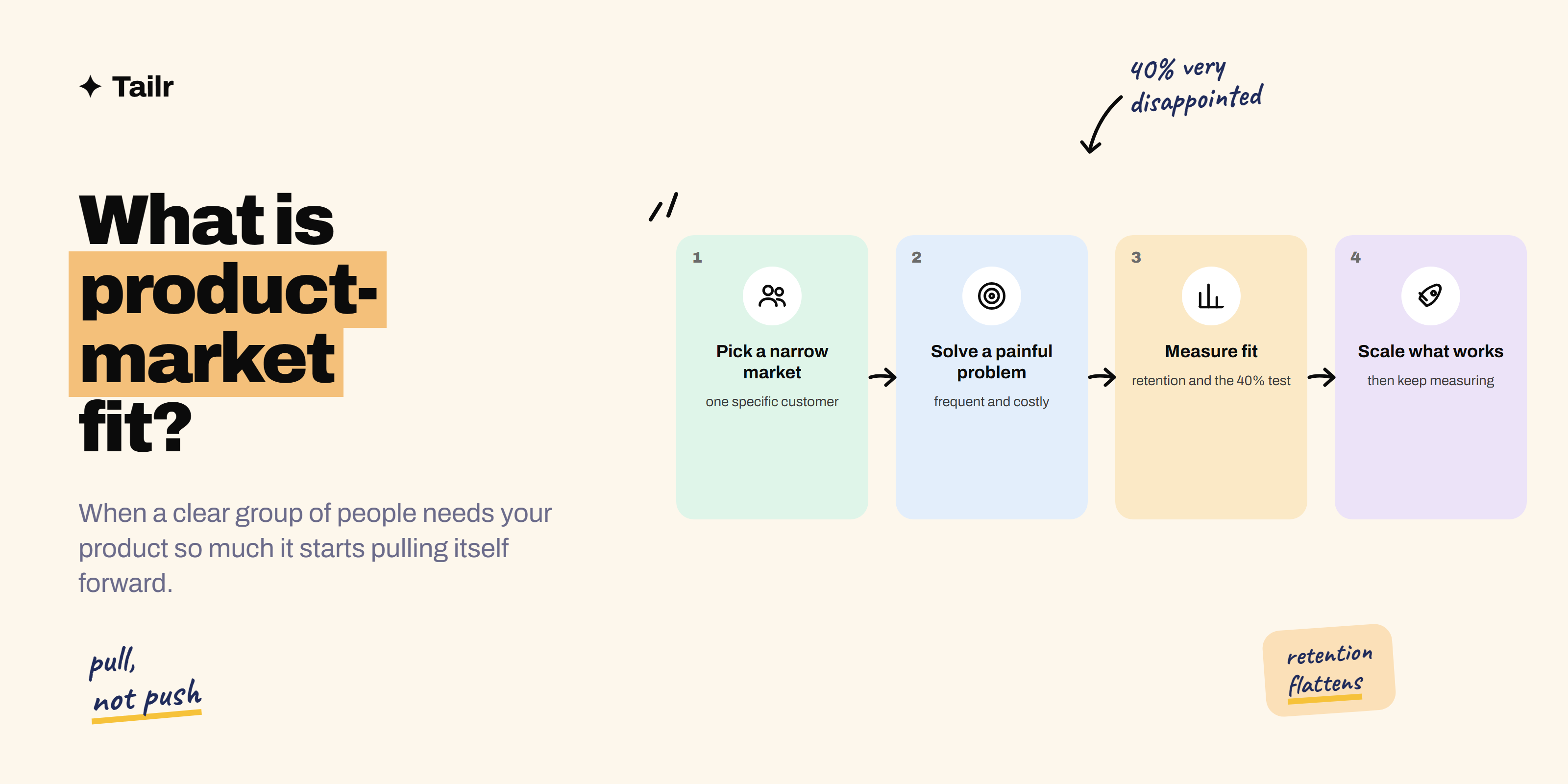
Product-market fit gets talked about as if it’s a finish line: before it, a startup is struggling; after it, everything works. That’s roughly right, but the term is used so loosely that it’s worth pinning down what it means, how you can tell whether you have it, and what to do if you don’t.
The short answer: product-market fit is when a product satisfies a real market so well that customers keep using it, pay for it, and tell other people about it, often faster than the company can keep up. Marc Andreessen popularised the term in 2007, describing it as “being in a good market with a product that can satisfy that market.” You can measure it with retention (does a group of users stick around for good?) and the Sean Ellis test (do 40% or more of users say they’d be very disappointed without it?). Until you have it, the job is to learn fast. Once you have it, the job is to grow.
Why product-market fit matters
Almost every other problem a young company has gets easier once it has fit. Marketing works because people want what you’re selling. Sales cycles get shorter. Investors are interested. Hiring is easier because the company is visibly working.
Without fit, the opposite is true. You can spend heavily on marketing and see sign-ups that never come back. You can hire a sales team that can’t close. Many startups fail not because they ran badly, but because they scaled before anyone really needed the product.
That’s why experienced founders and investors say the first job is to find fit, and nothing else matters as much until you do.
What it looks and feels like
Andreessen’s description is still the most vivid: without fit, customers aren’t quite getting value, word of mouth isn’t spreading, press is quiet, and sales take forever. With fit, customers buy as fast as you can make the product, usage grows as fast as you can add servers, and you’re hiring as fast as you can.
In practical terms, signs you’re getting there:
- Retention flattens. A group of users keeps coming back month after month.
- Organic growth. A meaningful share of new users arrive through referrals and word of mouth, not ads.
- Customers complain when it breaks. People who depend on something notice when it’s down.
- Pull, not push. Customers ask for more features, more seats, and more integrations.
- Sales gets easier. Deals close faster and prospects already know what you do.
Signs you’re not there yet:
- Users sign up, try it once or twice, and disappear.
- Growth only comes from paid marketing and stops when you stop spending.
- Customers say it’s “nice” but wouldn’t be upset if it went away.
- Each sale needs a custom deal or heavy discounting.
How to measure product-market fit
There’s no single number, but three measures do most of the work.
1. The retention curve
Take everyone who signed up in a given month and chart what percentage are still active each month after. For most products, the curve drops early. The question is whether it flattens out at some level or keeps falling towards zero. A flat curve means a core group gets lasting value. A curve that keeps falling means the product isn’t sticking for anyone yet.
What a good flat level looks like depends on the product: a daily messaging app should hold far more users than a tax tool people use once a year.
2. The Sean Ellis test
Growth marketer Sean Ellis proposed one survey question: “How would you feel if you could no longer use this product?” with the answers very disappointed, somewhat disappointed, and not disappointed. If 40% or more of active users say very disappointed, that’s a strong sign of fit.
The follow-up questions are just as useful: who are the very disappointed users, what’s the main benefit they get, and what would make the product better for the somewhat disappointed ones? Email app Superhuman famously used this approach to go from about 22% to well above 40% by focusing on the users who loved it most.
3. Business signals
For paid products, look at whether customers renew and expand, how long sales take, and whether the cost of acquiring a customer is well below what they pay over their lifetime. These tell you whether fit can turn into a sustainable business.
How to get closer to product-market fit
- Narrow your market. “Small businesses” is too broad. “Independent bookkeepers with 20 to 50 clients” is something you can serve very well. Fit usually starts in a narrow group and expands.
- Solve a painful, frequent problem. Nice-to-have products rarely find fit. Look for problems people already spend time or money trying to solve.
- Start with a minimum viable product. Build the smallest thing that tests whether the problem is real and your solution works. See what is an MVP for how.
- Talk to users every week. Especially the ones who love it and the ones who left. Both teach you something.
- Measure, change, repeat. Ship changes quickly, watch retention and the 40% test, and double down on what the happiest users value.
- Be willing to change the market, not just the product. Sometimes the product is fine and you’re selling it to the wrong people.
Common mistakes
- Scaling too early. Hiring a big sales team or spending on ads before retention has flattened.
- Counting sign-ups, not usage. A launch spike can look like fit and fade within weeks.
- Listening to everyone equally. Building for users who are lukewarm dilutes the product for the ones who love it.
- Treating it as permanent. Markets move. Keep measuring after you find fit.
Why this matters for your career
Product-market fit isn’t only for founders. If you’re interviewing for product, growth, marketing, or startup roles, you’ll be asked about it, and understanding where a company sits matters when you’re choosing where to work.
A company still searching for fit will be fast-moving, uncertain, and full of experiments; roles are broad. A company that’s found fit and is scaling needs people who can build repeatable systems. Ask in interviews: “What does retention look like for your best customer group?” It’s a sharp question that tells you a lot. If you’re looking at startups, our guide to the best websites for startup jobs is a good place to find them.
When you apply, show you understand the stage. For an early-stage role, lead with experiments you ran and what you learned. For a scaling company, lead with systems you built and the growth they drove. Tailr tailors your resume from the job listing you’re viewing, drafts a cover letter, and tracks the application, which makes it easy to frame your experience for each company’s stage.
Related guides
- DAU, MAU, Retention and Churn: Product Metrics Interviewers Expect
- What Is a North Star Metric? Definition and Examples
Conclusion
Product-market fit is when a product meets a real need for a clear group of people so well that they stick around and bring others with them. You can see it in a retention curve that flattens, a Sean Ellis score above 40%, and growth that comes from pull rather than push. Before fit, focus on a narrow market and learn fast. After, scale what works, and keep measuring so you don’t lose it.
Try Tailr to tailor your resume to the startup or product role you apply for next.
Frequently asked questions
01What is product-market fit in simple terms?
Product-market fit is when you've built something a specific group of people genuinely needs, so they keep using it, pay for it, and recommend it without much pushing. Before you have it, growth feels like pushing a boulder uphill. After, demand starts pulling the product forward.
02How do you measure product-market fit?
The most common measures are retention and the Sean Ellis test. If your retention curve flattens out instead of dropping to zero, a core group keeps getting value. The Sean Ellis test asks users how they'd feel if they could no longer use the product; if 40% or more say very disappointed, that's a strong sign of fit.
03Who coined the term product-market fit?
The idea is usually credited to investor Andy Rachleff, and Marc Andreessen popularised the term in a 2007 essay, where he defined it as being in a good market with a product that can satisfy that market. He argued it's the only thing that matters for a startup.
04What is the 40% rule for product-market fit?
The 40% rule comes from growth marketer Sean Ellis. Survey active users and ask how they'd feel if they could no longer use your product. If at least 40% answer very disappointed, you likely have product-market fit. Below that, keep iterating on the product or the target customer.
05How long does it take to reach product-market fit?
There's no fixed timeline. Some products find fit in months, others take years, and many never do. What speeds it up is focusing on one narrow customer group, talking to them constantly, and shipping changes quickly so you learn faster than you spend.
06Can you lose product-market fit?
Yes. Markets change, competitors copy you, customer needs shift, and new technology can make a product less necessary. Companies that keep fit keep measuring retention and satisfaction and treat fit as something to maintain, not a milestone they passed once.