What Is a North Star Metric? Definition and Examples
· updated
“What would you pick as the north star metric?” is one of the most common questions in product manager interviews, and one of the most common phrases in product teams. It sounds grand, but the idea is simple: pick the one number that best shows customers are getting value, and point the whole team at it. This guide explains what a north star metric is, shows well-known examples, walks through how to choose one, and gives you a structure for answering it in an interview.
The short answer: a north star metric is the single metric that best captures the core value a product delivers to its customers, and that predicts long-term business growth. A good north star:
- Reflects customer value, not just activity or company revenue.
- Leads to revenue over time, so growing it grows the business.
- Can be influenced by the team’s work through a few input metrics.
- Is easy to understand for everyone, from engineering to sales.
- Has a time frame, such as weekly or monthly.
Commonly cited examples: nights booked (Airbnb), time spent listening (Spotify) and messages sent within teams (Slack).
Why companies use a north star metric
Without a shared measure, teams pull in different directions. Marketing chases sign-ups, sales chases big contracts, the product team chases feature launches, and each can look successful while the product as a whole stalls.
A north star fixes that by giving everyone one question: will this move the north star? It helps teams:
- Prioritise: an idea that doesn’t plausibly move the north star or its inputs drops down the list.
- Align: different teams can own different input metrics but share the same top goal.
- Avoid vanity metrics: downloads, page views and total registered users look good on a slide but often don’t reflect value.
- Spot problems early: because the north star tracks value, a dip usually signals a real customer problem.
North star metric examples
| Company or product type | Commonly cited north star | Why it works |
|---|---|---|
| Airbnb | Nights booked | Both guests and hosts get value only when a stay happens |
| Spotify | Time spent listening | More listening means the user is getting more value from the catalogue |
| Slack | Messages sent within teams | Teams that message actively are getting real work done in Slack |
| Ride-hailing app | Rides completed per week | Each completed ride is value for the rider and income for the driver |
| Food delivery app | Orders delivered on time per week | Captures both demand and the quality of the experience |
| Online learning app | Weekly learners completing a lesson | Learning, not just signing up, is the value |
| Project management tool | Weekly active teams with tasks completed | Shows the tool is part of how teams actually work |
| Job search tool | Applications submitted per active user | The user’s goal is getting applications out, not browsing |
A few of these are well-known public examples; others are illustrations of what a sensible north star looks like for that kind of product. In an interview, the reasoning matters more than matching any company’s internal choice.
North star metric vs KPIs vs OKRs
These three work together:
- North star metric: one number for the whole product, reflecting customer value. It changes rarely.
- KPIs: the wider set of performance numbers, including the north star’s input metrics and business health measures like churn, margin and uptime. See what are KPIs.
- OKRs: time-boxed goals each team sets, usually aimed at moving an input metric this quarter. See OKRs vs KPIs.
For example, a meditation app’s north star might be weekly meditation minutes. Its KPIs include trial conversion and monthly churn. This quarter’s OKR for the onboarding team might be “raise the share of new users who finish a first session within 24 hours from 40% to 55%”.
Input metrics: how the north star gets moved
A north star is an outcome. Nobody can change it directly. You move it by improving the smaller input metrics that add up to it. A common way to break it down is:
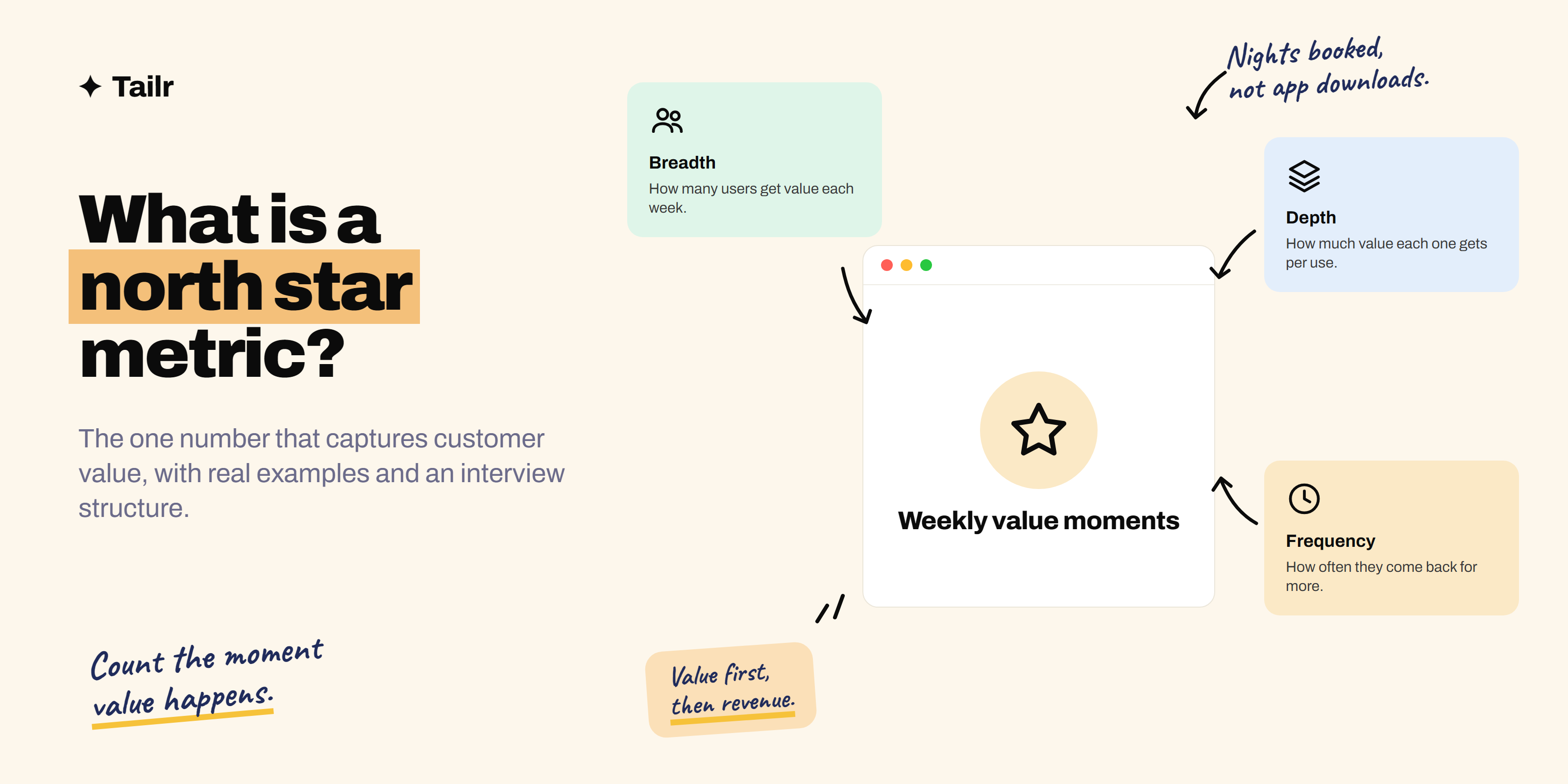
North star = breadth × depth × frequency (plus efficiency, for some products)
- Breadth: how many users or customers are getting value (for example, weekly active listeners).
- Depth: how much value each gets per use (minutes per session).
- Frequency: how often they come back (sessions per week).
- Efficiency: how quickly they reach value (time to first playlist).
For Airbnb’s nights booked, you could break it down as active guests × trips per guest × nights per trip, alongside supply-side inputs like active listings and host response rate.
Each input can be owned by a different team. Growth owns breadth, the core product team owns depth, lifecycle marketing owns frequency, and so on. That’s how one number organises a whole company.
How to choose a north star metric
1. Write down the core value
Finish the sentence: “Customers use our product to ___.” For a language app, maybe “build a daily practice habit that improves their fluency”. The north star should measure that, not something adjacent.
2. Find the moment value happens
Value is delivered at a specific moment: a ride completed, a song played, a lesson finished, an order delivered. Count that moment. Counting visits or sign-ups measures interest, not value.
3. Check it leads to revenue
Ask: if this number doubles, does the business very likely grow? If people listen more, they’re more likely to subscribe and stay. If they open the app more without listening, maybe not.
4. Make sure teams can influence it
Break it into input metrics. If you can’t name two or three levers that teams can pull, the metric is too abstract.
5. Add a time frame and a clear definition
“Weekly” or “monthly” depends on how often people naturally use the product. A tax app used once a year can’t have a weekly north star. Define exactly what counts: does a 10-second song play count as listening?
6. Pair it with guardrails
Any single number can be gamed. A video app pushing “time watched” could autoplay endlessly and annoy people. Pick guardrail metrics, such as satisfaction scores, unsubscribe rate or complaints, that you watch so the north star doesn’t grow at the customer’s expense.
Worked example: choosing a north star for a recipe app
Let’s run the six steps on a made-up product: a recipe app that helps busy people cook at home.
- Core value: “People use our app to cook good meals at home without stress.” Not “browse recipes”. Browsing is a means, not the goal.
- The value moment: a person actually cooks a recipe. We can detect this when someone opens cooking mode and goes through the steps, or taps “I made this”.
- Leads to revenue? People who cook from the app regularly are far more likely to subscribe to premium meal plans. Yes.
- Can teams influence it? Breadth (weekly cooks), depth (recipes cooked per cook) and frequency (cooking days per week) can each be moved by search, recommendations, shopping lists and reminders. Yes.
- Time frame and definition: weekly recipes cooked, counting a recipe when a user reaches the last step in cooking mode or marks it as made.
- Guardrails: recipe ratings (we don’t want people cooking more but enjoying it less) and notification opt-out rate.
Alternatives we rejected: app opens (people open it and leave), recipes saved (saving is aspiration, not value), and subscription revenue (a result, not the lever).
That’s the full reasoning an interviewer wants to hear, in under two minutes.
Marketplaces and B2B products
Two kinds of products need extra thought.
Marketplaces
A marketplace has two sets of customers: buyers and sellers, riders and drivers, guests and hosts. A good north star counts the moment both sides get value, which is why transaction-based metrics like nights booked or rides completed are so common. Teams then track supply-side inputs (active listings, driver hours) and demand-side inputs (searches, booking conversion) separately.
B2B software
In B2B, the customer is usually a team or company, not an individual. North stars often count active teams or accounts doing the core thing, such as weekly active teams that ship a project. Counting individual users can mislead you: one enthusiastic person in a 200-person company isn’t a healthy account.
Good vs bad north star metrics
| Bad choice | Why it’s weak | Better choice |
|---|---|---|
| App downloads | Says nothing about whether people use it | Weekly active users who complete a core action |
| Total registered users | Only ever goes up, even if everyone leaves | Monthly active customers |
| Revenue | Lagging, and can rise while customers suffer | The value moment that drives revenue |
| Page views | Can rise because people are lost or confused | Tasks completed successfully |
| Features shipped | Output, not outcome | Adoption and retention of those features |
The north star in PM interviews
Expect questions like “What should Instagram’s north star be?”, “Pick a north star for a food delivery app” or “Our north star fell 8% this week. Walk me through it.”
A structure for “choose a north star” questions
- Clarify the product and the user. “Are we talking about the whole app or just Reels? Consumers or creators?”
- State the core value. “People come to share and watch short moments from friends and creators.”
- Propose one metric with a time frame. “Weekly users who watch and engage with at least one piece of content from someone they follow.”
- Explain the trade-offs. “I’d avoid pure time spent, because it can be pushed by low-quality autoplay, and avoid DAU alone, because opening the app isn’t value.”
- Break it down into inputs. “Breadth is weekly engaged users, depth is meaningful interactions per user, frequency is days active per week.”
- Name a guardrail. “I’d watch reported content and time-well-spent survey scores.”
A structure for “the north star dropped” questions
- Check the data first. Did tracking break? Did a definition change? Is it a public holiday?
- Find when it started and whether anything shipped then.
- Segment by platform, country, new vs returning users, and acquisition channel.
- Look at the inputs. Did breadth, depth or frequency fall?
- Form a hypothesis, then decide what to do next: roll back, fix, or investigate further.
For the related vocabulary, see our 10 terms to know before a product management interview and DAU, MAU, retention and churn explained.
Common mistakes
- Choosing a business metric instead of a value metric. Revenue and profit matter, but they’re results, not the thing your team improves day to day.
- Picking something you can move directly. If a team can push the number up with a single campaign, it’s probably an input, not a north star.
- Changing it every quarter. A north star should be stable for a year or more. Change OKRs, not the north star.
- Ignoring one side of a marketplace. A marketplace north star needs to reflect value to both buyers and sellers.
- Forgetting the definition. If two teams calculate it differently, it can’t align anyone.
Use the idea on your own job search
The north star idea works for a job search too. Applications sent is a vanity number if they’re all the same generic resume. A better north star is interviews booked per week, and the input metrics are the number of good-fit roles you find, how well each application is tailored, and how fast you follow up.
Tailr helps with the middle input: the Chrome extension tailors your resume to the job listing you’re viewing, writes a matching cover letter and tracks every application, so more of your applications have a real chance of turning into interviews.
Try TailrRelated guides
Conclusion
A north star metric is the one number that shows customers are getting real value, chosen so that growing it grows the business. Find the moment value happens, count it over a sensible time frame, break it into inputs that teams can own, and guard it against gaming. In a PM interview, the specific metric matters less than showing that reasoning clearly: value first, then the metric, then the levers and the guardrails.
Frequently asked questions
01What is a north star metric in simple terms?
A north star metric is the single number that best captures the value your customers get from your product. If it goes up, customers are getting more value and the business should grow with it. Teams use it to align everyone's work around one shared measure of success.
02What are some examples of north star metrics?
Commonly cited examples include nights booked for Airbnb, time spent listening for Spotify, messages sent within teams for Slack, and rides completed for ride-hailing apps. Each reflects a moment where the customer actually got value, not just a visit or a download.
03Is revenue a good north star metric?
Usually not. Revenue is a lagging result of customer value, and it can be pushed up in ways that hurt customers, like price hikes or aggressive upsells. A good north star measures the value customers get, which then leads to revenue. Some transaction businesses use a value-linked revenue measure, but most teams keep revenue as a separate business KPI.
04What is the difference between a north star metric and a KPI?
A north star metric is one top-level number for the whole product that reflects customer value. KPIs are the wider set of metrics teams track to measure performance, including the input metrics that drive the north star, plus business and health metrics like churn, margins and uptime.
05Can a company have more than one north star metric?
Generally a product has one north star, because the point is to align everyone on a single measure. Large companies with very different products, or marketplaces with two sides, sometimes have one per product or track two closely linked numbers, but more than that defeats the purpose.
06How do I answer a north star metric question in a PM interview?
Clarify the product and its users, state the core value it delivers, then propose one metric that captures that value with a time frame (for example, weekly). Explain why you rejected obvious alternatives like downloads or revenue, break it into two or three input metrics, and add a guardrail metric you'd watch so the north star isn't gamed.