OKRs vs KPIs: What's the Difference?
· updated
OKRs and KPIs both involve numbers and goals, both show up in planning meetings, and both get asked about in product, marketing and management interviews. So it’s no surprise they get confused. They’re actually different tools for different jobs, and once you see the difference, it’s easy to explain.
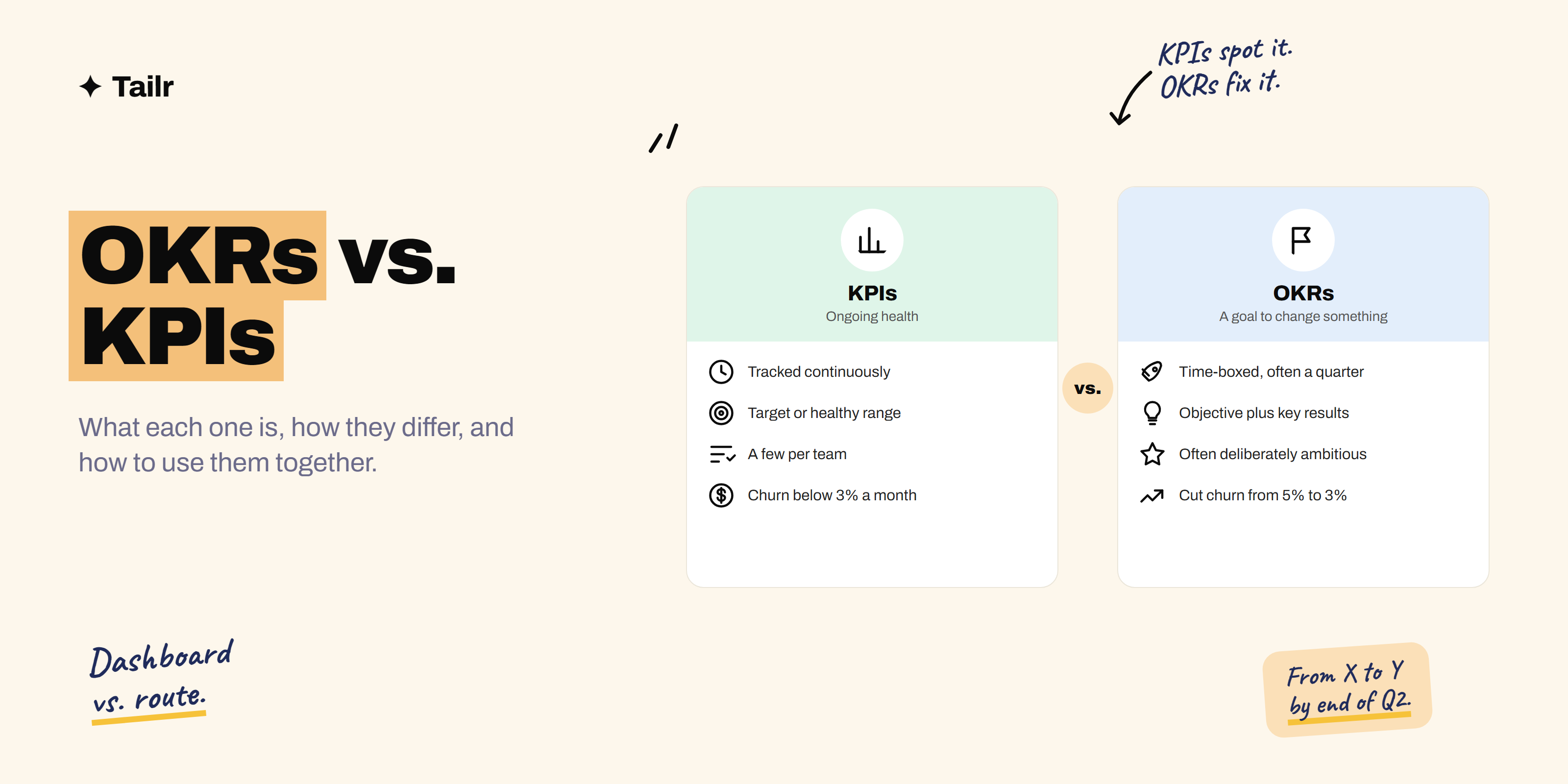
The short answer: KPIs (key performance indicators) measure the ongoing health of something, like revenue, churn or response time, and are tracked continuously. OKRs (objectives and key results) set a time-boxed goal to change something: an ambitious, qualitative objective plus two to five measurable key results, usually for a quarter. Think of KPIs as your car’s dashboard and OKRs as the route for a specific trip. Most teams use both: KPIs show where you stand, OKRs say what you’ll change next.
What are KPIs?
A KPI is a number you’ve chosen because it shows whether something important is on track. Teams track KPIs all the time, not just for one quarter.
Examples:
- Monthly recurring revenue (MRR)
- Customer churn rate
- Daily active users
- Average support ticket resolution time
- Website conversion rate
KPIs usually have a target or a healthy range (“churn below 3% a month”), and someone owns each one. If a KPI moves outside its range, it’s a signal to act. For a full explanation with examples by team, read what are KPIs.
What are OKRs?
OKRs are a goal-setting framework with two parts:
- Objective: what you want to achieve, written in plain, motivating language. It’s qualitative and doesn’t contain a number. “Make our checkout the easiest in the category.”
- Key results: two to five measurable outcomes that prove you achieved the objective. “Cut checkout drop-off from 62% to 45%.” “Raise mobile checkout conversion from 1.8% to 2.6%.”
OKRs are usually set every quarter, reviewed regularly, and scored at the end. They were developed by Andy Grove at Intel and brought to Google by John Doerr in 1999, and they’ve since spread to companies of every size.
Committed vs aspirational OKRs
Many teams split OKRs into two kinds:
- Committed OKRs: things the team agrees it will deliver. The expectation is close to 100%.
- Aspirational (or “moonshot”) OKRs: deliberately ambitious goals. Hitting around 60 to 70% of the way there is considered a good result.
Knowing which kind you’re setting matters, because “we hit 70%” means success for one and a miss for the other.
OKRs vs KPIs: the key differences
| KPIs | OKRs | |
|---|---|---|
| Purpose | Monitor ongoing performance and health | Drive a specific change or improvement |
| Question it answers | “How are we doing?” | “What do we want to achieve next, and how will we know?” |
| Time frame | Continuous | Time-boxed, usually a quarter |
| Structure | A metric with a target or range | A qualitative objective plus 2–5 measurable key results |
| Ambition | Realistic, steady | Often stretching, sometimes deliberately out of reach |
| How many | A handful per team, stable over time | 1–3 objectives per team per quarter |
| When they change | Rarely, when the business changes | Every cycle |
| Example | “Monthly churn: target below 3%” | “Objective: keep customers longer. KR: cut churn from 5% to 3% by end of Q1” |
How OKRs and KPIs work together
The cleanest way to see the relationship: KPIs spot the problem or opportunity; OKRs fix it.
- A KPI moves. Your SaaS app’s activation rate, a KPI you track every week, has fallen from 45% to 36%.
- You set an OKR to change it.
- Objective: get new users to value in their first day.
- KR1: raise day-1 activation from 36% to 50%.
- KR2: cut median time to first project from 3 days to under 1 day.
- KR3: reduce “how do I start?” support tickets by 40%.
- The quarter ends. If you succeed, activation goes back to being a KPI you monitor, with a new, higher healthy range. The OKR is done; the KPI carries on.
A KPI can become a key result for a quarter, but a key result doesn’t have to be an existing KPI. Sometimes it’s a one-off measure, like “launch in two new countries with 1,000 paying customers each”.
Examples by team
Product
- KPIs: DAU/MAU, 30-day retention, feature adoption, north star metric.
- OKR: Objective: make search the fastest way to find anything. KRs: search success rate from 58% to 75%; median time to first click from 9s to 4s; search used in 50% of sessions, up from 32%.
If you’re preparing for product interviews, see what is a north star metric and DAU, MAU, retention and churn explained.
Sales
- KPIs: revenue against quota, win rate, average deal size, sales cycle length.
- OKR: Objective: break into the mid-market. KRs: close 15 mid-market deals; average mid-market deal size of $40,000; sales cycle under 60 days for the segment.
Marketing
- KPIs: customer acquisition cost, lead-to-customer conversion rate, organic traffic.
- OKR: Objective: become the go-to resource for first-time managers. KRs: grow organic sign-ups from blog content from 800 to 2,000 a month; 25,000 newsletter subscribers; three guides ranking in the top three results for their target searches.
Customer support
- KPIs: first response time, resolution time, CSAT.
- OKR: Objective: help customers solve problems before they need us. KRs: 40% of tickets resolved by help articles before submission; ticket volume per 1,000 customers down 25%; CSAT stays at or above 90%.
Engineering
- KPIs: uptime, deployment frequency, change failure rate, time to restore service.
- OKR: Objective: make releases boring. KRs: deploy daily instead of weekly; change failure rate from 18% to under 8%; zero releases rolled back by hand.
How OKRs are scored
At the end of the cycle, each key result is usually scored from 0 to 1 (or 0% to 100%) based on how far you got.
Example: a key result was “raise setup completion from 40% to 60%”. You reached 54%. You moved 14 of the 20 points you aimed for, so the score is 14 ÷ 20 = 0.7.
How to read scores depends on the kind of OKR:
| Score | Aspirational OKR | Committed OKR |
|---|---|---|
| 0.0–0.3 | Missed; learn why | Failed; needs a clear explanation |
| 0.4–0.6 | Some progress | Missed |
| 0.6–0.7 | A good result | Missed, but close |
| 1.0 | Possibly set too low | Expected |
The objective’s score is often the average of its key results. Many teams also add a short written reflection, because “we scored 0.4, and here’s what we learned” is often more valuable than the number.
KPIs aren’t scored this way. They’re simply on target or off target, all the time.
A full quarter, start to finish
Here’s how a team might use both over one quarter, using a recruiting team as the example.
Week 0: look at the KPIs. The team tracks four KPIs: time to hire, offer acceptance rate, candidate satisfaction and cost per hire. Time to hire has crept from 32 days to 47 days, well outside the healthy range.
Week 1: set the OKR.
- Objective: hire great people before our competitors do.
- KR1: cut median time to hire from 47 days to 30 days.
- KR2: respond to every applicant within five working days, up from 60% today.
- KR3: keep offer acceptance at or above 85% (a guardrail so speed doesn’t cost quality).
Weeks 2–12: weekly check-ins. Each week, the team updates progress on each key result in a five-minute review and flags anything off track. Halfway through, they notice interview scheduling is the bottleneck, so they shift effort there.
Week 13: score and reflect. Time to hire reached 34 days (score 0.76), responses within five days hit 92% (score 0.8), and offer acceptance stayed at 87% (met). The team writes a short note on what worked.
Next quarter: time to hire goes back to being a KPI, now with a healthy range of under 35 days, and the team sets a new OKR on a different problem.
How to write good OKRs
- Make the objective inspiring but clear. “Delight users” is too vague. “Make first-time setup effortless” works.
- Write key results as outcomes, not tasks. “Launch a new onboarding flow” is a task. “Raise setup completion from 40% to 60%” is a result.
- Include a starting point and a target. “From X to Y” makes progress obvious.
- Keep it short. One to three objectives per team, two to five key results each.
- Add a guardrail where needed. If speed is the goal, add a key result that protects quality.
- Check in weekly or every two weeks, not just at the end of the quarter.
Common mistakes
- Treating every KPI as an OKR. If nothing is meant to change, it’s a KPI, not an OKR.
- Writing OKRs as to-do lists. Key results should measure change in the world, not tasks completed.
- Too many OKRs. Ten objectives means no focus at all.
- Tying OKRs directly to pay. Many companies avoid this, because it pushes people to set safe goals instead of ambitious ones.
- Setting and forgetting. OKRs that aren’t reviewed until the last week of the quarter rarely get hit.
How this comes up in interviews
Interviewers ask about OKRs and KPIs to see if you can set goals and measure success. Expect questions like:
- “What’s the difference between OKRs and KPIs?” Give the dashboard vs route analogy, then a one-line example of each.
- “How would you set goals for this product next quarter?” Start from a KPI that needs to move, then write one objective and three key results out loud.
- “Tell me about a goal you missed.” Be honest about the number, explain what you learned, and what you changed.
For more PM vocabulary, read 10 terms you should know before a product management interview.
Put your results on your resume like key results
The best resume bullet points read like achieved key results: a starting point, a target and the outcome. “Raised setup completion from 40% to 61% in one quarter by redesigning onboarding” is far stronger than “worked on onboarding”.
Then match those results to what each job listing cares about. Tailr is a Chrome extension that tailors your resume to the job listing you’re viewing, so your most relevant results come first, and it writes a matching cover letter and tracks the application too.
Try TailrRelated guides
Conclusion
KPIs and OKRs aren’t competing frameworks. KPIs are always on, showing the health of the business. OKRs are temporary, pointing a team at a few important changes for a quarter. When a KPI needs to move, an OKR is how you move it. Learn to explain that in one sentence with an example, and you’ll handle OKR and KPI questions in any interview.
Frequently asked questions
01What is the main difference between OKRs and KPIs?
KPIs measure the ongoing health of something you already do, like monthly churn or revenue, and are tracked continuously. OKRs set a time-boxed goal to change something, pairing a qualitative objective with two to five measurable key results, usually for a quarter. KPIs tell you where you stand; OKRs say where you want to go next.
02Can a KPI be a key result?
Yes, very often. If a KPI like activation rate needs to improve, a key result might be 'raise activation from 35% to 45% this quarter'. The KPI is the ongoing measure; the key result is a specific, time-bound target for moving it.
03Which is better, OKRs or KPIs?
Neither; they do different jobs and work best together. KPIs keep an eye on the health of the business all the time, while OKRs focus a team's effort on a few important changes for a set period. Most companies that use OKRs also track KPIs.
04What is an example of an OKR?
Objective: make onboarding effortless for new customers. Key results: raise the share of new accounts that complete setup within 7 days from 40% to 60%; cut onboarding support tickets per new account by 30%; increase the onboarding satisfaction score from 7.1 to 8.0. All by the end of the quarter.
05Who invented OKRs?
OKRs were developed by Andy Grove at Intel in the 1970s, building on Peter Drucker's management by objectives. John Doerr, who learned them at Intel, introduced them to Google in 1999, and his book Measure What Matters made them widely popular.
06How many OKRs should a team have?
Usually one to three objectives per team per quarter, each with two to five key results. More than that spreads effort too thin and defeats the point of OKRs, which is to focus on what matters most right now.