What Is a Product Roadmap? Types, Examples and How to Build One
· updated
Every product team has a roadmap, and every product manager interview eventually asks about one. “How do you build a roadmap?” “How do you handle a stakeholder who wants their feature on it?” “What would your roadmap look like for this product?” This guide explains what a product roadmap is, the main types, a worked example, how to build one step by step, and how to talk about roadmaps in interviews.
The short answer: a product roadmap is a high-level plan that shows where a product is heading, what problems the team will tackle over time, and why. A good roadmap:
- Starts from a goal or vision, not a list of feature requests.
- Is organised by themes or problems, such as “make onboarding effortless”, rather than individual tasks.
- Shows rough timing, often as now, next and later, or by quarter, with less certainty further out.
- Links each theme to an outcome, such as higher activation or lower churn.
- Changes as you learn, while the overall direction stays stable.
Why product roadmaps matter
A roadmap does three jobs at once:
- Alignment: engineering, design, sales, marketing and leadership all see the same priorities and the reasons behind them.
- Focus: by showing what’s in, it makes clear what’s out. Saying no is easier when the roadmap explains why.
- Communication: it gives customers, executives and new team members a simple picture of where the product is going.
Without one, teams drift toward whoever shouts loudest, and the product turns into a pile of unrelated features.
What a roadmap is not
- Not a release plan with exact dates. Promising specific dates six months out sets everyone up for disappointment.
- Not a backlog. The backlog holds detailed tasks; the roadmap holds direction.
- Not a list of every request. It’s a set of choices.
- Not fixed. A roadmap that never changes means the team isn’t learning.
Types of product roadmaps
Now, next, later
Three columns instead of dates:
- Now: what the team is building currently. Detailed and confident.
- Next: what’s coming soon, being researched and designed. Fairly confident.
- Later: bigger ideas for the future. Uncertain and open to change.
Best for: startups and teams that want to show priority without committing to dates. It’s one of the most popular formats today.
Timeline (date-based) roadmap
Themes or features laid out across months or quarters, often as horizontal bars.
Best for: organisations with fixed deadlines, such as hardware launches, regulatory changes, or customer contracts. The risk is that dates turn into promises.
Outcome-based (goal-based) roadmap
Organised by the outcome each theme should achieve: “increase activation”, “reduce churn among small businesses”, “expand to two new markets”. Features sit under each outcome as possible ways to get there.
Best for: teams using OKRs and teams that want to focus on results rather than output. See OKRs vs KPIs for how goals and metrics fit together.
Feature-based roadmap
A list of features with rough timing.
Best for: sharing with customers or sales teams who need to know when something specific is coming. Weaker for strategy, because it hides the “why”.
Other views
- Portfolio roadmap: several products on one view, for leadership.
- Internal vs external roadmap: internal versions show detail and uncertainty; external, customer-facing versions are simpler and avoid firm dates.
- Technology roadmap: infrastructure and platform work, often owned with engineering leaders.
Product roadmap example
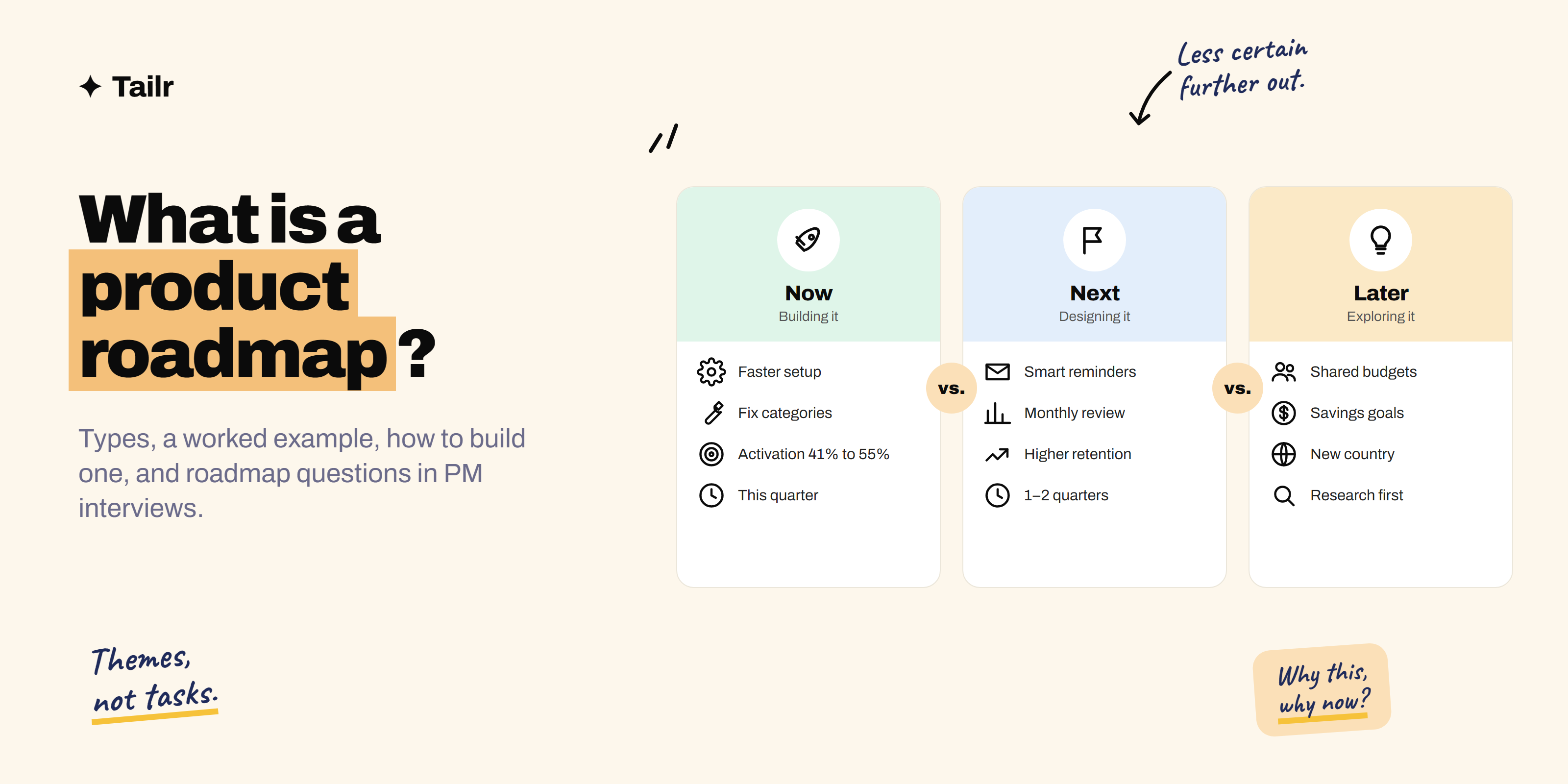
Here’s a now-next-later roadmap for an imaginary budgeting app whose goal for the year is “help users stick with a budget for three months”.
Vision: make managing money feel effortless for people new to budgeting.
Goal this year: raise the share of new users still budgeting after 90 days from 18% to 30%.
| Now (this quarter) | Next (next 1–2 quarters) | Later (6+ months) |
|---|---|---|
| Faster setup: connect a bank and get a first budget in under 5 minutes. Outcome: day-1 activation from 41% to 55%. | Smart reminders: gentle nudges before overspending in a category. Outcome: more weekly active budgeters. | Shared budgets for couples and housemates. |
| Fix category mistakes: better automatic categorisation of transactions. Outcome: fewer manual edits and support tickets. | Monthly review: a two-minute summary each month with one suggestion. Outcome: higher 90-day retention. | Savings goals linked to budgets. |
| Expansion to a second country. |
Notice what it shows: a clear goal at the top, themes rather than tiny tasks, an outcome for each item in “now” and “next”, and more uncertainty in “later”.
How to build a product roadmap, step by step
1. Start with vision and strategy
What’s the product for, and what’s the company trying to achieve this year? Write the vision and one to three goals at the top of the roadmap. Everything below should connect to them.
2. Gather inputs
Collect evidence from many sources:
- Customer interviews and feedback
- Product analytics: where users drop off, which features drive retention
- Sales and customer success: what deals are lost or customers leave over
- Engineering: technical debt, platform needs
- Market and competitor changes
- Leadership priorities
3. Turn requests into problems
Requests come in as solutions (“add a dark mode”, “build an export to Excel”). Ask why. Group similar requests into underlying problems (“users need to share reports with their finance team”). Problems make better roadmap themes than features.
4. Prioritise
Score themes against your goals using a framework like RICE, or a simple value vs effort comparison, and consider dependencies and risk. See RICE, MoSCoW and Kano: prioritization frameworks for PM interviews.
5. Choose the format and level of detail
Pick the roadmap type that suits your audience: now-next-later for most product teams, timelines where real deadlines exist. Keep “now” detailed and “later” loose.
6. Add outcomes and measures
For each theme, write the outcome you expect and how you’ll measure it. This turns the roadmap from a list of things to build into a list of results to achieve. See what are KPIs.
7. Share it and explain the why
Walk each audience through it: what’s in, what’s out and why. Expect pushback, and listen to it; it’s often where you learn about risks you missed.
8. Review and update regularly
Check progress monthly and update quarterly. Move items between columns as you learn, and tell people when something changes and why.
Presenting a roadmap to different audiences
The same roadmap should be told differently depending on who’s listening.
| Audience | What they care about | What to show |
|---|---|---|
| Executives | Strategy, business impact, risk | Goals, themes, expected outcomes, major trade-offs |
| Engineering | Feasibility, sequencing, technical work | Themes with dependencies, technical debt, rough sizing |
| Sales | What they can tell customers, and when | Upcoming capabilities, with careful wording about timing |
| Customer success and support | What will change for customers | Changes that affect workflows, what’s been fixed |
| Customers | Whether the product is heading their way | A simple, external version without firm dates |
A useful habit: keep one source of truth and create lighter views from it, rather than maintaining several different roadmaps that drift apart.
How to talk about dates
Dates cause most roadmap trouble. A few phrases help:
- “We’re working on this now and expect it this quarter” (high confidence).
- “This is next; we’re designing it and expect it in the first half of next year” (medium confidence).
- “This is on our list for later; we’ll share more when we’ve done the research” (low confidence).
Being honest about confidence levels builds more trust than precise dates that slip.
Roadmap vs backlog vs release plan
| Roadmap | Backlog | Release plan | |
|---|---|---|---|
| Purpose | Direction and priorities | Detailed work to do | What ships when |
| Time frame | Months to a year | Next few sprints | Weeks |
| Level | Themes and outcomes | User stories, bugs, tasks | Specific features and dates |
| Main audience | Whole company, leadership | Product and engineering team | Team, support, marketing |
The flow goes roadmap → backlog → release: themes on the roadmap get broken into user stories in the backlog, which ship in releases. Detailed requirements for a theme often live in a product requirement document.
Common roadmap mistakes
- Feature factory roadmaps: a list of features with dates and no goals or outcomes.
- Too much detail too far out: pretending to know exactly what you’ll build in nine months.
- Saying yes to everything: a roadmap with 40 items has no priorities.
- Not explaining the why: people push back harder on choices they don’t understand.
- Never updating it: it quickly becomes fiction, and people stop trusting it.
- Treating it as a contract: especially with customers, which makes change painful.
Roadmap questions in PM interviews
“How do you build a roadmap?”
Walk through the steps above briefly: start from strategy and goals, gather evidence, turn requests into problems, prioritise with a framework, add outcomes, share it and keep it updated. Then give a short real example if you have one.
“A senior stakeholder wants their feature on the roadmap. What do you do?”
Sample answer: “I’d start by understanding the problem behind the request: who it’s for and what outcome they want. Then I’d assess it the same way as everything else, against our goals and with a framework like RICE, and share that reasoning openly. If it’s high value, it goes in and something else moves, and I’d be clear about what. If not, I’d explain why, suggest an alternative if there is one, and agree when we’ll revisit it. The key is that the decision is transparent and tied to goals, not to who asked.”
“What would your roadmap be for this product?”
Treat it like a mini product sense question: clarify the goal, pick the key user segment, identify the biggest problems, and arrange three to five themes into now, next and later, with an outcome for each.
“How do you handle changing priorities?”
Talk about regular reviews, using evidence to justify changes, and communicating clearly: what changed, why, and what it means for each team.
Roadmaps on your resume
If you’ve owned or contributed to a roadmap, show it with outcomes: “Owned the onboarding roadmap for a 40,000-user app; shipped three themes in two quarters that raised day-7 activation from 28% to 39%.” For more PM vocabulary, read 10 terms you should know before a product management interview.
Different PM listings emphasise different parts of the job. Tailr is a Chrome extension that tailors your resume to the job listing you’re viewing, writes a matching cover letter and tracks each application, so your most relevant roadmap and product experience comes first.
Try TailrConclusion
A product roadmap is a plan for where a product is going and why, built around goals, organised by themes, and honest about uncertainty. Start from strategy, turn requests into problems, prioritise with evidence, attach outcomes, and update it as you learn. Whether you’re building one at work or explaining one in an interview, the strongest roadmaps always answer one question clearly: why this, and why now?
Frequently asked questions
01What is a product roadmap in simple terms?
A product roadmap is a visual plan that shows where a product is heading and what the team plans to work on over time, and why. It connects the product's goals to the problems the team will solve, helping everyone from engineers to executives understand priorities and direction.
02What should a product roadmap include?
A good roadmap includes the product vision or goal, the main themes or problems to solve, rough timing (such as now, next and later, or quarters), the outcomes each theme should achieve, and, where useful, owners and dependencies. It usually avoids detailed task lists and exact dates far in the future.
03What is the difference between a roadmap and a backlog?
A roadmap shows strategic direction over months: the big problems and themes the team will focus on and why. A backlog is the detailed, prioritised list of work items like user stories and bugs that the team pulls from in each sprint. Roadmap items are broken down into backlog items.
04What is a now-next-later roadmap?
A now-next-later roadmap sorts work into three columns instead of dates: now (what the team is working on currently), next (what's coming soon and being prepared) and later (ideas for the future that are less certain). It's popular because it shows priorities without promising exact dates that may change.
05Who owns the product roadmap?
The product manager usually owns the roadmap, but builds it with input from engineering, design, sales, customer success, leadership and customers. Owning it means keeping it up to date, explaining the reasoning behind it, and saying no to requests that don't fit the goals.
06How often should a product roadmap be updated?
Most teams review the roadmap monthly and do a deeper update each quarter. It should change when you learn something important, such as customer research, results from experiments or a shift in strategy, while the overall direction stays stable enough for teams to plan around.