B2B vs. B2C vs. D2C: What They Mean, With Examples
· updated
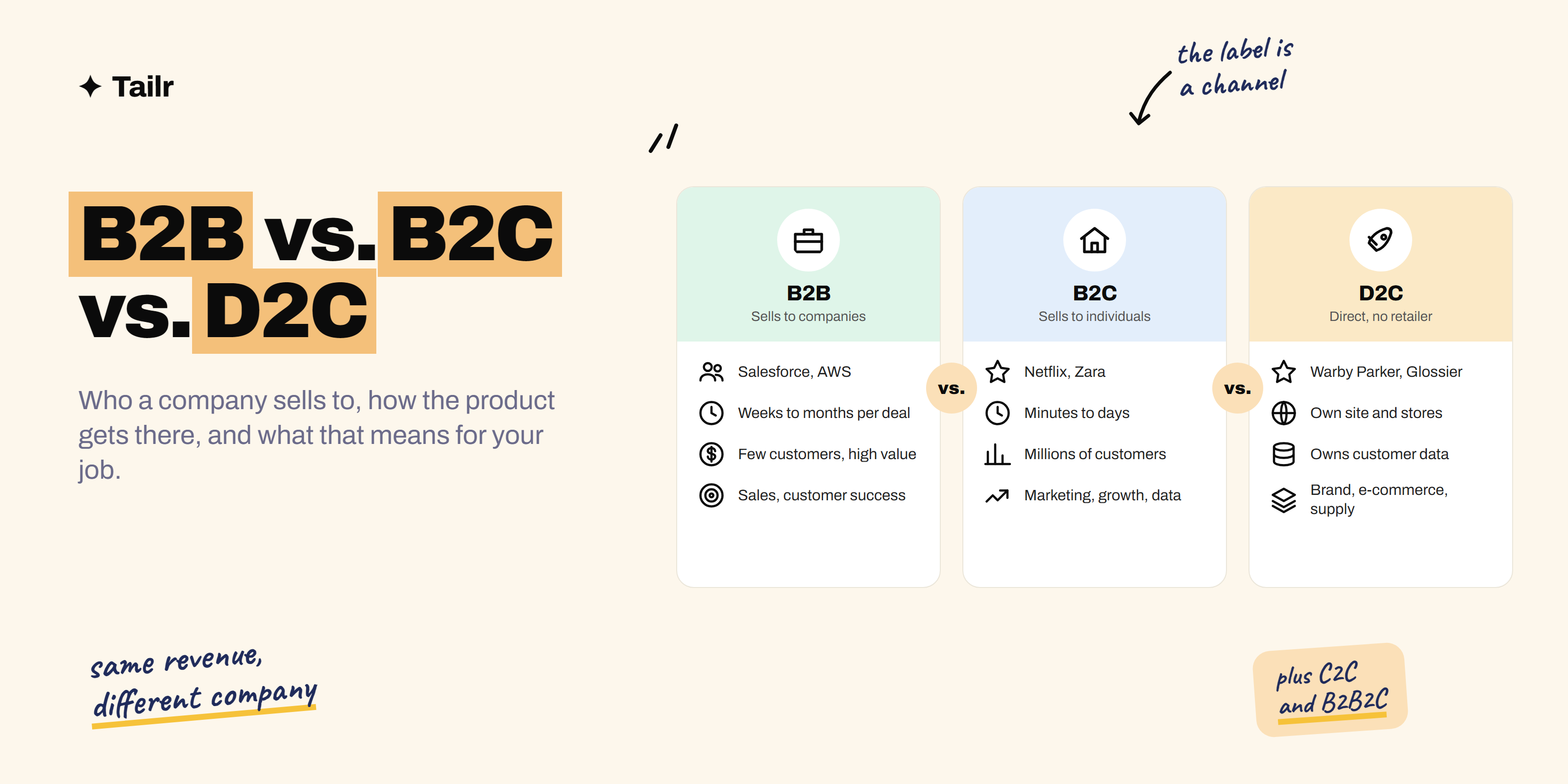
B2B, B2C, D2C, C2C, B2B2C. The letters show up in job postings, pitch decks and interview questions, and they all describe the same simple thing: who a company sells to and how the product gets to them. Once you know that, the rest of the jargon falls into place, and you can tell in ten seconds what a role at a “B2B SaaS company” or a “D2C brand” will actually involve. This guide explains B2B vs. B2C vs. D2C with examples, and what each model means if you’re choosing where to work.
The short answer: the five business models, in one line each:
- B2B (business-to-business): selling to other companies, like Salesforce or a packaging supplier.
- B2C (business-to-consumer): selling to individuals, like Netflix or a supermarket.
- D2C (direct-to-consumer): a form of B2C where the brand makes the product and sells it through its own channels with no retailer in between, like Warby Parker.
- C2C (consumer-to-consumer): people selling to each other through a platform like eBay.
- B2B2C: selling through a business partner to reach that partner’s customers.
The model shapes everything from sales cycles to marketing budgets to what your job looks like.
Why the model matters
The label tells you how a company makes money, and that determines how it’s organized. A B2B company with 200 customers paying $100,000 a year needs account managers, a sales process and a support team that knows each customer by name. A B2C company with 20 million customers paying $10 a month needs performance marketing, a data team and product changes that move numbers across a huge audience. Same revenue, completely different companies.
It also tells you what “good work” looks like. In B2B, one lost account is a bad quarter. In B2C, one lost customer is noise and a 1% change in conversion is a great quarter. Knowing which world you’re in changes how you prioritize, how you’re measured and which skills get you promoted.
B2B: business-to-business
What it is: a company sells products or services to other companies. Software like Salesforce and Slack, cloud infrastructure like AWS, and the whole supply chain of parts, packaging, logistics and consulting that other businesses run on.
How it sells: through sales teams, demos, proposals and contracts. Deals take weeks to months and involve several people on the buyer’s side: the person who’ll use it, the person who pays for it, and often legal, security and procurement. Pricing is frequently negotiated and tiered by size.
What it feels like to work in: fewer customers, deeper relationships, longer feedback loops. Roles are heavy on sales, customer success, solutions engineering and account management, and the marketing is about generating qualified leads rather than mass awareness. If you like solving one customer’s real problem, it suits you. See what a solutions engineer does and what a customer success manager does for two of the most common B2B roles.
B2C: business-to-consumer
What it is: a company sells to individual people. Netflix, Spotify, Zara, your supermarket, most apps on your phone.
How it sells: through marketing and distribution. Purchases are usually quick and emotional rather than evaluated by a committee, so brand, price, convenience and reviews drive the decision. Volume is everything: a B2C company wins by reaching millions of people and converting a small percentage.
What it feels like to work in: big numbers, fast feedback, constant experimentation. Roles cluster in marketing, growth, product, data and operations. You’ll run A/B tests, watch dashboards and see the effect of a change within days. If you like scale and measurable results, this is the environment.
D2C: direct-to-consumer
What it is: a brand that makes or designs its own product and sells it directly to consumers through its own website, app or stores, skipping wholesalers, retailers and marketplaces. Warby Parker (eyewear), Glossier (cosmetics) and a huge wave of online-first clothing, food and personal care brands.
How it sells: through its own storefront, backed by social media, content, influencer marketing and paid ads. Because there’s no retailer in between, the brand keeps the retail margin, controls the whole experience, and owns the customer data: who bought what, when and why.
What it feels like to work in: a B2C company with a much closer relationship to its product and its customers. Roles span brand, e-commerce, performance marketing, supply chain and customer experience, and the business lives or dies on customer acquisition cost versus lifetime value. Many D2C brands eventually add retail partners, at which point they’re D2C and B2C at once.
C2C and B2B2C
C2C (consumer-to-consumer) is individuals selling to individuals through a platform. eBay, Etsy, Facebook Marketplace and OLX. The platform doesn’t own the goods; it provides the marketplace, trust and payments, and takes a fee. Roles here are about marketplace dynamics: balancing supply and demand, trust and safety, and search.
B2B2C (business-to-business-to-consumer) is selling to a business in order to reach its customers. A payments company that powers checkout for online stores, or an insurance product sold through a bank’s app. You sell to the business but design for the consumer, which makes the roles a mix of both worlds.
B2B vs. B2C vs. D2C compared
| B2B | B2C | D2C | |
|---|---|---|---|
| Sells to | Companies | Individuals | Individuals, directly |
| Example | Salesforce, AWS | Netflix, Zara | Warby Parker, Glossier |
| Sales cycle | Weeks to months | Minutes to days | Minutes to days |
| Decision makers | Several per deal | One person | One person |
| Price per customer | High | Low | Low to mid |
| Number of customers | Tens to thousands | Millions | Thousands to millions |
| Key functions | Sales, customer success | Marketing, growth, data | Brand, e-commerce, supply chain |
| Owns customer data | Yes | Partly (via retailers) | Fully |
Companies rarely fit one box
Real companies run several models at once, which is why the labels describe channels rather than identities. Amazon is B2C to shoppers, B2B through AWS and Amazon Business, and a C2C-like platform for third-party sellers. A dairy cooperative like Amul sells to hotels and food manufacturers (B2B), through supermarkets (B2C) and through its own app (D2C). Nykaa started as a B2C beauty marketplace, launched its own product lines (D2C) and supplies salons (B2B).
When a job posting says “B2B” or “D2C”, it’s telling you which channel that role serves, and that’s the part to pay attention to.
Choosing where to work
If you’re deciding between B2B and B2C roles, ask yourself two questions. Do you prefer going deep with a few customers or measuring across many? And do you want your success tied to relationships and deals, or to experiments and numbers? Neither answer is better, and plenty of careers switch sides, but knowing your preference makes the choice of company much easier than comparing salaries.
Then read the posting for its model, because it changes what the same title means. A product manager at a B2B company spends time with customers and sales; a product manager at a B2C app spends time with data and design. A marketing role at a D2C brand is largely performance marketing and content; the same title at a B2B company is lead generation and events. Tailr reads the job listing you’re on and tailors your resume to that specific posting, so a B2B role sees your account and deal experience first and a B2C role sees your growth and experimentation work first, then generates a matching cover letter and tracks the application. Try Tailr if you’re applying across both, and see our guide on the best way to find jobs in 2026 for the rest of the search.
Conclusion
B2B sells to businesses, B2C to consumers, D2C straight to consumers with no retailer in between, C2C connects consumers to each other, and B2B2C reaches consumers through a business partner. The letters are simple; what they imply about sales cycles, marketing, team structure and daily work is what matters. Learn to read the model behind a company or a posting, and you’ll understand the job before you apply for it.
Frequently asked questions
01What is the difference between B2B, B2C and D2C?
B2B companies sell to other businesses, B2C companies sell to individual consumers, and D2C companies are a type of B2C that make their own product and sell it straight to consumers without retailers or marketplaces in between. The difference shows up in how they sell: B2B relies on sales teams and long deals, B2C on marketing and volume, and D2C on owning the brand, the store and the customer data.
02Is Amazon B2B or B2C?
Mostly B2C, since it sells to consumers, but it runs several models at once. Amazon Business sells to companies, Amazon Web Services is a large B2B business, and its marketplace is a platform where third-party sellers reach consumers. Big companies rarely fit one label.
03What does D2C mean?
D2C stands for direct-to-consumer. A D2C brand designs or makes its product and sells it through its own website or stores rather than through retailers, wholesalers or marketplaces. Examples include Warby Parker in eyewear and many online-first brands in clothing, cosmetics and food. The appeal is higher margins, control over the brand and direct access to customer data.
04What is C2C with an example?
C2C is consumer-to-consumer: individuals selling to other individuals through a platform. eBay, Etsy for handmade goods, Facebook Marketplace and OLX are examples. The platform doesn't own the products; it connects buyers and sellers and takes a fee.
05Which is better to work in, B2B or B2C?
Neither is better; they reward different skills. B2B roles tend to involve fewer, larger customers, longer sales cycles and deeper relationships, which suits people who like problem solving and account management. B2C roles involve big audiences, fast feedback and data-driven marketing, which suits people who like experimentation and scale. Many careers move between them.
06Can a company be both B2B and B2C?
Yes, and many are. A dairy brand might sell to hotels and food manufacturers (B2B), to shoppers through supermarkets (B2C) and through its own app (D2C) at the same time. Companies describe themselves by the model that drives most of their revenue, but the labels describe channels, not the whole company.