What Does a Customer Success Manager Do? Role, Skills and Salary
· updated
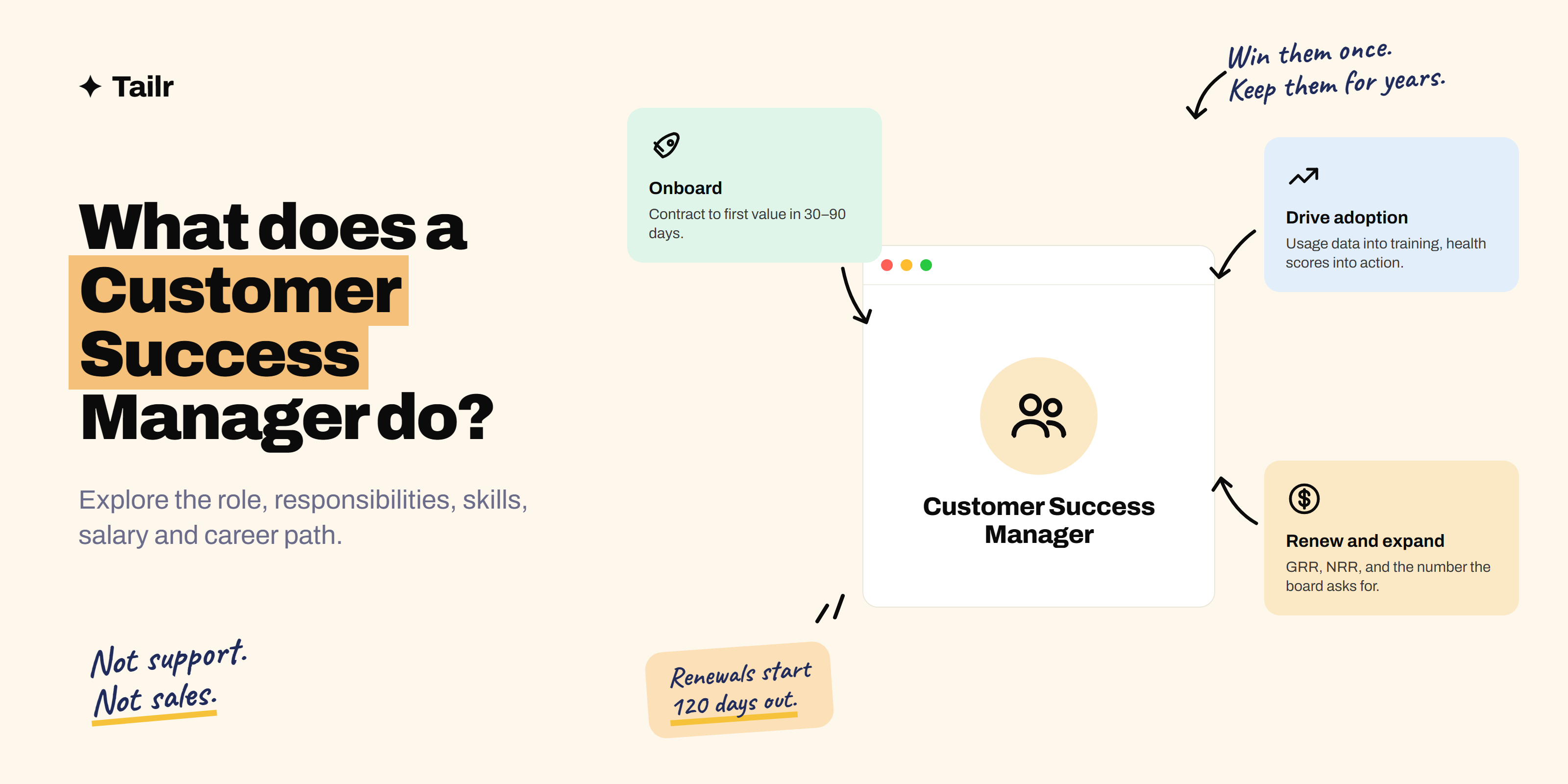
Every subscription business has the same problem: winning a customer is expensive, and the money is only made if they stay. Customer success is the function built to make that happen, and the customer success manager is the person who owns it account by account. It’s one of the most common jobs in software, one of the most misunderstood (it’s not support, and it’s not sales), and one of the more reachable roles for people coming from support, account management or an industry background.
The short answer: A customer success manager (CSM) owns a portfolio of customer accounts after the sale, with one goal: the customer gets the value they bought, so they renew and grow. Day to day that means:
- Onboarding new customers.
- Driving adoption of the product.
- Monitoring account health.
- Running regular business reviews.
- Handling escalations.
- Preparing renewals.
- Finding expansion opportunities.
CSMs are measured on retention (gross and net revenue retention), adoption, and customer health, and sometimes on expansion revenue. The role sits between support (reactive, ticket-based) and sales (new revenue), and it’s the standard next step from either.
Where the role came from
Customer success grew up with software-as-a-service. When software was sold as a licence, the vendor was paid up front and the customer’s satisfaction afterwards was mostly the customer’s problem. Subscription changed that: revenue arrives monthly or yearly, and a customer who doesn’t use the product cancels. Someone had to be responsible for making sure customers actually got value, and it couldn’t be sales (busy winning new accounts) or support (busy with tickets).
Salesforce is usually credited with formalising the function in the mid-2000s. By the 2010s every SaaS company of any size had a customer success team, and the CSM became a standard job title. It’s now common outside software too: in fintech, hardware with a subscription component, and any business where retention is the business model.
What a customer success manager actually does
The work follows the customer lifecycle. A typical CSM owns anywhere from ten enterprise accounts to several hundred smaller ones, and the week includes most of these:
- Onboarding. Taking a newly signed customer from contract to first value: kickoff, understanding their goals, configuring the product or coordinating implementation, training their users, and agreeing what success looks like. A customer who isn’t live in the first 30 to 90 days is a customer at risk.
- Adoption. Getting the customer’s users to actually use the product, and to use the features that deliver the outcome they bought it for. Usage data shows who’s logged in and what they’ve touched; the CSM’s job is to turn that into action: a training session, a workflow suggestion, a conversation with the executive sponsor.
- Health monitoring. Watching signals that predict churn: falling usage, a champion who’s left, unanswered emails, open escalations, late payments. Most teams roll these into a health score. The CSM’s job is to act on red and amber accounts before renewal, not at renewal.
- Business reviews. Regular structured meetings (quarterly for larger accounts) that show the customer what they’ve achieved, what’s coming, and what they could do next. The good ones are built around the customer’s numbers, not the product’s roadmap.
- Escalations. When something goes wrong (an outage, a bug that blocks a workflow, a billing problem), the CSM owns the customer relationship through it: getting the right people internally, keeping the customer informed, and repairing trust afterwards.
- Renewals. Starting 90 to 120 days out for annual contracts: confirming the value delivered, surfacing any risk, working with the account executive or handling the commercial conversation directly, depending on the company.
- Expansion. Spotting when a customer could use more seats, another module, or a higher tier, and either handing it to sales or closing it, again depending on the model. Net revenue retention above 100 percent, which every SaaS board wants, comes from this.
- Voice of the customer. Feeding what customers say and do back to product, marketing and sales. A CSM who keeps a running list of the top ten product gaps by revenue affected is worth a lot to a product team.
- Advocacy. Turning happy customers into references, case studies and speakers.
What they usually don’t do: answer first-line support tickets, prospect for new customers, or build the product. Those belong to support, sales and engineering.
CSM vs. account manager vs. support vs. sales
| Role | Focus | Measured on | Typical relationship |
|---|---|---|---|
| Customer success manager | Customer gets value; retention and growth | NRR, GRR, adoption, health, renewals | Ongoing, proactive, account-based |
| Account manager | Commercial relationship; renewals and upsell | Renewal rate, expansion revenue | Ongoing, commercial |
| Customer support | Resolving issues | Ticket volume, resolution time, CSAT | Reactive, per ticket |
| Account executive (sales) | Winning new customers | New bookings, quota | Pre-sale, then hands off |
At many companies the CSM and account manager roles are merged, and at others the CSM owns the whole renewal. Read the job listing for which model the company uses; it changes the job considerably. If you’re weighing the technical pre-sale side instead, what does a solutions engineer do covers that.
How CSMs are measured
The metrics come up in every interview, so know them:
- Gross revenue retention (GRR): the percentage of revenue retained from existing customers over a period, excluding expansion. Measures churn and downgrades. 90 percent and above is good for SMB; enterprise aims higher.
- Net revenue retention (NRR): the same, including expansion. Above 100 percent means the existing base is growing without new sales. Best-in-class SaaS runs 110 to 130 percent.
- Logo churn: the percentage of customers lost, regardless of size.
- Adoption: active users, feature usage, time to first value.
- Health score: a composite of usage, engagement, support and commercial signals, usually red/amber/green.
- CSAT and NPS: satisfaction and likelihood to recommend, from surveys.
- Time to value: how long from contract to the customer achieving the first outcome they bought for.
Who hires customer success managers
- SaaS companies of every size, from a first CSM at a Series A startup to teams of hundreds at public companies. This is the bulk of listings.
- Vertical software (healthcare, legal, construction, education, hospitality), where industry knowledge is prized and career-changers from the industry do well.
- Fintech and payments, where the role often includes compliance and risk conversations.
- Hardware and IoT companies with a subscription or services component.
- Agencies and consultancies with retainer clients, where the role is sometimes titled client success or account director.
Segments matter as much as industry. SMB or scaled CS means hundreds of accounts, mostly digital touch, a lot of process. Mid-market means 30 to 80 accounts and regular calls. Enterprise or strategic means five to fifteen accounts, executive relationships, and a lot of travel or on-site time. The pay, the pace and the skills differ.
Skills and background that get you hired
Core skills
- Running a meeting. A CSM lives in kickoffs, check-ins and business reviews. Being able to set an agenda, keep it to time, and send a follow-up that people act on is the job’s basic unit.
- Product depth. Enough to advise, not just demo: to say “for what you’re trying to do, use this workflow, not that one” and be right.
- Commercial judgement. Knowing when a renewal is at risk and why, when to bring in sales, and how to talk about price without apologising.
- Data comfort. Reading usage dashboards, maintaining a health score, using a CRM (Salesforce or HubSpot) and a CS platform (Gainsight, ChurnZero, Vitally, Planhat or similar).
- Project management. Onboarding is a project with a plan, owners and dates.
- Escalation handling. Staying calm, being honest about what you don’t know, and giving the customer a date and a name.
- Writing. Most of the relationship happens in email and shared docs. Clear, short, specific.
Background that works
- Customer support who want to move from tickets to relationships. The most common path; many companies hire associate CSMs from their own support team.
- Account management or sales development who prefer keeping customers to finding them.
- Implementation, onboarding or professional services roles, which already do the front half of the job.
- Industry practitioners moving into vertical SaaS: a nurse joining a healthcare software company, a recruiter joining an HR tech company. Domain credibility with customers is worth a lot.
- Teachers, consultants and project managers, whose skills transfer directly.
What customer success managers earn
- United States: base salaries for a CSM typically run from around $70,000 to $110,000, with on-target earnings higher where there’s a variable component tied to retention or expansion. Senior, enterprise and strategic CSMs earn $110,000 to $150,000 and above, with team leads and directors beyond that.
- United Kingdom and Europe: roughly £35,000 to £70,000 base for CSMs, higher for enterprise and London roles.
- India: from around 6 lakhs for early-career and associate roles to 25 lakhs and above for senior or enterprise CSMs at funded SaaS companies, with global-SaaS roles serving international customers at the upper end.
Two things push pay up: an enterprise portfolio with big renewal numbers attached to your name, and a track record you can quantify (GRR, NRR, expansion closed). Two things hold it down: scaled or SMB segments, and companies where CS is treated as support with a nicer title.
Career paths from customer success
- Upward within CS: senior CSM, enterprise or strategic CSM, team lead, manager, director, VP of customer success or chief customer officer.
- Sideways into revenue: account management, account executive, renewals specialist. The commercial half of the CSM job transfers directly.
- Into product: product manager or product marketing, on the strength of voice-of-customer work. What does a product operations manager do is a common landing spot.
- Into operations: CS operations, revenue operations, building the process and tooling for the team.
- Into solutions or implementation: for CSMs who prefer the technical and project side.
Is it the right job for you?
It suits you if:
- You like long relationships more than quick wins.
- You’re happy being the person the customer calls when something breaks, and you can stay useful under pressure.
- You enjoy a mix: some days are training, some are commercial, some are project management.
- You’re organised enough to run a portfolio without dropping anything.
It doesn’t suit you if:
- You want to build things rather than help people use them.
- You dislike being measured on a number you don’t fully control (customers churn for reasons that aren’t yours).
- You’d rather hunt than farm; sales may fit better.
- You find recurring meetings draining.
How to get in
- Learn the vocabulary and the metrics. GRR, NRR, churn, health score, QBR, time to value, expansion. Be able to explain each in a sentence and say why it matters.
- Get hands-on with the tools. HubSpot’s certifications are free and cover CRM basics. Watch a demo of Gainsight or ChurnZero; read their documentation. Know what a health score is built from.
- Reframe your current experience. If you’re in support, count the accounts you’ve saved, the escalations you’ve handled, the product feedback you’ve raised. If you’re in an industry, count the software you’ve bought and the vendors you’ve managed. That’s CS experience.
- Prepare the interview. Expect: walk me through how you’d onboard a new customer; a customer is threatening to churn, what do you do; how would you run a QBR; tell me about a difficult customer; how do you prioritise a portfolio of 60 accounts. Prepare stories with numbers.
- Tailor the resume to each listing. CSM listings differ on segment (SMB vs enterprise), model (owns renewals or not), and industry. Lead with what each one names; Tailr does this from the listing you’re viewing.
How to tailor your resume for a CSM role
Read the listing for segment and model. If it says enterprise, strategic, executive relationships, lead with your biggest accounts and the relationships you built. If it says scaled, SMB, digital touch, lead with process, playbooks and volume. If it says “owns renewals” or mentions a variable component, lead with commercial results. If it’s vertical SaaS, put your industry knowledge in the first line.
Quantify everything: retention rate on your book, renewals closed, expansion revenue, accounts onboarded, time to value improved, NPS or CSAT on your accounts. “Managed a portfolio of customers” is a job description; “managed a 45-account mid-market portfolio worth $2.1M ARR, 94% gross retention, 112% net retention, and cut average onboarding from 60 to 35 days” is a hire.
Tailr does this from the job listing itself: it tailors your resume to the specific CSM role you’re viewing, so the segment, metrics and tools that listing cares about are what your resume leads with, and generates a matching cover letter. How to tailor your resume to a job description walks through the method, and for the interview itself, 40 behavioral interview questions with sample answers covers the questions CSM interviews lean on most. Try Tailr on the next CSM listing you open.
Conclusion
A customer success manager is the person who makes sure customers get what they paid for, so the company keeps the revenue it worked to win. The job is a mix of onboarding, adoption, relationship, escalation and commercial work, measured on retention and growth, and it exists at almost every subscription business. It’s reachable from support, account management, implementation or an industry background, it pays well at the enterprise end, and it leads almost anywhere in a SaaS company. Learn the metrics, get hands-on with the tools, quantify what you’ve already done, and tailor the resume to the segment each listing describes.
Frequently asked questions
01What does a customer success manager do day to day?
A CSM owns a portfolio of customer accounts after the sale. Day to day that means running onboarding for new customers, holding regular check-ins and business reviews, watching product usage and health scores for signs of risk, resolving escalations with support and product, preparing renewals well before they're due, and spotting opportunities to expand the account. The goal is that customers get the value they were sold, so they stay and grow.
02Is customer success the same as customer support?
No. Support is reactive: a customer has a problem, support fixes it, the ticket closes. Customer success is proactive and account-based: a CSM works with a defined set of customers over the whole relationship, aims to prevent problems and drive adoption, and is measured on retention and growth rather than ticket resolution. Support is a function; success is a relationship.
03What skills does a customer success manager need?
Communication (especially running a structured meeting and writing a clear follow-up), product knowledge deep enough to advise rather than just demo, commercial judgement around renewals and expansion, comfort with data (usage metrics, health scores, a CRM and a CS platform), project management for onboarding, and the ability to stay calm and useful during an escalation. Industry knowledge helps a lot in vertical SaaS.
04How much does a customer success manager earn?
In the US, base salaries for a CSM typically run from around $70,000 to $110,000, with on-target earnings higher where there's a variable component tied to retention or expansion. Senior and enterprise CSMs earn $110,000 to $150,000 and above. In the UK, roughly £35,000 to £70,000 base. In India, from around 6 lakhs for early-career roles to 25 lakhs and above for senior or enterprise CSMs at funded SaaS companies.
05Is customer success a good career?
Yes for people who like a mix of relationship, product and commercial work and want a clear path upward. CSMs move into senior and enterprise roles, team leadership, account management, sales, product, and operations. The role exists at almost every SaaS company, and experienced CSMs with a track record of retention numbers are consistently in demand.
06How do I become a customer success manager with no experience?
The most common entry points are customer support, account management, sales development, implementation or onboarding roles, and industry roles where you were the customer. Learn the vocabulary (NRR, churn, health score, QBR), get hands-on with a CRM and a CS platform, and tailor your resume to the metrics and tools each listing names. Many companies hire associate CSMs directly from support.