40 Behavioral Interview Questions With Sample Answers
· updated
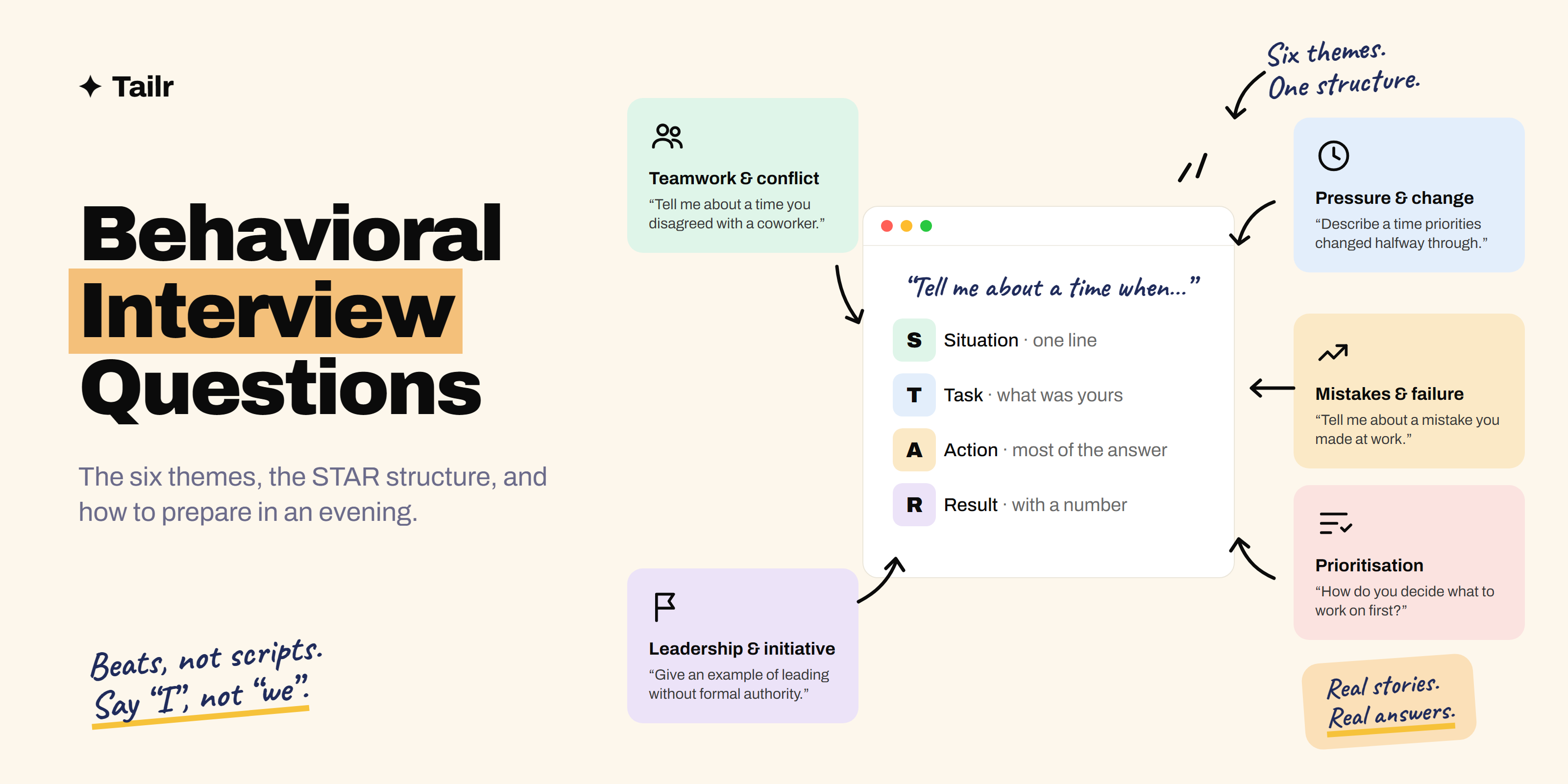
It’s the night before the interview and you want one page to go through, not forty. This is that page. Below are the questions that come up in almost every interview, behavioral or otherwise, grouped by what they’re really testing, each with a sample answer for a fresher and one for an experienced candidate. Read it once end to end, then go back and mark the six or eight questions your own stories fit best.
The short answer: Behavioral interview questions ask for a specific example of something you did. They cluster into six themes:
- Teamwork and conflict
- Pressure and change
- Mistakes and failure
- Leadership and initiative
- Communication
- Prioritisation
Alongside them, five general questions open almost every interview:
- Tell me about yourself.
- Why here?
- What’s your biggest weakness?
- Why should we hire you?
- Where do you see yourself in five years?
Every one of them is answered the same way: a short, specific story with a situation, a task, what you did, and a result. Six to eight stories from your own experience will cover all forty questions below.
How to use this the night before
- Read the whole thing once. Don’t memorise anything yet.
- For each question, note which of your own stories could answer it. You’ll find the same handful keep coming up. Those are your stories.
- Write each story as four lines, S, T, A, R. Put a number in the result wherever you can.
- Say each one out loud once, with a timer. One to two minutes.
- Sleep. A rested candidate with six stories beats a tired one with twenty.
The sample answers are there to show shape and level of detail. Don’t use them as scripts; an interviewer can tell, and a follow-up question exposes it immediately. Swap in your own situation, your own numbers, your own result.
STAR in sixty seconds
Situation (one or two sentences), task (what was your responsibility), action (most of the answer, in the first person), result (what happened, with a number, plus one line on what you learned). The most common failure is spending half the answer on the situation. Here’s the difference:
Weak: “We had a big project with a tight deadline and there was a lot going on. The team was stressed. We worked hard and got it done on time and the client was happy.”
Strong: “Our launch was two weeks out and the QA backlog was 40 tickets. I was the only tester on the project. I sorted the tickets by user impact, agreed with the product manager that we’d ship with the bottom 12 as known issues, and paired with a developer on the top five so fixes and retests happened the same day. We shipped on the date with zero customer-reported bugs in the first month, and the triage sheet became the template for the next two launches.”
Same story. The second one has a task, a decision, a number, and a follow-on effect.
The five questions that open almost every interview
These aren’t strictly behavioral, but they’re asked in nearly every interview and they set the tone for everything after. Have them ready.
1. Tell me about yourself.
What they’re really asking: give me a two-minute summary that tells me why you’re sitting in this chair. Present, past, future: what you do now, how you got here, why this role.
Fresher answer: “I’ve just finished a degree in mechanical engineering, and the part I enjoyed most was the final-year project where four of us designed and built a low-cost water filter for a village NGO. I ran the testing side: I set up the test rig, logged 60 trials, and the data we collected got the design through the NGO’s review. Alongside that I did a summer internship at a manufacturing plant, mostly on quality checks, which is where I learned I like the practical, measurable side of engineering. That’s why I applied for this graduate quality engineer role: it’s exactly that combination of hands-on testing and data.”
Experienced answer: “I’m a product manager with six years in B2B software, currently at a payments company where I own the onboarding product. Over the last two years I’ve taken onboarding from a 14-day median to four days, mostly by cutting the manual verification steps, which lifted activation by about 20 percent. Before that I spent three years at a smaller startup where I did a bit of everything, which is where I learned to work closely with engineers and sales. I’m looking for a role where I can own a bigger surface area, and the platform PM role here looked like exactly that.”
2. Why do you want to work here?
What they’re really asking: have you done any research, and is there a real reason beyond “you’re hiring”.
Fresher answer: “Two reasons. First, the graduate programme here rotates through three teams in the first year, and as someone who hasn’t worked full time yet, I’d rather find out what I’m best at by doing it than by guessing. Second, I’ve used your app for two years, and the thing I noticed is that it does one thing very well instead of ten things badly. I read your engineering blog post about how you decide what not to build, and that’s a way of thinking I’d like to learn.”
Experienced answer: “I’ve been following your move into mid-market accounts for about a year. That’s the segment I’ve spent most of my career in, and it’s a different sales motion from enterprise: shorter cycles, more self-serve, more reliance on product. Your job listing talks about building the playbook for that segment rather than running an existing one, and that’s the part of the work I’m best at and enjoy most. I also spoke to two people who’ve worked here and both said the same thing about how decisions get made, which matched what I was looking for.”
3. What’s your greatest weakness?
What they’re really asking: are you self-aware, and are you doing anything about it.
Fresher answer: “I’m not naturally good at speaking up in a group when I’m the least experienced person in the room. During my internship I sat through two weeks of stand-ups without asking a question I had, and it turned out three other people had the same question. So I made a rule: one question or comment per meeting, minimum. It felt awkward for about a month. By the end of the internship my manager mentioned in my review that I’d become one of the more vocal interns, which I wouldn’t have predicted.”
Experienced answer: “I hold on to problems too long before delegating. Two years ago I was running a team of five and still doing the vendor negotiations myself because I’d always done them. It only became obvious when I took two weeks’ leave and the renewals stalled. Since then I’ve made a point of handing off anything I’ve done more than twice, with a written checklist. My team now runs all vendor renewals, and my own time went back into the roadmap work I was hired for. I still catch myself doing it with new things; I just catch it faster.”
4. Why should we hire you?
What they’re really asking: match yourself to the job listing. Pick the two or three things the role needs most and show you’ve done them.
Fresher answer: “The listing asks for three things: SQL, comfort with ambiguity, and communication. On SQL, I did the analytics for our college fest, pulling ticketing data across three years to work out which events to cut, and the committee used it. On ambiguity, my internship project had no spec: I was told ‘find out why returns are up’, and I built the analysis from scratch and presented it to the ops head. On communication, I’ve done two years of student radio, so I’m used to explaining things clearly to people who aren’t paying full attention. I won’t have the experience of other candidates, but I’ll learn quickly and I’ve already done a small version of this job.”
Experienced answer: “You need someone who can take a support team from 8 to 20 people without the quality dropping. I’ve done that once already, at my current company, where we went from 6 to 18 in fourteen months and CSAT went up two points over the same period. The things that made it work, a written onboarding path, a QA rubric, and hiring for writing ability, are things I can bring on day one. The other thing I’d offer is that I’ve worked in both a startup and a large company, so I know what processes are worth adding at your stage and which ones are premature.”
5. Where do you see yourself in five years?
What they’re really asking: does this job fit into a plan, and are you likely to stay long enough to be worth training.
Fresher answer: “Honestly, I don’t have a five-year job title in mind, and I’d be suspicious of myself if I did. What I do know is that in five years I want to be the person on the team that others come to for one specific thing. I don’t know yet whether that’s data, or process, or a domain. The reason the rotation here appeals is that it’s the fastest way to find out. If I’ve found that thing by year three and I’m getting good at it by year five, I’d count that as a success.”
Experienced answer: “In five years I want to be leading a function, not just a team. The gap between where I am and that is mostly commercial: I’ve run delivery well but I haven’t owned a P&L. This role includes budget ownership for the first time, and that’s the main reason I applied rather than staying put. If I do the job well, the natural next step here is head of operations, and that’s a path I’d want to earn.”
Teamwork and conflict
What they’re testing: can you disagree without it turning personal, and do you go to the person before going around them.
6. Tell me about a time you disagreed with a coworker.
Fresher answer: “In my final-year project one teammate wanted to build the whole app before testing any of it, and I thought we’d lose weeks if the core piece didn’t work. Rather than argue in the group chat, I asked him for twenty minutes and showed him a rough timeline where we’d have no demo for the mid-term review if a single thing broke. We agreed to build the riskiest piece first and test it alone. It did break, twice, and we fixed it in week three instead of week eight. We ended up getting the top mark for the demo, and he and I worked together on another project the next semester.”
Experienced answer: “A senior engineer and I disagreed about whether to rebuild our reporting pipeline or patch it. He wanted a rewrite; I thought we couldn’t afford the three months. Instead of taking it to our manager, I asked him to spend an afternoon with me listing every failure in the last quarter. It turned out 80 percent came from two components. We agreed to rewrite just those, which took five weeks. Failures dropped by around three quarters, and it gave us the data to justify the full rebuild the following year, which he then led. The thing I took from it is that most disagreements are really disagreements about the data.”
7. Describe a time you had to work with someone whose style was very different from yours.
Fresher answer: “During my internship I was paired with an analyst who wanted every detail confirmed before starting anything, while I tend to start and adjust. The first week was frustrating for both of us. So I suggested we split by strengths: she’d define the checks we needed to pass, I’d build the first version fast and she’d test it against her list. We shipped the report on time and it had fewer errors than the one I’d done alone the month before. I learned that the person who slows you down is often the person who’s stopping you from shipping something wrong.”
Experienced answer: “I managed a designer who worked best with long, uninterrupted stretches, while I ran a fairly chatty team with lots of quick check-ins. Her work was excellent but she was visibly stressed, and I was frustrated that I couldn’t get quick answers. I asked her what would help and we agreed on two protected days a week with no meetings and a shared doc for questions I’d otherwise have asked in person. Her output on the redesign went up noticeably, her feedback in the next survey went from a two to a four, and I ended up offering the same option to two engineers who asked for it.”
8. Tell me about a time you had to give someone difficult feedback.
Fresher answer: “I was the lead on a group assignment and one member kept submitting work late, which meant the rest of us were doing his part the night before. Instead of complaining to the tutor, I asked him for a coffee and just asked what was going on. It turned out he was working two part-time jobs. We agreed on a smaller, clearly scoped piece he’d own fully, with an earlier deadline so there was slack. He delivered every piece after that. I learned to ask before assuming.”
Experienced answer: “One of my best-performing salespeople was also the one other teams complained about most: promises to customers that engineering couldn’t keep. I prepared for the conversation with three specific examples and the cost of each, and I started with what she did well so it was clear I wasn’t questioning her value. Then I was direct about the pattern and the consequence. She was defensive at first, but we agreed she’d loop in a solutions engineer before committing to any custom work. Her close rate didn’t drop, and escalations from her accounts went from roughly one a week to one a quarter.”
Pressure, change and ambiguity
What they’re testing: do you stay useful when things are unclear or moving. Show the decision you made, the trade-off you accepted, and how you told people.
9. Tell me about a time you had to meet a tight deadline.
Fresher answer: “In my second year our team’s hackathon project lost its backend developer the night before submission. We had 14 hours. I was doing the front end, so I made a call: cut two of the four features, hard-code the data for the demo, and make sure the two remaining features worked perfectly. I told the judges upfront which parts were mocked. We placed third out of 40 teams, and the feedback specifically mentioned that the demo was one of the few that didn’t crash.”
Experienced answer: “A regulatory change gave us six weeks to update how we stored customer data, in a system that usually took a quarter for any significant change. I broke the work into what was legally required versus what was nice-to-have, and got the compliance team to sign off on the minimum in writing, which nobody had asked them to do before. Then I took the two engineers off a lower-priority project and put in a daily 15-minute check-in. We shipped in five weeks, passed the audit, and the nice-to-haves went into the next quarter’s plan instead of being lost.”
10. Describe a time when priorities changed halfway through a project.
Fresher answer: “Two weeks into my internship project, which was an analysis of customer returns, my manager told me the leadership team now wanted it to focus on one product category rather than the whole range. Most of my data prep was still usable, but the framing wasn’t. I rewrote the plan that afternoon, sent it to her so she could confirm I’d understood the change, and reused about 70 percent of what I’d built. The narrower report was actually more useful, and it went straight into the category review meeting.”
Experienced answer: “We were three months into building a new self-serve signup flow when the company decided to move upmarket, which made self-serve much less important. I could have argued to finish it. Instead I looked at what we’d built and found that the identity verification piece was exactly what the enterprise onboarding team needed. I proposed we finish that one piece, hand it over, and stop the rest. We lost about a month of work rather than three, and the verification module cut enterprise onboarding time by about 30 percent. The lesson was to salvage rather than defend.”
11. Tell me about a decision you made without all the information.
Fresher answer: “At my campus job in the library, the booking system went down during exam week and students were arriving for study rooms with no way to check reservations. My supervisor wasn’t reachable. I decided to run first-come-first-served, wrote it on a whiteboard at the door with a start time, and kept a paper log so anyone with a real booking could be sorted out later. A couple of people were annoyed, but the queue moved and no one was double-booked. My supervisor said afterwards she’d have done the same thing.”
Experienced answer: “We had a suspected data issue in a customer-facing report, and the analyst who owned it was on leave. I couldn’t confirm the cause within the day. I had to decide whether to pull the report or leave it up. I pulled it, told the three affected customers why in plain language, and gave them a date. Two of them said they appreciated being told before they found it themselves. The cause turned out to be minor and we restored the report in two days. If I’d left it up and been wrong, the cost would have been much higher than two days of a missing report.”
Mistakes and failure
What they’re testing: self-awareness and ownership. Pick a real mistake with real consequences, own it without excuses, and spend most of the answer on what changed afterwards.
12. Tell me about a mistake you made at work.
Fresher answer: “In my internship I sent a weekly sales report to the regional team with last week’s figures because I’d copied the wrong tab. Someone spotted it within an hour. I sent a correction immediately, with a one-line apology and the right file, rather than hoping nobody had noticed. Then I built a check into the sheet that flags if the date range doesn’t match the current week. My manager used that sheet for the rest of the year. I’d rather be known as the intern who fixed the process than the one who made the mistake.”
Experienced answer: “I approved a pricing change that went live on a Friday afternoon without a rollback plan. It broke checkout for a subset of customers for four hours and we lost roughly a day’s revenue from that segment. I told my director that evening, took responsibility in the incident review, and then wrote the release checklist we should have had: no pricing changes after Wednesday, a tested rollback for anything touching checkout, and a named person watching for an hour after release. We’ve had no checkout incidents from releases since. It was an expensive lesson, but it’s a process the whole team still uses.”
13. Describe a time you failed to meet a goal.
Fresher answer: “I set a goal to get 200 people to a student society event and got 90. I’d focused almost entirely on social media and assumed that would be enough. Afterwards I asked the 90 who came how they’d heard about it, and most said a friend told them in person. For the next event I gave each committee member ten people to personally invite, and we got 170. I didn’t hit the original target that time either, but I learned more from the miss than I’d have learned from hitting it by luck.”
Experienced answer: “I committed to launching a partner integration by the end of Q2 and we shipped it in mid-Q3. The root cause was that I’d estimated based on our side of the work and not the partner’s, and their legal review alone took six weeks. I told stakeholders in week three of the slip rather than hoping to catch up, and gave a revised date we then hit. The change I made afterwards was to put every external dependency on the plan with its own owner and its own date. The next two partner launches both shipped on time.”
14. Tell me about a time you received critical feedback.
Fresher answer: “My internship manager told me my written updates were too long and she couldn’t find the point. It stung because I’d put effort into them. I asked her for an example of one she liked, and it was three lines: what’s done, what’s next, what’s blocked. I switched to that format the next week. By the end of the internship she was forwarding my updates to her manager unchanged, which she’d never done with the long ones.”
Experienced answer: “In a 360 review, two of my reports said I gave feedback too rarely and that they only heard from me when something was wrong. My first reaction was that they were being unfair, since I thought I was protecting their time. But when I checked my calendar I’d cancelled half of our one-to-ones that quarter. I put them back, made them non-negotiable, and started each with something specific that had gone well. In the next review, the same question went from a two to a four. The thing I took from it is that your intent doesn’t matter if the experience on the other side is different.”
Leadership and initiative
What they’re testing: do you act like an owner. You don’t need a title for this one.
15. Tell me about a time you led without formal authority.
Fresher answer: “In a group project of five, nobody was assigned as lead and by week two we had no plan. I didn’t want to appoint myself, so I put together a one-page plan with tasks and dates, sent it to the group, and asked people to pick what they wanted. Everyone picked something within a day. I kept a shared tracker and sent a short reminder every Monday. We submitted two days early. Nobody ever called me the lead, but the plan was the thing that made it work.”
Experienced answer: “Our on-call rota was a mess: three teams, three different processes, and nobody owned the whole thing. I wasn’t a manager, but I’d been on the sharp end of it enough times. I wrote a proposal for a single rota with a shared runbook, got informal sign-off from the three team leads by showing each of them the incidents it would have prevented on their team, and ran the first month myself. Median time-to-acknowledge dropped from 25 minutes to 8. A year later it’s still the process, and I was later asked to lead the platform team partly because of it.”
16. Describe something you improved that nobody asked you to.
Fresher answer: “At my part-time café job, the closing checklist was a printed sheet that was always missing or out of date. I made a laminated version with a whiteboard marker, added the two steps people kept forgetting, and put it by the till. Closing time went from about 45 minutes to 30, and the manager rolled it out to the other branch. It’s a tiny thing, but it’s the kind of thing I notice.”
Experienced answer: “New hires on my team were taking about three months to become productive, and everyone treated that as normal. Nobody had asked me to fix it. I interviewed the last four hires about what had slowed them down, and most of it was environment setup and not knowing who to ask. I wrote a first-week guide and a setup script, and paired each new hire with a named buddy. The next three hires shipped their first change in their second week. My manager put it in my review as the most valuable thing I’d done that year, and it wasn’t on any roadmap.”
17. Tell me about a time you pushed back on a manager.
Fresher answer: “My internship manager asked me to add a fourth chart to a dashboard the day before it went to the leadership team. I thought it would make the page harder to read, and I said so, but I also offered a middle ground: put the fourth chart on a second tab so it was there if anyone asked. She agreed. In the meeting nobody clicked the second tab. She mentioned later that she’d appreciated that I’d pushed back with an alternative rather than just doing it or just refusing.”
Experienced answer: “My director wanted to cut the QA phase from our release process to hit a launch date. I understood why, but I’d seen what happened last time. I asked for fifteen minutes and brought the data: the last release without full QA had cost us two weeks of firefighting, which was longer than the QA phase itself. I proposed a reduced QA scope focused on the payment paths and a delay of three days rather than the two weeks she’d assumed. She took it. We launched three days late with no critical bugs. Since then she’s asked for my input on release timing rather than around it.”
Communication
What they’re testing: do you adjust to the audience. The strong version names who you were talking to and what you did differently for them.
18. Tell me about a time you had to explain something technical to a non-technical person.
Fresher answer: “For my final-year project I had to present a machine learning model to the NGO staff who’d be using it. I’d prepared slides full of accuracy metrics and they were lost within two minutes. So I stopped, put the slides away, and showed them the model as a colleague: ‘Here’s what you’d give it, here’s what it gives back, here’s how often it’s wrong and what you’d do then.’ The questions changed immediately from confused to practical. I rewrote the whole presentation that way for the final review.”
Experienced answer: “I had to explain to our CFO why a migration would cost two quarters of engineering time with no visible feature output. I dropped the architecture entirely and framed it as insurance: here’s what the current system costs us per month in incidents and manual work, here’s the probability of a serious outage, here’s what one would cost. He asked two questions, both about the numbers, and approved it. I’ve used the same approach since: for a finance audience, translate everything into cost and risk.”
19. Tell me about a time you persuaded someone to change their mind.
Fresher answer: “Our society committee wanted to hold the annual event at the same venue as always. I thought we were losing attendance because it was off-campus. Rather than argue, I put up a two-question poll in the society group: would you come to an on-campus venue, and did the location stop you last year. 140 people answered and 60 percent said location had put them off. The committee changed the venue, and attendance went from 90 to 170. I learned that a small piece of real data beats a good argument.”
Experienced answer: “Our head of sales wanted to build a custom feature for one large prospect. I thought it would tie up half the team for a deal we might not win. Rather than say no, I asked her what the feature was really for, and it turned out the prospect needed an export in a particular format. I showed her that a generic export tool would meet that need and also help forty existing customers who’d asked for one. She agreed to pitch the generic version. We won the deal, shipped the export in three weeks, and it became one of our most-used features.”
20. Tell me about a time you had to deliver bad news.
Fresher answer: “During my internship I found that a report the team had been sending to a client for two months had a formula error that overstated one figure. I had to tell my manager, who’d been signing it off. I brought the exact error, the corrected numbers, and a draft of the note to the client, so the conversation was about the fix rather than the blame. She sent the note that day. The client thanked us for catching it.”
Experienced answer: “I had to tell a customer that a feature they’d been promised by a previous account manager wasn’t going to be built. I called rather than emailed, said it plainly in the first minute, explained why, and then spent the rest of the call on what we could do instead, which was a workaround using an existing integration. They were unhappy, but they renewed. I’ve found the worst thing you can do with bad news is bury it in the third paragraph.”
Prioritisation and time management
What they’re testing: do you have a method, and do you tell people early when something will slip.
21. How do you decide what to work on when everything is urgent?
Fresher answer: “During exams I had three deadlines in the same week plus shifts at my part-time job. I listed everything, estimated the hours, and ranked by what would hurt most if it were late: the assignment worth 40 percent went first, the 10 percent one last. Then I asked my shift manager two weeks ahead to swap one shift, rather than the night before. Everything went in on time. The method is simple: write it down, rank by consequence, and ask for help early rather than late.”
Experienced answer: “My default is impact over effort, with a second pass for what’s blocking other people. Last quarter I had a compliance deadline, a customer escalation, and a roadmap item all land in the same week. I ranked them: the compliance item had a hard external date, the escalation had a single unblocked step I could do in an hour, and the roadmap item could slip a week without anyone outside the team noticing. I told my manager that order on Monday morning so there were no surprises. All three were done by the following Wednesday, and nobody had to chase me.”
22. Tell me about a time you had to juggle several projects at once.
Fresher answer: “In my final semester I was doing my thesis, a group project, and running the society’s biggest event, all with deadlines in the same month. I used a single weekly plan with fixed blocks for each, so I wasn’t deciding every morning what to work on. I also decided early which one I’d let slip if I had to, which was the society event, and I told the committee that so they could pick up more. In the end nothing slipped, but knowing what would have made everything less stressful.”
Experienced answer: “I was running two product launches with overlapping timelines, and a third team needed my input on a pricing change. I gave each launch a named deputy who owned the day-to-day, and I moved to twice-weekly check-ins rather than daily. For the pricing work I set a fixed two-hour block on Fridays and asked them to batch questions. Both launches shipped within a week of plan, and the deputies both said it was the most responsibility they’d been given. Juggling well is mostly about deciding what you don’t personally need to hold.”
23. Tell me about a time you missed a deadline.
Fresher answer: “I missed a coursework deadline by a day in my second year because I’d underestimated how long the data cleaning would take. I emailed the tutor before the deadline, not after, explained where I was, and asked for an extension. She gave me 24 hours and docked a small amount. The change I made was to start every assignment by doing the boring part first, because it’s always the boring part that takes longer than I think.”
Experienced answer: “We missed a client delivery by two weeks because a subcontractor’s piece was late and I’d had no visibility into their progress. I told the client the day I knew, not the day of the deadline, gave them a new date, and offered a reduced scope to hit the original one if they preferred. They took the new date. Afterwards I added weekly written check-ins to every subcontractor agreement, with a demo at the halfway point. We’ve not missed a client date since. The lesson was that I’d been managing my own team’s risk and not the project’s.”
Seventeen more questions to expect
You won’t be able to prepare a full answer for everything, but knowing what each is testing means your existing stories can bend to fit.
| Question | What they’re testing |
|---|---|
| Tell me about a time you went above and beyond for a customer. | Ownership; whether you notice the person behind the ticket. |
| What’s your proudest professional achievement? | Whether you measure success in outcomes or activity. |
| Tell me about a time you had to learn something quickly. | How you learn; whether you ask for help. |
| Describe a time you had to adapt to a new tool or process. | Attitude to change. |
| Tell me about a time you worked with a team in another location or time zone. | Written communication; proactive updates. |
| Tell me about a time you handled an angry customer. | Composure; whether you solve or deflect. |
| Describe a time you took a calculated risk. | Judgement; whether you thought about the downside. |
| Tell me about a goal you set and how you achieved it. | Follow-through; whether you track progress. |
| Tell me about a time you had to ask for help. | Whether you know your limits. |
| Describe a time you faced an ethical dilemma at work. | Integrity; whether you escalate. |
| Tell me about a time you motivated a struggling teammate. | Empathy; whether you ask before advising. |
| Tell me about a time you had to say no to a request. | Boundaries; whether you offer an alternative. |
| Describe a time you had too much to do and not enough time. | Prioritisation under real pressure. |
| Tell me about a time you were bored or under-used in a role. | Initiative; what you do with slack. |
| Tell me about a time you worked with a difficult manager. | Managing upward; discretion. |
| What would your last manager say about you? | Self-awareness; whether you know your reputation. |
| Is there anything you’d like to ask us? | Curiosity; whether you’ve been listening. |
On that last one: always have two questions. Good ones are “What does someone in this role do in their first 90 days that tells you they’re going to be good?” and “What’s the hardest part of this job that the listing doesn’t mention?”
Mistakes that cost people the offer
- Answering the hypothetical instead of the behavioral. If the question starts with “Tell me about a time”, they want a time. “I would usually…” is a non-answer.
- All “we”, no “I”. Crediting the team is good. Never saying what you personally did leaves the interviewer unable to assess you.
- No result. Stories that end at the action feel unfinished. Even “it didn’t work, and here’s what I changed” is a result.
- A story that’s too old. A university example is right for a fresher. Five years into a career it suggests nothing has happened since.
- The fake weakness. “I’m a perfectionist” or “I work too hard” tells the interviewer you didn’t take the question seriously.
- Rehearsing word for word. Beats, not scripts. A memorised answer collapses the moment they interrupt with a follow-up.
- Not reading the job listing. The behaviours it names, “thrives in ambiguity”, “cross-functional”, “bias for action”, are the themes you’ll be asked about. Prepare for those first.
Where Tailr fits
The questions you’ll get are shaped by the job listing and by what’s on your resume, so the best prep starts with both. Tailr tailors your resume to the specific job you’re viewing, which puts the experience that matches the listing’s behaviours front and centre, so the interviewer asks about the stories you’ve prepared. If your resume says you cut onboarding time in half, have the STAR version ready; every line on it is a behavioral question waiting to happen. To see how that works, start with how to tailor your resume to a job description, and keep it honest with how to tailor your resume without lying. Try Tailr to line the resume up before you rehearse the answers.
For practising delivery, the mock-interview tools in best tools for interview preparation let you record yourself answering and hear where you ramble.
Related guides
- 50 Group Discussion Topics and How to Score in a GD
- 30 Most Asked HR Interview Questions and Answers
- 30 Situational Interview Questions With Sample Answers
- 25 Interview Tricks You Should Know Before Your Next Interview
- How to Answer “Tell Me About Yourself” in Any Interview
- How to Answer “What Is Your Greatest Weakness?” (With Examples)
- Interview answer frameworks: 7 methods to structure any answer
- Top 20 sales interview questions and how to answer them
Conclusion
Forty questions look like a lot the night before. They’re not, because they’re six themes and five openers wearing different words. Pick six to eight real stories, write each one as situation, task, action, result, put a number in the result, and say them out loud once. Read the job listing for the behaviours it names, and make sure your resume and your stories point at the same ones. Then sleep. Tomorrow, “Tell me about a time when…” is the part of the interview you’re readiest for.
Frequently asked questions
01What are the most common behavioral interview questions?
The ones that come up in almost every interview are: tell me about yourself, why do you want to work here, what's your greatest weakness, tell me about a time you disagreed with a coworker, describe a time you worked under pressure, tell me about a mistake you made, and tell me about a time you led something. Most other behavioral questions are variations on those themes.
02How do I answer behavioral interview questions as a fresher with no work experience?
Use what you do have: college projects, internships, part-time jobs, hackathons, clubs, volunteering, and group assignments. Interviewers asking freshers behavioral questions want to see how you think and behave, not a long employment history. Pick a situation with a real problem and a real outcome, and tell it with the same situation-task-action-result structure an experienced candidate would use.
03What is the STAR method for answering behavioral questions?
STAR stands for situation, task, action, result. You set the scene in a sentence or two, say what you were responsible for, spend most of the answer on what you personally did, and finish with what happened, ideally with a number. It keeps an answer focused and makes sure you don't skip the result, which is the part interviewers care about most.
04How long should a behavioral interview answer be?
Aim for one to two minutes. That's long enough to give real detail on the action and result, and short enough that the interviewer can follow up. If you're past three minutes you're almost certainly spending too long on the situation and not enough on what you did.
05How many stories should I prepare for a behavioral interview?
Six to eight good stories cover nearly every question. Pick ones from the last few years that had a clear challenge and a clear outcome, and make sure at least one is a mistake or failure. The same story can answer several different questions depending on which part you emphasise.
06How do I answer the greatest weakness question?
Pick a real weakness that isn't central to the role, describe it plainly, and spend most of the answer on what you're doing about it with a concrete example. Avoid fake weaknesses like being a perfectionist or working too hard; interviewers have heard them hundreds of times and read them as dodging the question.