Top 20 Sales Interview Questions and How to Answer Them
· updated
A sales interview is a sales call where the product is you. The questions are fairly predictable, and the hiring manager is listening for two things at once: what you say, and whether you sell well while you say it. This guide covers the 20 questions that come up most for SDR, account executive and account manager roles, what each one is really testing, and how to answer it.
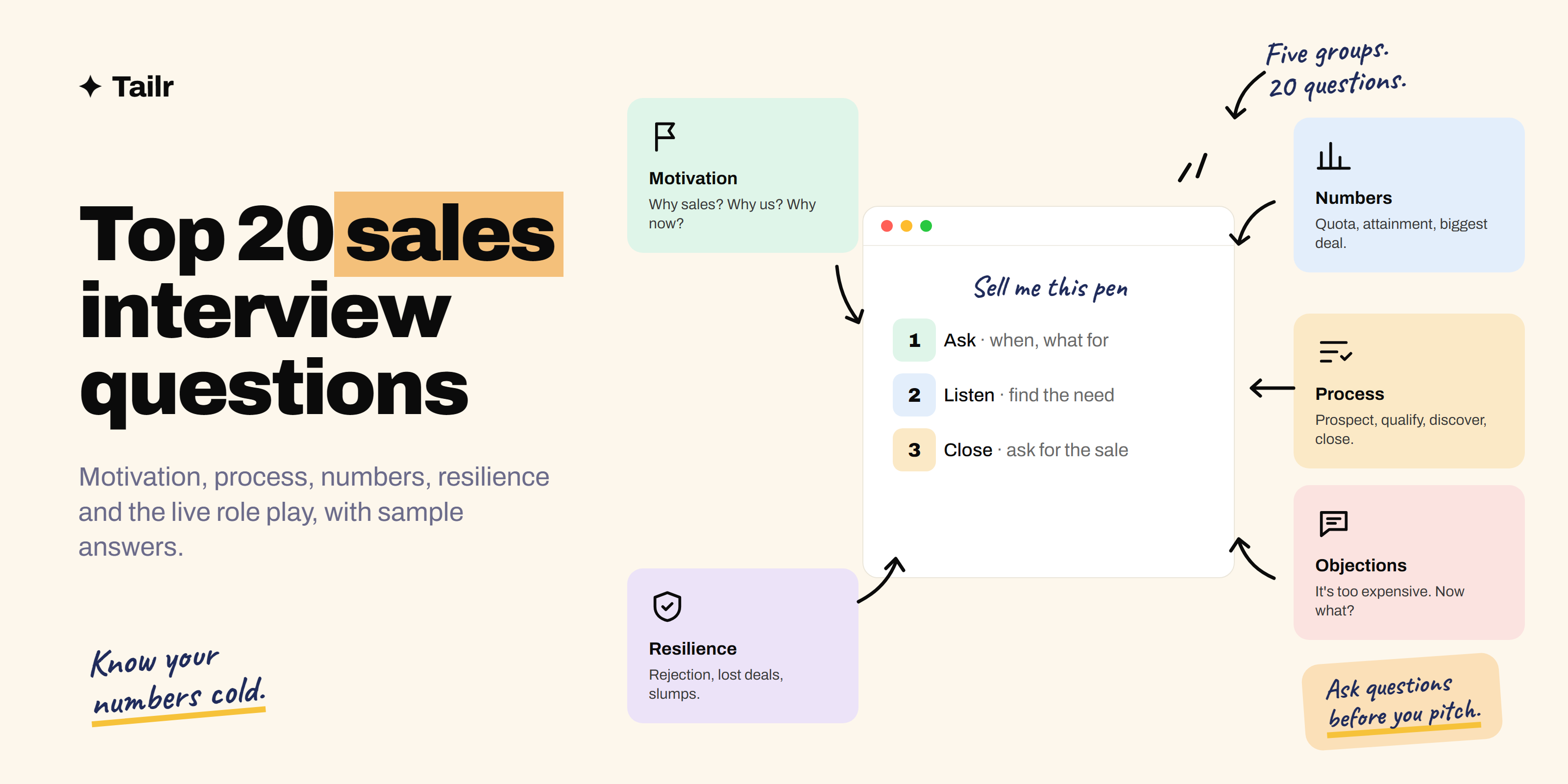
The short answer: the 20 sales interview questions you’re most likely to hear fall into five groups:
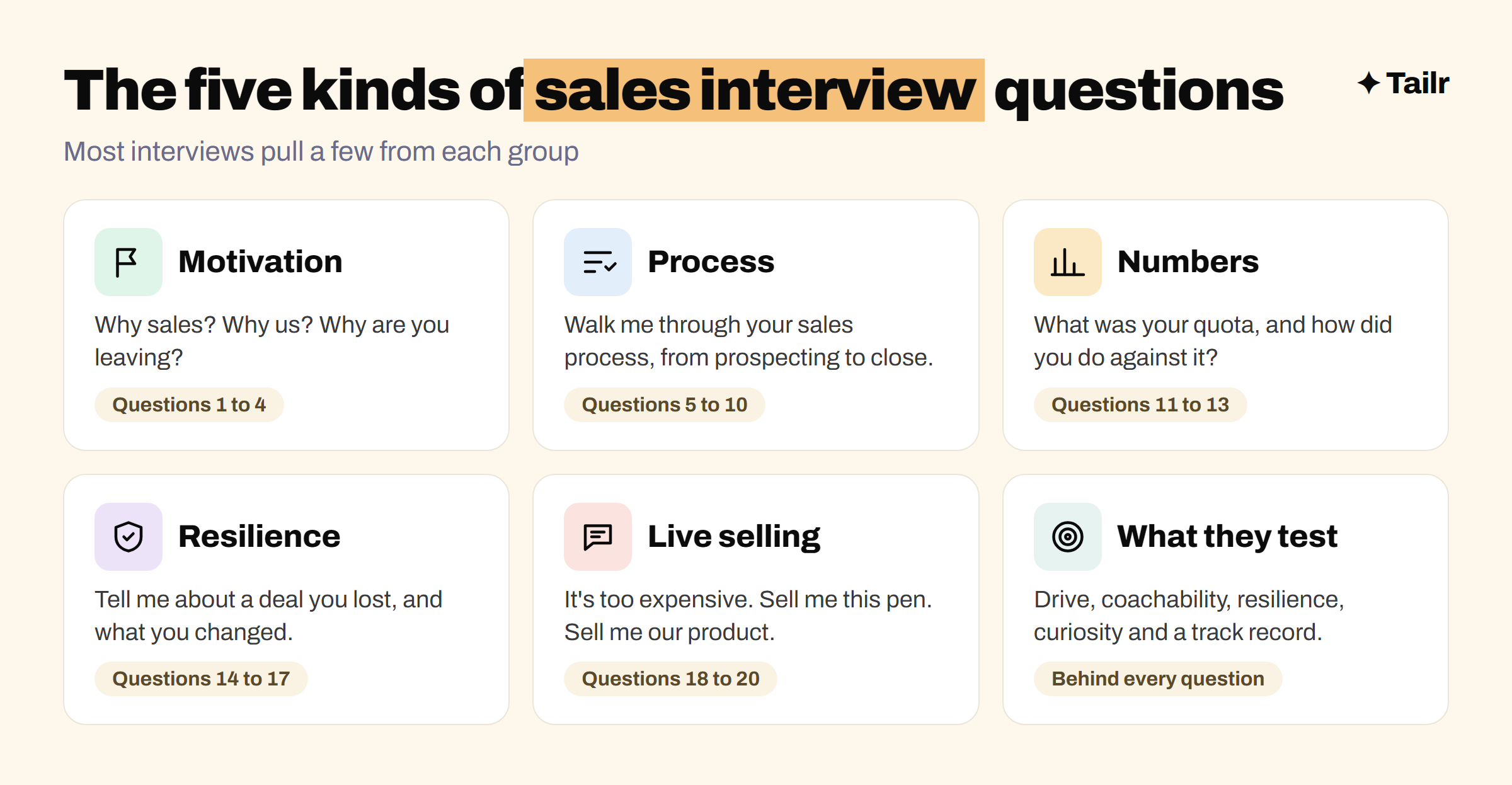
- Motivation: why sales, why this company, why you’re leaving, where you see yourself.
- Process: your sales process, how you prospect, qualify, run discovery and close.
- Numbers: quota attainment, your biggest deal, your pipeline and the metrics you track.
- Resilience: rejection, lost deals, slumps and hard customers.
- Live selling: objection handling and the “sell me this pen” role play.
Answer with real numbers, use a short story for every behavioural question, and treat the whole interview as a deal you’re trying to close.
What sales interviewers are really testing
Every sales hiring manager is trying to predict one thing: will this person hit quota here? They get there through a handful of traits:
- Drive. Do you want to win, and do you work hard when nobody’s watching?
- Coachability. Can you take feedback and change your approach quickly?
- Resilience. Sales is mostly hearing no. How do you bounce back?
- Curiosity. Do you ask good questions, or just pitch?
- Track record. Have you hit numbers before, in sales or anywhere else?
Keep those five in mind. Almost every question below maps to one of them.
Motivation questions
1. Why do you want to work in sales?
They’re checking that you understand the job: targets, rejection and variable pay. Weak answers talk about “loving people”. Strong ones talk about liking measurable results and solving problems for buyers.
“I like work where the result is clear. In my last role I ran our society’s sponsorship drive and raised ₹4.2 lakh from 23 local businesses, and I enjoyed the whole loop: finding the right person, working out what they cared about, and getting a yes. Sales is that, every day, with a number that tells me how I’m doing.”
2. Why do you want to sell for us?
Show you’ve researched the product, the buyer and the market. Mention who the company sells to and why the product wins.
“You sell to mid-size logistics companies, and from the reviews I read, customers pick you because setup takes days rather than months. That’s an easy story to tell a buyer who’s been burned by a long implementation, and it’s the kind of product I’d want to put my name behind.”
3. Why are you leaving your current role?
Stay positive and forward-looking: a bigger market, a more complex sale, a better product fit. Never criticise your current manager.
4. Where do you see yourself in three to five years?
Sales managers like ambition with a plan. “Moving from SDR to AE within 18 months, then into a mid-market or enterprise role” is a fine answer, as long as it fits the career path they actually offer.
Process questions
5. Walk me through your sales process
This is the big one for experienced reps. Give clear stages: research, prospecting, discovery, demo, proposal, negotiation, close, handover. Name the methodology you use if you have one (MEDDIC, BANT, SPIN, Challenger) and give one example of how a stage played out in a real deal.
6. How do you prospect and build pipeline?
Talk channels, volume and conversion. “I build a list of 50 accounts a week using job changes and funding news, run a three-touch sequence across email, LinkedIn and phone, and book about eight meetings a month from that” is far better than “I use LinkedIn a lot”.
7. How do you qualify a lead?
Show you don’t waste time on deals that won’t close. Mention budget, authority, need and timeline, and give one sign that tells you to walk away.
8. How do you run a discovery call?
Interviewers want to hear more questions than pitch. Describe how you uncover the problem, the cost of the problem, who else is involved and what happens if they do nothing.
9. How do you close a deal?
Explain how you agree next steps on every call, confirm the decision process early and ask for the business directly. Closing isn’t a trick at the end; it’s the result of a clean process.
10. How do you work with marketing, sales engineers and customer success?
Modern sales is a team sport. Give an example of using a sales engineer for a technical demo or handing a customer to customer success with clear notes.
Numbers questions
11. What was your quota, and how did you perform against it?
Give the quota, your attainment, your rank and the period. Be exact and be honest; good managers check with references.
“My 2025 quota was $640K in new ARR. I closed $755K, which was 118%, and I finished second of nine reps. The first half was slow, at 82%, so I rebuilt my outbound around recently funded companies and closed three of my four biggest deals in Q4.”
12. Tell me about your biggest deal
Pick one with a clear story: how you found it, who was involved, what nearly went wrong and how you closed it. Size matters less than the clarity of your role.
13. What metrics do you track for yourself?
Activities (calls, emails, meetings booked), conversion rates at each stage, pipeline coverage (often three times quota), average deal size and sales cycle length. Mention one metric you improved deliberately.
Resilience questions
14. How do you handle rejection?
Show a routine, not a feeling. “I review the call notes for one thing I’d change, log it, and get on the next call within ten minutes” sounds like someone who’ll survive a cold-calling block.
15. Tell me about a deal you lost
Own the loss, explain what you learned, and show what you do differently now. This is a behavioural question, so use a short story with a clear result. The structures in our guide to interview answer frameworks help here.
16. Tell me about a time you missed your target
Same approach: what happened, what you changed, and the result the following quarter. Never blame leads, territory or the product.
17. How do you deal with a difficult customer?
Describe listening first, restating the problem, being honest about what you can and can’t do, and following up in writing.
Live selling questions
18. How do you handle an objection?
Give a simple method: acknowledge, ask a question to understand it, respond with evidence, and check it’s resolved. Then show it on a real objection like “it’s too expensive”:
“That makes sense. When you say too expensive, is it the total price or how it compares to what you’re spending today? … Right, so today your team spends about 30 hours a month on manual reports. At your average salary, that’s more than the licence costs. Does that change how you see the price?”
19. Sell me this pen
The classic. Don’t describe the pen. Ask questions first: “When did you last use a pen? What for? What happened when you didn’t have one?” Then sell the pen as the answer to the need they just told you, handle one objection, and ask for the sale: “Shall I put you down for a box of ten?”
20. Sell me our product
A modern version of the pen. Research the product well enough to do a two-minute pitch to their typical buyer. Start with a question about the buyer’s problem, connect one or two features to it, and close with a next step.
How to prepare for a sales interview in a week
- Know your numbers cold. Quota, attainment, rank, deal sizes, conversion rates. Write them down.
- Prepare six stories. A big win, a lost deal, a missed target, a hard customer, a time you were coached, a time you went beyond the process.
- Research the company like a prospect. Who they sell to, their main competitors, their pricing model, recent news.
- Rehearse the role play. Practise “sell me this pen” and a pitch for their product out loud.
- Prepare your close. At the end, ask whether they have any concerns about your fit, and ask about next steps.
Tailor your resume like a sales pitch
Your resume is the first pitch the hiring manager sees, and sales managers read it for numbers. Put quota attainment, rank and deal sizes in your top bullets, and use the language of the listing: if it says “full-cycle”, “outbound” or “mid-market”, show where you’ve done exactly that. Tailr is a Chrome extension that does this from the job listing you’re viewing: it tailors your resume to the role, writes a matching cover letter and tracks the application. For more on this, see how to tailor your resume to a job description.
Try TailrRelated guides
- 40 behavioral interview questions with sample answers
- Questions to ask at the end of an interview
- GTM interview questions and answers
Conclusion
Sales interviews reward preparation more than charisma. Know your numbers, have six stories ready, research the company the way you’d research a prospect, and practise the role play out loud. Then sell yourself the way you’d sell the product: ask good questions, handle pushback calmly and, before you leave the room, ask for the next step.
Frequently asked questions
01What are the most common sales interview questions?
The most common are: why do you want to work in sales, walk me through your sales process, what was your quota and how did you do against it, tell me about a deal you lost, how do you handle rejection, how do you handle an objection, and sell me this pen. Expect at least one role play and several questions about numbers.
02How do you answer 'sell me this pen'?
Don't start by describing the pen. Ask questions first: when did you last use a pen, what for, what annoyed you about it. Then pitch the pen as the answer to the need they described, handle any objection calmly, and finish by asking for the sale. The interviewer is testing discovery and closing, not product knowledge.
03How do I answer sales interview questions with no sales experience?
Use experience that shows the same skills: persuading people, handling rejection, hitting targets and talking to strangers. Retail, hospitality, fundraising, recruiting for a student club and customer support all count. Give numbers where you can, and show you've researched the company's product and buyers.
04What do sales managers look for in an interview?
They look for drive, coachability, resilience after rejection, curiosity about the customer, and a track record of hitting numbers. They also watch how you sell yourself in the interview itself: whether you ask good questions, handle pushback well and ask for the next step at the end.
05How do I talk about my quota attainment in an interview?
Be specific and honest: give the quota, the percentage you hit, your rank on the team and the time period, such as '118% of a $600K annual quota, second of nine reps in 2025.' If a year went badly, say so, explain what changed and show the improvement since. Interviewers often verify numbers with references.
06What questions should I ask at the end of a sales interview?
Ask what percentage of reps hit quota last year, how territories and leads are assigned, what the ramp period looks like, what separates the top rep from the rest, and what the hiring manager would need to see from you in the first 90 days. Then ask directly whether they have any concerns about your fit.