30 Questions to Ask at the End of an Interview
· updated
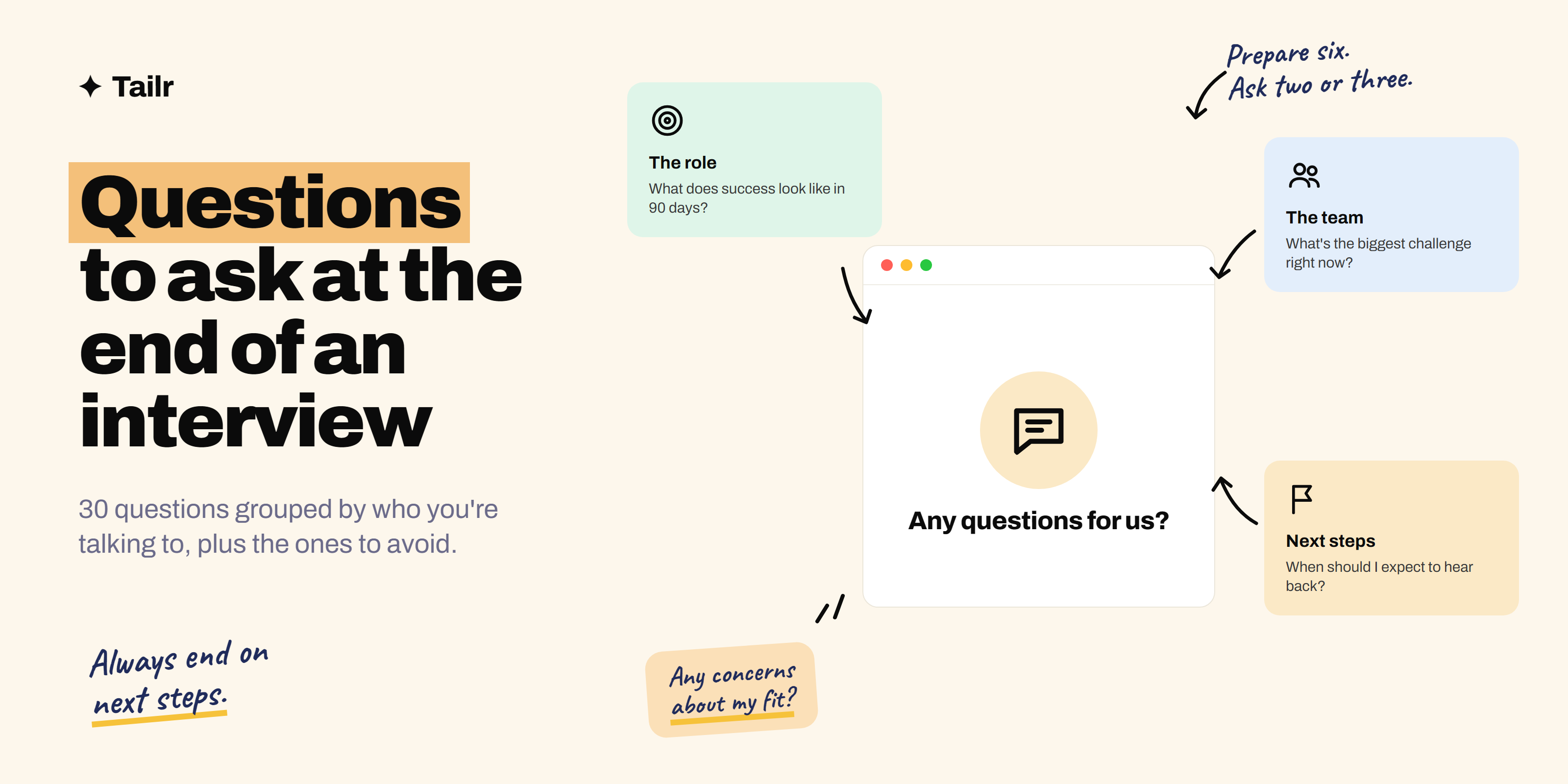
“Do you have any questions for us?” comes at the end of almost every interview, and it isn’t a formality. Interviewers judge you on your questions: they show how much you’ve prepared, what you care about and how you think. A great question can also uncover a doubt you can fix before you leave the room. Here are 30 questions worth asking, grouped by who you’re talking to, plus the ones to avoid.
The short answer: the best questions to ask at the end of an interview are:
- “What would success look like in the first 90 days?”
- “What’s the biggest challenge the team is facing right now?”
- “How will my performance be measured?”
- “What do the people who do best in this role have in common?”
- “Is there anything in my background that makes you unsure about my fit?”
- “What are the next steps, and when should I expect to hear back?”
Prepare five or six, ask two or three, and always end with next steps.
Why your questions matter
Your questions do three jobs at once:
- They show interest. Specific questions prove you’ve thought about this role, not just any job.
- They help you decide. You’re interviewing them too. The answers tell you whether you’d actually want the job.
- They give you a last chance to sell. A question like “what’s the biggest challenge?” lets you respond with how you’ve handled something similar.
Questions about the role
- “What would success look like in the first 30, 60 and 90 days?”
- “What does a typical week look like in this role?”
- “What’s the most important thing you need this person to get done in their first six months?”
- “Is this a new role or a replacement? What did the previous person do especially well?”
- “How will my performance be measured, and how often?”
- “Which parts of the job description matter most to you in practice?”
Questions about the team
- “How is the team structured, and who would I work with most closely?”
- “What’s the biggest challenge the team is facing right now?”
- “How does the team make decisions when people disagree?”
- “How do you give feedback to people on your team?”
- “What’s something the team does especially well?”
- “How do you work with other teams, like product, sales or engineering?”
Questions about growth
- “What do the people who do best in this role have in common?”
- “Where have people in this role moved on to, inside or outside the company?”
- “What does learning and development look like here, in practice?”
- “How do promotions work, and how long do they usually take?”
Questions about the company
- “What are the company’s priorities for the next year, and how does this team contribute?”
- “What’s changed most since you joined?”
- “What’s something about working here that surprised you?”
- “What are you most excited about in the product roadmap?”
- “How has the company’s strategy changed after [specific recent news]?”
Question 21 is the strongest one in this group. Reading the company’s latest news, funding or product launch and asking about it proves you prepared.
Questions to ask the interviewer personally
- “Why did you join, and why have you stayed?”
- “What’s your favourite part of working here?”
- “What’s one thing you’d change if you could?”
People like talking about their own experience, and the answers tell you a lot about the culture.
Closing questions
- “Is there anything in my background that makes you unsure about my fit for this role?”
- “Is there anything I haven’t covered that would help your decision?”
- “What are the next steps in the process?”
- “When can I expect to hear back?”
- “Who else will I meet in the next round?”
- “Is there anything I can send you that would help, such as work samples or references?”
Question 25 feels bold, but it’s the most useful question in this list. If they say “you haven’t managed a team before”, you can answer with the time you led a project of six people, right there, instead of losing the offer to a doubt you never heard.
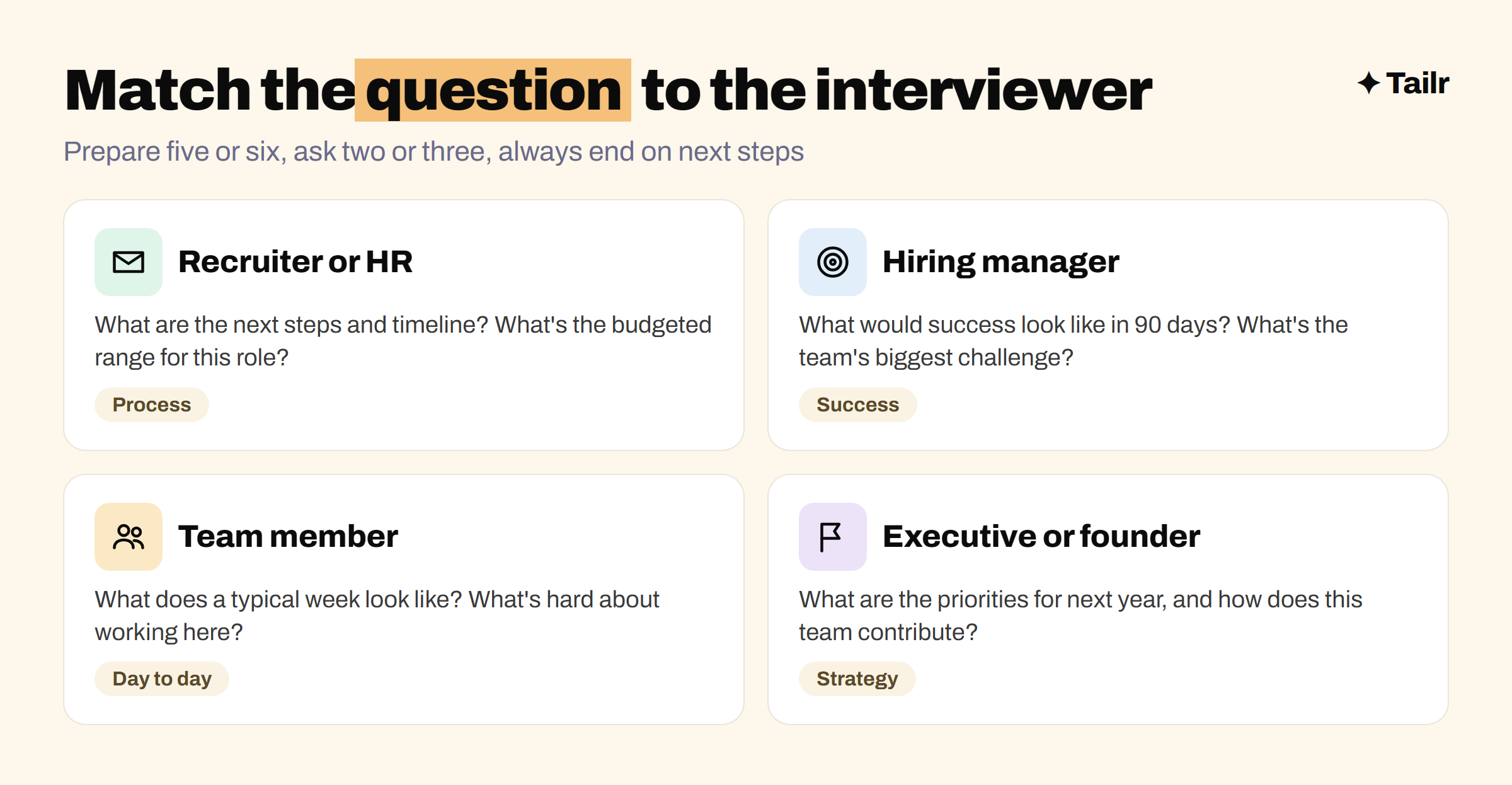
Match the questions to the interviewer
| Interviewer | Good questions to ask | Avoid |
|---|---|---|
| Recruiter or HR | Process, timeline, team structure, salary range | Deep technical questions |
| Hiring manager | Success in 90 days, challenges, how you’re measured | Questions about perks |
| Team member or peer | Day-to-day work, collaboration, what’s hard | Questions about strategy |
| Executive or founder | Strategy, priorities, what’s changing | Small operational details |
Questions to avoid
- Anything the website answers. “What does the company do?” signals zero preparation.
- Salary, leave and perks in a first interview with the hiring manager. Ask the recruiter instead, or wait for them to raise it. Our guide on how to negotiate salary covers timing.
- “Did I get the job?” It puts the interviewer on the spot. Ask about next steps instead.
- Negative framing. “How many hours do people really work?” Rephrase as “What does a typical week look like?”
- Yes-or-no questions. “Do you like it here?” gets one word. “What do you like most about working here?” gets a conversation.
- Too many questions. Watch the clock. If time’s up, ask your best one and offer to send the rest by email.
How to prepare your questions
- Read the job description again and write one question about the requirement that matters most.
- Read the company’s latest news and write one question about it.
- Look up your interviewers on LinkedIn and write one question for each based on their role.
- Add the two closers: concerns about your fit, and next steps.
- Bring them written down. Glancing at notes for this part of the interview is completely normal.
The same research you use for your questions also helps your resume and cover letter. Tailr is a Chrome extension that reads the job listing you’re viewing, tailors your resume and cover letter to it and tracks the application, so you can walk into the interview knowing exactly what the role asks for.
After the interview
Write down the answers while they’re fresh, and use one of them in your thank-you note: “I enjoyed hearing about the migration project you’re planning for Q1.” Our guide to the thank-you email after an interview has templates, and how to follow up after a job application covers what to do if you hear nothing.
Try TailrRelated guides
Conclusion
The end of the interview is your turn to ask, and it’s still part of the assessment. Prepare five or six questions tailored to the role, the company and the person in front of you, ask two or three, and always finish by asking about any concerns and the next steps. Good questions show you’ve prepared, help you decide whether you want the job, and give you one last chance to close the gap between you and the offer.
Frequently asked questions
01What questions should I ask at the end of an interview?
Ask about what success looks like in the first 90 days, the biggest challenge facing the team, how performance is measured, what the team is like to work with, and what the next steps are. Finish by asking whether the interviewer has any concerns about your fit, so you can address them before you leave.
02How many questions should I ask at the end of an interview?
Prepare five or six and plan to ask two or three, depending on time. Some will be answered during the interview, so you need spares. If you're running out of time, prioritise one question about the role and one about next steps.
03Is it bad to say I have no questions at the end of an interview?
Yes, usually. Saying you have no questions can come across as uninterested or unprepared. If your questions were genuinely answered, say so and ask one follow-up on something specific they mentioned, such as 'You mentioned the migration project. How far along is it?'
04What questions should you not ask in an interview?
Avoid questions you could answer from the company website, questions about salary, leave and perks in a first interview unless they raise it, 'did I get the job?', and anything negative, like asking how often people get fired. Also avoid yes-or-no questions, which don't start a conversation.
05Can I ask about salary at the end of an interview?
In an early round with a hiring manager, it's usually better to wait or to raise it with the recruiter, who expects the question. Once there's mutual interest or the recruiter asks for your expectations, discussing salary is normal. A good neutral question is 'What's the budgeted range for this role?'
06What is a good last question to ask in an interview?
Two strong closing questions are 'Is there anything about my background that makes you unsure about my fit for this role?' and 'What are the next steps, and when can I expect to hear back?' The first lets you address doubts on the spot; the second tells you when to follow up.