How to Negotiate Salary After a Job Offer (Scripts and Email Templates)
· updated
The offer arrives, the number is lower than you hoped, and you have about 48 hours to decide whether to say something. Most people don’t, and the cost compounds: every future raise and every future offer is anchored on this number. Negotiating is expected, it rarely goes wrong when it’s done politely and specifically, and it takes one email and one phone call. This is how to do it, with the research, the scripts and the templates.
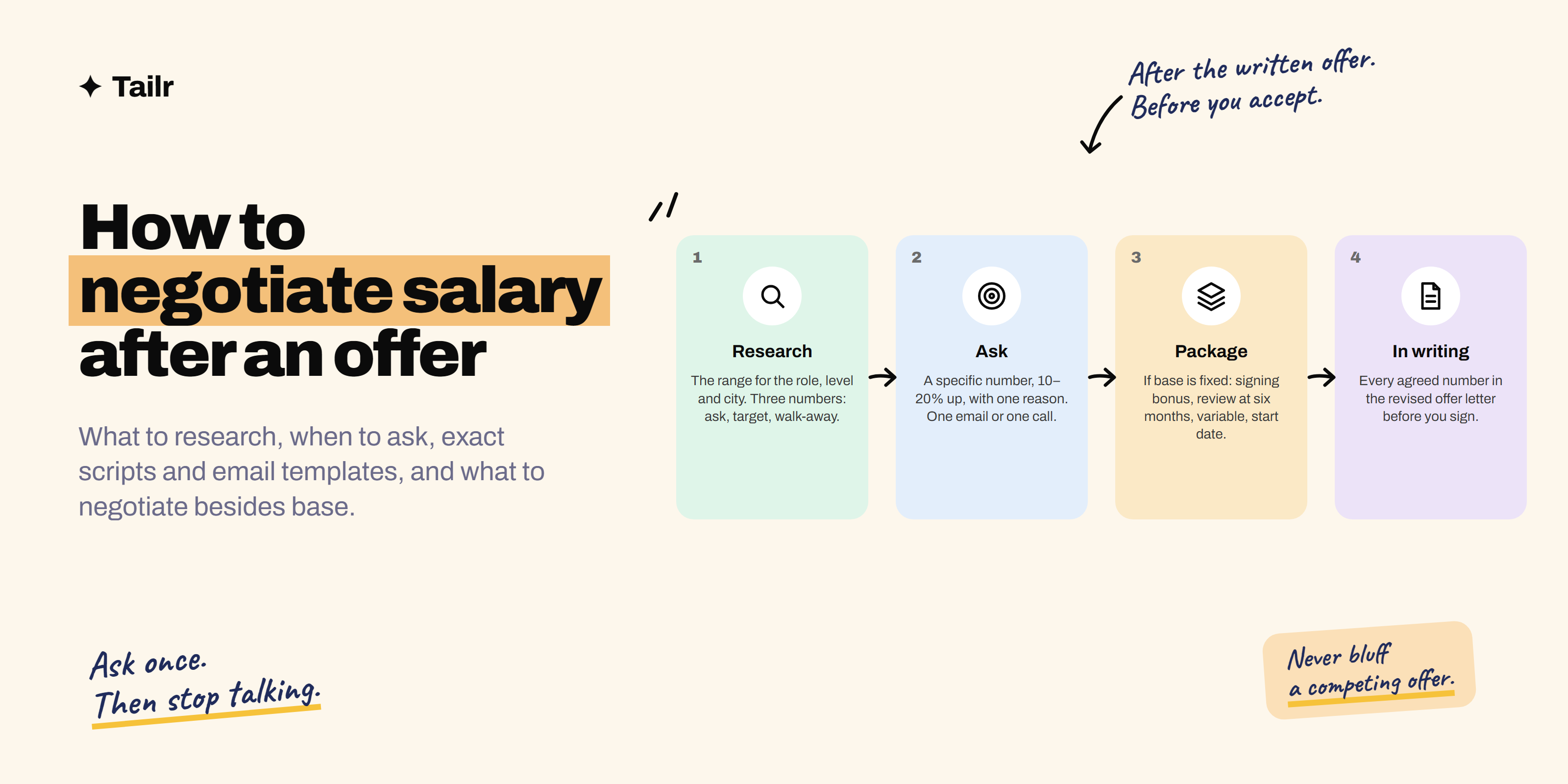
The short answer: Negotiate after you have a written offer and before you accept:
- Research the range for the role, level and city.
- Pick a specific number at the top of the realistic range, usually 10 to 20 percent above the offer.
- Ask for it with one or two reasons: the market range, the scope of the role, what you’re bringing, a competing offer if you have one.
- Ask once, politely, by email or phone, and let them respond.
- If base is fixed, negotiate the package: signing bonus, variable, equity, start date, remote days, a six-month review.
- Get whatever’s agreed in the written offer before you accept.
Never bluff a competing offer and never issue an ultimatum.
Before the offer: deflect, don’t negotiate
The salary question comes up in the first call. The goal at that stage is to not anchor yourself low, and not to get screened out, without negotiating yet.
If asked “what are your salary expectations?”:
“Based on what I’ve seen for this role at companies of your size in this city, the range seems to be around X to Y. I’d be comfortable in that range, and I’d want to understand the full scope of the role and the package before landing on a number. Can you tell me the band you’ve budgeted for?”
Give a range whose bottom is a number you’d actually accept. If they insist on a number, give the top of your range. If they give you their band first, and it’s acceptable, say so and move on; you’ll negotiate within it later.
If asked “what’s your current salary?”: in many places you don’t have to answer, and it’s better not to. “I’d rather focus on the value of this role than my current package; the market range for this level seems to be X to Y.” If pressed, and you’re comfortable, give the total package including variable, not just base.
Step 1: research the range
You can’t negotiate without knowing what the role pays. Spend an hour on:
- Salary sites: Glassdoor, Levels.fyi (tech), Payscale, AmbitionBox (India), the government’s own data where it exists. Filter by role, level, city and company size.
- Recent listings for the same title that publish ranges; increasingly common, and often the most current data.
- People: two or three people in similar roles, asked directly. “What’s the range for a senior analyst at a company like yours?” gets answered more often than you’d think.
- The company’s own band, if they told you during the process.
You’ll end up with a range and a sense of where the offer sits in it. If the offer is already at the top, negotiate the package rather than base. If it’s in the bottom half, there’s room.
Step 2: decide your numbers
Three numbers, before you say anything:
- Your ask: specific, at the top of the realistic range. ₹18,50,000, not “around 18 or 19”. Specific numbers signal research; round numbers signal guessing.
- Your target: what you’d be pleased with. Usually between the offer and the ask.
- Your walk-away: the number below which you decline. Decide it now, calmly, not during the call.
Typical asks are 10 to 20 percent above the offer. Higher than that needs a strong reason (a competing offer, a big scope gap, a clearly below-market number).
Step 3: the ask
One ask, with reasons, politely, and then stop talking. Reasons that work, in rough order of strength:
- A competing offer, real and specific. “I have an offer at X from another company; I’d prefer this role, and I’d like to accept it if we can get closer to that.”
- The market range. “The range for this level in this city is X to Y; the offer is toward the bottom and I’d like to be at Z.”
- Scope. “The role as we discussed includes owning the team and the budget, which is a step up from the level the offer reflects.”
- What you bring. A specific, relevant result from your history that the role needs. Keep it to one line; they already hired you.
- Your current package, if it’s higher than the offer and you’re comfortable sharing.
Reasons that don’t work: your rent, your loan, what a friend earns, “I just feel I’m worth more”.
Email template: the ask
Subject: [Role] offer
Hi [Name],
Thank you for the offer; I’m genuinely excited about the role and the team, and I’d like to make this work.
Before I accept, I’d like to discuss the base salary. Based on the market range for [role] at this level in [city], and the scope we discussed, which includes [specific responsibility], I was expecting something closer to [specific number]. [If true: I also have another offer at [number], and I’d prefer to join you if we can get closer to it.]
Is there flexibility on base? If base is fixed, I’d be glad to talk about a signing bonus or an early review instead.
I’m happy to discuss on a call whenever suits. Thanks again; I’m looking forward to getting started.
[Your name]
Four paragraphs. Warm, specific, one ask, one alternative, no apology.
Phone script: the ask
“Thanks so much for the offer; I’m excited about it and I want to find a way to make it work. I’d like to talk about base. From what I’ve seen, the range for this level here is X to Y, and given the scope we discussed, I was hoping for [specific number]. Is there room to move on that?”
Then stop. Silence is fine. Let them respond.
Step 4: handling the response
“Let me check and get back to you.” The normal response. “Thank you; I’ll wait to hear.” Don’t fill the gap with concessions.
“We can do [a number between the offer and your ask].” Usually the real ceiling. If it’s at or above your target, accept warmly. If it’s below, one more move: “I appreciate that. Could we meet at [a number slightly higher], or add a signing bonus of [amount] to bridge the gap?” Then take what you get.
“The base is fixed at this level.” Often true, especially at large companies with bands. Move to the package: “Understood. Is there flexibility on a signing bonus, the variable target, or a salary review at six months?”
“This is our final offer.” Believe them. Decide against your walk-away number. If it’s above it, accept; if it’s below, decline politely and leave the door open.
Counter-question: “What would it take for you to accept today?” Give them your target, not your ask, and mean it: “If we can get to [target], I’ll sign today.”
What to negotiate besides base
In rough order of how often they’re granted:
- Signing bonus. One-off, doesn’t affect their bands, the most common yes when base is fixed.
- Early salary review at six months, in writing, with criteria.
- Variable or bonus target, as a percentage.
- Start date, which is often worth more to you than money.
- Notice period buyout if you’re moving from a long notice period.
- Remote or hybrid days.
- Equity or options, at startups; ask for the number of shares, the current valuation, the vesting schedule and the strike price, not just a percentage.
- Title, which affects your next negotiation more than this one.
- Learning budget, conference travel, extra leave, equipment.
Pick the two that matter most to you; asking for everything reads as haggling.
Special situations
Fresher or graduate offer. Bands are often fixed and everyone in the cohort gets the same number. Ask once, politely, about a signing bonus or the joining date, and accept gracefully if the answer is no. Don’t push; the goodwill is worth more than the difference.
Internal promotion or counter-offer. Same research, same specific ask, and the reason is the scope change. Get the new title and number in writing before you tell the other company no.
Competing offers. The strongest position you’ll ever be in, and the one where honesty matters most. Never invent or inflate an offer; companies do check, and being caught ends both processes. Real competing offers can be stated plainly: “I have an offer at X; I’d rather join you.”
The offer is far below market. A large gap usually means a level mismatch, not stinginess. Ask whether the role has been levelled correctly, with the scope you discussed, before negotiating the number.
Mistakes that cost people the raise
- Not asking. The most expensive one. A polite, specific ask almost never costs the offer.
- Negotiating before the offer. No leverage yet. Deflect with a range.
- A round number with no reason. Easy to refuse. Specific number, one reason.
- Asking twice, then a third time. One ask, one follow-up on the package, then decide.
- An ultimatum. “I need X or I walk” invites them to let you walk. “I’d like to make this work; is there room?” invites them to find it.
- Bluffing a competing offer. The one mistake that genuinely gets offers withdrawn.
- Negotiating base only. When base is fixed, the package is where the movement is.
- Accepting on the call. “Thank you; I’d like to review the written offer and get back to you tomorrow” is always fine.
- Not getting it in writing. Anything agreed verbally goes into the revised offer letter before you sign.
Where Tailr fits
The negotiation starts long before the offer: the number a company puts on the table reflects how well your application made the case for the role’s scope. Tailr tailors your resume to the specific job listing you’re viewing, so the experience and results that justify the top of the band are the ones a recruiter sees first, and generates a cover letter that makes the same case. Apply for the right level, with the evidence in front of them, and the offer starts higher. For the round where the salary question first comes up, 30 most asked HR interview questions has the deflection scripts alongside the rest. Try Tailr on the next listing you open.
Conclusion
Negotiating a job offer is one email and one call: research the range, pick a specific number at the top of it with a reason, ask once politely after the written offer, and negotiate the package if base is fixed. Decide your walk-away number before you start, never bluff, never ultimatum, and get the agreed number in writing before you sign. It takes an hour of research and ten minutes of nerve, and it’s the highest-paid hour of most people’s year.
Frequently asked questions
01Should I negotiate a job offer?
Almost always, yes. Most employers expect it, most offers have room built in, and a polite, specific ask rarely costs anyone the offer. The exceptions are structured graduate programmes with fixed bands and public-sector roles with published scales, where the answer is usually no and asking once is still fine. The people who don't negotiate leave money on the table every year they stay.
02How much should I ask for when negotiating salary?
Ask for a specific number at the top of the realistic range for the role, level and city, typically 10 to 20 percent above the offer, with a reason attached. Research the range first from salary sites, recent listings and people in similar roles. An ask with a reason ('the market range for this level is X, and I'm bringing Y') is taken seriously; a round number with no reason is easy to refuse.
03When is the right time to negotiate salary?
After you have a written offer and before you accept it. That's when you have the most leverage: they've chosen you, they've spent weeks getting here, and they want it done. Don't negotiate during the interviews; deflect the salary question with a range until there's an offer. Once you've accepted, the window is closed until your first review.
04How do I negotiate salary over email?
Thank them, say you're excited about the role, state your ask as a specific number with one or two reasons, and ask whether there's flexibility. Four short paragraphs. Keep it warm, keep it specific, and don't apologise for asking. Email works well for the ask itself; be ready to take the follow-up conversation by phone.
05What can I negotiate besides base salary?
Signing bonus, variable or bonus target, equity or stock options, start date, notice period buyout, relocation, remote or hybrid days, title, an early salary review at six months, learning budget, extra leave, and equipment. If base is fixed, a signing bonus or a six-month review are the two most commonly granted alternatives.
06Can negotiating make a company withdraw the offer?
It's rare, and when it happens it's usually because the ask was delivered badly (an ultimatum, a wildly unrealistic number, or going back a third time after they said final) rather than because asking is risky. A polite, specific, one-time ask with a reason is normal business and companies treat it that way. If a company withdraws an offer over a courteous negotiation, you've learned something useful about them.