30 Most Asked HR Interview Questions and Answers
· updated
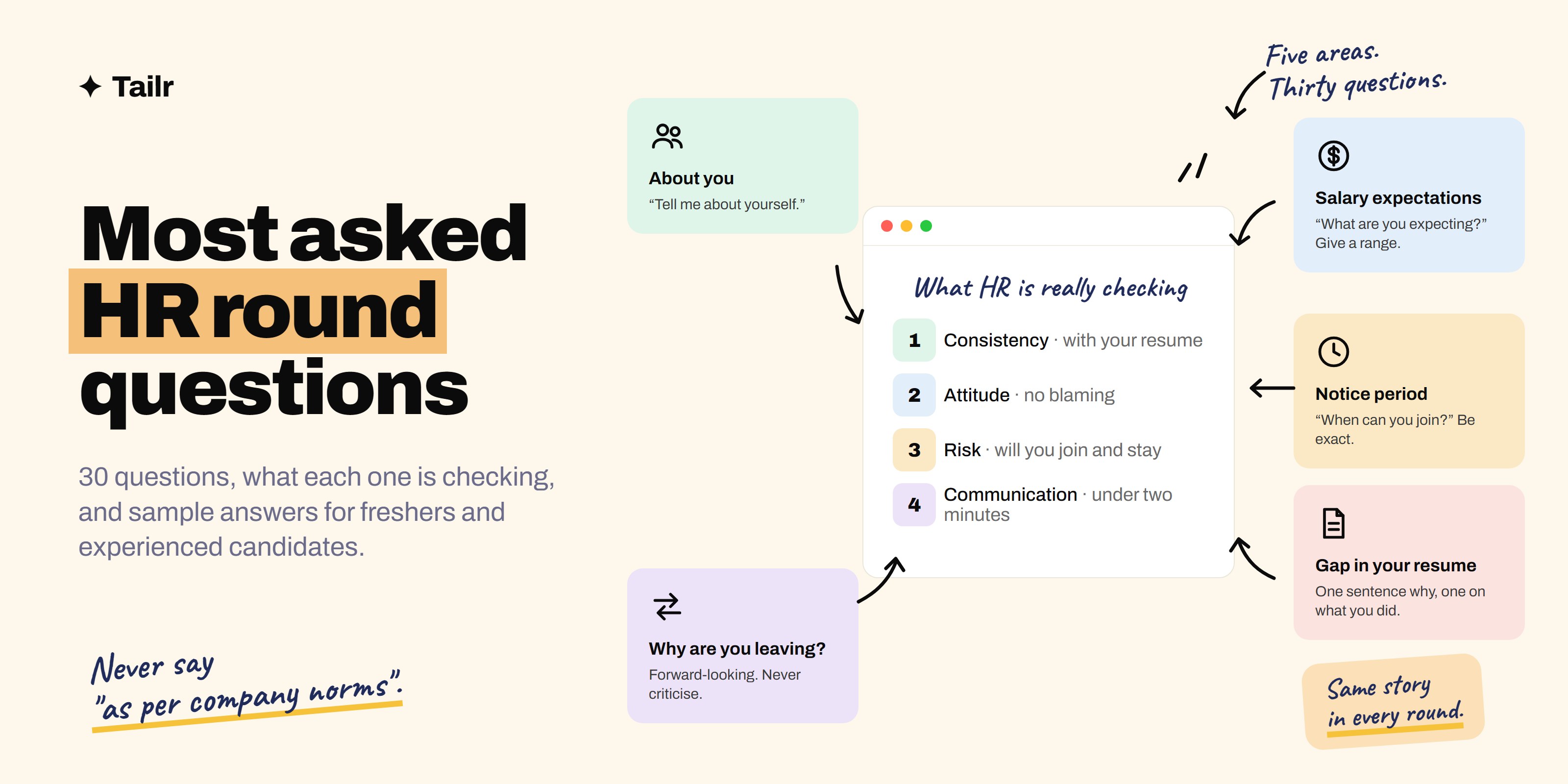
The HR round is the one people prepare for least and lose the most on. The technical rounds are done, you’ve relaxed, and then someone asks what salary you’re expecting and you say “as per company norms” because you never thought about it. This is a night-before page for that round: the 30 questions HR interviewers ask most, what each is really checking, and a sample answer for a fresher and for an experienced candidate.
The short answer: HR interview questions cover five areas:
- You: tell me about yourself, strengths, weaknesses, hobbies.
- The job: why this company, why this role, why should we hire you.
- Logistics: salary expectations, notice period, relocation, shifts, other offers.
- Your past: why you’re leaving, gaps, low grades, your biggest achievement.
- The future: five years, higher studies.
Almost every HR interview draws from the same 30 questions below. The round is checking for communication, attitude, fit, and whether your answers are consistent with your resume and with what you’d said in earlier rounds.
What the HR round is actually checking
The person interviewing you isn’t testing your skills; the previous rounds did that. They’re checking four things:
- Consistency. Does what you say match your resume and what the technical panel heard? A different reason for leaving in round one and round three is a red flag.
- Attitude. Do you speak badly about past employers, colleagues, or professors? Do you take ownership of things that went wrong?
- Fit and risk. Will you accept the offer, join on time, and stay? Salary, notice period, relocation, higher-study plans and other offers are all risk questions.
- Communication. Can you answer a simple question in under two minutes without rambling?
Prepare with that in mind. Every answer below is short, consistent, forward-looking, and honest.
About you
1. Tell me about yourself.
What they’re checking: can you introduce yourself in two minutes with a clear thread from past to present to why you’re here.
Fresher answer: “I’ve just completed my B.Tech in computer science from [college], with a CGPA of 8.2. The project I’m proudest of was a final-year attendance system using face recognition that our department actually deployed for one semester; I built the backend and handled the data pipeline. I also did a two-month internship at a fintech startup, where I wrote test automation for their payments API. Outside of that I ran our college’s coding club for a year, which taught me more about organising people than any course did. I’m looking for a role where I can do backend work on a product that real users depend on, which is why this position stood out.”
Experienced answer: “I’m a marketing manager with seven years’ experience, the last four in B2B SaaS. At my current company I lead a team of five and own demand generation, and over the past two years we’ve doubled inbound pipeline while keeping cost per lead flat, mostly through a content and SEO programme I built from scratch. Before that I spent three years at an agency, which is where I learned to work across many industries fast. I’m looking for a role with more ownership of the full funnel, including product marketing, and this role has exactly that scope.”
2. What are your strengths?
What they’re checking: are your strengths relevant to the job, and can you evidence them.
Fresher answer: “Two things. I pick things up fast: in my internship I was given a test framework I’d never used and was writing production tests in it within a week. And I finish what I start. Our final-year project had five people and I was the one keeping the tracker and chasing the pieces that were late. It shipped two weeks early. Both of those seem relevant to a graduate role where I’ll be learning a lot and expected to deliver.”
Experienced answer: “I’m good at making things measurable. When I joined my current team, campaign performance was reported as ‘good engagement’. Within a quarter we had a pipeline dashboard the sales team actually used, and it changed which campaigns we ran. The second one is that I hire well; four of the five people on my team were my hires and all four have been promoted. For a role that’s building a team, that’s probably the one that matters most.”
3. What is your greatest weakness?
What they’re checking: self-awareness, and whether you’re working on it. Don’t say perfectionism.
Fresher answer: “I tend to keep working on a problem alone for too long before asking for help. In my internship I spent most of a day stuck on an environment issue that my mentor fixed in five minutes when I finally asked. Since then I set myself a limit: if I’m stuck for 30 minutes, I ask, with a summary of what I’ve tried. It’s made me faster and, honestly, people seem to like being asked.”
Experienced answer: “Public speaking to large groups. I’m fine in a meeting of ten but I used to avoid anything bigger. Last year I made myself take our quarterly all-hands product update, prepared far more than I needed to, and it went fine. I’ve done three since. It’s still not my favourite part of the job, but it no longer limits what I’ll take on.”
4. What are your hobbies and interests?
What they’re checking: are you a rounded person, and can you talk naturally. Have one thing you can speak about for a minute.
Fresher answer: “I play football twice a week for a local club, which is mostly about the people. And I’ve been building a small weather station with a Raspberry Pi on my balcony, which started as a weekend thing and is now a year-long obsession with sensor calibration. It’s taught me a lot about how messy real data is.”
Experienced answer: “I run, badly but consistently, and I did my first half marathon last year. I also read a lot of business history; I’ve just finished a book on the early years of the container shipping industry, which sounds dull but is really a book about standardisation, and I keep seeing parallels in my own work.”
5. Tell me something about yourself that isn’t on your resume.
What they’re checking: can you think on your feet and show some personality.
Fresher answer: “I taught myself to cook properly during the lockdown year, from YouTube, and I now cook for my family most weekends. It’s the thing that made me realise I like following a process, measuring the result, and adjusting, which is not unlike debugging.”
Experienced answer: “I volunteer one Saturday a month with a group that helps older people with their phones and laptops. It’s the most patient I ever have to be, and it’s made me much better at explaining things without jargon, which turns out to be useful when I’m presenting to the board.”
6. What motivates you?
What they’re checking: does what motivates you match what the job offers.
Fresher answer: “Seeing something I built get used. The attendance project I mentioned was motivating in a way coursework never was, because a hundred people used it every day and told me when it broke. I’d like a job where that loop is tight.”
Experienced answer: “Building something that works after I’ve left. I get more satisfaction from a process my team still runs two years later than from any single campaign. It’s why I’m drawn to roles with team-building in them.”
About the job
7. Why do you want to work for this company?
What they’re checking: have you done any research, and is there a real reason beyond “you called me”.
Fresher answer: “Three reasons. The graduate programme here has a structured first year with rotations, which as a fresher is what I want. Two seniors from my college joined last year and both said the mentoring is real, not just on the website. And I’ve used your product; I noticed the last update fixed the exact thing I’d complained about, which tells me you listen to users.”
Experienced answer: “I’ve watched your move into the mid-market segment over the past year, and it’s the segment I know best. The job listing talks about building the marketing playbook for it rather than running an existing one, and that’s the work I’m best at. I also spoke to two people who’ve worked here, and both described the same culture of giving people ownership early, which matches what I’m looking for.”
8. Why this role?
What they’re checking: do you understand what the job actually is.
Fresher answer: “Because it’s a backend role on a product with real scale. I’ve done small backend projects and an internship in test automation, and the thing I want next is to work on systems where performance and reliability actually matter. The listing mentions on-call rotation after six months, and honestly that’s a plus for me; it’s how you learn what breaks.”
Experienced answer: “It’s the first role I’ve seen that combines demand generation with product marketing under one head. I’ve done the first for four years, I’ve done pieces of the second, and I want to own both. The size of the team is also right: big enough to matter, small enough that I’d still be hands-on.”
9. What do you know about our company?
What they’re checking: did you spend ten minutes on the website.
Fresher answer: “You make inventory software for small retailers, you’ve been around since 2016, and you raised a Series B last year to expand into logistics. I read your engineering blog post about the migration to microservices, which was candid about what went wrong. I also saw you’re hiring across three cities, which suggests the expansion is real.”
Experienced answer: “You’re the third-largest player in mid-market payroll in this region, growing at roughly 40 percent a year according to your last press release, and your differentiation is the integrations with local accounting tools. The two things I’d want to understand better are how the new product line is landing and how marketing and sales are currently split, which I’d guess is why this role exists.”
10. Why should we hire you?
What they’re checking: match yourself to the job listing.
Fresher answer: “The listing asks for Python, SQL and someone who communicates well. I’ve used Python and SQL in my internship on real data, not just coursework. On communication, I ran a 40-person club for a year and did the department’s tech-fest presentations. I won’t have as much experience as some candidates, but I’ve done a small version of this job and I’ll learn the rest quickly.”
Experienced answer: “You need someone who can build the mid-market playbook, hire a team, and show pipeline results within two quarters. I’ve done exactly that once, in a company at a similar stage, and the numbers are on my resume. I can bring the playbook, the hiring process, and the dashboard on day one, and I’ve worked in both agency and in-house so I know which processes are worth adding at your size.”
11. What are your expectations from this job?
What they’re checking: are your expectations realistic.
Fresher answer: “Mainly to learn from people who are better than me and to be given real work early. I’d like clear feedback, even when it’s critical. Beyond that, I’d expect that if I do well, there’s a path to more responsibility, but I know that has to be earned.”
Experienced answer: “Clear ownership of the function, a manager who gives direct feedback, and the budget to actually execute what I’m accountable for. In return I’d expect to be measured on pipeline and revenue contribution, not activity.”
Logistics
12. What are your salary expectations?
What they’re checking: are you in the band, and have you thought about it. Give a range based on research, not a single number and not “as per company norms”.
Fresher answer: “From what I’ve seen for graduate roles at companies your size in this city, the range is around 6 to 8 lakhs. I’d be comfortable in that range, and honestly the role and the learning matter more to me than the exact number at this stage.”
Experienced answer: “I’m currently on 24 lakhs fixed plus a variable component. For a role with this scope I’d be looking at 30 to 34, but I’m open to discussing the whole package, including variable and equity, once we’re both sure it’s the right fit.”
13. What is your notice period?
What they’re checking: when can you actually start. Be exact.
Fresher answer: “I graduate in June and I’m available to join from the first week of July. If you need someone earlier, I could start part-time in June.”
Experienced answer: “My notice period is 60 days. I haven’t resigned yet, but I’ve checked and my current employer has a buyout option, so if the timing matters I could potentially bring it down to 30 days.”
14. Are you willing to relocate?
What they’re checking: a risk question. Answer honestly.
Fresher answer: “Yes. I’m from Coimbatore and I’ve studied in Chennai, so I’ve already moved once for the right opportunity. If the role is in Bangalore or Hyderabad, that’s fine with me.”
Experienced answer: “For the right role, yes, though I’d want to understand the timing. My partner works here and we’d need a few months to plan a move. If the role allows a remote start with relocation in the first six months, that would work well.”
15. Are you comfortable with night shifts or weekend work?
What they’re checking: whether you’ll say yes now and resign in three months.
Fresher answer: “Yes, I’m comfortable with rotational shifts. I’d want to understand the rotation pattern so I can plan around it, but I don’t have any constraints that would stop me.”
Experienced answer: “I’ve done on-call rotations for three years, so weekend and occasional night work is familiar. I’d want to know whether it’s occasional or the standard schedule, because that affects how I’d plan family commitments, but neither is a dealbreaker.”
16. Are you interviewing anywhere else? Do you have other offers?
What they’re checking: how fast they need to move, and whether you’ll accept.
Fresher answer: “I’m in the final round with one other company, but this role is my first preference because of the rotation programme. If you were able to make a decision within two weeks, I wouldn’t need to wait on the other.”
Experienced answer: “I’m in late-stage conversations with one other company, yes. I’m being open about that because I’d rather you know than be surprised. This role is the better fit for what I want to do next, and if we can align on the package I’d be ready to decide quickly.”
17. When can you join?
Fresher answer: “Immediately after my final exams end on the 20th; the first Monday after that works.”
Experienced answer: “Sixty days from the date I resign, which I’d do the day I sign the offer. If you need me sooner I’ll explore a buyout.”
Your past
18. Why are you leaving your current job?
What they’re checking: attitude. Never criticise your employer, and keep it forward-looking.
Fresher answer (internship or first job): “It was a six-month internship, which ended as planned. They did offer to extend it, but the work was mostly maintenance, and I want to be on a team that’s building something new.”
Experienced answer: “I’ve been there four years and I’ve grown as far as the role allows; my manager and I have talked openly about it. The company is doubling down on enterprise, and the mid-market work I’m best at is being wound down. Rather than drift, I’d rather move to a place where that’s the focus.”
19. Can you explain the gap in your resume?
What they’re checking: is there something you’re hiding. There usually isn’t; say the reason once and move on.
Fresher answer: “I took a year after my degree to prepare for the civil services exam. I cleared the prelims but not the mains, and I decided not to try again. During that year I also completed two online courses in data analysis, which are on my resume. I’m now fully focused on a career in industry.”
Experienced answer: “I took eight months off last year to care for my father after surgery. He’s fully recovered. I kept a hand in by doing two short freelance projects, which are on my resume, and I’ve been actively interviewing since March. I’m ready to get back to full-time work.”
20. Why are your grades low?
What they’re checking: whether you take ownership or make excuses.
Fresher answer: “In my second year I over-committed to club activities and my grades dropped. I realised it by the end of that year, cut back, and my final two years were the strongest. I also made sure the technical work I did outside class, the projects and the internship, showed what I’m capable of. I don’t think the second-year grades reflect how I work now.”
21. What is your biggest achievement?
Fresher answer: “Getting our college’s coding club from 12 members to over 100 in one year. I did it by running weekly beginner sessions instead of only competitive events, which is what had been putting people off. Three members from that year have gone on to internships at good companies, which is the bit I’m proudest of.”
Experienced answer: “Building the inbound programme at my current company from nothing to 60 percent of pipeline in two years. There was no content, no SEO, and no dashboard when I started. The team I built for it is now four people, and the programme is the reason the sales team has stopped relying on cold outreach.”
22. What was the toughest decision you’ve had to make?
Fresher answer: “Choosing between a higher-paying internship in a service company and a lower-paying one at a startup. I picked the startup because I’d learn more, and I did, but it meant saying no to a lot of family advice. It taught me to make decisions on what I’d learn, not just what I’d earn.”
Experienced answer: “Letting go of a team member who was well-liked but consistently underperforming. I’d given feedback for six months and put a plan in place, and it wasn’t working. I did it as respectfully as I could, and the team’s output actually went up afterwards, which told me I’d waited too long.”
23. Have you ever had a conflict with a manager? How did you handle it?
Fresher answer: “During my internship, my mentor wanted me to write tests for a module I thought was about to be rewritten. I asked whether the rewrite was confirmed before I started; it was, so we agreed I’d write tests for the new version instead. It wasn’t really a conflict, but it taught me to ask before assuming.”
Experienced answer: “My previous manager and I disagreed on whether to cut the events budget. I thought the data showed events were our best source of pipeline; he thought they were expensive. I built a one-page analysis showing cost per opportunity by channel, and events came out second-best. He kept half the budget. What worked was making it about the numbers rather than opinions.”
The future
24. Where do you see yourself in five years?
Fresher answer: “I’d like to be the person on the team others come to for one thing, and I don’t yet know whether that’s backend, data, or infrastructure. This role would help me find out. If I’ve found it by year three and I’m properly good at it by year five, that’s a success.”
Experienced answer: “Leading a marketing function, not just a team, and owning a number. The gap between where I am and that is mostly commercial experience, and this role closes it. If I do well here, head of marketing is the natural next step, and I’d want to earn it here rather than somewhere else.”
25. Are you planning higher studies?
What they’re checking: will you leave in a year for an MBA or a master’s. Be honest; a vague “maybe” is worse than a clear plan.
Fresher answer: “Not in the next few years. I’ve thought about a master’s, but I’d rather work first and decide later with real experience behind me. If I do it, it’d be part-time and with the company’s knowledge.”
Experienced answer: “No. I considered an MBA at the four-year mark and decided the experience I’d get from a bigger role was worth more than two years out. I’m settled on that.”
26. How long would you stay with us?
Fresher answer: “As long as I’m learning and growing, and from what I’ve heard about the role, that’s a long time. I’d rather build something over three or four years than move every eighteen months.”
Experienced answer: “My track record is four years at each of my last two companies, and I’d expect the same here. I’m looking for a role I can grow into, not a stepping stone.”
Closing
27. Do you have any questions for us?
What they’re checking: are you curious, and have you been listening. Always have two.
Good questions: “What does someone in this role do in their first 90 days that tells you they’re going to be good?” “What’s the most common reason people leave this team?” “How is performance reviewed, and how often?” “What’s the next step in the process and when should I expect to hear back?”
Avoid: anything on the website, and anything about leave policy or perks before you have an offer.
Three more you should be ready for
| Question | What they’re checking | One-line approach |
|---|---|---|
| 28. How do you handle stress and pressure? | Composure, and whether you have a method. | Give one real example and the specific thing you do: list, prioritise, communicate early. |
| 29. What would your last manager say about you? | Self-awareness; whether you know your reputation. | One strength they’d name, one thing they’d say you’re working on, both honest. |
| 30. Is there anything that would stop you accepting an offer? | Risk. | Be honest: salary range, location, start date. Better now than after the offer letter. |
Mistakes that lose the offer in the HR round
- “As per company norms.” It’s not humility; it reads as unprepared. Give a range.
- Criticising your current employer. Even when justified. The interviewer imagines you saying the same about them.
- A different story from earlier rounds. HR compares notes. Reasons for leaving, notice period, and salary should be the same in every round.
- Vague on higher studies or relocation. “Maybe” makes you a risk. Decide before the interview.
- Over-explaining a gap. One sentence on why, one on what you did, move on.
- No questions at the end. It looks like you don’t care. Prepare two.
Where Tailr fits
The HR round checks your answers against your resume, so the resume needs to tell the same story you’re about to tell. Tailr tailors your resume to the specific job you’re applying for, from the listing itself, so the experience that matches the role is front and centre and the “why this role” answer writes itself. If you’ve tailored honestly, every question above has an answer that matches the page in front of the interviewer. Start with how to tailor your resume to a job description, and for the behavioral questions that leak into HR rounds, 40 behavioral interview questions with sample answers covers them the same way. Try Tailr to get the resume right before the round that reads it most closely.
Related guides
- 50 Group Discussion Topics and How to Score in a GD
- 30 Situational Interview Questions With Sample Answers
- 25 Interview Tricks You Should Know Before Your Next Interview
- How to Ace Your Technical Interview (With Sample Questions and Answers)
- How to Answer “Tell Me About Yourself” in Any Interview
- How to Answer “What Is Your Greatest Weakness?” (With Examples)
Conclusion
The HR round is predictable: five areas, thirty questions, and the same four checks behind all of them. Prepare a two-minute introduction, a salary range with a reason, an exact notice period, a clear line on relocation and higher studies, a one-sentence reason for leaving that doesn’t blame anyone, and two questions to ask. Make sure it all matches your resume. Then treat the round as the real interview it is, because it’s the one that decides what your offer letter says.
Frequently asked questions
01What questions are asked in an HR round interview?
The HR round covers five areas: you (tell me about yourself, strengths, weaknesses, hobbies), the job (why this company, why this role, why should we hire you), logistics (salary expectations, notice period, relocation, shifts), your past (why are you leaving, gaps, low grades, biggest achievement), and the future (five years, higher studies). Most HR interviews draw from the same 30 or so questions.
02How do I answer salary expectations in an HR interview?
Give a range, not a single number, and base it on the market rate for the role and city. Say something like 'Based on what I've seen for this role, I'm looking at X to Y, but I'm open to discussing the whole package.' Freshers can add that they're flexible and more interested in the role and learning. Never say 'as per company norms' on its own; it reads as unprepared.
03What is the best answer for why are you leaving your current job?
Keep it forward-looking and never criticise your current employer. Good reasons are growth, a role that fits your strengths better, a change in what the company is doing, or relocation. One or two sentences, then move on to why this role is the right next step. If you were laid off, say so plainly; it's common and interviewers don't hold it against you.
04How should a fresher answer HR interview questions with no experience?
Use college projects, internships, part-time jobs, events you organised, and clubs. HR interviewers asking freshers questions want to see communication, attitude, and whether you've thought about the job, not a work history. Prepare a clear two-minute introduction, know why you applied, and have a sensible answer for salary, relocation and higher studies.
05How do I explain a gap in my resume?
State the reason in one sentence, say what you did during the gap, and move on. Health, family, caring for someone, a failed venture, study, or a long job search are all normal reasons. Don't apologise or over-explain. If you learned or built anything during the gap, mention it; if you didn't, say you're ready to get back to work and prove it.
06Is the HR round just a formality?
No. You can lose an offer in the HR round on salary misalignment, attitude, unclear reasons for leaving, or an answer that contradicts your resume. Treat it as a real interview. It's also where the offer gets shaped, so it's the round that most affects what you'll actually be paid.