How to Answer "Tell Me About Yourself" in Any Interview
· updated
“So, tell me about yourself.” It’s the first question in most interviews, it sounds casual, and it’s surprisingly easy to fumble. Many people either recite their whole resume or freeze and say “well, I’m from…”. But this question is a gift: it’s the one moment where you choose what the interviewer hears about you first. This guide gives you a simple formula, sample answers for different situations, and the mistakes to avoid.
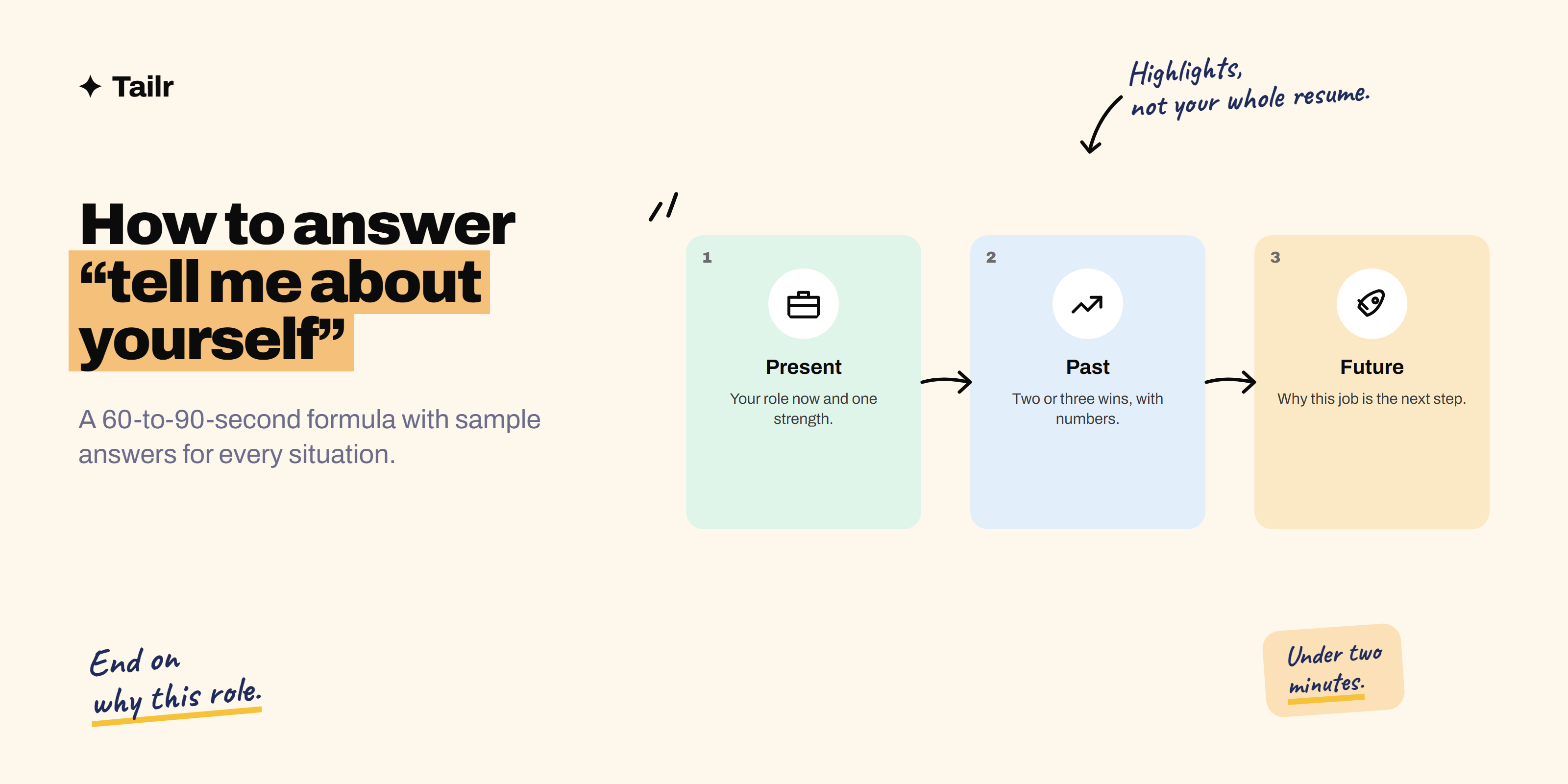
The short answer: answer “tell me about yourself” with the present, past, future formula, in 60 to 90 seconds:
- Present: your current role or situation, and one strength you’re known for.
- Past: two or three experiences or achievements that are directly relevant to this job, ideally with a number.
- Future: why you want this role at this company, and how it fits where you’re heading.
Keep it professional, tailored to the job description, and finish on the role you’re interviewing for, so the conversation moves naturally to your fit.
Why interviewers ask it
It’s not small talk. With this one question, the interviewer is checking:
- Can you communicate clearly and concisely? A focused 90-second answer shows you can summarise; a rambling five minutes shows you can’t.
- What do you think is most important about yourself? What you choose to mention tells them how you see your own strengths.
- Do you understand this role? The best answers clearly connect your experience to what the job needs.
- Are you genuinely interested? The “future” part shows whether you’ve thought about this job or are applying everywhere.
It also sets the agenda. Interviewers often ask follow-ups about whatever you mention here, so you can steer the conversation toward your strongest stories.
The present, past, future formula
Present (about 20 seconds)
Start with who you are professionally right now.
- “I’m a QA engineer at a fintech startup, where I own testing for our payments app.”
- “I’m a final-year computer science student focused on data analysis.”
- “I’ve spent five years in customer support and I’m moving into customer success.”
Add one strength or focus area that matters for this job: “…and I’m the person the team goes to for automating repetitive tests.”
Past (about 40 seconds)
Pick two or three experiences that prove you can do this job. Not your whole history, just the relevant highlights. Numbers make them memorable.
- “Before that, I spent two years at an e-commerce company, where I built our first automated regression suite and cut release testing from three days to one.”
- “In my internship, I built a dashboard that the sales team now uses every week to track their pipeline.”
Future (about 20 seconds)
Connect it to this role. This is the part most people skip, and the part that makes the answer land.
- “I’m looking for a role where I can work on test strategy across a whole product, and your focus on reliability for a platform this size is exactly that.”
- “I want to move into a role where I’m closer to customers’ long-term success, which is why this customer success position stood out.”
Sample answers
Fresher or recent graduate
“I recently graduated in computer science, and I’ve spent the last year focused on data analysis. In my final-year project I analysed three years of city bike-share data to predict demand, using Python and SQL, and our model was accurate to within about 10% on held-out weeks. I also interned at a retail startup for four months, where I built a weekly sales dashboard in Power BI that the founders still use. I enjoy turning messy data into something a team can act on, and that’s why this junior data analyst role appealed to me, especially since your team works so closely with product decisions.”
Why it works: education first, then two specific, relevant proofs, then a clear link to the role. No apology for lack of experience. If you’re worried about that, read how to write a resume with no experience.
Experienced professional
“I’m a product manager at a mid-size B2B software company, where I own our onboarding and activation area. Over the last two years I led a redesign of our setup flow that raised day-7 activation from 34% to 51%, and I introduced a weekly experiment review that’s now used across three product teams. Before that, I was a business analyst for four years, which is where I got comfortable with SQL and with turning customer interviews into requirements. I’m looking to move into a growth PM role where experimentation is central, which is exactly what this team is building.”
Why it works: current scope, a quantified achievement, a relevant earlier background, and a clear reason for this move.
Career changer
“I’ve spent six years as a high school maths teacher, and over the last year I’ve been moving into UX research. Teaching taught me a lot of what research needs: explaining complex things simply, watching how people actually struggle, and changing my approach based on what I see. I completed a UX certification this spring, and for my main project I ran usability tests with eight users on a local library’s website, which led to a redesign of their booking page. I’m excited about this role because your product is used by teachers, and I understand those users from the inside.”
Why it works: it frames the old career as an asset, shows concrete steps taken, and links to the company’s users. More in how to switch careers into tech.
Returning after a career gap
“I’m a marketing specialist with five years’ experience in email and content marketing. I took two years out to care for a family member, and during that time I kept my skills current with a course on marketing automation and some freelance newsletter work for two local businesses. Before my break, I ran email campaigns at a travel company that grew our list from 40,000 to 110,000 subscribers. I’m now ready to return full time, and this role is a great fit because it’s focused on lifecycle email, which is exactly where my experience is strongest.”
Why it works: one calm sentence on the gap, then straight back to skills and value. See how to explain employment gaps for more.
Technical interview
“I’m a backend engineer with four years of experience, mostly in Python and Go. At my current company I work on the payments platform, and last year I led the move from a single monolith to three services, which cut our deploy time from 40 minutes to under 10. Before that, I worked at an agency building APIs for several clients, which taught me to ship quickly and write code other people can maintain. I’m interested in this role because of the scale of your systems and the team’s focus on reliability.”
For more technical interview preparation, see how to ace your technical interview.
How to tailor it to each job
The structure stays the same; the examples change. Before each interview:
- Re-read the job description and highlight the three skills or responsibilities that appear most.
- Pick experiences that prove those three things. Drop anything that doesn’t help.
- Use the listing’s own words where they’re true for you. If it says “stakeholder management”, say that rather than “working with teams”.
- Research the company for one specific reason you want to work there, for the “future” part.
This is the same thinking you use to tailor a resume. If your resume was already tailored to the listing, your answer practically writes itself: the top bullet points become your “past” section. Tailr can help with that first step: it’s a Chrome extension that tailors your resume to the job listing you’re viewing, writes a matching cover letter and tracks the application.
Mistakes to avoid
- Reading out your resume. The interviewer has it. Choose highlights and add the “why”.
- Starting too far back. “I was born in…” or “In school, I…” Start with the present unless you’re a fresher, and even then, start with your degree.
- Too personal. Hobbies, family, age, religion and marital status don’t belong here. A brief, relevant personal touch at the end is fine if it supports the role.
- Too long. Over two minutes and you’ve lost them. Practise with a timer.
- Too vague. “I’m passionate, hard-working and a team player” proves nothing. One specific achievement beats five adjectives.
- Negativity. Never criticise a current or former employer, even if that’s why you’re leaving.
- No ending. Trailing off with “…so yeah, that’s me” wastes your best moment. End on why this role.
Fill-in-the-blank template
If you’re staring at a blank page, start here and replace the brackets:
“I’m a [current role or situation] with [X years / a background in] [field], and I’m known for [one strength relevant to this job].
At [company or project], I [achievement with a number]. Before that, [second relevant experience], which taught me [skill the job needs].
I’m now looking for [the kind of role you want], and this position stood out because [specific reason about this company or team].”
Read it aloud and you’ll have a solid first draft in five minutes. Then edit until it sounds like you.
Adjusting it for the interview stage and format
Recruiter or HR screen
Keep it shorter, around 45 to 60 seconds, and broad. The recruiter is checking basic fit, communication and motivation. Make sure your current role, years of experience and why you’re looking are crystal clear. Our HR interview questions and answers cover what else comes up at this stage.
Hiring manager interview
Go deeper on the “past” section. Choose the achievements closest to the team’s actual problems, which you can often spot in the job description or by asking the recruiter what the team is working on.
Panel or final round
You may be asked again by someone new. Give the same core answer, but tilt the examples toward the person asking: a technical example for an engineer, a customer example for a sales leader.
Video interviews
Keep it slightly shorter, look at the camera rather than the screen when you start, and avoid reading from notes, which is very obvious on video. A few keywords on a sticky note beside the camera is fine.
Answers that work vs answers that don’t
| Weak answer | Why it fails | Strong version |
|---|---|---|
| “Well, I grew up in Chennai, studied at…” | Starts too far back; personal | “I’m a data analyst with three years in retail analytics…” |
| “I’m a hard-working team player who loves challenges.” | Adjectives with no proof | “I’m known for automating reporting; last year I saved my team 20 hours a month.” |
| “As you can see on my resume, in 2019 I…” | Repeats the resume | Picks two relevant highlights and explains why they matter |
| “…and that’s pretty much it.” | No ending | “…which is why this role, focused on X, is exactly the next step I’m looking for.” |
How to practise
- Write it out using the formula, then cut it to about 200 words.
- Say it out loud five or six times without reading it, wording it a little differently each time.
- Record yourself on your phone. Check for filler words, speed and whether it sounds natural.
- Time it. Aim for 60 to 90 seconds.
- Prepare for follow-ups. For each experience you mention, have a fuller STAR story ready, because the interviewer will probably ask about it. Our guide to behavioral interview questions helps.
Variations of the question
The same formula handles all of these:
- “Walk me through your resume.” Go through your roles in order, briefly, but still end with why this job.
- “Describe yourself.” Lead with two or three qualities, each backed by a quick example.
- “Tell me something that’s not on your resume.” Share a relevant story, side project or skill that shows how you work.
- “Why should we hire you?” Use the “past” proof points and tie them directly to the job’s needs.
For more common questions and model answers, see HR interview questions and answers and our interview tricks.
Try TailrRelated guides
- How to Answer “What Is Your Greatest Weakness?” (With Examples)
- How to answer “why should we hire you?”
- Interview answer frameworks: 7 methods to structure any answer
Conclusion
“Tell me about yourself” is your chance to set the tone for the whole interview. Use present, past, future: who you are now, two or three relevant achievements with numbers, and why this role is the right next step. Keep it to 60 to 90 seconds, tailor the examples to each job, and practise until it sounds like you talking, not reading. Get this one right and the rest of the interview starts on your terms.
Frequently asked questions
01How do you answer 'tell me about yourself' in an interview?
Use the present, past, future formula. Start with what you do now and one strength, then two or three past experiences or achievements that are relevant to this role, and finish with why you want this specific job. Keep it to 60 to 90 seconds and focus on your professional story, not your personal life.
02How long should my answer to 'tell me about yourself' be?
Aim for 60 to 90 seconds, roughly 150 to 250 words when spoken. Under 30 seconds can feel like you have little to say; over two minutes and the interviewer starts losing focus. You can always add detail when they ask follow-up questions.
03How do I answer 'tell me about yourself' as a fresher?
Lead with your degree or training and what you're focused on, then talk about one or two projects, internships or achievements that show the skills the role needs, and finish with why this job is the right next step. Projects, coursework, volunteering and part-time work all count as experience.
04What should I not say when asked to tell me about yourself?
Avoid reciting your resume line by line, starting from childhood or school, personal details like marital status or religion, complaints about past employers, and vague clichés like 'I'm a hard worker' without proof. Don't open with salary or benefits, and don't ask 'what do you want to know?'
05Should I memorize my 'tell me about yourself' answer?
Memorise the structure and the key points, not a word-for-word script. A memorised script sounds robotic and falls apart if you're interrupted. Practise it out loud five or six times with slightly different wording each time so it sounds natural.
06Is 'tell me about yourself' the same as 'walk me through your resume'?
They're very close. 'Walk me through your resume' invites a slightly more chronological answer covering each role briefly, while 'tell me about yourself' gives you more room to choose the highlights. The same present, past, future structure works for both; for the resume version, move through roles in order but still end with why this job.