How to Explain Employment Gaps on Your Resume and in Interviews
· updated
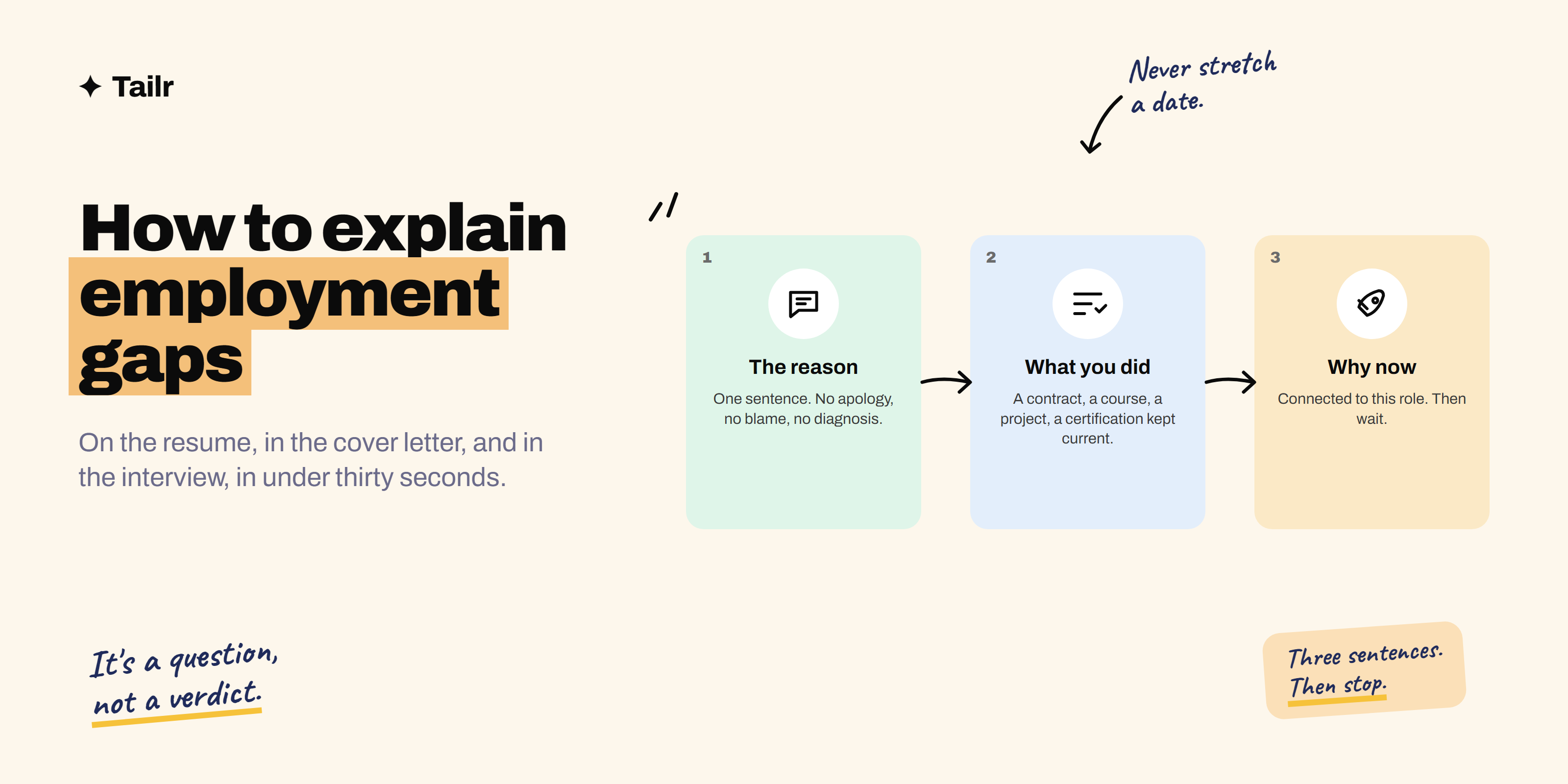
A gap in your resume feels bigger to you than it does to the person reading it. Recruiters see them constantly, most have had one themselves, and what they’re actually checking is simple: is there a reason, did you stay switched on, and are you ready now. This is how to handle a gap on the resume so it doesn’t distract, and how to answer the question in an interview in under thirty seconds so the conversation moves on to what you can do.
The short answer: A gap of under six months rarely needs explaining; use years rather than months for dates and it usually disappears. For longer gaps, do three things:
- On the resume: fill it with whatever you did (freelance, study, caring, a project) as a dated entry, or name it in one line with the same format as a job.
- In the cover letter, if you send one: one calm sentence.
- In the interview: reason, what you did, why you’re ready now, in three sentences, then stop.
Never stretch dates; they’re the easiest thing on a resume to verify. Employers care far less about the gap than about whether you stayed current and can talk about it without flinching.
Which gaps need explaining
- Under six months: usually not. Job searches take months; nobody expects back-to-back end and start dates. Use years for dates (“2023–2025”) and most short gaps vanish.
- Six months to a year: a one-line explanation somewhere, and an answer ready for the interview.
- Over a year: a dated entry on the resume that accounts for the time, a sentence in the cover letter, and a rehearsed interview answer.
- Multiple gaps: the pattern is what gets asked about. Have a one-line answer for each and, if there’s a common thread (contract work, an industry that laid people off repeatedly), name it.
- A gap that’s current: the most common one. “I’ve been searching since March, and I’ve been selective about the roles I apply for” is a complete answer.
How to handle it on the resume
Option 1: fill it
If you did anything during the gap, it’s an entry, with dates, in the same format as your jobs.
Freelance financial reporting consultant — Jan 2025 – Present
- Completed year-end close and audit preparation for two SMEs (₹8 crore and ₹15 crore revenue) on short-term contracts.
- Completed the IFRS 2025 update course.
Career break: full-time parent — Mar 2023 – Aug 2025
- Returned to work in September 2025. Kept current with the PMP renewal and a six-week course on agile delivery.
Independent study and portfolio — Jun 2024 – Feb 2025
- Completed a 600-hour data analytics programme; built three projects in SQL and Python, including a churn analysis on a public dataset (link).
Caring, study, freelance, a business that didn’t work, a long-planned trip: all of these are entries. The entry doesn’t need to be impressive. It needs to account for the time and, ideally, show one thing you did to stay current.
Option 2: format around it
- Years instead of months. “2021–2023, 2024–Present” hides a gap of up to eleven months without misleading anyone. Every resume guide accepts this. It stops working for gaps over a year, and if the interviewer asks for months, give them.
- A summary at the top. Two or three lines that say who you are and what you’ve done pull the reader’s attention to your strengths before they reach the dates.
- Group short contracts. “Contract roles, 2023–2025” with the clients underneath reads as continuous work rather than three gaps.
Don’t switch to a fully functional (skills-only, no dates) resume to hide a gap. Recruiters know exactly why people do that, and applicant tracking systems parse it badly.
Option 3: name it in one line
When there’s nothing to fill it with, a one-line entry is better than an unexplained hole.
Career break — 2024 – 2025 Full-time carer for a parent, now recovered. Available for full-time work from January 2026.
Same format as a job. No apology, no detail beyond the sentence.
One-line explanations for the common reasons
Use these on the resume, in a cover letter, or as the first sentence of an interview answer.
- Layoff or redundancy: “My role was made redundant in a company-wide restructuring in March 2025, along with about 20% of the team.”
- Long job search: “I’ve been searching since the restructuring and have been selective about the roles I’ve pursued, which is why this one is the fourth I’ve applied for rather than the fortieth.”
- Caring for a child: “I took two years out as a full-time parent and returned to work when my youngest started school.”
- Caring for a family member: “I took eighteen months out to care for my father after surgery; he’s fully recovered.”
- Health: “I took time out for a health issue that’s fully resolved, and I’ve been cleared to return to full-time work.” (You don’t owe anyone the diagnosis.)
- Study: “I took a year to complete a master’s in data science full-time.”
- A business that didn’t work: “I spent two years building a food delivery startup that reached 400 orders a week before we ran out of runway. I learned more about operations in those two years than in the five before them.”
- Travel or a planned break: “I took a planned six-month break to travel after eight years without one, and came back with a clear idea of what I want to do next.”
- Burnout: “I took time out to recover from burnout after a very intense period, and I’ve come back with better habits around it.” (Say this only if you’re comfortable; “a planned break” is also honest.)
The interview answer: reason, activity, readiness
The question is coming, so have the answer ready. Three parts, under thirty seconds:
- The reason, in one sentence, without apology.
- What you did during the gap that kept you current or taught you something.
- Why you’re ready now, connected to this role.
Then stop talking. The silence after is the interviewer moving on, not an invitation to say more.
Layoff, nine months ago:
“My role was cut in a restructuring last December, along with about a fifth of the department. I used the time to finish the AWS certification I’d been putting off and did a three-month contract for a former colleague’s company, which is on my resume. I’ve been selective about the next role, and this one is exactly the scope I’ve been looking for.”
Caring, eighteen months:
“I took eighteen months out to care for my father after a major surgery; he’s fully recovered. I kept a hand in with two short year-end contracts and the IFRS update, and I’ve been actively interviewing since March. I’m ready for a full-time role with this level of ownership.”
Failed business, two years:
“I left to build a food delivery startup with a co-founder. We got to 400 orders a week and ran out of money before we could raise. I learned more about operations, hiring and cash in those two years than in the five before them, and I’m bringing all of it to an operations role rather than trying to be a founder again.”
Current gap, six months:
“I’ve been searching since my contract ended in March. I’ve been selective, which is why I’ve applied for a handful of roles rather than everything, and I’ve used the time to build the portfolio project on my resume. This role is the one I’ve been most interested in.”
What each of these has in common: no apology, no defensiveness, one concrete thing done during the gap, and a turn toward the role in the last sentence.
What not to do
- Don’t stretch dates. Extending an end date to cover a gap is the one thing here that can cost you the job after you’ve got it. Background checks and reference calls verify dates routinely.
- Don’t apologise. “I’m sorry, I know this looks bad” tells the interviewer it looks bad. It didn’t, until you said so.
- Don’t over-explain. The diagnosis, the family conflict, the details of the layoff. One sentence, then the next part.
- Don’t blame. Even a genuinely bad former employer. “The company restructured” is enough.
- Don’t fill the silence. After the three sentences, wait. The interviewer will move on.
- Don’t hide it with a functional resume. It signals exactly what you’re hiding.
- Don’t leave it unexplained. A hole with no line is the only version that actually raises a flag.
Where Tailr fits
A gap changes how you should present the rest of the resume: the summary has to carry more, the most recent relevant work needs to lead, and the language of the listing matters more because the recruiter is looking for reasons to keep reading. Tailr tailors your resume to the specific job listing you’re viewing, so the summary uses the listing’s title and priority skills, the strongest matching experience leads, and the cover letter says in one calm line what the gap was and what you did, in the structure above. How to write a cover letter has a full returner example, and 30 most asked HR interview questions covers the gap question alongside the others in that round. Try Tailr on the next listing you open.
Conclusion
A gap is a question, not a verdict, and it gets one calm answer: the reason, what you did, why you’re ready now. On the resume, fill it with whatever you did or name it in one line in the same format as a job; use years for dates so short gaps disappear; never stretch a date. In the interview, three sentences and stop. Employers stopped treating gaps as red flags some time ago. The only thing that still hurts is treating it like one yourself.
Frequently asked questions
01Do I need to explain a gap in my resume?
Only if it's long enough to be noticed, roughly six months or more, or if a recruiter asks. Gaps under six months usually pass without comment, especially if you use years rather than months for dates. For longer gaps, a one-line explanation on the resume or in the cover letter, plus a calm two-sentence answer ready for the interview, is enough. Don't over-explain; the gap matters less to employers than it does to you.
02How do I explain a gap in employment on a resume?
Three options, in order of preference. Fill it: if you did anything during the gap (freelance, study, caring responsibilities, a project), list it as an entry with dates. Format around it: use years instead of months so a short gap disappears, or a functional summary at the top so the timeline isn't the first thing read. Name it: a one-line entry such as 'Career break, 2024–2025: full-time carer for a parent, now recovered' with the same date format as your jobs.
03What is a good reason for a gap in employment?
Any honest one. Caring for a child or a family member, health, redundancy or a layoff, a long job search, study, relocation, a failed business, travel, burnout and recovery. Interviewers have heard all of them and hold none against a candidate who states the reason in a sentence and moves on to what they did and why they're ready now. The only bad reason is an invented one.
04How do I answer why is there a gap in your resume in an interview?
Reason, activity, readiness, in that order, in under thirty seconds. 'I took eighteen months out to care for my father after surgery; he's fully recovered. During that time I did two short contract projects and kept my certification current. I'm ready to return to a full-time role with this scope.' Then stop. Don't apologise, don't fill the silence, and don't volunteer more detail than the sentence.
05Should I lie about a gap or stretch my dates?
No. Employment dates are among the easiest things to verify, through references, background checks and payroll records, and being caught is a withdrawn offer or a dismissal later. Using years instead of months is a normal formatting choice; extending an end date into a gap is a lie. The honest one-line explanation costs you far less than the risk.
06Are employment gaps still a problem in 2026?
Much less than they were. The pandemic normalised gaps, layoffs have been common across tech and other sectors, and most recruiters now treat a gap as a question rather than a red flag. What still hurts is a gap with no explanation, or a candidate who seems ashamed of it. A clear sentence and evidence you stayed current resolves both.