How to Write a Cover Letter in 2026 (With Examples and a Template)
· updated
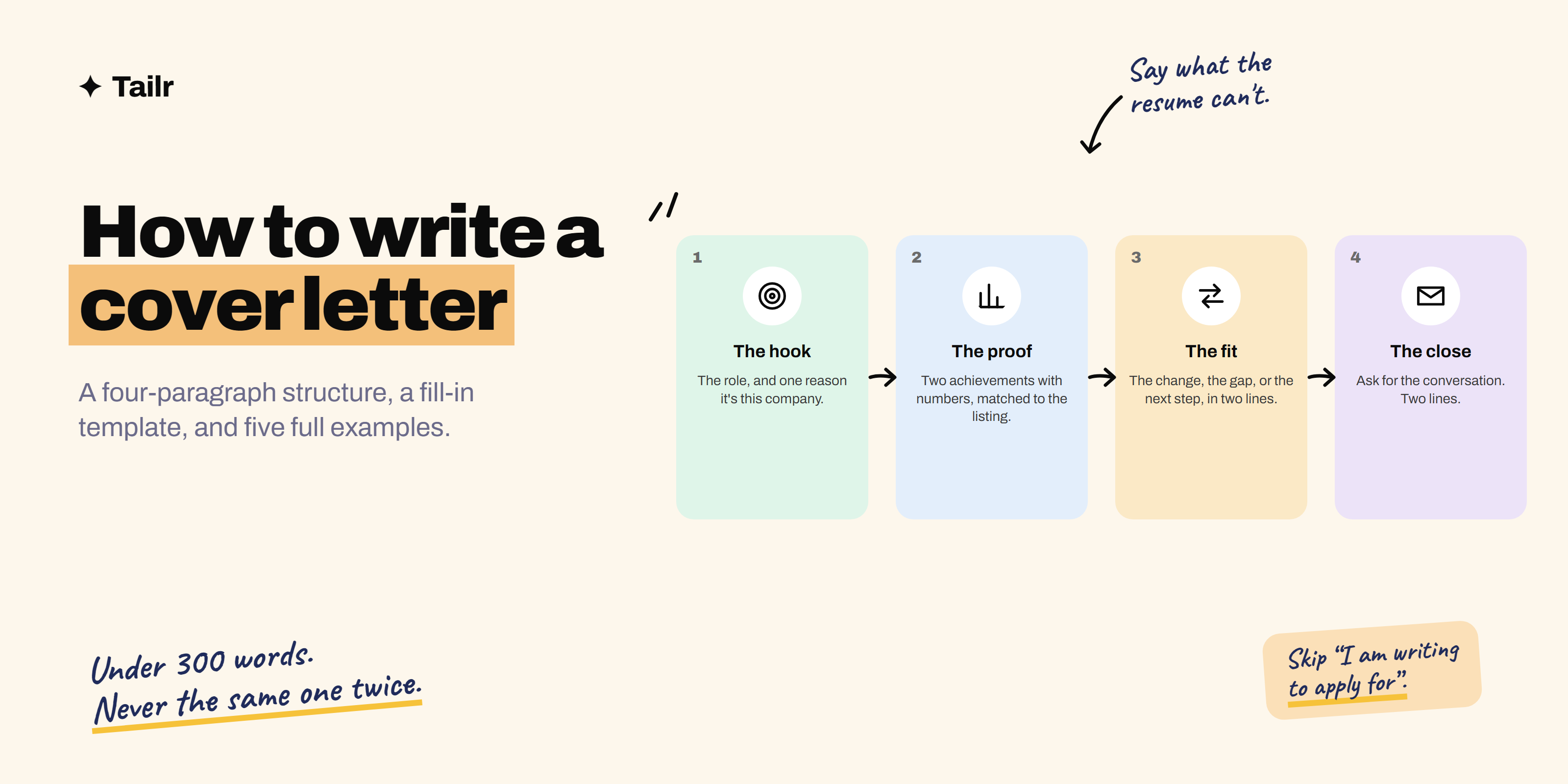
Most cover letters are written the night before, start with “I am writing to apply for”, restate the resume in paragraph form, and end with “I look forward to hearing from you”. Recruiters have read ten thousand of them and skip them on sight. The good ones are short, specific to one company, and say something the resume can’t. This is how to write that one, with a structure, a template, and five full examples.
The short answer: A cover letter is three or four short paragraphs, under 300 words:
- The role and one specific reason you want it at this company.
- One or two achievements with numbers that prove you can do what the listing asks.
- The connection between your background and their need that the resume doesn’t make on its own (a career change, a gap, why you’re moving).
- A two-line close.
Address a named person if you can find one. Rewrite paragraphs one and three for every application; keep the achievements. Write one when it can do a job the resume can’t; skip it when it would just repeat the resume. Tailr drafts one in this structure from the listing you’re viewing.
When a cover letter matters and when it doesn’t
Write one when:
- The listing asks for it. Not sending one is a filter.
- You’re changing careers, industries or countries, and the resume alone doesn’t explain why you’re a fit.
- You have a gap, a demotion or an odd move to explain in one calm sentence.
- The role is with a small company, or the hiring manager reads applications directly. They read letters; recruiters at large companies often don’t.
- You have a genuine, specific reason to want this company, and it’s a differentiator.
Skip it or keep it to three lines when:
- The listing says “optional” and the application is through a large-company portal where a recruiter is screening hundreds.
- You’d only be restating the resume.
- You’d be sending the same letter to everyone.
The four-paragraph structure
Paragraph 1: the role and the reason (two or three sentences)
Name the role. Then say the one thing that made you apply to this company rather than any other. It has to be true and specific: a product you’ve used, a problem the listing describes that you’ve solved, a person you spoke to, something they published. “I’ve admired your company for years” is not a reason; “your job listing describes an onboarding problem I spent the last two years fixing” is.
Paragraph 2: the proof (three or four sentences)
One or two achievements, with numbers, chosen because they match what the listing asks for. Not your whole history; the two things this role needs most. If the listing is about building a team, the achievement is the team you built. If it’s about revenue, the number.
Paragraph 3: the fit (two or three sentences)
The thing the resume can’t say for itself. For a career changer: what transfers and why you’re moving. For someone with a gap: one sentence on the gap and what you did. For a straightforward candidate: why this is the right next step and what you’d bring in the first few months. This paragraph is where the letter earns its place.
Paragraph 4: the close (one or two sentences)
Ask for the conversation, say you’re available, thank them. No “I look forward to hearing from you at your earliest convenience”.
The template
Dear [Name, or Hiring Manager],
I’m applying for the [role] at [company]. [One specific reason you want this role at this company: a product you use, a problem the listing describes that you’ve solved, something they’ve done.]
At [current or most recent company], I [achievement 1 with a number, matched to the listing’s top requirement]. Before that, I [achievement 2 with a number, matched to the second requirement]. [Optional: one line on the skills or tools the listing names that you’ve used.]
[The fit: what transfers, why you’re moving, what you’d bring in the first 90 days, or the one-sentence explanation of a gap or change.]
I’d welcome a conversation about the role. I’m available at [phone or email] and can start [notice period].
[Your name]
Five full examples
1. Fresher, first job (software)
Dear Ms. Rao,
I’m applying for the graduate backend engineer role at Kestrel. I’ve used your API in two college projects, and the listing’s line about “owning a service end to end within six months” is the reason I applied rather than to a larger company where I’d be one of a hundred graduates.
In my final year I built the attendance system our department ran for a semester, used by 300 students daily. I owned the backend and the data pipeline, and I learned what breaks in production when real people depend on something. In a six-month internship at a fintech startup I wrote the test automation for their payments API, which caught two issues before release. I’m comfortable in Python, SQL and Git, and I’ve deployed to AWS.
I know a graduate role means learning fast and asking a lot of questions. I’d rather do that on a small team building something real than in a rotation programme, which is why Kestrel was the first application I sent.
I’d welcome a conversation. I’m available at +91 98xxx xxxxx and can start in July after my final exams.
Aditya Menon
2. Experienced, same field (marketing)
Dear Hiring Manager,
I’m applying for the Senior Marketing Manager role. Your listing describes building the mid-market playbook from scratch rather than running an existing one, and that’s the work I’m best at and want to do next.
At Lumen I built the inbound programme from nothing to 60% of pipeline in two years, holding cost per lead flat while the team grew from one to four. Before that, at an agency, I ran demand generation for eleven B2B clients, which is where I learned to find what works in a new segment quickly. I’ve run HubSpot and Salesforce end to end and I’m comfortable owning a number.
I’ve been at Lumen four years and grown as far as the role allows; my manager and I have talked openly about it. The mid-market motion is the one I know best, and your move into that segment is the right time to join.
I’d welcome a conversation about the role and can share the playbook and the numbers behind it. I’m on a 60-day notice period.
Priya Nair
3. Career changer (teacher to corporate learning)
Dear Mr. Okafor,
I’m applying for the Learning and Development Specialist role at Northwind. I’m a secondary school teacher moving into corporate learning, and your listing’s emphasis on designing programmes rather than delivering someone else’s is exactly the shift I want to make.
In eight years of teaching I designed and delivered curriculum to about 150 students a year, and for the last three I trained every new teacher in our department in classroom management, which cut their first-term escalations by half. Outside school I completed an instructional design certification and built two e-learning modules in Articulate for a local nonprofit, both still in use.
What transfers is the core of the job: understanding what people need to learn, designing something that gets them there, and measuring whether it worked. What I’m still learning is the corporate context, which is why I’m targeting a specialist role rather than a lead, and why a company with an established L&D team appealed.
I’d welcome the chance to talk it through. I’m available immediately at the number below.
Sarah Whitfield
4. Returning after a gap (finance)
Dear Hiring Manager,
I’m applying for the Financial Reporting Manager role. I spent five years leading month-end close at a listed manufacturer, took eighteen months out to care for a parent, and I’m ready to return to a role with exactly this scope.
At Meridian I ran the close for three entities, cut it from twelve days to seven by rebuilding the intercompany process, and managed the statutory audit for three years with no material findings. During the gap I kept current: I completed the IFRS update course, did two short contract engagements on year-end for smaller companies, and I’ve been following the changes in your sector’s reporting requirements.
I’m returning with the same technical base and, honestly, a clearer sense of what I want to spend my time on. This role’s mix of close ownership and process improvement is it.
I’d welcome a conversation. I’m available immediately.
Daniel Mensah
5. Short version, when it’s optional
Dear Hiring Manager,
I’m applying for the Customer Success Manager role. I currently manage a 45-account mid-market portfolio worth $2.1M ARR at 94% gross and 112% net retention, and I cut average onboarding from 60 to 35 days by rebuilding the kickoff process. Your listing’s focus on onboarding and expansion is the part of the job I’m strongest at. I’d welcome a conversation; I’m on 30 days’ notice.
Arjun Bhat
Mistakes that get a cover letter skipped
- “I am writing to apply for…” They know. Start with the reason.
- Restating the resume. If the letter says the same things as the resume, one of them is unnecessary, and it’s the letter.
- Generic praise. “Your company’s reputation for innovation” could be pasted into any letter and has been.
- Talking about what you want. “This role would help me grow” is about you. The letter is about what they get.
- Length. Past 300 words, the reader is skimming. Past 400, they’ve stopped.
- Formality that isn’t yours. “I would be most grateful for the opportunity to be considered” reads as a template. Write how you’d talk to a competent colleague.
- Typos, and especially the wrong company name. Read it aloud. Then check the name once more.
Where Tailr fits
A cover letter is only worth sending when it’s specific to the listing, and that’s exactly what’s tedious about it: reading the listing carefully, choosing which of your achievements match, and writing the first paragraph fresh every time. Tailr does this from the job listing you’re viewing: it tailors your resume to that role and generates a cover letter from the listing and your real experience, in the structure above, so the first paragraph is about that company and the achievements are the ones the role asks for. You edit and send. How to tailor your resume to a job description covers the resume half. Try Tailr on the next listing that asks for a letter.
Conclusion
A cover letter earns its place by saying something the resume can’t: why this company, which two achievements matter for this role, and what connects your background to their need. Four short paragraphs, under 300 words, a named person if you can find one, and a fresh first paragraph for every application. Write one when it can do a job, skip it when it would only repeat the resume, and never send the same one twice.
Frequently asked questions
01Do cover letters still matter in 2026?
Less than they did, but more than people think. Many recruiters skip them, and a bad one hurts more than none. But when a listing asks for one, when you're changing careers, when you have a gap to explain, or when the hiring manager reads applications directly, a short specific cover letter is often what separates two similar resumes. Write one when it can do a job the resume can't.
02How long should a cover letter be?
Three to four short paragraphs, 200 to 300 words, on well under one page. Recruiters read cover letters in under a minute if at all. Anything past 350 words is cut before it's read. If you can say it in 150 words, do.
03What should a cover letter include?
Four things in order: why this role at this company specifically (one or two sentences, with something you couldn't say about any other company), one or two achievements that prove you can do what the listing asks, a line that connects your background to what they need that the resume can't show, and a short close asking for the conversation. Skip restating your resume.
04How do you start a cover letter?
With the role and one specific reason you want it, not with your name or 'I am writing to apply'. Something like: 'I've used your product for two years and applied the day I saw the customer success role, because the onboarding problem it describes is the one I solved at my current company.' Address it to a named person if you can find one; 'Dear Hiring Manager' if you can't.
05Should I write a different cover letter for every job?
Yes, but not from scratch. Keep a base version with your two or three strongest achievements, then rewrite the first paragraph and the fit paragraph for each listing. The first paragraph is the one that has to be specific to the company; the achievements can mostly stay. A generic letter is worse than no letter.
06Can I use AI to write my cover letter?
Yes, if it works from your real experience and the actual listing, and you edit the result. A tool that reads the job description and your resume and drafts a letter from both is genuinely useful; a tool that produces the same template for every job is what recruiters have learned to spot. Whatever you use, read it aloud, cut anything you wouldn't say, and make sure every claim is one you can back up in an interview.