Interview Answer Frameworks: 7 Methods to Structure Any Answer
· updated
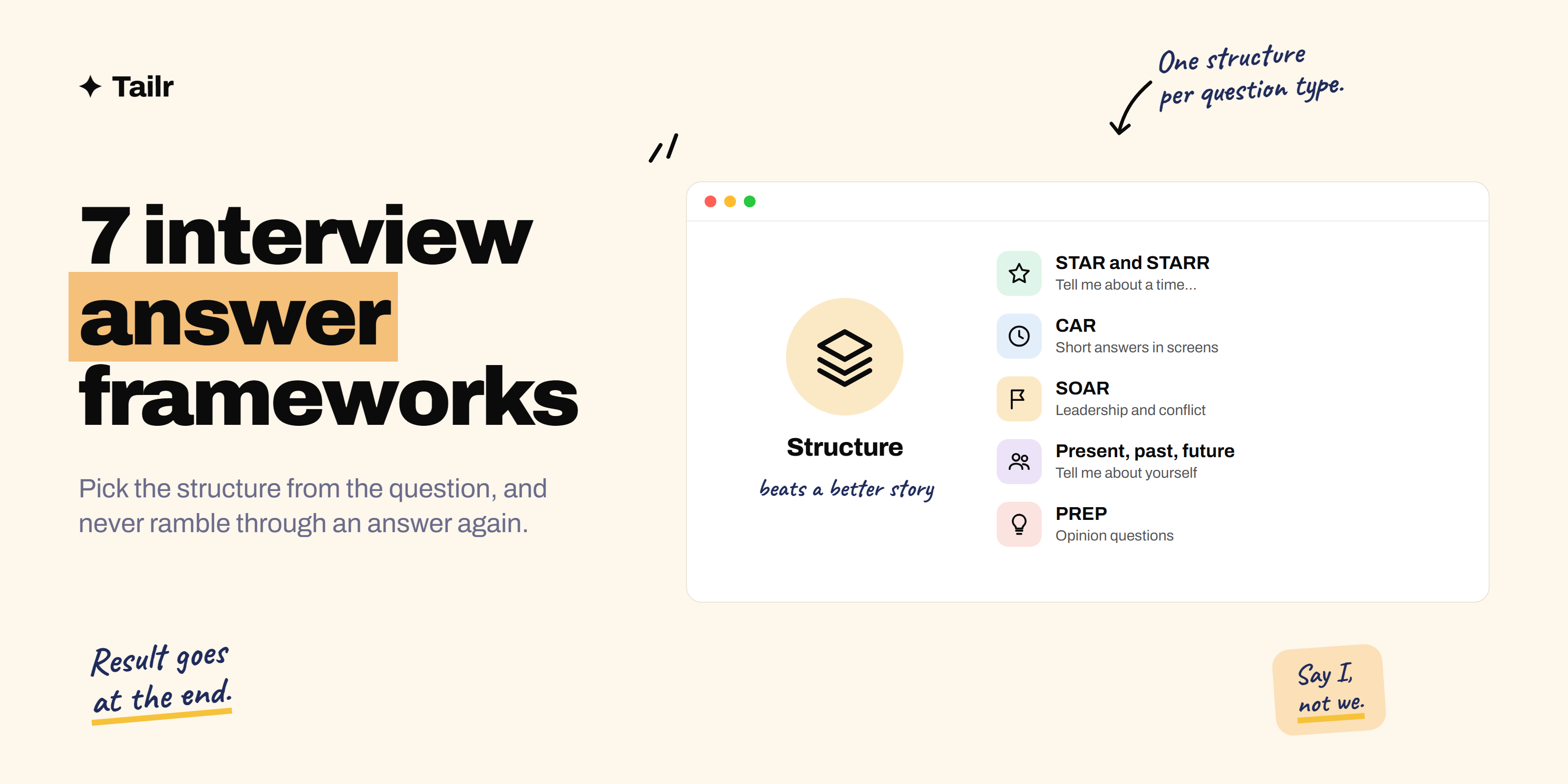
Most interview answers go wrong in the same way: a good story told in the wrong order. You start with background, wander into detail, and run out of time before the result, which was the only part the interviewer needed. An answer framework fixes that. It’s a simple order to tell things in, so every answer has a beginning, a middle and an end. This guide covers the seven frameworks worth knowing, when to use each one, and an example of each.
The short answer: these seven frameworks cover almost every interview question:
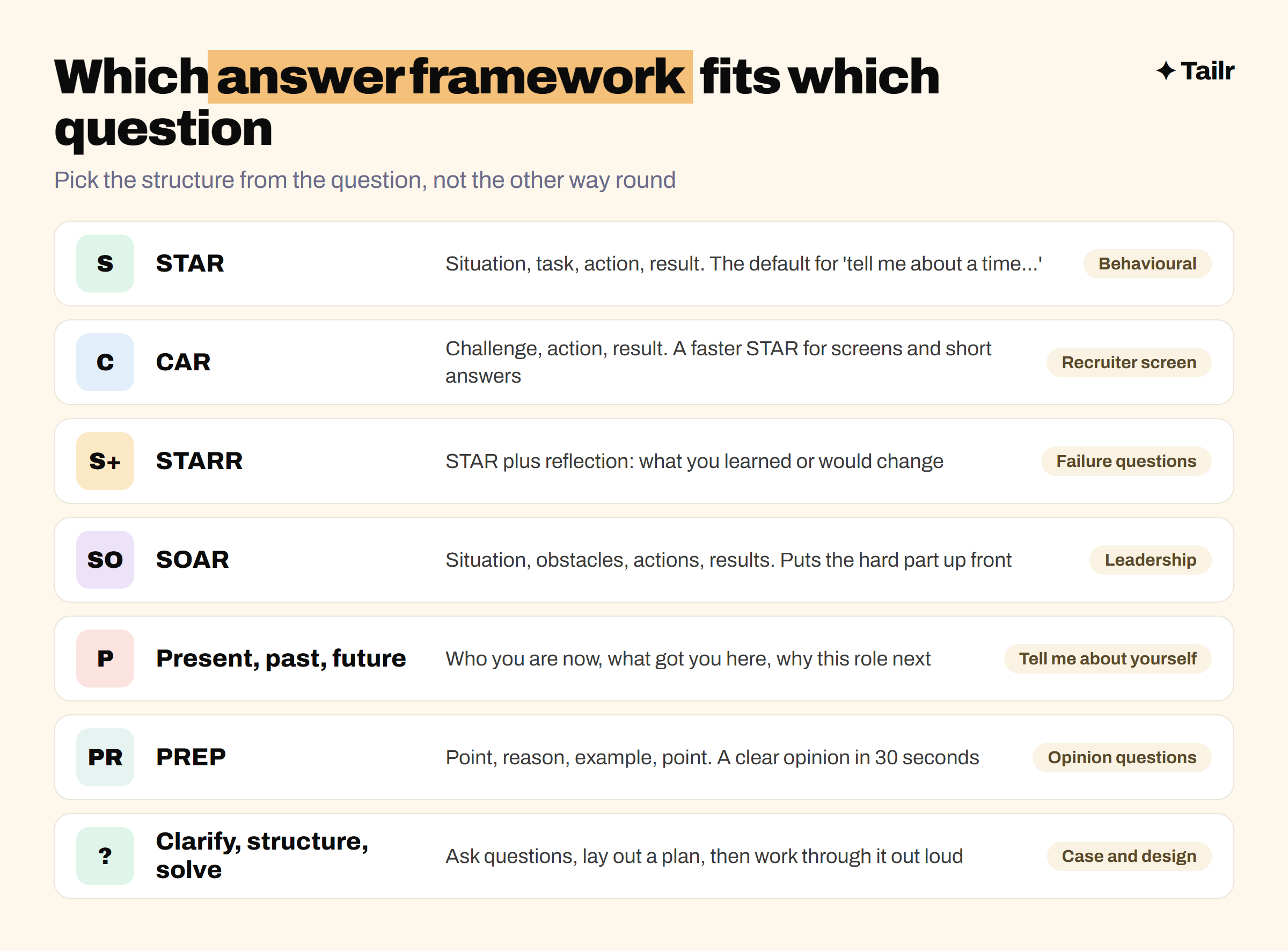
- STAR (situation, task, action, result) for “tell me about a time…” questions.
- CAR (challenge, action, result) for short answers in screens.
- STARR (STAR plus reflection) for failure and mistake questions.
- SOAR (situation, obstacles, actions, results) for leadership and conflict.
- Present, past, future for “tell me about yourself”.
- PREP (point, reason, example, point) for opinion questions.
- Clarify, structure, solve for case, product and technical questions.
Choose the framework from the question, keep the result at the end, and practise until the structure is invisible.
Why frameworks work
Interviewers hear dozens of answers a week. A framework helps them in three ways:
- They can follow you. When the story has a clear order, they don’t have to work to understand it.
- They hear the evidence. Frameworks force you to say what you did and what changed because of it, which is what they score.
- You stay short. Knowing where the answer ends stops you rambling.
Many companies use structured interviews with a scoring sheet. The interviewer is literally listening for the situation, your action and the result. Give them those three things clearly and you score well, even with an ordinary story.
1. STAR: situation, task, action, result
Use it for: behavioural questions that start “tell me about a time…”, “give me an example of…” or “describe a situation where…”.
- Situation: one or two sentences of context.
- Task: what you were responsible for.
- Action: what you did, step by step. This is the longest part.
- Result: what changed, with a number if possible.
Q: Tell me about a time you met a tight deadline.
“Our biggest client moved their launch forward by two weeks (situation), and I was responsible for getting the reporting dashboard ready in time (task). I cut the scope to the five reports they’d use on day one, agreed that list with the client in a 20-minute call, and paired with a backend engineer to get the data pipeline done in parallel (action). We shipped two days early, and the remaining reports went out the following sprint with no complaints (result).”
Common mistake: saying “we” all the way through. The interviewer can’t hire your team. Say “I”.
2. CAR: challenge, action, result
Use it for: recruiter screens, short video interviews and quick examples in the middle of another answer.
CAR merges situation and task into one “challenge”, so it’s about 30% shorter than STAR.
“Our support backlog hit 400 tickets after a bad release (challenge). I wrote ten saved replies for the most common issues and set up tagging so the team could clear similar tickets in batches (action). We were back under 50 within four days (result).”
3. STARR: STAR plus reflection
Use it for: questions about failure, mistakes and feedback, and anywhere the interviewer wants to see self-awareness.
The extra R is what you learned or what you’d do differently. That reflection is the real answer to “tell me about a time you failed”.
“…The release slipped by a week (result). What I learned is that I’d agreed a date before checking with the two other teams involved. Now I don’t commit to a date until every dependency owner has confirmed theirs (reflection).”
It pairs well with our guide to answering “what is your greatest weakness?”.
4. SOAR: situation, obstacles, actions, results
Use it for: leadership, conflict and difficult-project questions.
SOAR swaps “task” for “obstacles”. It puts what made the situation hard at the centre, which is exactly what leadership questions are about.
“I took over a project that was three weeks behind (situation). The two lead engineers disagreed on the architecture and had stopped talking to each other (obstacles). I met each one separately, wrote up both options with their trade-offs, and ran a single decision meeting with our manager (actions). We chose one design in an hour, and shipped only one week late instead of three (results).”
5. Present, past, future
Use it for: “tell me about yourself”, “walk me through your resume” and “why this role?”.
- Present: what you do now and one strength.
- Past: two or three relevant experiences, with a number.
- Future: why you want this job.
We’ve covered this one in depth, with sample answers, in how to answer “tell me about yourself”.
6. PREP: point, reason, example, point
Use it for: opinion and judgement questions: “what makes a good manager?”, “how do you prioritise?”, “speed or quality?”.
Q: Is it better to ship fast or ship perfect?
“Ship fast, with a clear quality bar (point). You learn more from real users in a week than from a month of internal polishing (reason). On my last team we launched the import feature with CSV only, and learned that 70% of users actually wanted Google Sheets, which we built next (example). So: fast, but never below the bar where a bug would lose a customer’s trust (point).”
7. Clarify, structure, solve
Use it for: case interviews, product sense questions, estimation and system design.
- Clarify. Ask two or three questions about goals, users and constraints.
- Structure. Say your plan out loud before you start: “I’ll look at users, then problems, then solutions, then how we’d measure it.”
- Solve. Work through the plan, thinking out loud, and finish with a recommendation.
You’ll see this shape in product sense interview questions and system design interviews.
Quick comparison
| Framework | Parts | Best for | Typical length |
|---|---|---|---|
| STAR | Situation, task, action, result | Behavioural questions | 1.5 to 2 minutes |
| CAR | Challenge, action, result | Screens, quick examples | 45 to 60 seconds |
| STARR | STAR plus reflection | Failure, mistakes, feedback | 2 minutes |
| SOAR | Situation, obstacles, actions, results | Leadership, conflict | 2 minutes |
| Present, past, future | Now, background, next | Tell me about yourself | 60 to 90 seconds |
| PREP | Point, reason, example, point | Opinion questions | 30 to 60 seconds |
| Clarify, structure, solve | Questions, plan, answer | Case and technical | 10 to 40 minutes |
How to build a story bank
Frameworks only work if you have stories to put in them. Before your next interview:
- List six to eight stories from the last few years: a win, a failure, a conflict, a tight deadline, leading something, learning something fast, a hard customer, a time you disagreed with your manager.
- Write each one in STAR form in four short bullet points, with the number in the result.
- Map each story to questions. One good story can answer five or six different questions depending on what you emphasise.
- Pick stories that match the job. Read the listing, note the skills it repeats, and lead with stories that prove those skills.
That last step is the same work as tailoring your resume. The achievements in your top resume bullets should be the stories you’re ready to tell. Tailr, our Chrome extension, tailors your resume to the job listing you’re viewing, so your strongest, most relevant achievements are already up front when you prepare your story bank.
Mistakes that break any framework
- Too much situation. If the setup takes a minute, the interviewer has stopped listening. Two sentences is enough.
- No result. “And it went well” isn’t a result. Give a number, a decision or a change.
- Sounding memorised. Learn the bullet points, not the script.
- Forcing a framework. “What’s your notice period?” doesn’t need STAR.
Related guides
- 40 behavioral interview questions with sample answers
- Situational interview questions
- Top 20 sales interview questions
Conclusion
A framework doesn’t make your story better; it makes it heard. Use STAR for “tell me about a time”, CAR when you’re short on time, STARR for failures, SOAR for leadership, present-past-future for “tell me about yourself”, PREP for opinions, and clarify-structure-solve for cases. Build a bank of six to eight stories, map them to the job you’re interviewing for, and practise out loud until the structure disappears and only the story is left.
Frequently asked questions
01What is the best method to answer interview questions?
There isn't one method for every question. STAR (situation, task, action, result) is best for behavioural 'tell me about a time' questions, present-past-future for 'tell me about yourself', PREP for opinion questions, and clarify-structure-solve for case and technical questions. Pick the structure that fits the question.
02What is the difference between STAR and CAR?
STAR has four parts: situation, task, action and result. CAR merges the situation and task into a single 'challenge', so it's shorter: challenge, action, result. CAR is useful when time is tight, such as recruiter screens or when the interviewer wants a quick example; STAR suits longer behavioural interviews.
03What does SOAR stand for in interviews?
SOAR stands for situation, obstacles, actions and results. It's similar to STAR but puts the obstacle front and centre, which makes it a good fit for questions about leadership, conflict or difficult projects, where what made the situation hard is the interesting part of the story.
04How long should a STAR answer be?
Aim for one and a half to two minutes, roughly 200 to 300 words spoken. Spend about 20% on the situation and task, 60% on your actions and 20% on the result. If the interviewer wants more detail, they'll ask a follow-up question.
05What is the PREP method for interviews?
PREP stands for point, reason, example, point. You state your answer, give the main reason, back it with a short example, and restate the point. It's ideal for opinion and judgement questions like 'what makes a good manager?' or 'should we prioritise speed or quality?'
06Can I use the same story for different interview questions?
Yes. A strong story about a difficult project can answer questions on conflict, leadership, problem-solving and deadlines if you change which part you emphasise. Prepare six to eight stories and map each one to the questions it can answer, so you aren't caught without an example.