How to Prepare for a System Design Interview (Step-by-Step)
· updated
The system design round is the interview most engineers feel least prepared for. There’s no test suite, no single right answer, and 45 minutes to design something like YouTube. The good news is that it’s very learnable: interviewers are mostly checking how you think, and that follows a pattern you can practise. This guide gives you that pattern, the concepts to know, and a plan to get ready.
The short answer: How to prepare for a system design interview:
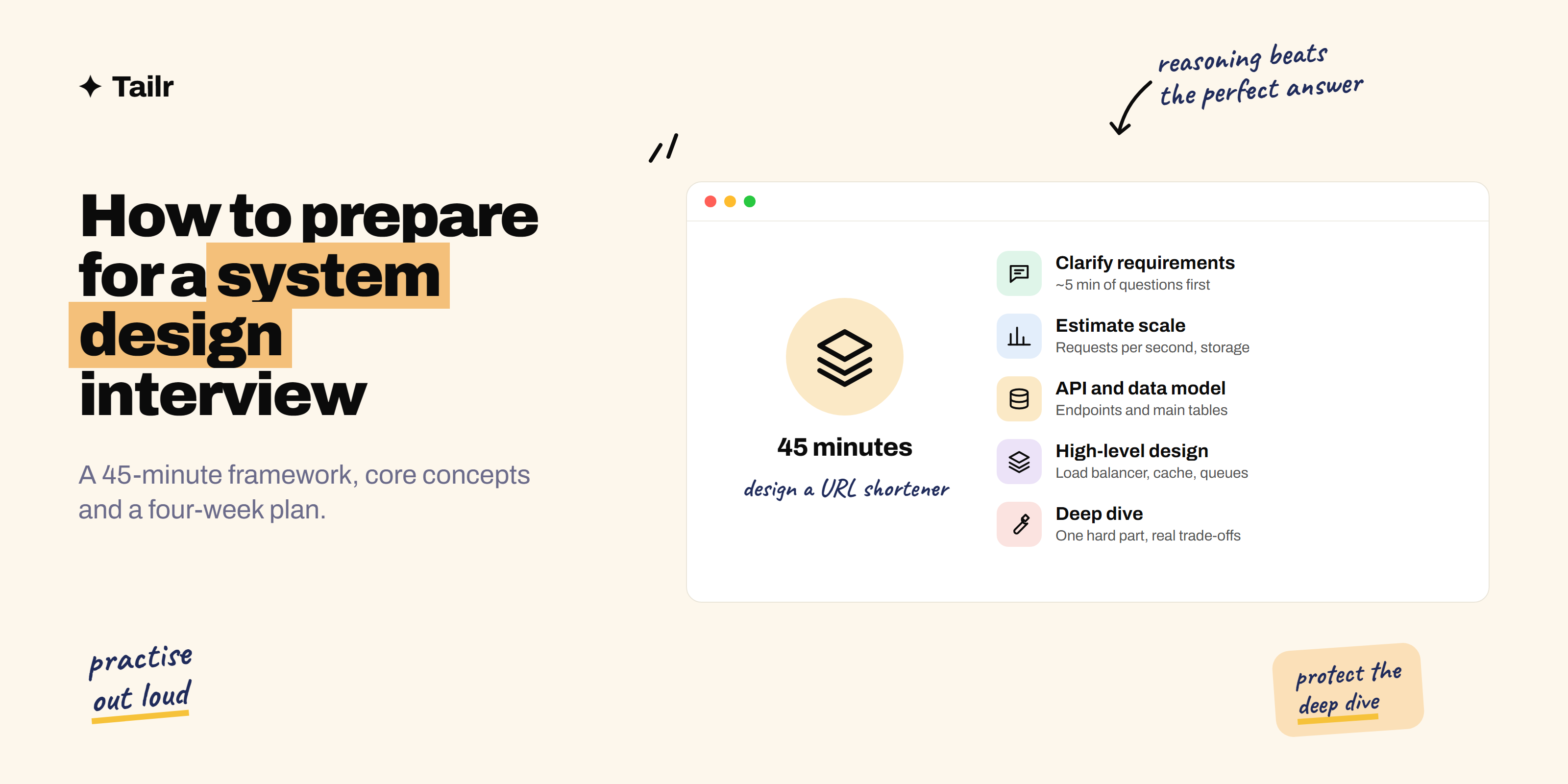
- Learn a framework for the 45 minutes: requirements, estimates, API and data, high-level design, deep dive.
- Learn the core building blocks: load balancers, caches, databases, queues, sharding and replication.
- Study 8–10 classic problems, like a URL shortener, news feed and chat app.
- Practise out loud with a whiteboard or drawing tool, ideally in mock interviews.
- Prepare stories from your own work about systems you’ve built and trade-offs you made.
Most people need two to six weeks. The framework matters more than memorising designs.
What interviewers are actually looking for
- Clarity: do you ask good questions before drawing boxes?
- Structure: can you break a vague problem into parts and stay on track?
- Trade-offs: do you explain why you chose SQL over NoSQL, or a queue over a direct call?
- Depth: can you go deep on one hard part instead of staying shallow everywhere?
- Communication: do you think out loud and respond to hints?
They’re not looking for the “correct” architecture. Two very different designs can both score well if the reasoning is sound.
A 45-minute framework
| Step | Time | What you do |
|---|---|---|
| 1. Clarify requirements | ~5 min | Core features, users, what’s out of scope, non-functional needs (latency, availability) |
| 2. Estimate scale | ~5 min | Users, requests per second, storage per year, read-to-write ratio |
| 3. API and data model | ~5–10 min | Key endpoints, main tables or documents |
| 4. High-level design | ~10 min | Clients, load balancer, services, databases, cache, queues |
| 5. Deep dive and trade-offs | ~15 min | Scale the hardest part, handle failures, discuss alternatives |
Example: design a URL shortener
- Requirements: shorten a URL, redirect fast, optional custom aliases and expiry. Reads far outnumber writes.
- Estimates: say 100 million new links a month; that’s about 40 writes a second, and maybe 4,000 redirects a second at a 100:1 read ratio. Five years of links at ~500 bytes each is a few terabytes.
- API and data:
POST /linksreturns a short code;GET /{code}redirects. One table: code, long URL, owner, created, expires. - High-level design: load balancer, stateless app servers, a key-value store for links, and a cache in front for hot codes.
- Deep dive: how to generate unique short codes (counter plus base62 encoding vs random codes with collision checks), cache eviction, and what happens if a region goes down.
That shape works for almost any question. Only the hard part in step 5 changes.
Example 2: design a chat app
Here’s the same framework on a harder problem, to show how the deep dive changes.
- Requirements: one-to-one and small group chats, messages delivered in real time, message history, online status, and notifications for offline users. Out of scope: voice and video calls. Messages must not be lost, and order within a conversation matters.
- Estimates: say 50 million daily users sending 40 messages each: 2 billion messages a day, or about 23,000 a second on average, with peaks several times higher. At ~200 bytes a message, that’s around 400 GB of new messages a day before replication.
- API and data: clients keep a long-lived connection (WebSockets) to send and receive. Main data: messages keyed by conversation ID and a per-conversation sequence number; conversations and their members; user devices for push notifications.
- High-level design: clients connect to a fleet of connection servers. A message service writes each message to a database built for heavy writes and partitioned by conversation ID, then looks up which connection server each recipient is on and forwards it. Offline recipients get a push notification through a notification service. A cache holds who is online.
- Deep dive: pick the hardest parts and go deep:
- Ordering: assign a sequence number per conversation so every client shows messages in the same order, even if they arrive out of order.
- Delivery guarantees: store first, then deliver; the client acknowledges, and anything unacknowledged is resent when it reconnects.
- Presence: clients send a heartbeat every so often; online status is a cache entry that expires if the heartbeats stop.
- Groups: for small groups, send to each member; for very large ones, consider having clients pull new messages instead.
You won’t cover all four in 15 minutes. Name them, then ask which one the interviewer wants to explore.
Back-of-the-envelope numbers to remember
You don’t need precise maths, just quick, defensible estimates. These shortcuts cover most questions:
| Shortcut | Value |
|---|---|
| Seconds in a day | ~86,400, round to 100,000 |
| 1 million requests a day | ~12 per second |
| 100 million requests a day | ~1,200 per second |
| Peak traffic | Assume 2–5x the average |
| 1 KB × 1 million | 1 GB |
| 1 KB × 1 billion | 1 TB |
| Reading from memory | Nanoseconds |
| Reading from SSD | Tens to hundreds of microseconds |
| Round trip within a data centre | Under a millisecond |
| Round trip across continents | Around 100–150 milliseconds |
Say your assumptions out loud (“let’s assume 10 million daily users, each making 20 requests”), round aggressively, and move on. The point is to decide things like “this fits on one database” or “we’ll need to shard”, not to get the exact number.
Core concepts to know
| Concept | What to understand |
|---|---|
| Load balancing | Spreading traffic across servers; keeping servers stateless |
| Caching | Where to cache (CDN, app, database), eviction, stale data |
| Databases | SQL vs NoSQL, indexes, when each fits |
| Replication | Read replicas, leader and follower, consistency lag |
| Sharding | Splitting data by key; hot keys; resharding |
| Queues and streams | Decoupling services, retries, background jobs |
| Consistency | Strong vs eventual; the CAP trade-off in plain terms |
| Rate limiting | Protecting services; token bucket basics |
| Storage | Object storage for files, blobs and media |
| Observability | Logs, metrics, alerts; how you’d know it’s broken |
If these feel shaky, start with what software architecture is, which covers the main patterns these build on. Brushing up on SQL interview questions also helps with the data-model step.
Practice questions, easiest to hardest
- URL shortener
- Rate limiter
- Pastebin or a key-value store
- Notification system
- News feed (like X or Instagram)
- Chat app (like WhatsApp)
- File storage and sync (like Dropbox)
- Video streaming (like YouTube)
- Ride-sharing (like Uber)
- Search autocomplete
Do each one twice: once learning from a worked example, once timed and out loud on your own.
A four-week study plan
| Week | Focus |
|---|---|
| 1 | Learn the framework and core concepts; read the fundamentals |
| 2 | Work through 4–5 classic problems with worked examples |
| 3 | Timed solo practice out loud; record yourself and review |
| 4 | Mock interviews with a friend or peer; polish your own project stories |
Resources people rely on: Designing Data-Intensive Applications by Martin Kleppmann for fundamentals; Alex Xu’s System Design Interview books and ByteByteGo (bytebytego.com) for worked examples; the free System Design Primer (github.com/donnemartin/system-design-primer); and a drawing tool like Excalidraw (excalidraw.com) to practise diagrams the way many remote interviews run. Our roundup of the best tools for interview preparation lists more.
What changes with seniority
The same question is graded differently depending on the level you’re interviewing for:
| Level | What a strong answer shows |
|---|---|
| Junior / new grad | A sensible high-level design, knowledge of the basic building blocks, and good questions. Often an API or object design question instead. |
| Mid-level | A complete design driven by requirements and estimates, plus one solid deep dive with clear trade-offs. |
| Senior | You lead the conversation, spot the hardest part early, and handle failures, scaling limits, data consistency and operations without being asked. |
| Staff and above | Everything above, plus cost, team boundaries, migration paths from the current system, and when not to build something. |
If you’re aiming for senior, the biggest jump is ownership: don’t wait for the interviewer to ask “what happens if this server dies?” Raise it yourself.
Phrases that help in the room
Small bits of language make your thinking visible and keep the interviewer with you:
- “Before I design anything, can I check a few requirements?”
- “Let me make a rough estimate so we know what scale we’re designing for.”
- “I’ll sketch the simple version first, then we can scale the parts that need it.”
- “There are two options here. A gives us X, B gives us Y. Given our requirements, I’d pick A because…”
- “This is the part I think is hardest. Would you like me to go deeper here or somewhere else?”
- “If I had more time, I’d look at monitoring and what happens during a regional outage.”
Practise saying these during mock interviews until they come naturally. They buy you thinking time and show the interviewer you’re structured, which is half the score.
Common mistakes
| Mistake | Fix |
|---|---|
| Drawing boxes before asking questions | Spend the first five minutes on requirements |
| Skipping estimates | Rough numbers decide the design; do them quickly |
| Going wide and shallow | Pick one hard part and go deep |
| Naming tools without reasons | Say why: “Postgres, because we need transactions here” |
| Talking silently into the diagram | Narrate as you go, and check in |
| Running out of time | Watch the clock; protect the deep dive |
Bring your own experience
Interviewers often ask about systems you’ve actually built, and those answers can carry the round. Prepare two short stories: a system you designed or changed, the trade-off you made, and what happened. Use the same structure as behavioral interview questions: situation, decision, result.
Make sure those systems show up on your resume too, with scale and results (“Moved order processing to a queue-based design, handling 5x peak traffic with no outages”). Tailr tailors your resume from the job listing you’re viewing, so the design experience that role cares about is the first thing a recruiter sees, and it tracks each application while you prep. For the coding rounds, see how to ace your technical interview.
Try TailrRelated guides
- 50 Group Discussion Topics and How to Score in a GD
- 30 Most Asked HR Interview Questions and Answers
- 30 Situational Interview Questions With Sample Answers
- 25 Interview Tricks You Should Know Before Your Next Interview
Conclusion
System design interviews reward structure and reasoning, not a memorised perfect answer. Learn the framework, get comfortable with the core building blocks, practise ten classic problems out loud, and prepare real stories from your own work. Give yourself a few focused weeks, and the round that felt the most open-ended becomes the one you’re best prepared for.
Frequently asked questions
01What is a system design interview?
A system design interview asks you to design a large software system, such as a URL shortener or a chat app, in about 45 to 60 minutes. There's no single right answer. The interviewer is judging how you clarify requirements, structure the design, and reason about trade-offs.
02How long does it take to prepare for a system design interview?
Most people need two to six weeks of steady practice, depending on experience. If you've built and operated real services, a couple of weeks of learning the framework and doing mock interviews can be enough. Starting from scratch, plan for four to six weeks.
03Do junior engineers get system design interviews?
Sometimes, but they're usually lighter or replaced by object-oriented or API design questions. System design carries much more weight for mid-level and senior roles, where it often decides the level you're offered.
04What are the most common system design interview questions?
Classic questions include designing a URL shortener, a news feed, a chat app, a rate limiter, a file storage service like Dropbox, a video platform like YouTube, a ride-sharing service, and a notification system. They test the same core ideas: scaling, storage, caching and trade-offs.
05What is the best way to structure a system design answer?
Clarify requirements, estimate scale, define the API and data model, sketch a high-level design, then go deep on one or two hard parts and discuss trade-offs. Keep checking in with the interviewer, and save at least a third of the time for the deep dive.
06What books or resources help with system design interviews?
Popular picks are Designing Data-Intensive Applications by Martin Kleppmann for fundamentals, Alex Xu's System Design Interview books for worked examples, and the free System Design Primer on GitHub. Pair reading with mock interviews out loud, which is where most improvement happens.