25 Interview Tricks You Should Know Before Your Next Interview
· updated
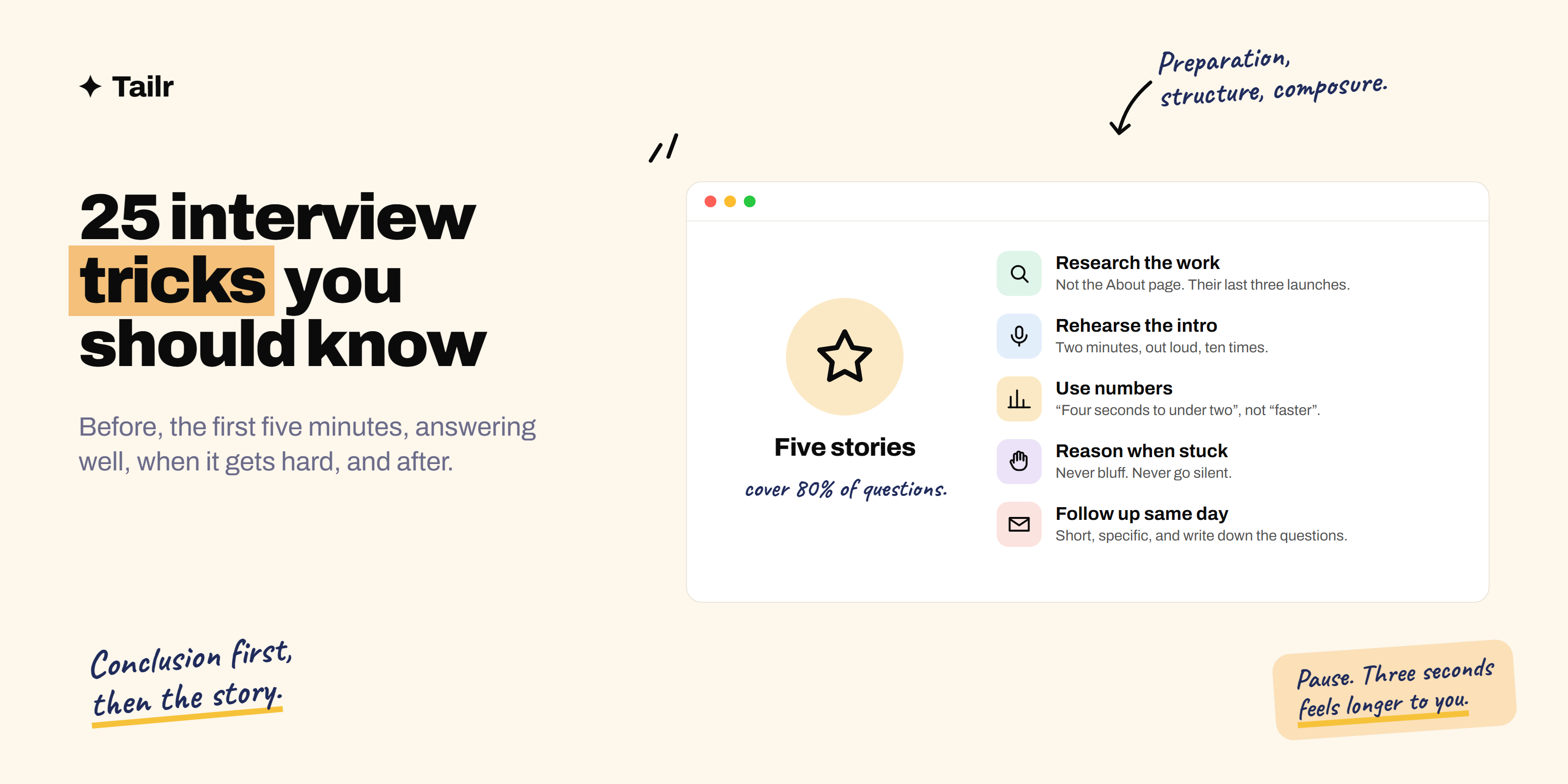
Most interview advice is either obvious (“be confident”) or useless (“mirror their body language”). These are the tricks that experienced candidates and interviewers actually use, in the order you’ll need them: before, at the start, during, when it gets hard, and after.
The short answer: the interview tricks that work are preparation, structure and composure:
- Before: research the company’s real work, prepare five stories that cover most questions, rehearse your introduction out loud, and find out the format.
- At the start: be early, use names, and mention something specific you noticed.
- During: lead with the conclusion, use numbers, pause before hard questions, and turn weaknesses into evidence of growth.
- When it gets hard: reason out loud, ask clarifying questions, and never bluff.
- After: send a short thank-you the same day, write down what you were asked, and follow up once if you hear nothing.
None of these replace being able to do the job; they make sure the interviewer can see that you can.
Before the interview
1. Research the work, not the About page. Everyone reads the About page. Instead, read the company’s last three blog posts or product updates, look at the team on LinkedIn, try the product, and find one recent decision or launch you have an opinion on. Mentioning it early is the fastest way to show you’re serious.
2. Prepare five stories, not fifty answers. Most behavioural questions map onto a handful of themes: a success with numbers, a failure and what you learned, a conflict you resolved, a time you led without authority, a time you handled ambiguity. Prepare one strong story for each, with a situation, what you did and the result, and you’ve covered eighty percent of what you’ll be asked. Our behavioral interview questions guide has the full list.
3. Rehearse your introduction out loud, with a timer. “Tell me about yourself” is the first question in almost every interview, and most people ramble. Two minutes: what you do, one or two things you’re known for, why this role. Say it out loud ten times until it’s smooth but not robotic.
4. Ask the recruiter for the format. Which rounds, who’s interviewing, what each round covers. Recruiters almost always tell you, and it turns vague preparation into targeted preparation.
5. Re-read the job listing the night before. Highlight the five things it asks for most. Make sure each one connects to a story or an example you can give. If the listing says “stakeholder management” three times, that’s a question you’re going to get.
6. Prepare your questions for them in advance. Four good ones, written down. “What would success look like at six months?”, “What’s the hardest part of this job right now?”, “What did the last person in this role do well?”, “What’s one thing the team tried recently that didn’t work?” You’ll ask two or three.
The first five minutes
7. Be early, and use the time. Ten minutes early in person; log in three minutes early for video. Use the wait to breathe slowly and read your five-story list once. Don’t scroll your phone.
8. Say their name once, early. “Nice to meet you, Priya.” People warm to their own name, and it shows you paid attention to who you’d be meeting.
9. Mention something specific in the first exchange. When they ask how you are or whether you found the place, add one line: “Good, thanks. I was reading about the pricing change you launched last month on the way here.” It reframes you from applicant to peer in one sentence.
10. Match their energy. If the interviewer is calm and measured, don’t perform enthusiasm; if they’re upbeat, don’t be flat. People hire people they’re comfortable with, and matching pace is the simplest way to be comfortable to talk to.
Answering well
11. Conclusion first, then the story. Answer the question in the first sentence, then give the example. “Yes, I’ve managed a budget: last year I owned $400k of paid spend and brought cost per lead down by a third. Here’s how.” Interviewers can stop listening once they have the answer; rambling towards the answer means they might stop before they get it.
12. Use numbers, even rough ones. “Improved performance” is a claim; “cut page load from four seconds to under two” is evidence. If you don’t have an exact figure, give a range or a scale (“a team of six”, “roughly 20,000 users”). Numbers are what interviewers write down.
13. Say “I”, not “we”, for your own work. On a team project, be precise about your part. “The team shipped it; my part was the data model and the migration.” Interviewers are trying to work out what you did, and “we” hides it.
14. Make your weakness a real one, with evidence of progress. “I’m a perfectionist” fools nobody. Pick something true and moderate (“I used to over-prepare and under-delegate”), say what you did about it, and give a sign it’s working. Self-awareness is the trait being tested.
15. Pause before hard questions. Three seconds of silence feels like an age to you and like thoughtfulness to them. Use it. “Let me think about that for a second” is a perfectly good sentence.
16. Connect every answer back to the role. End stories with a bridge: “…which is why the cross-team part of this role appealed to me.” It reminds the interviewer why they’re listening.
17. If you’re asked about salary, give a range and a reason. Research the range first, then anchor near the top of it with a justification: “Based on the market for this level and my experience with X, I’m looking at $A to $B.” If they push for a number before you know the scope, it’s fine to ask what the band is. Our guide to how to negotiate salary covers what to say after the offer.
When it gets difficult
18. Reason out loud when you don’t know. Silence and bluffing both lose. “I haven’t worked with that directly, but here’s how I’d approach it” followed by real reasoning often scores as well as a correct answer, because it shows how you think under uncertainty.
19. Ask a clarifying question before a hard problem. For case questions, technical problems and scenario questions alike, one clarifying question buys you thinking time and often reveals what the interviewer actually cares about. “When you say improve retention, are we talking about the first week or the first year?” For technical rounds specifically, how to ace your technical interview walks through the full method.
20. Handle the gap or the short stint directly. If there’s a gap or a job you left after six months, say why in one calm sentence and move on to what you did next. Prepared, unembarrassed answers close the topic; evasive ones open it. We’ve covered the wording in how to explain employment gaps.
21. If you make a mistake, correct it. “Actually, let me revise that: I said 20% but it was closer to 12%.” Correcting yourself reads as honest and careful. Hoping they didn’t notice reads as neither, if they did.
22. Don’t criticise a former employer. Even when they deserve it. Frame departures as moving towards something. Interviewers assume you’ll talk about them the way you talk about your last boss.
Finishing strong
23. Ask your questions like a colleague, not a candidate. Follow up on their answers. If they say the hardest part of the job is a legacy system, ask what’s been tried. A two-minute conversation about a real problem is worth more than a list of polite questions.
24. Close with a clear statement of interest. “I’ve enjoyed this, and I’d be keen to move forward. What are the next steps?” Interviewers often note enthusiasm in their write-up, and a surprising number of candidates leave without ever saying they want the job.
25. Send the thank-you the same day, and write down the questions. A short email: thanks, one specific thing from the conversation, anything useful you forgot to say, and that you’re interested. Then write down every question you were asked while you still remember. The next interview will reuse half of them.
A few myths
- “Mirror their body language.” People notice, and it’s creepy. Just be attentive.
- “Never say you don’t know.” You should, when it’s true, and then reason from there.
- “Bring printed copies of your resume.” Harmless, rarely needed. Bring a pen and paper instead.
- “Ask about salary only when they raise it.” It’s fine to ask the recruiter about the band in the first call. Nobody sensible is offended.
- “Interviews are decided in the first thirty seconds.” They’re influenced, not decided. A strong middle beats a strong handshake.
The trick that happens before any of these
Every interview starts with your resume getting you in the door, and the highest-return trick isn’t in the room at all: tailor your resume to the specific listing so the interviewer walks in already believing you fit. Read the job description for what it asks for most and lead with that. Tailr is a browser extension that does this from the listing you’re viewing: it tailors your resume to that job, writes a matching cover letter and tracks the application, so the interview begins with the right first impression. Try Tailr on the next role you apply for. For the screening-round questions that come before the main interview, see HR interview questions and answers.
Related guides
- 50 Group Discussion Topics and How to Score in a GD
- 30 Situational Interview Questions With Sample Answers
- How to Prepare for a System Design Interview (Step-by-Step)
- Best Tools for Interview Preparation in 2026
- How to Answer “Tell Me About Yourself” in Any Interview
Conclusion
Interview tricks aren’t tricks, really; they’re the habits of people who’ve done a lot of interviews. Prepare stories instead of answers, know the format, lead with the conclusion, use numbers, pause when it’s hard, reason out loud when you don’t know, ask real questions, and follow up the same day. Do those consistently and the interview stops being a test you might fail and becomes a conversation about work you know how to do.
Frequently asked questions
01What are the best tricks to pass an interview?
The tricks that work are mostly preparation in disguise: research the company's actual work rather than its About page, prepare five stories that cover most behavioural questions, rehearse your two-minute introduction out loud, answer questions with the conclusion first, pause before answering hard ones, and ask questions that show you've thought about the job. None of them replace being able to do the work, but they make sure the interviewer sees that you can.
02How do I make a good first impression in an interview?
Arrive or log in a few minutes early, greet the interviewer by name, and have your two-minute introduction ready so the first question goes smoothly. Match their energy rather than performing enthusiasm. In the first five minutes, mention one specific thing you noticed about the company's work; it signals preparation faster than anything else you can say.
03How do I answer a question I don't know in an interview?
Pause, then say what you do know and reason towards an answer out loud. If it's a factual question, say you're not certain and give your best understanding. If it's a scenario, describe how you'd find out. Interviewers are far more forgiving of an honest, structured partial answer than of a confident wrong one or a long silence.
04What questions should I ask at the end of an interview?
Ask about the work and the team, not perks. Good options: what would success look like in six months, what's the hardest part of the job right now, what did the last person in this role do well, how does the team make decisions, and what's one thing the team tried recently that didn't work. Prepare four and ask two or three, depending on time.
05Should I send a thank-you email after an interview?
Yes, within a day. Keep it short: thank them, mention one specific thing from the conversation, add anything useful you forgot to say, and confirm your interest. It rarely changes a decision on its own, but it's noticed when it's missing, and it gives you a natural way to follow up if you don't hear back.
06How do I stop being nervous in an interview?
Preparation removes most of it: when you've rehearsed your stories and your introduction, there's less to be nervous about. On the day, slow your breathing before you go in, treat the first question as a warm-up, and remember that a pause of a few seconds feels long to you and normal to them. Reframing it as a conversation about work you know well, rather than a test, also helps.