Best Tools for Interview Preparation in 2026
· updated
Interviews are a performance, and performances get better with rehearsal. The frustrating truth most candidates hit is that they know the answers — they’ve thought through their stories and read the common questions — but under pressure the words come out scattered. The right tools close that gap between knowing and delivering.
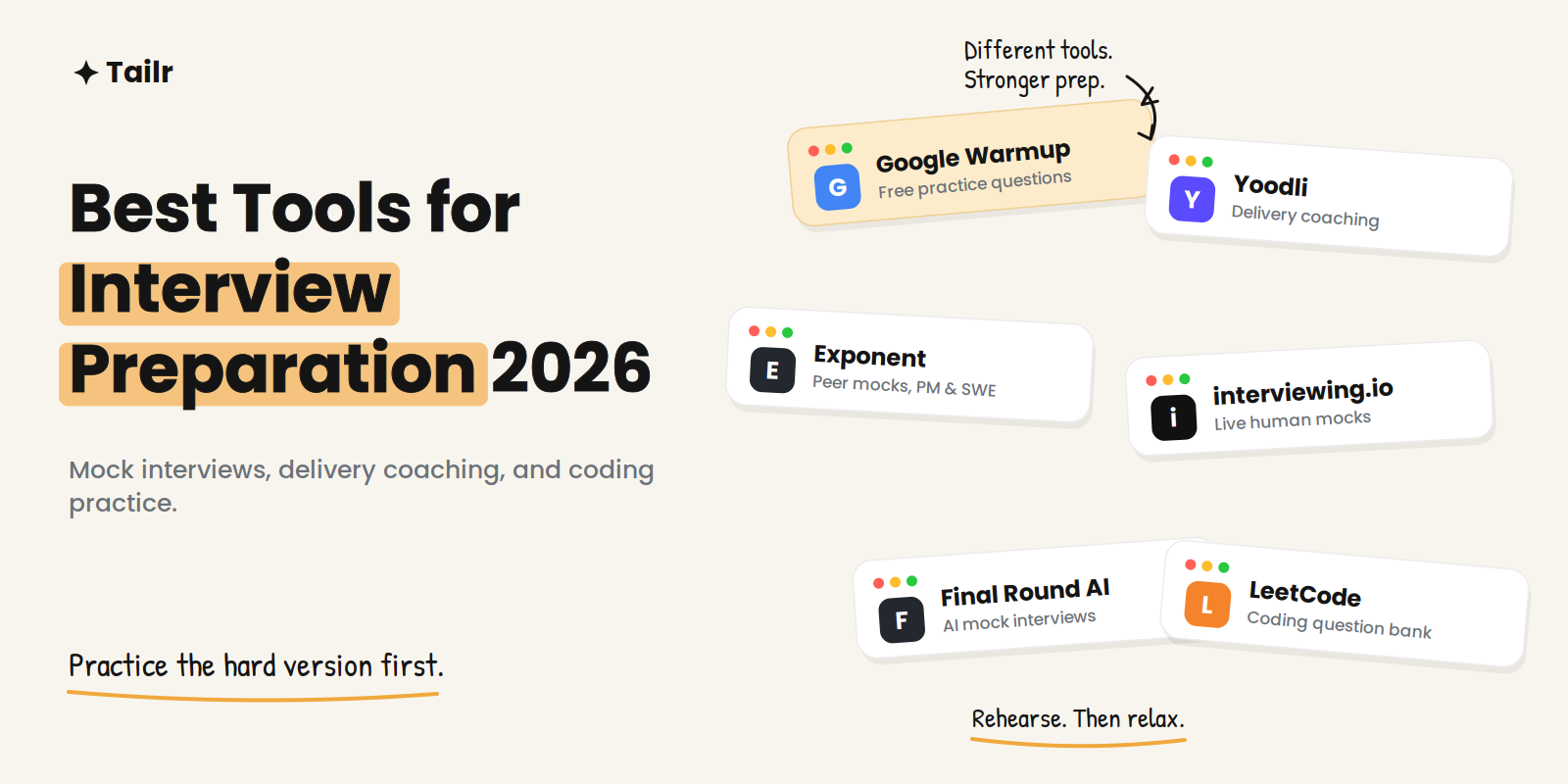
The short answer: the best tools for interview preparation in 2026 are:
- Google Interview Warmup: best free starting point.
- Yoodli: best for delivery and filler-word coaching.
- Big Interview: best guided end-to-end course.
- Exponent: best for peer practice and PM/SWE prep.
- interviewing.io: best for realistic technical mocks with real engineers.
- Final Round AI: best broad AI mock platform.
- LeetCode: best coding-question bank.
Pick one to drill questions and one to fix your weakest area: delivery, technical correctness, or nerves.
Why interview prep tools matter now
Two things changed the game. First, more first-round interviews are remote and recorded, so how you come across on camera — pacing, structure, filler words — carries more weight than it used to. Second, AI mock tools got good enough to give useful, instant feedback on answer structure, which means you can run ten reps of a behavioral question in the time it used to take to schedule one practice call.
What these tools can’t reliably do is tell you whether your technical answer was actually correct. AI feedback tends to grade delivery and confidence while missing wrong logic, so for technical rounds you still want real questions and, ideally, a human on the other side. The best prep plan uses AI for volume and a human for realism.
1. Google Interview Warmup
Website: grow.google/interview-warmup
The easiest place to start, and it’s completely free with no account required. You pick a field, answer common questions out loud, and get a transcript with light insights — which terms you leaned on, whether you covered the job-relevant topics. It won’t score you like a coach, but it removes the awkwardness of hearing yourself answer for the first time.
What it’s useful for:
- Free, no-signup warm-up on common questions
- Getting comfortable answering out loud
- A quick transcript to spot rambling
Best for: Anyone who wants a zero-friction first rep.
2. Yoodli
Website: yoodli.ai
Yoodli is a delivery coach. It records your spoken answers and reports on pacing, filler words, and clarity — the mechanics of how you say things rather than what you say. If your content is solid but you say “um” every eight words or race through answers, this is the tool that fixes it.
What it’s useful for:
- Filler-word and pacing feedback
- Delivery coaching across repeated attempts
- Private practice you can review afterward
Best for: Strong candidates whose delivery undersells them.
3. Big Interview
Website: biginterview.com
Big Interview is the closest thing to a structured course. It combines lessons with an AI practice tool and a large question library, organized into guided tracks so you move from beginner to confident on a clear path. If you want to be taught how to interview rather than just drilled, the progression is the draw.
What it’s useful for:
- Guided curriculum plus practice in one place
- Broad question coverage across roles
- Structured path for first-time interviewers
Best for: People who want a roadmap, not just reps.
4. Exponent
Website: tryexponent.com
Exponent (which absorbed the peer-practice tool Pramp) is a go-to for product management, software engineering, and data roles. Its strength is peer practice — you get matched with another candidate and take turns interviewing each other — plus company- and role-specific question sets and courses. The free peer practice alone makes it worth a look.
What it’s useful for:
- Free peer-to-peer mock practice
- Role-specific prep for PM, SWE, and data
- Courses and question banks by company
Best for: PM and engineering candidates who want live, low-cost reps.
5. interviewing.io
Website: interviewing.io
This one isn’t an AI tool at all — it’s a marketplace for anonymous live mock interviews with engineers from major tech companies. For high-stakes technical loops, a real human applying real pressure is closer to the actual experience than any simulator, and you get candid feedback from someone who runs these interviews for a living. Sessions cost real money because human time does, but for a big interview it can be the highest-leverage spend.
What it’s useful for:
- Live technical mocks with experienced engineers
- Honest, human feedback on coding and system design
- Anonymous practice with no reputational risk
Best for: Engineers preparing for a specific high-stakes technical loop.
6. Final Round AI
Website: finalroundai.com
Final Round AI offers AI mock interviews across many roles, with scored feedback on your answers. It’s a solid volume tool for behavioral and general practice. Note that it also markets a separate real-time “copilot” for live interviews — that’s a different activity, and using answer assistance during an employer’s actual interview can breach their rules, so keep this to preparation only.
What it’s useful for:
- Scored AI mocks across a wide range of roles
- Fast repetition on behavioral questions
- Feedback on answer structure
Best for: Candidates who want lots of AI-graded practice reps.
7. LeetCode
Website: leetcode.com
For any coding interview, LeetCode remains the default question bank. Thousands of problems, sorted by difficulty and company tag, with discussion threads full of worked solutions. It’s the content you study; pair it with a mock tool for the live-pressure practice it doesn’t provide.
What it’s useful for:
- Huge bank of real coding problems
- Company and difficulty tags
- Community solutions and explanations
Best for: Grinding coding fundamentals before technical rounds.
Interview prep tools compared
| Tool | Practice type | Cost | Best for |
|---|---|---|---|
| Google Interview Warmup | Solo question drill | Free | A zero-friction start |
| Yoodli | Delivery coaching | Free + paid | Fixing how you speak |
| Big Interview | Course + practice | Paid | A guided roadmap |
| Exponent | Peer mocks + courses | Free + paid | PM/SWE/data roles |
| interviewing.io | Live human mocks | Paid per session | High-stakes technical loops |
| Final Round AI | AI mocks | Free + paid | Volume behavioral reps |
| LeetCode | Coding question bank | Free + paid | Coding fundamentals |
How to prepare efficiently
Don’t try to use all seven. Start with a free warm-up to get talking, then pick tools that target your actual weak spot. If your problem is nerves and delivery, live in Yoodli and do a couple of peer mocks. If it’s technical correctness, grind a focused set of LeetCode problems and book one or two human mocks close to the real thing. Across all of them, prepare four to six STAR stories (Situation, Task, Action, Result) you can adapt to most behavioral questions, and always research the specific company and role first.
The step people skip: prep starts before the interview is even booked. A resume tailored to the job sets up the whole conversation, because interviewers ask about what’s on the page. If your resume is matched to the role, you’ll be answering questions about the exact skills they care about — which is why tailoring and interviewing are two halves of the same job. Tailr handles the first half from the job listing you’re viewing. See our roundup of the top AI tools for job search for the full picture, and how to tailor your resume to a job description for the step before this one.
Where Tailr fits
Great interviews start with a resume that got you into the room for the right reasons. Tailr tailors your resume to the specific job you’re viewing, so the experience you get asked about is the experience that matches the role — and it generates a cover letter and tracks the application while it’s at it. Do that first, then run your mocks. Try Tailr to line up the resume before you prep the answers.
Related guides
- 50 Group Discussion Topics and How to Score in a GD
- 30 Most Asked HR Interview Questions and Answers
- 40 Behavioral Interview Questions With Sample Answers
- 30 Situational Interview Questions With Sample Answers
Conclusion
The best interview preparation in 2026 is a small, targeted stack: one free tool to get you talking, one to fix your weakest area, and real practice questions for anything technical. Rehearse out loud, prepare adaptable stories, and walk in having already done the hard version of the conversation. Tools give you the reps; you provide the substance.
Frequently asked questions
01What is the best tool to prepare for an interview?
It depends on what you need to practice. Google Interview Warmup is the best free starting point, Yoodli is best for fixing how you deliver answers, and interviewing.io is best for realistic technical mocks with real engineers. Most people combine a free question-drill tool with one coaching or mock tool aimed at their weakest area.
02Are AI mock interview tools worth it?
Yes, mostly for repetition and confidence. AI mocks let you rehearse dozens of answers and get instant feedback on structure and delivery, which no human coach can do at that scale or price. Their weakness is judging technical correctness, so pair them with real practice questions or a human mock for high-stakes technical loops.
03How do I practice for a technical interview?
Practice on real, recently-asked questions and simulate the pressure of the live round. Work problems on LeetCode or a similar bank, then do timed mocks — ideally with a real engineer through interviewing.io or a peer through Exponent's practice — so you rehearse thinking out loud, not just solving in silence. Reviewing your solutions afterward matters as much as the attempt.
04Can I use AI during a real interview?
You shouldn't. Real-time answer assistants exist, but using one during an employer's interview usually breaks their rules and defeats the point of the assessment. Use these tools to prepare beforehand, then rely on your own preparation in the actual interview.
05How long before an interview should I start preparing?
Start as soon as the interview is booked, even if that's only a few days out. A focused few hours over two or three days — researching the company, drafting STAR stories, and running two or three mocks — beats a single cram session. For technical loops, give yourself a week or more if the format is unfamiliar.
06What is the best free interview prep tool?
Google Interview Warmup is fully free with no signup and covers common behavioral and role-based questions. For technical practice, LeetCode's free tier and Exponent's peer practice give you a lot without paying. Many AI mock tools also offer a free session so you can test the format before committing.