50 Group Discussion Topics and How to Score in a GD
· updated
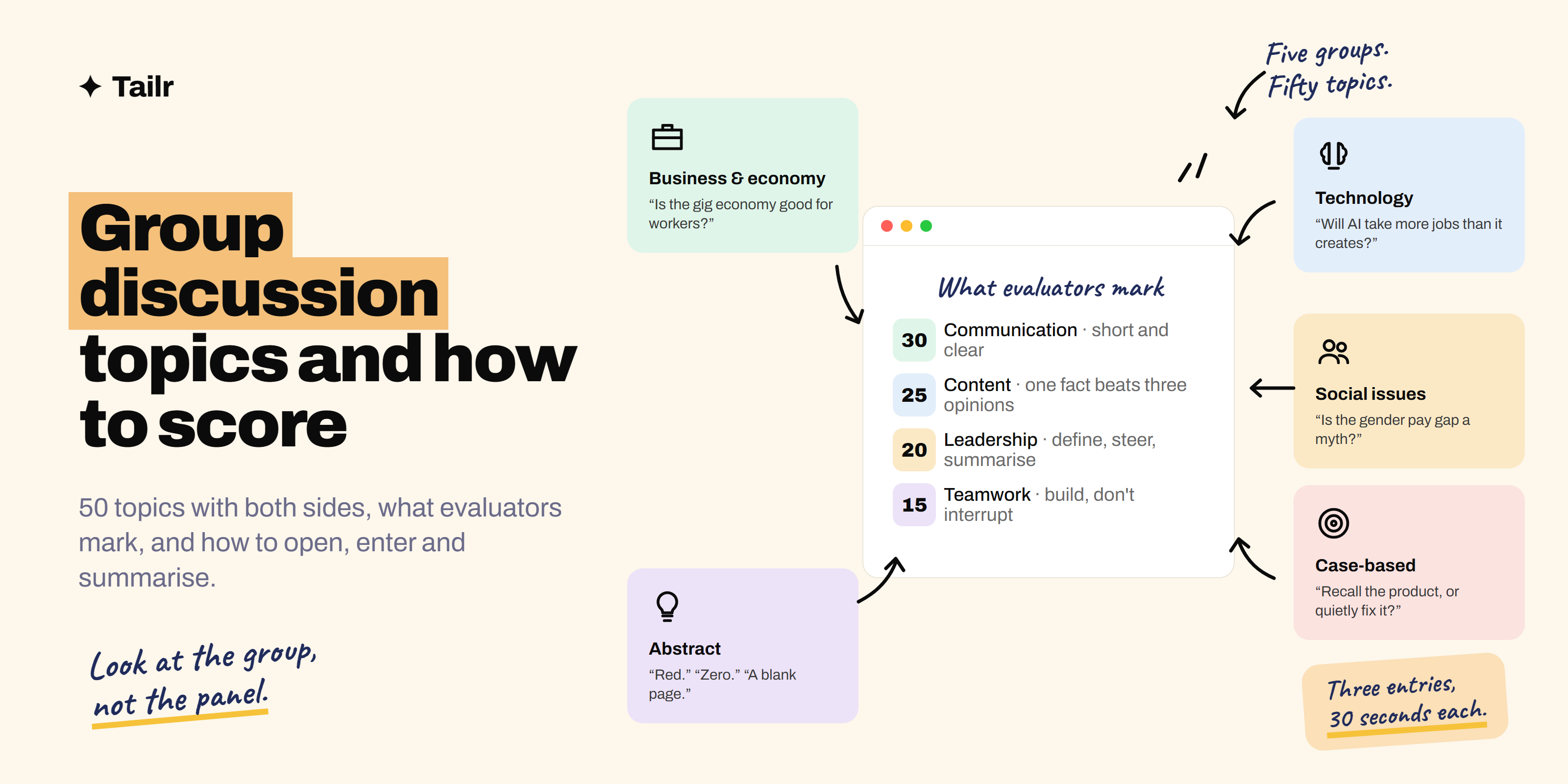
A group discussion is the round most candidates walk into with the least idea of what’s being marked. You know the topic will be a surprise, you know eight to twelve people will be talking over each other, and you know there’s a panel writing things down. This page covers what they’re writing, the 50 topics that come up most in placements and admissions, and the mechanics of opening, entering and closing a GD so you score even on a topic you’ve never thought about.
The short answer: GD evaluators mark five things:
- Content: facts and structure.
- Communication: clarity, brevity, listening.
- Leadership: steering, bringing others in, summarising.
- Teamwork: building on others without interrupting.
- Body language.
Topics come from five groups: business and economy, technology, social issues, abstract topics, and case-based problems. To score well:
- Make three or four clear entries of 30 to 45 seconds each.
- Open only if you have something sharp.
- Add structure when you don’t have facts.
- Summarise or bridge near the end.
Prepare 20 topics with two sides each and you’ll have something to say on almost any of the 50 below.
What a GD actually looks like
- Group: 8 to 12 candidates, seated in a circle or U.
- Time: 15 to 20 minutes, sometimes with one to two minutes of thinking time after the topic is given.
- Topic: read out or written on the board. Sometimes a case (a short scenario the group must decide) or an abstract word.
- Panel: two or three evaluators who don’t participate. They mark individuals, not the group, but a group that reaches a conclusion tends to score better across the board.
- Format variations: some companies ask for a written summary at the end; some ask each candidate to conclude in one line; some run a “fishbowl” where an inner circle discusses and the outer observes and then swaps.
You’ll usually be told the format before you start. Ask if you aren’t.
What evaluators are marking
The exact weights vary by company, but most placement GDs mark something close to this:
| What | Roughly | What it looks like when you do it well |
|---|---|---|
| Communication | 30% | Short, clear sentences. You stop when the point is made. You can be heard without shouting. |
| Content | 25% | You bring a fact, a number, an example, or a framework the group hadn’t considered. |
| Leadership | 20% | You define the topic, steer the group back when it drifts, bring in a quiet person, or summarise. |
| Teamwork | 15% | You build on others (“Adding to what Priya said…”), you don’t interrupt, you acknowledge a good point from the other side. |
| Body language | 10% | You look at the group, not the panel. You sit forward. You don’t point or wave. |
Two things follow from this table. First, you can score well without being the most knowledgeable person in the room, because structure and steering are worth 35 percent between them. Second, the loudest person usually scores badly, because shouting fails communication and teamwork at the same time.
How to open
Open only if you can do it in 20 to 30 seconds and it does one of three things: defines the topic (“Before we take sides, I think we should agree what we mean by ‘gig economy’: platform work like delivery and ride-hailing, not freelancing in general”), frames it (“There are really two questions here: is it good for workers, and is it good for the economy. Can we take them in that order?”), or anchors it with a fact (“India has roughly 12 million gig workers today and the government’s own estimate is 23 million by 2030, so the scale is the first thing to note”).
Don’t open with “I would like to start by saying” or a dictionary definition. Don’t open just to be first; a weak opener that gets talked over costs more than a strong second entry.
How to enter a running discussion
The hardest part of a GD is getting in. Four entries that work:
- Build: “Adding to Rahul’s point about cost…” Then say something new.
- Bridge: “I think both sides are actually agreeing on one thing…” This scores leadership and teamwork together.
- Redirect: “We’ve spent five minutes on the urban angle; can we look at what this means for smaller towns?”
- Question: “Does anyone have a number for how many jobs this actually affects?” Then, if nobody does, offer one.
Physically: lean in slightly, make eye contact with the person who’s finishing, and start in the half-second gap. Don’t put your hand up. Don’t say “excuse me” three times.
How to close
In the last two or three minutes, someone should summarise. If nobody is doing it, do it: “We’ve broadly agreed that X, with two concerns: Y and Z. The group’s view seems to be that it’s a net positive if Y is addressed.” Keep it neutral and fair to both sides. If the panel asks each person to conclude in one line, have yours ready from the halfway point and don’t repeat someone else’s.
The 50 topics
The ones marked ★ are asked most often. For the top topics in each group, there are points on both sides so you can argue either way.
Business and economy
- ★ Is the gig economy good for workers? For: flexibility, low barrier to entry, income for people outside formal jobs. Against: no social security, algorithmic control, income volatility, hidden costs (fuel, vehicle).
- ★ Should India adopt a four-day work week? For: productivity evidence from UK and Iceland trials, retention, mental health. Against: manufacturing and services can’t compress, client expectations, 24-hour sectors.
- ★ Startups vs. established companies: where should a fresher start? For startups: ownership, learning speed, equity. For established: structure, mentoring, brand on the resume, stability.
- Is the Indian economy too dependent on services?
- Are unicorn valuations a bubble?
- Should India move to a cashless economy?
- Is work from home here to stay? For: talent access, cost, productivity for focused work. Against: collaboration, onboarding of juniors, blurred boundaries, office real estate.
- Does the minimum wage help or hurt low-income workers?
- Should the government privatise public sector banks?
- Is entrepreneurship overrated as a career?
- Are quick-commerce companies (10-minute delivery) sustainable?
- Should companies be allowed to hire and fire freely?
Technology
- ★ Will AI take more jobs than it creates? For: routine cognitive work is automatable, the speed of change is faster than reskilling. Against: every previous wave created new categories, AI augments more than replaces so far, the bottleneck is adoption not capability.
- ★ Should social media be regulated by the government? For: misinformation, child safety, election interference. Against: free speech, government overreach, platforms already self-regulate, enforcement is hard.
- ★ Is data privacy a luxury only rich countries can afford? For: consent frameworks slow down services the poor depend on. Against: the poor are most exploited by data misuse, the DPDP Act exists for a reason, privacy is a right not a feature.
- Should AI-generated content be labelled by law?
- Is the metaverse dead?
- Should coding be compulsory in schools?
- Are electric vehicles really green in India? For: zero tailpipe emissions, grid is getting cleaner, urban air quality. Against: coal-heavy grid today, battery mining, charging infrastructure, cost.
- Is UPI India’s biggest technology success?
- Should companies be allowed to monitor employees’ screens?
- Will cryptocurrency ever replace traditional banking?
- Is online education as good as classroom education?
- Should there be a right to disconnect after work hours?
Social issues
- ★ Is reservation still needed in India? Handle with care: acknowledge the constitutional basis, argue about implementation and creamy layer rather than the principle, and never be dismissive.
- ★ Is the gender pay gap a myth? Against the myth claim: adjusted gaps persist across studies, motherhood penalty, occupational segregation. For: raw gaps overstate discrimination, choice and hours explain part of it.
- Should voting be compulsory?
- Is the Indian education system producing employable graduates?
- Should the retirement age be raised?
- Is nationalism good for a country?
- Should there be a uniform civil code?
- Is censorship of films and OTT content justified?
- Are exams the right way to measure learning?
- Should junk food advertising to children be banned?
- Is the joint family system dying, and does it matter?
- Should India have a two-child policy?
Abstract topics
These test structure more than knowledge. The trick is to give the word a frame in your first sentence, then let the group fill it.
- ★ Red. Frames: danger and warning; passion and energy; red in economics (deficit, red flag); red in Indian culture (weddings, sindoor).
- ★ Zero. Frames: India’s mathematical contribution; zero as a starting point; zero-sum thinking; zero tolerance policies.
- A blank page. Frames: opportunity vs. fear; freshers entering the workforce; startups.
- Is a rolling stone better than a rooted tree? Frames: job-hopping vs. loyalty; generalist vs. specialist.
- Black or white? Frames: binary thinking; grey areas in ethics; absolutes in policy.
- Doors. Frames: opportunity, closure, choice, privacy.
- Silence. Frames: communication, consent, protest, mental health.
- The colour of money.
Case-based
The group is given a scenario and must reach a decision. Marks go to people who identify the stakeholders, weigh options, and push the group to a conclusion.
- ★ Your company’s best-selling product has a safety defect affecting 1 in 10,000 units. Recall, quiet fix, or wait for complaints? Stakeholders: customers, regulators, shareholders, employees. Most groups converge on recall; the argument is about how and how fast.
- A team member is underperforming because of a personal crisis. Deadline is in two weeks. What does the manager do?
- You’re the CEO. A 20% layoff will save the company; a 10% pay cut across the board might. Which do you choose?
- A rival company offers you a job at double your salary the day after your current company paid for your training. What do you do?
- Your college’s placement cell wants to ban students from sitting for more than one offer. Argue for and against.
- A city must choose between a new metro line and 200 new buses for the same budget.
Preparing the night before
You can’t prepare 50 topics properly in one evening, and you don’t need to. Do this instead:
- Pick the 15 starred and near-starred topics and write three points for and three against on each. That’s 90 points, but most repeat across topics (the “AI and jobs” points also serve “coding in schools” and “online education”).
- Memorise ten numbers. Gig workers in India, unemployment rate, GDP growth, internet users, UPI transactions per month, EV share of car sales, women’s labour force participation rate, startup count, median age. A number in your first entry is worth more than three opinions.
- Learn five frames. Stakeholders (who’s affected), short-term vs. long-term, economic vs. social, urban vs. rural, individual vs. society. Any topic fits at least two of these, including abstract ones.
- Practise one entry out loud with a timer. 30 seconds. Most people are surprised by how much they can say in 30 seconds and how long 60 feels.
- Decide your default role. If you know the topic, you’ll bring content. If you don’t, you’ll bring structure: define, redirect, summarise. Both score.
Phrases that work
- “Before we take sides, can we agree on what we mean by…”
- “There are two separate questions here…”
- “Adding to what [name] said…”
- “I’d push back on that slightly, because…”
- “We’ve covered the economic side; what about…”
- “Can we hear from people who haven’t spoken yet?” (only once, and only if you mean it)
- “To summarise where we’ve got to…”
Use people’s names if you caught them. It’s the cheapest teamwork mark in the room.
Mistakes that cost marks
- Speaking to the panel. Your eyes should be on the group. The panel is not part of the discussion.
- Interrupting. Even a good point loses marks if you cut someone off to make it.
- Bluffing a statistic. Someone will know the real number.
- Changing sides to agree with the loudest person. Evaluators mark consistency.
- One long speech. Ninety seconds of monologue scores less than three 30-second entries.
- Silence for the first ten minutes. If you haven’t spoken by the halfway mark, enter with a bridge or a question; don’t wait for the perfect moment.
- Aggression. Pointing, raising your voice, “that’s completely wrong”. It fails three of the five criteria at once.
Where Tailr fits
A GD is the round before the interviews, and what gets you into it is a resume that matches the role. Tailr tailors your resume to the specific job listing you’re viewing, so the shortlist stage goes your way and you get to the GD in the first place. Once you’re through, the interview rounds that follow are covered in 40 behavioral interview questions with sample answers and 30 most asked HR interview questions. Try Tailr to get the resume through screening before the GD.
Related guides
- 30 Situational Interview Questions With Sample Answers
- 25 Interview Tricks You Should Know Before Your Next Interview
- How to Ace Your Technical Interview (With Sample Questions and Answers)
- How to Prepare for a System Design Interview (Step-by-Step)
Conclusion
A GD is not a debate and it’s not a quiz. It’s a test of whether you can add something useful to a group under time pressure, and most of what scores is structure: defining the topic, bringing one fact, building on others, and pulling the discussion together. Prepare the 15 most-asked topics with both sides, learn ten numbers and five frames, practise one 30-second entry out loud, and walk in planning three or four entries rather than one big speech. Look at the group, not the panel. That’s most of the marks.
Frequently asked questions
01What are the most common group discussion topics?
The most repeated GD topics fall into five groups: business and economy (startups, gig economy, four-day week), technology (AI replacing jobs, social media regulation, data privacy), social issues (reservation, work from home, gender pay gap), abstract topics (red, a blank page, zero), and case-based topics where the group has to decide something. Business and technology topics together make up well over half of what's asked in placements.
02How do I start a group discussion?
Open only if you have something clear to say in 20 to 30 seconds: define the topic, give a fact or number, and state the two sides the group should discuss. Don't open just to be first. A weak opener that gets ignored costs you more than a strong second or third entry.
03What do evaluators look for in a GD?
Content (do you know the topic and bring facts), communication (clarity, brevity, listening), leadership (steering the group, bringing others in, summarising), teamwork (building on others' points without interrupting), and body language (eye contact with the group, not the panel). Communication and content are weighted most heavily in most placement GDs.
04How many times should I speak in a group discussion?
Three to four quality entries of 30 to 45 seconds each in a 15-minute GD is a strong showing. One long speech or ten one-line interruptions both score badly. Aim to open or make an early point, add something new in the middle, and either summarise or bridge two sides near the end.
05What should I do if I don't know anything about the GD topic?
Listen to the first two or three speakers, pick the side with the stronger argument, and add structure rather than facts: 'So far we've covered the economic angle; nobody has mentioned the effect on smaller towns.' Asking a sharp question or summarising what's been said scores well even without domain knowledge. Never bluff a statistic.
06How do I handle a group where everyone is shouting?
Don't shout back. Wait for a natural pause or a breath, then enter with a calm, slightly lower voice and a structuring phrase: 'Can we take the two points one at a time?' Evaluators notice the person who brings order to a noisy group more than the loudest voice, and it counts as leadership.