30 Situational Interview Questions With Sample Answers
· updated
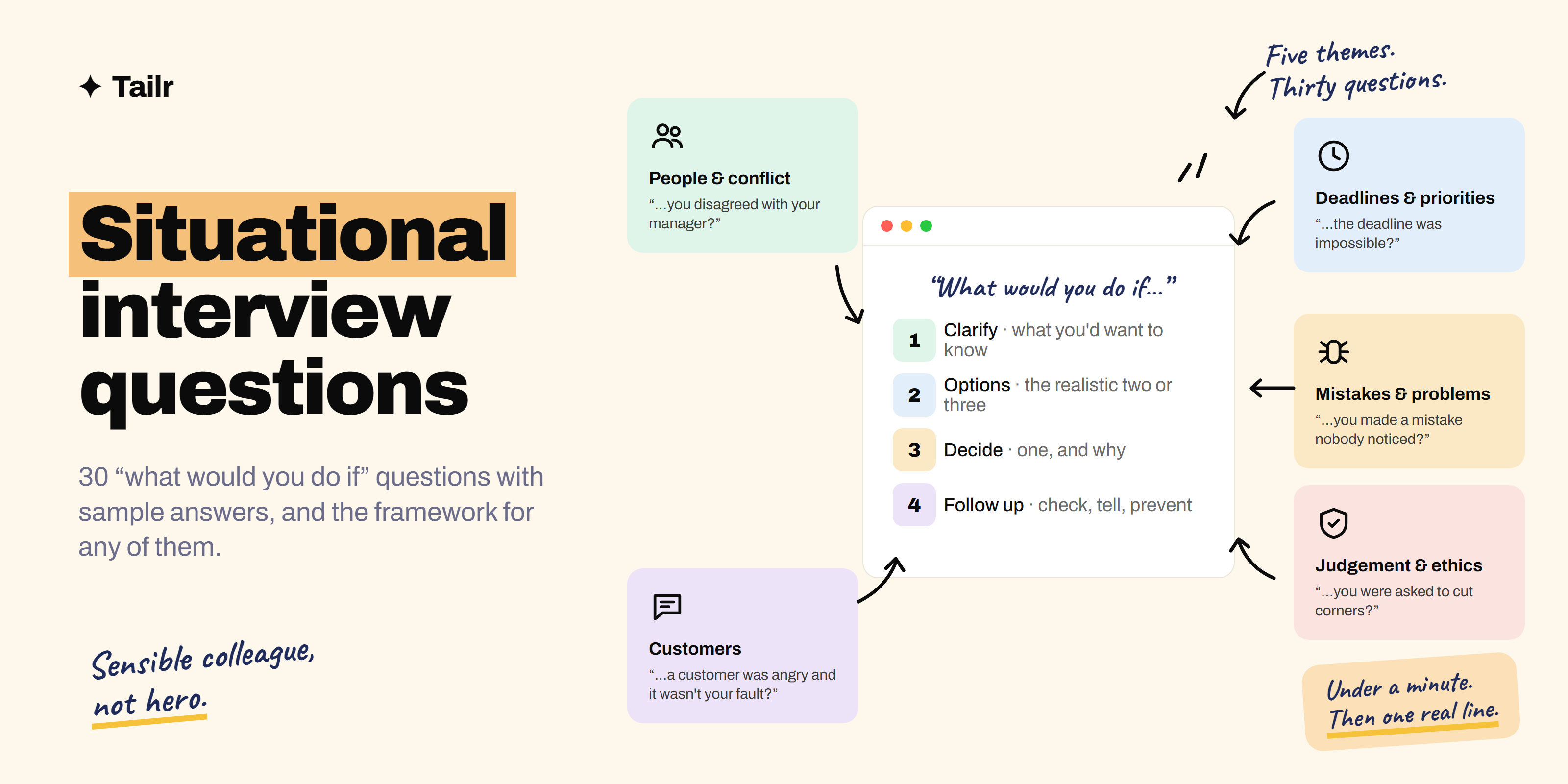
“What would you do if…” is the question interviewers reach for when they want to see how you think rather than what you’ve done. It’s the most common question type for freshers, it’s standard in customer-facing and management interviews, and most candidates answer it badly, either with a vague “I’d communicate with the team” or by picking the option that makes them look like a hero. This page has a framework that works for any situational question, and 30 of the most asked ones with sample answers at fresher and experienced level.
The short answer: Situational interview questions describe a hypothetical work scenario and ask what you would do. Answer them in four steps, in about a minute:
- What you’d want to find out first.
- The realistic options.
- The one you’d choose, and why.
- How you’d follow up.
Pick the option a sensible colleague would take, not the dramatic one. If you’ve handled something similar, add one sentence of real evidence at the end. The questions cluster into five themes: people and conflict, deadlines and priorities, mistakes and problems, customers, and judgement and ethics. Prepare an approach to each theme and the specific wording won’t matter.
Situational vs. behavioral
| Situational | Behavioral | |
|---|---|---|
| Starts with | “What would you do if…” | “Tell me about a time when…” |
| Wants | Your approach to a hypothetical | A real past example |
| Structure | Clarify, options, decide, follow up | Situation, task, action, result (STAR) |
| Common for | Freshers, career changers, customer and management roles | Experienced candidates, most roles |
| Strongest answer | The framework, plus one line of real evidence | A specific story with a number |
Interviewers often mix them, and a good situational answer ends by turning into a behavioral one. 40 behavioral interview questions with sample answers covers the other half.
The framework: clarify, options, decide, follow up
- Clarify. What would you want to know first? This shows you don’t act on assumptions. “I’d first want to know whether the deadline is fixed by a client or internal, and what’s driving it.”
- Options. The two or three realistic things you could do. Shows you see the trade-offs.
- Decide. Pick one and say why. The reason matters more than the choice.
- Follow up. What you’d do afterwards: check it worked, tell someone, prevent it recurring.
Then, if you have it: “That’s more or less what happened when…” and one sentence.
Weak: “I’d stay calm and communicate with everyone involved to find a solution.”
Strong: “First I’d find out whether the date is a hard external commitment or an internal target, because that changes everything. If it’s fixed, the options are to cut scope, add people, or accept lower quality on the non-critical parts. I’d propose cutting scope, because adding people late rarely speeds things up and quality debt comes back. I’d put the trade-off to my manager in writing the same day, with what we’d ship and what would slip. Afterwards I’d want to understand why the estimate was wrong. That’s roughly what I did on our last launch: we shipped on the date with twelve low-priority items moved to the next release.”
People and conflict
1. What would you do if you disagreed with your manager’s decision?
Fresher: “I’d first make sure I understood the reasoning, because as a new person I’m probably missing context. If I still disagreed, I’d raise it once, privately, with a specific concern and an alternative, not just an objection. If they held their position, I’d go with it and do it well; it’s their call. I’d only escalate if it were an ethical or safety issue.”
Experienced: “I’d ask what’s behind the decision; often the disagreement is about information, not judgement. If I still thought it was wrong, I’d bring data or a specific risk and one alternative, in private, once. If they decided against me, I’d commit to it publicly and make it work. What I wouldn’t do is agree in the room and undermine it afterwards. When my director wanted to cut QA for a launch, I brought the incident data from the last time, proposed a reduced scope, and she took a three-day delay instead of the two weeks she’d feared.”
2. What would you do if a colleague took credit for your work?
Fresher: “The first time, I’d assume it wasn’t deliberate and talk to them directly: ‘I noticed the deck went out under your name; can we make sure both of us are on it next time?’ Most people correct it. If it happened again, I’d make my contributions more visible as I go, by sending updates to the team, and I’d raise it with my manager as a pattern, with examples.”
Experienced: “Direct conversation first, assuming good faith. If it’s a pattern, I’d document my contributions as I go, keep my manager informed of what I’m working on so the attribution is clear before the fact, and raise it as a pattern with examples. I’d avoid making it a public confrontation; it damages both of us.”
3. What would you do if a team member wasn’t pulling their weight?
Fresher: “I’d talk to them first, privately, and ask what’s going on, because there’s often a reason: they’re stuck, overloaded, or unclear on what’s expected. If it’s a skill gap, I’d offer to pair. If it continued after that, I’d raise it with whoever’s leading, framed as a risk to the deadline rather than a complaint about the person.”
Experienced: “Same first step: ask, don’t assume. Then agree specific, smaller deliverables with dates so the expectation is unambiguous. If it’s still not working, it goes to the manager with specifics and what I’ve already tried. In a group project at college a teammate kept missing deadlines; it turned out he was working two jobs, and a smaller, clearly scoped piece with an earlier deadline fixed it.”
4. What would you do if you were assigned to work with someone you’d had a conflict with before?
“I’d treat it as a fresh start and be the one to set that up: a short conversation at the beginning about how we’ll work together, what each of us owns, and how we’ll handle disagreements. Most old conflicts were about a situation, not a person. I’d keep communication written and clear so misunderstandings don’t restart it.”
5. What would you do if your manager gave you a task with unclear instructions?
“I’d ask, but with a proposal rather than a blank question. I’d write down what I think they want in three lines and ask them to confirm or correct. That respects their time and surfaces the gaps fast. If they’re unavailable, I’d start on the part I’m sure about and check the rest when they’re back.”
6. What would you do if you were promoted over colleagues who are now your reports?
“Acknowledge it directly in one-to-ones rather than pretending nothing changed. Be clear that I’ll be fair and that the relationship has a new shape. Avoid overcorrecting in either direction: not the friend who can’t give feedback, not the boss who suddenly acts like a stranger. Get some early wins for the team so the promotion is justified by what happens next.”
Deadlines and priorities
7. What would you do if you were given an impossible deadline?
Fresher: “I’d check whether it’s actually impossible or just hard, by breaking the work down and estimating. If it really doesn’t fit, I’d go back the same day with what I can deliver by the date, what would need to slip, and what would make the full scope possible, like help or a different order. Raising it early is the whole point; raising it the day before is the mistake.”
Experienced: “Estimate honestly, then present the trade-off in writing: scope, time, people, quality; pick which one gives. I’d recommend an option rather than just listing them. Most ‘impossible’ deadlines become possible with a smaller scope, and most managers would rather know on day one than day ten.”
8. What would you do if you had two urgent tasks from two different managers?
“I’d ask each what their real deadline is and what happens if it slips; ‘urgent’ usually means different things. Then I’d tell both managers what I’m proposing to do in what order, so the conflict is visible to them and not just to me. If they can’t agree, they resolve it between themselves; I don’t pick a side silently and disappoint one of them.”
9. What would you do if you realised halfway through a project that you’d underestimated it badly?
“Tell the people who need to know immediately, with a revised estimate and options. The temptation is to work harder and hope; that almost never closes a big gap and it destroys trust when it fails. Then look at why the estimate was wrong, so the next one is better.”
10. What would you do if priorities changed halfway through your work?
“Confirm the change in writing so everyone’s working from the same version, look at what I’ve already built that can be salvaged for the new direction, and re-plan from there. On an internship project the scope narrowed from all products to one category; about 70 percent of the data work still applied, and the narrower report was more useful.”
11. What would you do if you were overloaded and couldn’t finish everything?
“Write everything down with estimates, rank by consequence of being late, and take that list to my manager with a proposal: here’s what I’ll do, here’s what I suggest slips or moves. Asking for help with a list is a sign of organisation; missing things silently is the failure.”
12. What would you do if a project you were leading was clearly going to fail?
“Say so, early, with evidence, and with options: cut scope, extend, add resource, or stop. Stopping is sometimes right and it’s better to recommend it than to burn another month. Whatever the decision, protect the team from blame and capture what went wrong so it’s not repeated.”
Mistakes and problems
13. What would you do if you made a serious mistake that nobody had noticed?
Fresher: “Tell someone. Immediately, with what happened and what I think the fix is. Hiding it makes a mistake into a trust problem, and someone usually notices eventually. In my internship I sent a report with last week’s figures; I sent the correction within the hour with a one-line apology, then built a check so it couldn’t happen again.”
Experienced: “Report it, contain it, fix it, then prevent it, in that order. The reporting comes first even if I don’t yet have the fix. Afterwards I’d write up what happened without blame so the process improves. The mistakes that end careers are the ones that were hidden, not the ones that were made.”
14. What would you do if you found a mistake in a colleague’s work that had already gone to a client?
“Tell the colleague first, privately and quickly, with the specifics, so they can own the correction. If it’s urgent and they’re unreachable, I’d tell the manager and fix it, and let the colleague know as soon as I could. The client gets a correction fast either way; what I’d avoid is going over someone’s head when I didn’t need to.”
15. What would you do if a system you’re responsible for failed during a critical period?
“Stabilise first: the fastest safe way to get it working, even if that’s a rollback or a workaround. Communicate while doing it: who’s affected, what we know, when the next update is. Root cause after it’s stable, not during. Then a blameless review and a fix that prevents the category, not just the instance.”
16. What would you do if you were asked to do a task you had no idea how to do?
“Say so, and say what I’d do about it: find out who’s done it before, read what exists, ask for a quick walkthrough, and give a first version early so I get corrected before I’ve gone far in the wrong direction. Pretending to know is the expensive option.”
17. What would you do if you discovered a process everyone follows is inefficient?
“Measure it first so I’m not arguing from opinion: how long it takes, how often, what it costs. Then propose a specific change, small enough to try, to whoever owns it, framed as ‘can we test this for two weeks’. At my part-time café job the closing checklist was always out of date; I laminated a new one with the missing steps and closing time dropped from 45 minutes to 30. Small, measured, adopted.”
18. What would you do if you inherited a project that was behind schedule and poorly documented?
“Spend the first few days understanding rather than acting: what’s actually done, what’s actually left, what the real deadline is, who the stakeholders are. Then reset expectations with a realistic plan, in writing, and get the documentation started as a by-product of the work rather than a separate task. Resist the urge to announce a rescue on day one.”
Customers
19. What would you do if a customer was angry about something that wasn’t your fault?
Fresher: “Let them finish, acknowledge the problem without arguing about whose fault it is, and focus on what I can do now. ‘I can see why that’s frustrating; here’s what I can do today.’ If it needs someone else, I’d stay on it and follow up rather than just transferring them. The customer doesn’t care whose fault it is; they care whether someone owns it.”
Experienced: “Listen fully, acknowledge, and take ownership of the resolution even when the cause is elsewhere. Give them a specific next step and a time, and deliver on it. Afterwards, feed the cause back to whoever owns it so it doesn’t recur. Anger usually fades when someone competent takes charge; it escalates when they get passed around.”
20. What would you do if a customer asked for something you can’t authorise?
“Be clear about what I can and can’t do, rather than vague; then find out who can, and either bring them in or take it to them myself with a recommendation. ‘I can’t approve that, but I can take it to my manager today with what you’ve told me’ is an answer. ‘Let me see what I can do’ with no follow-through is what customers hate.”
21. What would you do if a customer asked you to do something against company policy?
“Explain the policy and the reason for it, offer whatever I can do within it, and if they push, escalate rather than bend. Policies exist because someone got burned; the one time you make an exception is the one that comes back.”
22. What would you do if you had to deliver bad news to a customer?
“Do it early and directly, in the first sentence, then spend the rest of the conversation on what happens next. Call rather than email for anything significant. Bad news buried in paragraph three, or delayed a week, is what makes customers leave; bad news delivered straight with a plan usually doesn’t.”
23. What would you do if a customer’s request was technically possible but a bad idea for them?
“Say so, with the reason, and offer the alternative. They’re paying for judgement as well as compliance. If they hear the reason and still want it, and it’s not harmful, do it and document the advice. My job is to make sure they decide with full information, not to overrule them.”
Judgement and ethics
24. What would you do if your manager asked you to do something you believed was unethical?
“Ask for clarification first; sometimes it’s a misunderstanding. If it’s clearly wrong, say plainly that I’m not comfortable and why, and propose an alternative. If they insist, I’d decline and, depending on severity, take it to HR or whoever the proper channel is. I’d document it. I’d rather lose a job than be the person who did it.”
25. What would you do if you noticed a colleague breaking a safety or compliance rule?
“If there’s immediate risk, stop it. Otherwise, talk to them first if it’s minor and probably careless. If it’s serious, repeated, or they brush it off, report it through the proper channel. Compliance rules are the ones where ‘not my job’ isn’t an answer.”
26. What would you do if you were offered a gift by a supplier?
“Check the policy; most companies have a threshold. Anything above it, decline politely and say why. Anything that could look like it influences a decision, decline regardless of value. When in doubt, ask, and disclose.”
27. What would you do if you had confidential information a colleague asked about?
“Say I can’t share it, without making it awkward: ‘That’s not something I can discuss, sorry.’ Most people accept that immediately. I wouldn’t hint, and I wouldn’t confirm or deny.”
28. What would you do if you were asked to cut corners to hit a target?
“Depends what corner. Reducing scope or skipping a nice-to-have is a normal trade-off and I’d agree it explicitly. Skipping a safety check, a test on the money path, or a legal step isn’t a corner, it’s a cliff, and I’d say so and offer the trade-offs that don’t involve it.”
29. What would you do if you realised the data in a report you’d presented was wrong?
“Correct it as soon as I knew, to everyone who saw it, with what changed and whether the conclusion changes. It’s embarrassing for an hour and it’s the only version that keeps trust. I’d then find out how the error got in and add a check.”
30. What would you do if you had to choose between finishing on time and doing it right?
“Find out whether ‘right’ is a real requirement or a preference, and whether ‘on time’ is a real deadline or a target. Usually one of them has give. If neither does, I’d raise it before the deadline with the options and a recommendation, rather than choosing alone and surprising someone. If it’s a safety or correctness issue, right wins, and I’d say so.”
Preparing the night before
- Learn the framework until it’s automatic: clarify, options, decide, follow up.
- Prepare an approach to each of the five themes, not to each question. The wording varies; the themes don’t.
- Find one real example per theme, even a small one from college or a part-time job, to add as the last sentence.
- Practise two out loud with a timer. Under a minute each.
- Decide now that you’ll pick the sensible option, not the heroic one. Interviewers hire colleagues, not protagonists.
Where Tailr fits
The scenarios you’ll be given are the ones the job listing describes: a customer-facing role gets customer scenarios, a lead role gets people scenarios, a delivery role gets deadline scenarios. Tailr tailors your resume to the specific listing you’re viewing, so the experience it leads with is the experience that matches those scenarios, and the interviewer’s hypotheticals land on ground you’ve already prepared. For the other question types in the same interview, 40 behavioral interview questions and 30 most asked HR interview questions use the same night-before format. Try Tailr to line the resume up first.
Related guides
- 50 Group Discussion Topics and How to Score in a GD
- 25 Interview Tricks You Should Know Before Your Next Interview
- How to Ace Your Technical Interview (With Sample Questions and Answers)
- How to Prepare for a System Design Interview (Step-by-Step)
Conclusion
A situational question is a request to watch you think. Clarify what you’d need to know, name the realistic options, pick one for a reason, and say how you’d follow up; then, if you have it, one sentence of real evidence. Prepare the five themes rather than thirty questions, choose the sensible option every time, and keep it under a minute. That’s the whole technique, and it works on any hypothetical an interviewer can invent.
Frequently asked questions
01What are situational interview questions?
Hypothetical questions about how you would handle a specific work scenario: 'What would you do if a customer demanded a refund you can't authorise?' They differ from behavioral questions, which ask what you actually did in the past. Situational questions test judgement, priorities and process, and they're common for freshers, career changers and roles where the interviewer wants to see how you think rather than what you've done.
02What is the difference between situational and behavioral interview questions?
Behavioral questions start with 'tell me about a time' and want a real past example, answered with the STAR structure. Situational questions start with 'what would you do if' and want your approach to a hypothetical, answered with a short framework: clarify what you'd want to know, name the options, pick one and say why, and say how you'd follow up. The strongest situational answers end with a real example that shows you've done something similar.
03How do you answer a situational interview question?
Four steps in about a minute: say what you'd want to find out first, name the two or three realistic options, choose one and give the reason, and say what you'd do afterwards to check it worked or prevent it recurring. If you have a real example of handling something similar, add one sentence at the end. Don't pick the option that makes you look heroic; pick the one a sensible colleague would take.
04What are the most common situational interview questions?
Variations on a small set: a conflict with a colleague or manager, an unreasonable deadline, a mistake you discover, an angry customer, competing priorities, a team member not pulling their weight, being asked to do something you think is wrong, a task you don't know how to do, and taking over a struggling project. Prepare a clear approach to each theme and you'll handle the specific wording.
05Are situational questions common for freshers?
Yes, more than behavioral ones, because freshers often don't have work examples to draw on. Interviewers use hypotheticals to see how a graduate thinks about priorities, communication and ownership. Freshers should answer with the framework and, where they can, connect it to a college, internship or part-time experience that was similar in a smaller way.
06Should I give a real example when answering a hypothetical?
Yes, briefly, at the end. 'That's roughly what happened when…' followed by one sentence turns a hypothetical into evidence and is what separates a strong answer from an adequate one. Don't start with the story; answer the hypothetical first, because that's what was asked.