How to Answer "What Is Your Greatest Weakness?" (With Examples)
· updated
“What is your greatest weakness?” is the interview question people dread most. Say something too serious and you worry you’ve ruled yourself out; say something fake like “I care too much” and the interviewer’s eyes glaze over. There’s a better way. This guide gives you a simple three-part formula, 15 example weaknesses with sample answers, and a list of what not to say.
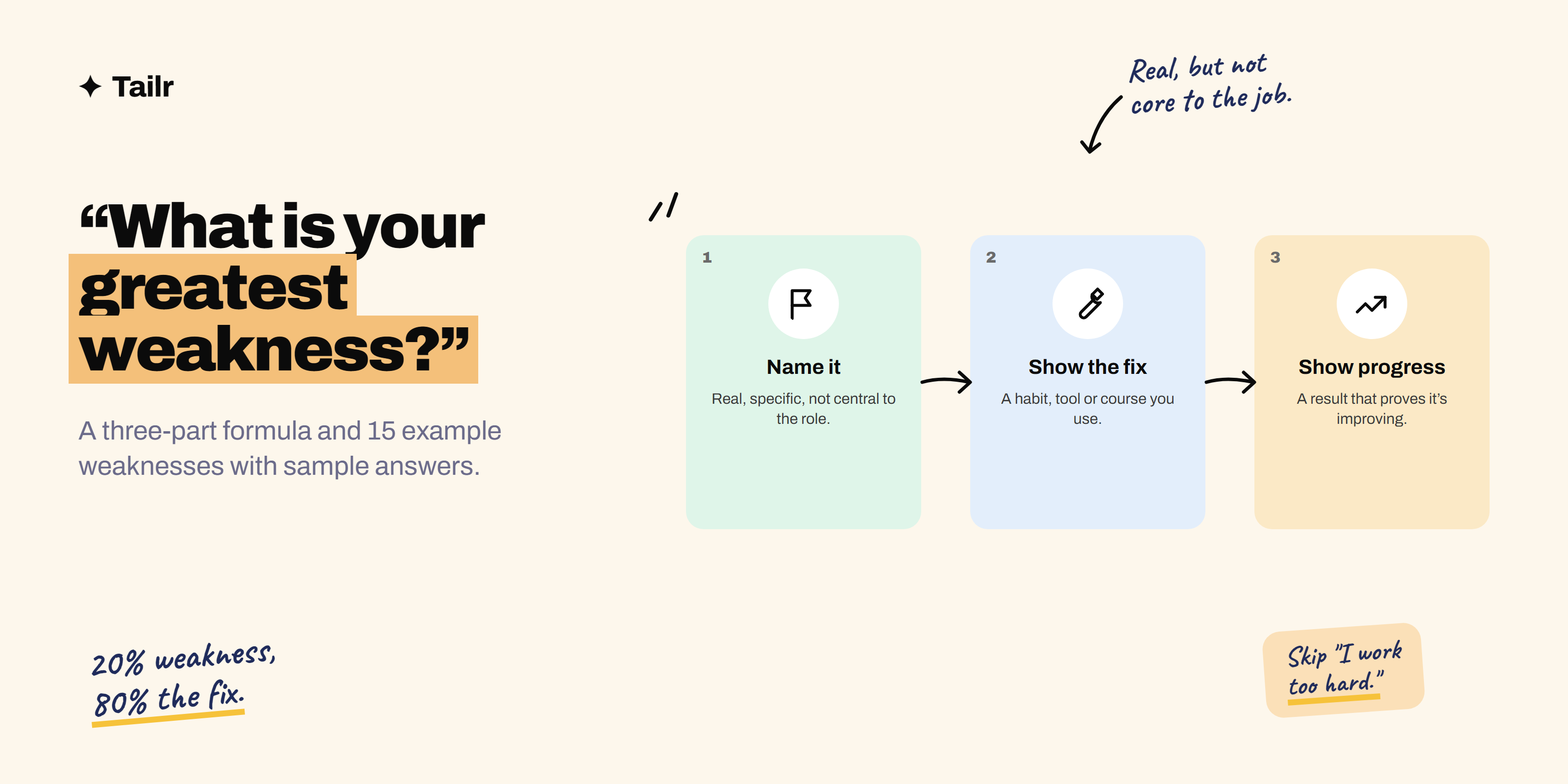
The short answer: answer the weakness question in three parts:
- Name a real weakness: specific, honest, and not essential to the job you’re applying for.
- Show what you’re doing about it: a concrete habit, tool, course or change you’ve made.
- Show progress: a short example or result proving it’s getting better.
Keep it to 45 to 60 seconds, stay calm and matter-of-fact, and end on the improvement, not the problem.
Why interviewers ask about your weaknesses
They aren’t trying to trap you. Most interviewers are looking for:
- Self-awareness: can you look at yourself honestly?
- A growth habit: when you spot a gap, do you do something about it?
- Honesty: do you give a real answer or a rehearsed dodge?
- Fit: is your weakness something that would seriously hurt this particular job?
A thoughtful answer to this question can actually make you look stronger, because it shows maturity that many candidates don’t.
The formula in detail
1. Name a real weakness
Pick something genuine and specific. “Public speaking” is better than “communication”. “I sometimes take on too many tasks instead of saying no” is better than “time management”.
Check it against the job description. If the listing says “presents weekly to senior leadership”, don’t choose public speaking. Choose a weakness that’s real but not central.
2. Show what you’re doing about it
This is the most important part. Describe a concrete action:
- A habit: “I now block 30 minutes every Friday to plan the next week.”
- A tool: “I use a task board so I can see my workload before agreeing to new work.”
- Learning: “I took a short course in data visualisation.”
- Feedback: “I asked my manager to flag it when I go into too much detail.”
3. Show progress
Finish with evidence. Numbers help but aren’t required:
- “Last quarter I gave three presentations to the wider team, and the feedback was that they were clear and well-paced.”
- “I haven’t missed a deadline since I started doing this.”
15 example weaknesses with sample answers
1. Public speaking
“Speaking to large groups used to make me nervous, and I’d rush through presentations. I joined a local speaking club and started volunteering to present our team’s updates every other week. I’m still more comfortable in small groups, but last month I presented our quarterly results to about 60 people and got good feedback on pace and clarity.”
Good for: roles where presenting is occasional, not the core job.
2. Delegating
“I’ve tended to do things myself rather than hand them off, because I knew exactly how I wanted them done. As my team grew, that became a bottleneck. Now I write a short brief for each task and agree on what ‘done’ looks like before handing it over. Over the last two months I delegated our weekly reporting entirely, which freed up about four hours a week.”
Good for: people moving into lead or management roles.
3. Saying yes to too much
“I like helping people, and I used to say yes to every request, which meant my own priorities slipped. I started keeping my week visible on a task board and checking it before agreeing to anything new. Now I’ll say ‘I can do this Thursday’ or suggest someone better placed. My on-time delivery has improved noticeably since.”
4. Too much detail
“I sometimes go into more detail than people need, especially in written updates. I now lead with a two-line summary and put the detail underneath for anyone who wants it. My manager told me recently that my updates are much easier to scan.”
5. Perfectionism (done properly)
“I used to spend too long polishing first drafts before showing anyone. That meant I’d sometimes get feedback late and have to redo work. Now I share a rough draft after a day for early input. It’s made me faster, and the final versions are better because problems get caught earlier.”
Notice this works because it’s specific and has a cost. “I’m a perfectionist” alone doesn’t.
6. Impatience with slow processes
“I can get impatient when decisions take a long time. I’ve learned that slower processes often exist for good reasons, like legal checks. Now I ask early about timelines and approvals so I can plan around them, rather than getting frustrated later.”
7. Asking for help
“Early in my career I’d spend too long stuck on problems before asking for help, because I didn’t want to look like I didn’t know things. Now I give myself a time limit of about an hour; if I’m still stuck, I ask. It’s made me faster and I’ve learned a lot more from colleagues.”
Good for: freshers and junior roles.
8. Lack of experience with a specific tool
“I haven’t used Tableau professionally; my reporting experience is mostly in Excel and Google Sheets. Since applying, I’ve completed a beginner Tableau course and rebuilt one of my old Excel dashboards in it, which I’m happy to show you.”
Good for: when a “nice to have” skill is missing. Don’t use this for a must-have skill.
9. Being too self-critical
“I tend to focus on what went wrong in my work rather than what went right. I now write down one thing that went well alongside one thing to improve after each project. It’s helped me give a more balanced view in retrospectives, and it’s made me better at giving balanced feedback to others too.”
10. Conflict avoidance
“I used to avoid difficult conversations, hoping problems would sort themselves out. After a project where a small disagreement turned into a missed deadline, I started raising concerns early and privately, using specific examples. It still isn’t my favourite thing, but I now handle it within a day rather than letting it build up.”
11. Data analysis or numbers (for non-analytical roles)
“Numbers weren’t my strongest area, which became a problem when I started owning campaign reporting. I took an online course in spreadsheet analysis and now build my own reports rather than relying on our analyst. I’m not an expert, but I can answer most performance questions myself.”
12. Getting too involved in one task
“When a problem interests me, I can go deep and lose track of my other priorities. I now set time blocks in my calendar and a check-in at the end of each one to decide whether to keep going. It keeps my curiosity useful rather than distracting.”
13. Writing concisely
“My emails used to be long. I now draft, then cut by about a third before sending, and I put the request in the first line. Replies come back faster, which tells me it’s working.”
14. Being uncomfortable with ambiguity
“I like clear plans, so early-stage projects with lots of unknowns used to stress me out. I’ve learned to write down my assumptions and agree on small next steps instead of waiting for a full plan. On my last project, which started with very vague requirements, that approach got us to a working version in three weeks.”
15. Taking feedback personally (earlier in your career)
“When I started out, I took critical feedback personally. I’ve learned to separate the work from myself and ask follow-up questions like ‘what would make this better?’ Now I actively ask for feedback after every project, and it’s one of the main reasons I’ve grown quickly.”
Weakness examples by role
The best weakness depends on what the job needs. Here are safer choices for common roles, and what to avoid for each.
| Role | Safer weakness to discuss | Avoid |
|---|---|---|
| Software engineer | Public speaking, estimating timelines, delegating | Writing clean code, debugging, learning new tools |
| QA engineer | Presenting to large groups, saying no to extra requests | Attention to detail, documenting bugs |
| Product manager | Going too deep into details, a specific technical area you’re learning | Prioritising, communicating, making decisions |
| Data analyst | Presenting to non-technical executives, a specific new tool | Accuracy, SQL, working with numbers |
| Sales | Admin and CRM updates (with your fix), delegating | Handling rejection, talking to customers |
| Marketing | A specific analytics tool, delegating creative work | Writing, creativity, understanding customers |
| Customer support | Getting too involved in one complex case | Patience, empathy, written communication |
| Fresher (any role) | Asking for help late, limited experience with a nice-to-have tool | Anything listed as a must-have skill |
How to deliver it
The words matter, but so does the delivery:
- Be calm and matter-of-fact. You’re describing something you’re working on, not confessing.
- Spend about 20% of the answer on the weakness and 80% on what you’ve done about it.
- Don’t over-apologise or add extra weaknesses you weren’t asked for.
- Stop when you’ve finished. End on the improvement and let the interviewer move on.
Weaknesses to avoid mentioning
| Avoid | Why |
|---|---|
| A core skill for the job (attention to detail for an accountant, coding for a developer) | It tells them you can’t do the job |
| Reliability problems (lateness, missing deadlines) | Raises concerns about trust |
| Integrity issues (bending rules, exaggerating) | Usually an instant no |
| Personal life or health details | Not relevant, and not something you need to share |
| “I don’t have any weaknesses” | Sounds arrogant or unaware |
| “I work too hard” / “I care too much” | Sounds rehearsed and dodges the question |
| Something you’ve done nothing about | Shows no growth |
Variations of the question
The same formula works for:
- “What’s an area you’d like to improve?”
- “What would your manager say you need to work on?” Use real feedback you’ve received, and show what you did with it.
- “Tell me about a time you failed.” Use the STAR method, then focus on what you learned and changed. Our behavioral interview questions guide covers this.
- “What are your strengths and weaknesses?” Give one strength with proof, then one weakness with the fix and progress.
How to prepare
- List three genuine weaknesses from feedback, reviews or your own reflection.
- Cross out any that are central to the job description.
- For each remaining one, write what you’ve done about it and one piece of evidence.
- Pick the strongest one and practise it out loud until it takes about a minute.
- Keep a second one ready in case they ask for another.
The question usually comes up alongside how to answer “tell me about yourself” and the other HR interview questions, so prepare them together.
Match your answer to the role
The right weakness depends on the job. “I’m still building my SQL skills” is fine for a marketing role and a problem for a data analyst role. Re-read the listing before every interview, check which skills are essential, and choose your example accordingly.
The same applies to your resume: each listing has different must-haves, and your strongest matching experience should be the first thing a recruiter sees. Tailr is a Chrome extension that tailors your resume to the job listing you’re viewing, writes a matching cover letter and tracks every application.
Try TailrConclusion
The weakness question isn’t a trap; it’s a chance to show self-awareness and a habit of getting better. Name a real weakness that isn’t central to the job, explain the specific steps you’re taking, and finish with evidence of progress. Skip the fake answers, practise it out loud, and you’ll turn the question everyone dreads into one of your stronger moments.
Frequently asked questions
01What is a good answer to 'what is your greatest weakness?'
A good answer names a real, specific weakness that isn't central to the job, explains what you're doing to improve it, and gives evidence of progress. For example: 'I used to find it hard to delegate. I now break projects into tasks at the start and assign them in our planning meeting, and last quarter I handed off two reports I'd always done myself.'
02What weaknesses should you not mention in an interview?
Avoid weaknesses that are core to the role (poor attention to detail for an accountant), ones that raise integrity or reliability concerns (lateness, missing deadlines, dishonesty), personal or health information, and fake weaknesses like 'I'm a perfectionist' or 'I work too hard' with no real substance.
03Is it okay to say perfectionism is my weakness?
Only if it's true and you make it concrete. 'I'm a perfectionist' on its own sounds rehearsed. 'I used to spend too long polishing first drafts, so now I share a rough version with my manager after a day to get feedback early' is specific, honest and shows a fix.
04How do I answer the weakness question as a fresher?
Pick a skill gap or habit from your studies, internships or projects, such as limited experience presenting to large groups or a tendency to take on too much in group projects. Explain the specific steps you've taken, like joining a speaking club or using a task board, and one result that shows improvement.
05Should I give more than one weakness?
Usually one well-explained weakness is best. If the interviewer asks for three weaknesses, keep each answer short and follow the same pattern: name it, show the fix, show progress. Make sure none of them are critical to the job.
06Why do interviewers ask about weaknesses?
They want to see self-awareness, honesty and a habit of improving. Everyone has weaknesses, so a candidate who can name one calmly and show what they're doing about it comes across as coachable and mature. They also check that your weakness won't seriously affect the role.