How to Switch Careers Into Tech in 2026 (Without a CS Degree)
· updated
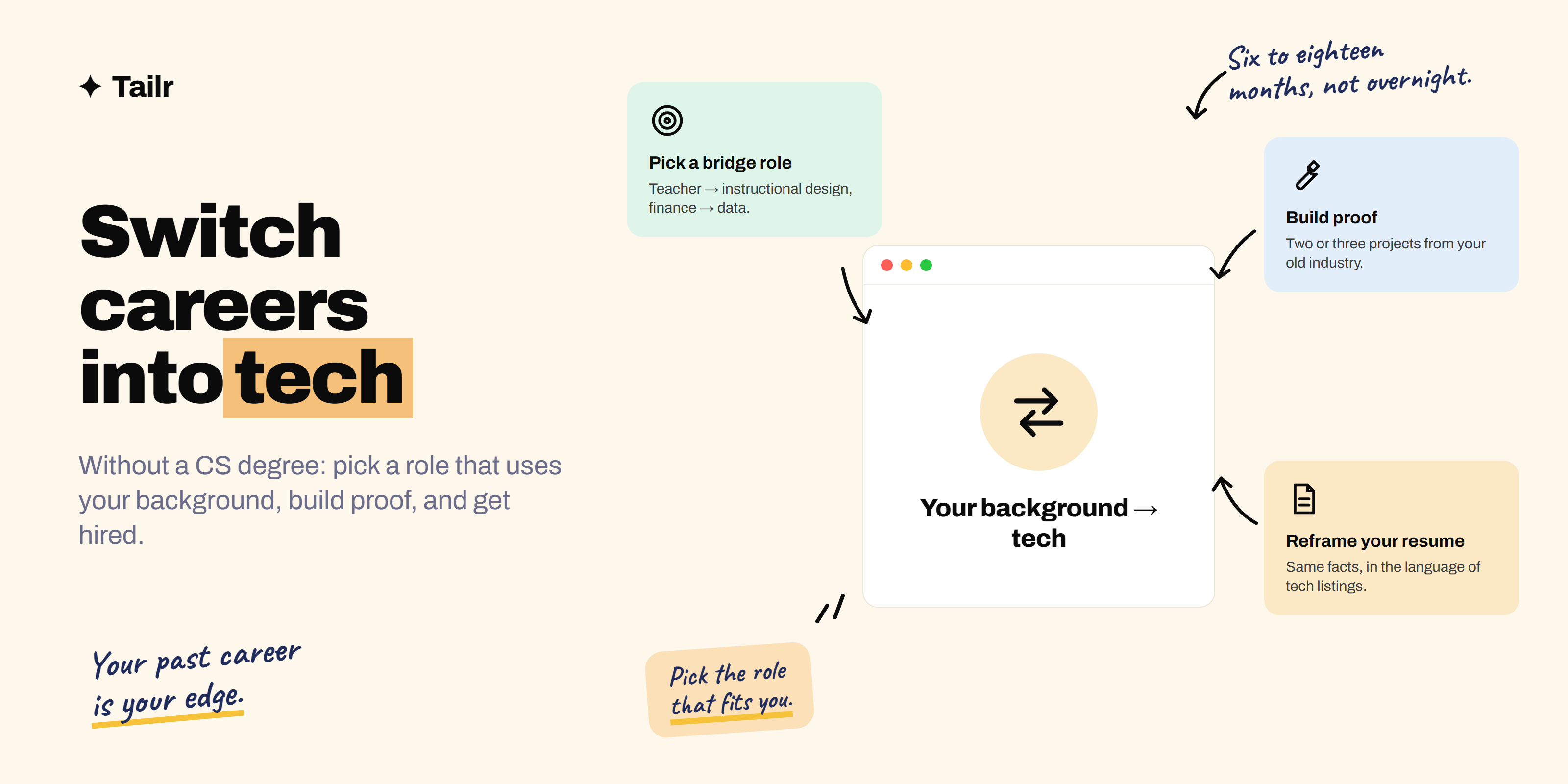
You don’t need to start over to move into tech. The people who switch fastest aren’t the ones who throw away their past career; they’re the ones who find a tech role where that past career is an advantage. A teacher who becomes an instructional designer, an accountant who becomes a data analyst, a sales rep who becomes a solutions engineer. This guide shows you how to choose that role, what to learn, how to build proof, and how to present a career change so hiring managers see strength rather than risk.
The short answer: To switch careers into tech in 2026:
- Pick a role that uses your background, not just the one with the highest salary. Bridge roles such as data analyst, customer success, QA, technical writing, product operations or sales engineering build on skills you already have.
- Learn the core skills for that one role, using free and low-cost resources, in three to six months of focused study.
- Build proof: two or three real projects, ideally in the industry you’re coming from, deployed and written up.
- Reframe your experience: rewrite your resume and LinkedIn around transferable skills, in the language of tech job listings.
- Apply smart: target companies where your domain knowledge matters, use referrals and direct outreach, and tailor every application.
Expect six to eighteen months, depending on how far the new role is from your current one.
Why career changers get hired
Tech hiring managers see plenty of candidates who know the tools. Fewer candidates understand the customer, the industry, or how real work gets done. That’s your edge:
- Domain knowledge: a former nurse understands clinical workflows that a health-tech team is trying to digitise.
- Professional habits: managing stakeholders, deadlines, difficult conversations.
- Communication: explaining complex things to non-experts, which most tech roles need.
- Motivation: you chose this deliberately.
Your job in the switch is to add the missing technical skills and then make the connection obvious.
Step 1: choose the right tech role
Start with what you’re good at and enjoy, then find the tech role that uses it.
| If you come from… | Consider… | Why it fits |
|---|---|---|
| Teaching, training | Instructional design, technical writing, developer education, customer onboarding | Explaining complex things clearly |
| Finance, accounting | Data analyst, business analyst, fintech product or operations | Numbers, spreadsheets, rigour |
| Sales, account management | Customer success, sales engineering, solutions engineering, partnerships | Customer conversations, persuasion |
| Operations, logistics, retail management | Product operations, project or program management, supply chain analytics | Processes, coordination, metrics |
| Healthcare | Health-tech product, clinical informatics, QA for medical software | Domain expertise |
| Marketing, communications | Growth marketing, content design, product marketing | Audience, messaging, experiments |
| Design, arts | UX/UI design, content design | Visual thinking, user empathy |
| Customer service | Support engineering, customer success, QA | Troubleshooting, user empathy |
| Engineering (non-software), science | Software engineering, data science, QA automation | Problem-solving, maths |
Not sure which one? Non-coding jobs in tech describes many of these roles in detail, and posts like what does a product manager actually do, what does a customer success manager do and what does a sales engineer do go deeper on individual jobs.
Test before you commit: read 20 job listings for the role, talk to two people doing it (see how to cold message on LinkedIn), and try a small piece of the work, such as analysing a public dataset or writing documentation for an open source tool.
Step 2: learn the skills that role actually needs
Use the job listings as your syllabus. Copy the skills that appear in most of them and learn those, in that order. Examples:
- Data analyst: Excel/Google Sheets, SQL, one visualisation tool (Power BI, Tableau or Looker Studio), basic statistics, then Python.
- Product manager or product ops: user research, writing a PRD, metrics and analytics tools, prioritisation, working with engineers.
- QA: testing fundamentals, test case design, bug reporting, then automation with Playwright or Selenium. What is software testing is a good start.
- Customer success: the SaaS business model, onboarding, account health metrics, a CRM.
- Software engineering: one language (Python or JavaScript), Git, building and deploying small apps, then data structures and a framework.
Learning tips:
- Go deep on one role, not a little of everything.
- Learn by building. Tutorials teach syntax; projects teach the job.
- Use AI as a tutor. Ask Claude to explain concepts, quiz you and review your work, but write and understand things yourself.
- Certifications: worth it only when listings ask for them (cloud, security, some data tools). They support proof; they don’t replace it.
Step 3: build proof
Proof is what turns “career changer” into “candidate”. Aim for two or three projects that:
- Solve a real problem, ideally from your old industry. An ex-teacher’s dashboard of school attendance data, a former nurse’s shift-scheduling prototype, an accountant’s automated reconciliation script. These show both skill and domain knowledge.
- Are finished and live, with a README or case study explaining the problem, your approach and the result.
- Match the role you want. Weekend projects to build with Claude to get hired has one project per role, with prompts.
Other kinds of proof: freelance or volunteer work for a nonprofit, open source contributions, and internal projects at your current job (automating a report, running a tool rollout). That last one is underrated: it’s real, paid experience you can put on your resume. See how to get experience when every job asks for experience for more routes.
Put it all in one place with a simple portfolio: how to build a portfolio to get hired in 2026.
Step 4: reframe your experience
Your past jobs don’t disappear from your resume; you rewrite them in the language of your new field.
Summary: name the target role and your bridge. For example:
Former secondary school teacher moving into instructional design. Built three e-learning modules in Articulate and a course analytics dashboard; eight years designing curriculum for 150+ students a year.
Bullets: keep the facts, change the emphasis to transferable skills.
-
Before: “Managed a team of 12 retail staff and handled daily operations.”
-
After (for product ops): “Ran daily operations for a 12-person team; redesigned the shift handover process, cutting stock errors by 30% in three months.”
-
Before: “Prepared monthly financial reports.”
-
After (for data analyst): “Built monthly reporting in Excel from three source systems; automated reconciliation with Power Query, saving 6 hours a month.”
Structure: put a Projects section above or alongside Experience, list the relevant skills clearly, and keep it to one or two pages. Update your LinkedIn headline to the target role too: how to optimize your LinkedIn profile.
Never overstate. “Familiar with SQL” is fine if true; “SQL expert” after a month isn’t. How to tailor your resume without lying covers where the line is.
Step 5: apply smart
- Target companies where your background matters: health-tech for healthcare people, fintech for finance people, edtech for educators. Your domain knowledge is worth most there.
- Look for internal moves: if your current company has a tech team, a transfer is often the easiest switch.
- Use your network and outreach: career changers get more from referrals and direct messages than from cold applications. See how to cold email for a job.
- Consider stepping-stone roles: a support or operations role at a tech company gets you inside, where moving teams is easier.
- Tailor every application. A career changer’s resume has to make the connection obvious in the first few lines, and each listing emphasises different things. Tailr does this from the job listing you’re viewing, rewriting your summary and bullets around what that role asks for, using only your real experience.
- Prepare your story for “Why are you switching?”: what drew you, what you’ve done to prepare, and why your background makes you better at this job. Three sentences, positive about your past, specific about your future.
Common mistakes career changers make
| Mistake | Fix |
|---|---|
| Chasing the highest-paid role regardless of fit | Pick the role that uses your background |
| Learning a bit of everything | Go deep on one role’s core skills |
| Endless courses, no projects | Build and ship two or three real projects |
| Hiding the old career | Make it your advantage |
| Mass-applying with one resume | Tailor each application, use referrals |
| Expecting senior pay immediately | Aim for a strong first role, then grow fast |
A 90-day starter plan
- Days 1–30: read 20 listings, talk to two people in the role, pick the role, start the core skills.
- Days 31–60: keep learning, build project one, rewrite your resume and LinkedIn.
- Days 61–90: build project two, publish your portfolio, start networking and applying to 5–10 well-matched roles a week.
Then keep going: most switches take longer than 90 days, but by then you’ll be interviewing.
Tailor your career-change resume for every role
The hardest part of a career-change resume is making each hiring manager see the connection quickly, and the connection is different for every listing. Tailr is a Chrome extension that tailors your resume to the job listing you’re viewing, drawing only on your real experience, writes a matching cover letter (useful for explaining a switch), and tracks every application.
Try TailrConclusion
Switching into tech doesn’t mean starting from zero. Choose a role that builds on your background, learn the handful of skills it really needs, build two or three projects that prove it, rewrite your experience in the new field’s language, and apply where your domain knowledge counts. Give it six to eighteen months of steady work, and your past career becomes the reason you’re hired, not the thing you have to explain.
Frequently asked questions
01Can I switch to tech without a computer science degree?
Yes. Many tech roles, including product, data analysis, customer success, sales engineering, technical writing, QA, design and operations, don't require a CS degree, and plenty of software engineers are self-taught or bootcamp graduates. What employers want to see is proof you can do the work: projects, certifications that matter for the role, and experience you can connect to the job.
02What is the easiest tech job to get into?
The easiest entry points are usually roles closest to your current experience. Common ones are customer success or support for people from service and account roles, QA or data analysis for detail-oriented and analytical people, technical writing for writers and teachers, and product operations or project management for people from operations. Bridge roles let you use what you already know while you learn.
03How long does it take to switch careers into tech?
Typically six to eighteen months. Bridge roles that build on your background, such as data analyst from finance or customer success from sales, can take three to six months of focused learning and applying. Moving into software engineering from scratch usually takes a year or more of consistent study and projects.
04Is it too late to switch to tech at 30, 40 or older?
No. Career changers bring domain knowledge, communication skills and work habits that new graduates don't have, and many teams value that. Pick a role where your past experience is an advantage, such as a nurse moving into health-tech product or a teacher moving into instructional design, and present your background as the reason you'll be good at it.
05Should I do a bootcamp to switch into tech?
Only if you need structure and can afford it, and research outcomes carefully first. Bootcamps can speed things up, but many people switch successfully with free and low-cost resources plus a few strong projects. Whatever route you choose, employers will judge you on what you can show and explain, not the certificate.
06How do I write a resume for a career change into tech?
Lead with a summary that names your target role and the strengths you bring from your past career. Put relevant projects and certifications near the top, rewrite past job bullets to highlight transferable skills in the language of tech listings (data, process, customers, tools), and tailor it for each application so the most relevant experience appears first.