How to Get Experience When Every Job Requires Experience
· updated
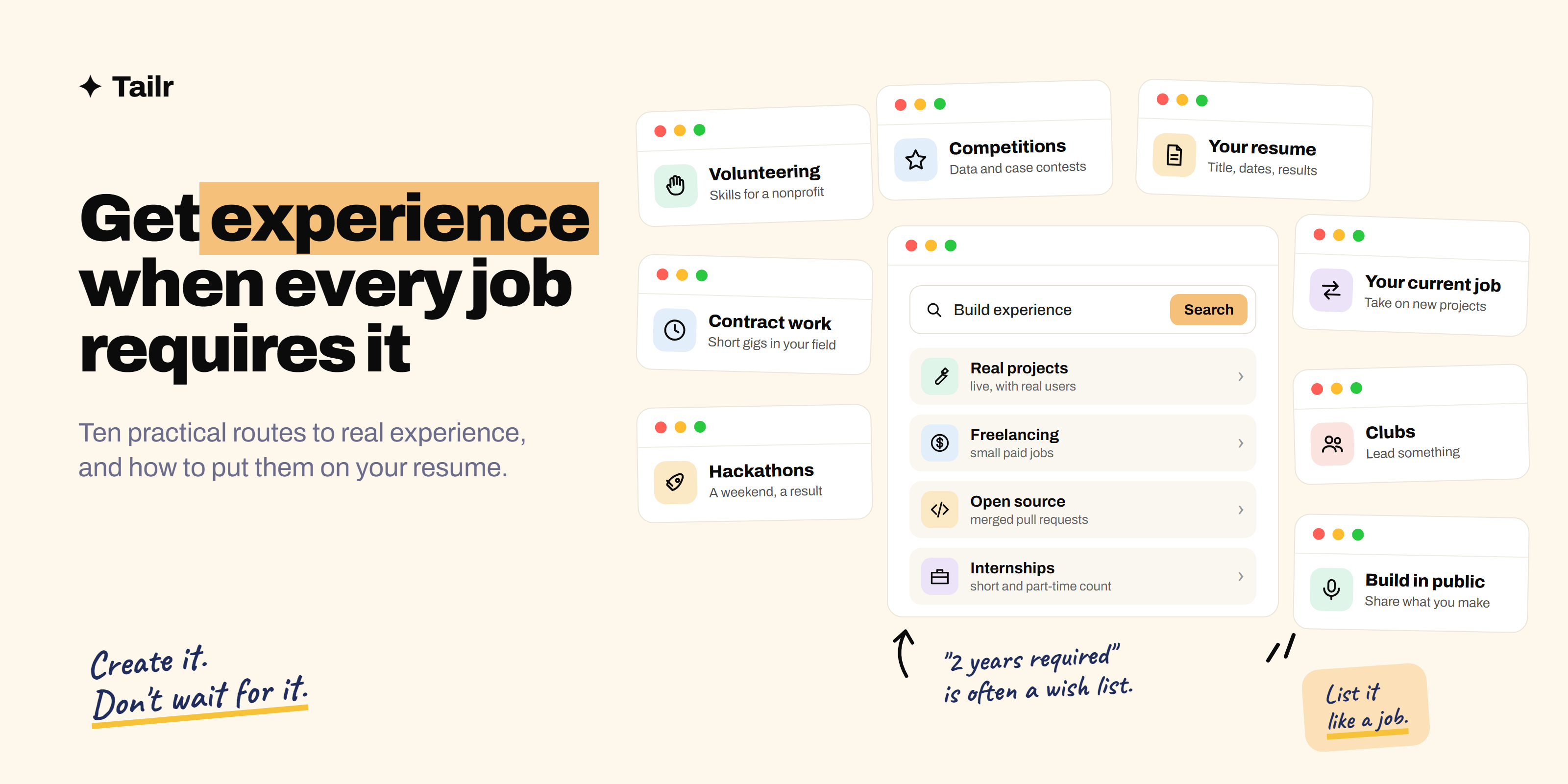
It’s the oldest job-search trap: you need experience to get a job, and a job to get experience. The way out is to stop waiting for someone to give you experience and start creating it. Almost everything a first job teaches, delivering real work, taking feedback, meeting deadlines, working with others, you can get outside a job. This guide covers ten practical routes, how to choose between them, and how to put the results on your resume so recruiters count them.
The short answer: Create experience that doesn’t need permission, then present it like a job. The ten best routes:
- Build real projects that solve a problem for real users.
- Freelance small paid jobs for local businesses, nonprofits and startups.
- Contribute to open source projects you already use.
- Volunteer your skills for a nonprofit or community group.
- Take internships, apprenticeships and returnships, including short or part-time ones.
- Do contract, temp or gig work in your target field.
- Join hackathons and competitions.
- Create experience in your current job by taking on projects in the area you want to move into.
- Join student or community organisations and lead something.
- Publish your work and learning in public.
Then list each one with a title, dates, what you did and a result, and apply even when a listing asks for a year or two more than you have.
First: “experience required” is often softer than it looks
Many listings ask for one to three years of experience because the hiring manager wrote down their ideal candidate. What they actually need is someone who can do the work. That’s why candidates with strong projects, internships or freelance work regularly get hired into roles that “require” experience.
Rules of thumb:
- Entry-level, junior, or “0–2 years”: apply if you meet most of the core skills.
- “2–3 years”: apply if you have substantial project, internship or freelance experience in the exact skills.
- “5+ years”, senior or lead titles: skip for now.
What makes the difference is evidence. Everything below is about creating it.
The 10 ways to get experience
1. Build real projects
Not tutorials: projects that solve a real problem, ideally with a few real users. A tool your club actually uses, a dashboard for a local business’s sales data, an app your friends rely on. Deploy them, write a README, and track something measurable (users, time saved, accuracy).
Why it works: it’s fully under your control and shows the whole cycle from problem to shipped result. Start here: weekend projects to build with Claude to get hired gives one project per role, and how to deploy a website on GitHub Pages gets it online for free.
2. Freelance
Small paid work: a website for a café, a spreadsheet model for a small firm, social media for a local gym, data cleanup for a researcher. Find clients through your network, local businesses, alumni groups, and freelance marketplaces.
Why it works: a paying client, a deadline, feedback and a reference. It reads as real work because it is. Tip: charge something, even a small amount. It makes the relationship professional.
3. Contribute to open source
Fix bugs, improve documentation, add tests in projects you use. Your merged pull requests are public, reviewed by experienced engineers and linked to your name.
Why it works: real codebases, real code review, public proof. Start here: what is open source contribution walks through your first pull request.
4. Volunteer your skills
Nonprofits, charities, community groups and student organisations need websites, data analysis, marketing, events and operations help, and rarely have budget. Offer a defined project with a finish date.
Why it works: real stakeholders and impact, and often more responsibility than an entry-level job would give you.
5. Internships, apprenticeships and returnships
Apply broadly, including to smaller companies and startups, which often give interns more ownership. Look for part-time, remote, and short (6–12 week) internships, and apprenticeship programmes in tech, data and digital marketing. Returnships are designed for people coming back after a career break.
Why it works: it’s formal experience with a company name, a manager and often a path to a full-time offer.
6. Contract, temp and gig work
Short contracts, temp roles and gig platforms in your field (user testing, data labelling and annotation, content writing, QA testing, virtual assistance for a startup) build relevant experience and references quickly.
Why it works: lower hiring bar, real employers, and it counts as work.
7. Hackathons and competitions
Weekend hackathons, case competitions, data challenges (such as those on Kaggle), design sprints and coding contests.
Why it works: teamwork under a deadline, a finished result, sometimes prizes, and recruiters often attend. Programmes like Google Summer of Code pay you to contribute to open source with a mentor.
8. Create experience in your current job
Already working, just not in your target field? Volunteer for projects that use the skills you want: automate a report, analyse customer data, help roll out a new tool, write documentation, run a small experiment.
Why it works: it’s paid, real, on your current employer’s name, and often the easiest way to switch careers. See how to switch careers into tech.
9. Student and community organisations
Lead something: run the technical side of a club, organise an event, manage a budget, start a study group, edit a publication.
Why it works: leadership, project management and teamwork examples for your resume and your behavioral interview stories.
10. Learn and build in public
Write short posts about what you’re building and learning on LinkedIn, a blog, or GitHub. Share project write-ups and lessons from mistakes.
Why it works: it makes your experience visible, attracts opportunities, and shows communication skills. How to optimize your LinkedIn profile covers how to present it.
Which route should you pick?
| Route | Time to first result | Credibility with recruiters | Best for |
|---|---|---|---|
| Projects | Days to weeks | High if live and real | Everyone, especially tech roles |
| Freelancing | Weeks | High | Developers, designers, marketers, writers |
| Open source | Weeks | High for engineering | Developers, technical writers |
| Volunteering | Weeks | Medium to high | Any role |
| Internships | Months (application cycles) | Highest | Students, recent grads |
| Contract/gig | Days to weeks | Medium to high | Quick relevant experience |
| Hackathons | A weekend | Medium | Students, developers, designers |
| Current job projects | Weeks | High | Career changers |
Combine two or three: for example, one strong project, one freelance or volunteer engagement, and ongoing applications for internships.
How to put it on your resume
Present every one of these the way you’d present a job:
Freelance Web Developer · Self-employed · Jan 2026 – Present
- Built and launched websites for 3 local businesses using Astro and Vercel; one client’s online bookings rose 40% in two months.
- Gathered requirements, delivered in 2-week cycles, and handled all client feedback directly.
Open Source Contributor · [Project name] · Mar 2026 – Present
- Fixed 4 bugs in the CLI’s config parser; all merged after code review (PRs #1203, #1250).
Tips:
- Use accurate titles: Volunteer Data Analyst, Freelance Designer, Open Source Contributor.
- Lead with results: numbers where you have them, outcomes where you don’t.
- Put the most relevant items first, in a section called Experience or Projects.
- Never inflate. Interviewers will ask about every line.
How to write a resume with no experience goes deeper on structure and examples.
Then apply, and tailor every time
Once you have evidence, the next problem is making each recruiter see it in the few seconds they spend on your resume. Different listings care about different parts of what you’ve done: a front-end role wants the website projects first; a data role wants the analysis. Tailr is a Chrome extension that tailors your resume to the job listing you’re viewing, reordering and rewording your real projects and experience to match, then writes a cover letter and tracks the application.
Don’t wait for applications alone, either. Reaching out directly to hiring managers with a link to your work often works better for early-career candidates: see how to cold email for a job in 2026.
Try TailrConclusion
You break the experience trap by creating experience yourself: real projects, freelance and volunteer work, open source, internships, contracts, hackathons and projects at your current job. Pick two or three routes, finish something real in each, present it on your resume like a job with results, and apply even when listings ask for a little more than you have. Experience is evidence that you can do the work, and you can start building that evidence this week.
Frequently asked questions
01How do I get experience if no one will hire me without experience?
Create experience that doesn't need someone's permission: build real projects, freelance for small businesses, contribute to open source, volunteer your skills for a nonprofit, take part in hackathons, and look for internships, apprenticeships and contract work. Then present it on your resume exactly like a job, with what you did and what happened.
02Does project experience count as work experience?
For most entry-level roles, yes, if it's real and well presented. Recruiters care whether you can do the work. A deployed project with users, a freelance job for a paying client, or merged open source contributions show that. List them under Projects or Experience with dates, what you built and a result, and be ready to talk about them in detail.
03Should I apply for jobs that ask for 2 years of experience?
Often, yes. Experience requirements are frequently a wish list rather than a hard filter, especially for early-career roles. If you meet most of the core skills and can show relevant projects or internships, apply, and tailor your resume so that evidence is easy to see. Skip roles asking for five or more years or senior titles.
04How can I get experience while still in college?
Take internships, part-time or campus jobs, research assistant roles and relevant student club leadership. Build projects for real users, enter hackathons and competitions, contribute to open source, and apply to programmes like Google Summer of Code. Many of these fit around classes and all count as experience on a first resume.
05Is freelancing good experience for a first job?
Yes. Freelancing shows you can deliver work for a real client, handle feedback and meet deadlines. Even two or three small paid projects for local businesses, nonprofits or friends' startups give you concrete results, a reference and portfolio pieces. Describe it on your resume as a freelance role with the clients and outcomes.
06How do I put unpaid experience on my resume?
Treat it like any job: a title (Volunteer Data Analyst, Open Source Contributor, Freelance Web Developer), the organisation or project, dates, and two to four bullets with what you did and the result. You don't need to label it unpaid. Accuracy is what matters, so never inflate the title or scope.