How to Write a Resume With No Experience (Fresher Guide With Examples)
· updated
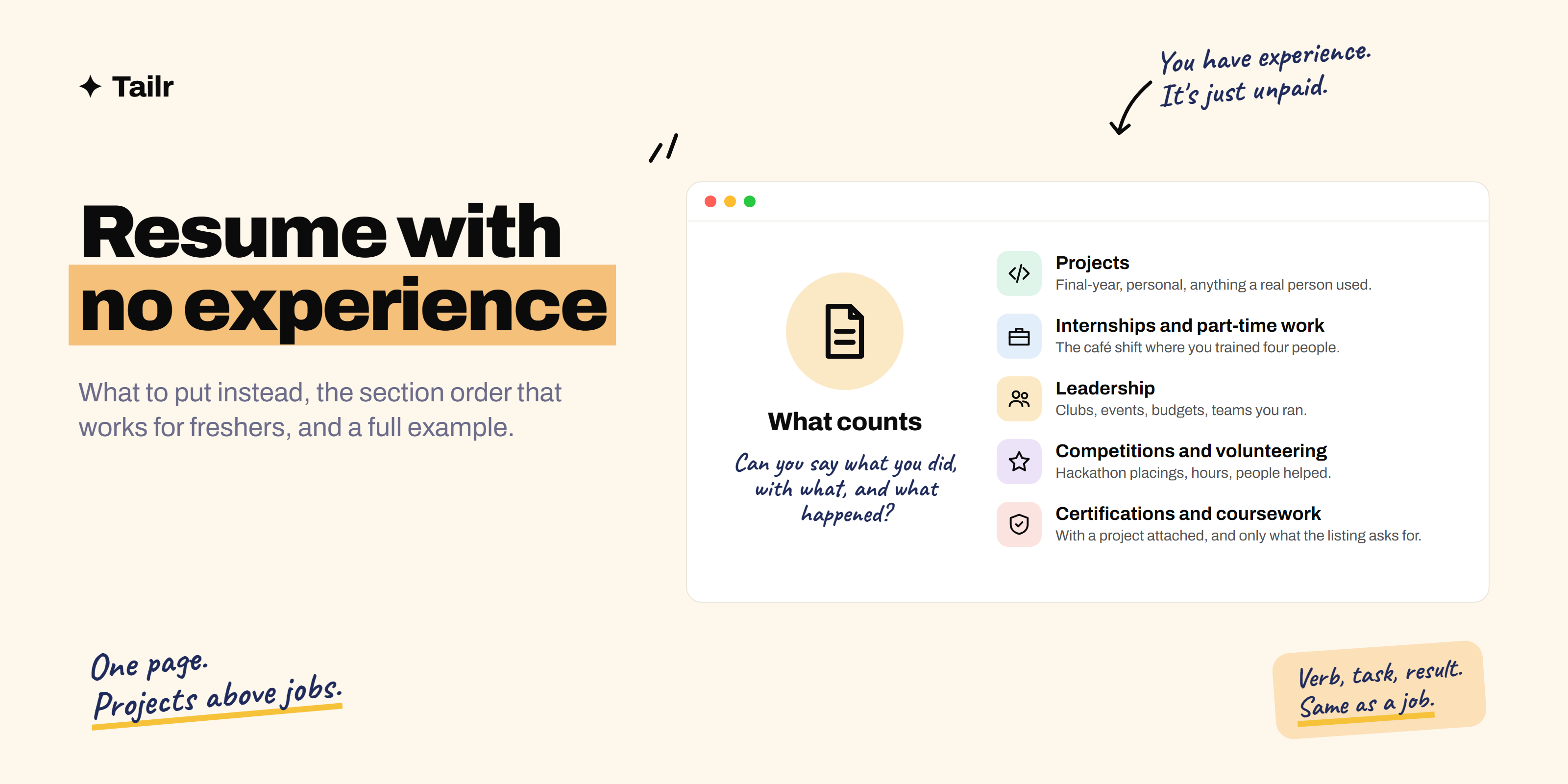
The problem with a first resume isn’t that you have nothing to put on it. It’s that you’ve been told “experience” means jobs, and you’re staring at a blank experience section. Recruiters hiring freshers know you don’t have a work history; what they’re looking for is evidence that you can do the work, and that evidence exists: it’s in your projects, your internship, your part-time job, the society you ran, the thing you built over a summer. This is how to find it, order it, write it, and tailor it so it gets read.
The short answer: A resume with no work experience leads with what you do have:
- A two-line summary that names your degree, your strongest skill and the role you want.
- Your education, with relevant detail.
- Projects written like jobs: what you built, with what, and what happened.
- Internships and any part-time or campus work.
- A skills section matched to the listing.
- Leadership, volunteering, competitions and certifications.
One page, single column, verbs and numbers in every bullet. Then tailor the summary and the project order to each listing, because the fresher who does that is the one who gets the interview. Tailr does that tailoring from the job you’re viewing.
What counts as experience when you have no experience
If you’re short on all of these, how to get experience when every job requires experience lists ten ways to build some quickly.
Recruiters hiring for entry-level roles are looking for signals that you’ll be useful within a few months. All of these are signals:
- Academic projects, especially final-year projects and anything a real person used.
- Personal projects: an app, a website, a data analysis, a hardware build, a YouTube channel with numbers.
- Internships of any length, paid or unpaid, remote or in person.
- Part-time and campus jobs: retail, tutoring, the library desk, a family business. They show reliability and often more responsibility than you think.
- Leadership in clubs, societies and events: running a budget, a team, a schedule, an event with attendance figures.
- Volunteering, with what you actually did and for how many people.
- Hackathons, competitions and olympiads, with placement.
- Freelance or gig work: designed logos for three local businesses, wrote for a blog, built a website for a relative’s shop.
- Certifications and courses, especially with a project attached.
- Relevant coursework, briefly, when the listing asks for a subject you’ve studied.
The test for whether something goes on the resume: can you describe what you did, what you used, and what happened? If yes, it’s experience.
The section order that works for freshers
- Contact details. Name, phone, email, city, LinkedIn, and GitHub or portfolio if relevant. No photo, no date of birth, no full address.
- Summary. Two lines. Degree and its strongest relevant detail, one or two skills or projects that match the role, the role you’re applying for.
- Education. Degree, institution, year, CGPA if it’s good. Relevant coursework or a thesis title if it helps.
- Projects. Two to four, most relevant first, each with two or three bullets.
- Experience. Internships, part-time work, campus jobs, freelance. If you have none, skip the section rather than leaving it empty.
- Skills. Grouped: languages, tools, methods. Only ones you could discuss in an interview.
- Leadership, achievements, certifications. Whichever you have. Short.
Education and projects go above experience because they’re the strongest evidence you have. An experienced candidate’s resume is the other way round.
Writing the summary
Formula: [Degree] graduate with [strongest relevant detail]. [One or two skills or projects that match the listing]. Seeking [the role, as the listing names it].
- “Computer science graduate (8.4 CGPA) with a final-year project deployed to 300 users and a summer internship in test automation. Strong in Python, SQL and Git. Seeking a graduate backend engineer role.”
- “Commerce graduate who ran the accounts for a 200-member college society, including a ₹4 lakh budget. Comfortable with Excel modelling and Tally. Seeking an entry-level financial analyst role.”
- “Mass communication graduate who grew a college society’s Instagram from 400 to 6,000 followers and ran the campaign that doubled event attendance. Hands-on with Canva and Meta Ads Manager. Seeking a marketing associate role.”
No objective (“seeking a challenging position where I can grow”), no adjectives (“hardworking, passionate, quick learner”).
Writing projects like jobs
A project entry has the same shape as a job entry: a title, a context line, and two or three bullets with a verb, a task and a result.
Weak:
Attendance Management System
- Made an attendance system using face recognition for the final year project.
- Used Python and OpenCV.
Strong:
Face-recognition attendance system — final-year project, team of four, Jan–Apr 2026
- Built the backend (Python, Flask, PostgreSQL) and the data pipeline for a system the department ran for one semester with 300 students.
- Reached 97% recognition accuracy on a 1,200-image test set after replacing the initial model with a pre-trained embedding approach.
- Wrote the deployment guide the department used to run it without us.
The strong version says what your part was, what tools, and three outcomes: it was used, it was accurate, it was maintainable. If your project has no number, find one: users, accuracy, marks, time saved, people trained, downloads, attendees.
Non-technical projects work the same way:
College fest sponsorship drive — sponsorship head, Sept–Dec 2025
- Led a team of six to raise ₹6.5 lakh from 14 sponsors, 40% more than the previous year.
- Built the sponsor deck and the pricing tiers; closed the two largest deals personally.
- Ran post-event reporting to sponsors, which led to three renewals for the following year.
Writing part-time work honestly and well
A campus or retail job looks thin until you write what you actually did.
Weak: “Worked at a café part-time.”
Strong:
Barista and shift lead (part-time), Brew & Co., Pune — 2024–2026
- Ran closing shifts for a 12-seat café three nights a week, including cash reconciliation and stock counts.
- Rebuilt the closing checklist, cutting closing time from about 45 to 30 minutes; adopted at a second branch.
- Trained four new hires.
Reliability, responsibility, initiative and training others are all things a first employer wants to see. The café is where you showed them.
Skills that match the listing
List skills the job description asks for that you genuinely have, grouped:
Languages: Python, SQL, JavaScript Tools: Git, Flask, PostgreSQL, AWS (EC2, S3), Postman Methods: REST APIs, unit testing, agile (from internship)
Don’t list “MS Office” unless the listing asks for Excel specifically. Don’t list soft skills. Don’t list anything you couldn’t answer a question about.
A full example
Aditya Menon Chennai · +91 98xxx xxxxx · aditya@example.com · github.com/adityam · linkedin.com/in/adityam
Summary Computer science graduate (B.Tech, 8.4 CGPA) with a final-year project deployed to 300 users and a six-month internship writing test automation for a payments API. Strong in Python, SQL and Git. Seeking a graduate backend engineer role.
Education B.Tech, Computer Science — Anna University, Chennai — 2022–2026 — CGPA 8.4 Relevant coursework: databases, operating systems, distributed systems, machine learning.
Projects Face-recognition attendance system — final-year project, team of four, Jan–Apr 2026
- Built the backend (Python, Flask, PostgreSQL) and data pipeline for a system the department ran for one semester with 300 students.
- Reached 97% recognition accuracy on a 1,200-image test set.
- Wrote the deployment guide the department used to run it without us.
Expense-splitting web app — personal project, 2025
- Built and deployed a React and Node app used by 40 hostel residents; handled auth, group ledgers and settlement suggestions.
- Added unit and API tests (Jest, Supertest) after a bug in settlement logic; 85% coverage since.
Experience Software testing intern, Payflow Technologies (fintech), Chennai — Jun–Nov 2025
- Wrote 120 automated API tests in pytest for the payments service, covering validation, auth and idempotency; caught two issues before release.
- Built a fixture library so tests created their own data; cut suite runtime by a third.
Skills Python, SQL, JavaScript · Git, Flask, Node, React, PostgreSQL, pytest, Postman, AWS (EC2, S3) · REST APIs, unit and API testing, agile
Leadership and achievements
- Coding club coordinator, 2024–2025: grew membership from 12 to 100+ by running weekly beginner sessions.
- Third place, 40 teams, Smart India Hackathon regional round, 2025.
One page. Every bullet has a verb and a number. Nothing on it is invented, and nothing on it is a job.
Tailoring it for each listing
Freshers send the same resume to fifty companies and wonder why nothing comes back. The fix is small and it matters more at entry level than anywhere else, because the recruiter has two hundred near-identical graduate resumes and is looking for the one that seems to be about their job.
- Summary: use the listing’s job title and its top two skills.
- Project order: put the project most relevant to this role first. A data analysis project leads for an analyst role; the web app leads for a frontend role.
- Skills: move the ones the listing names to the front. Add any you have that it asks for and you’d left off.
- Bullets: if the listing emphasises testing, the internship bullets lead. If it emphasises building, the projects do.
Ten minutes per application, or less with Tailr, which tailors your resume from the listing you’re viewing. How to tailor your resume to a job description walks through it, and resume keywords covers which words to pull from the listing.
Mistakes freshers make
- An objective instead of a summary. Recruiters skip “seeking a challenging role where I can grow”.
- Projects with no detail. A title and a tech stack isn’t a project; what you did and what happened is.
- Everything ever studied. Twenty coursework items nobody reads. Pick the four the listing cares about.
- Photo, date of birth, father’s name, full address, marital status. None of it belongs on a resume for a private company, and some of it invites bias.
- Two pages. One, for a fresher, always.
- Soft-skill lists. “Leadership, communication, teamwork, time management” proves nothing. The society you ran proves leadership.
- Same resume for every job. The single biggest reason graduate applications go unanswered.
- Lying about a skill or a grade. Verification is routine. How to tailor your resume without lying covers where the line is.
Where Tailr fits
The tailoring step is the one freshers skip because it’s tedious at fifty applications, and it’s the one that gets replies. Tailr tailors your resume to the specific job listing you’re viewing: it rewrites the summary with the listing’s title and skills, reorders and rewords your projects and bullets to match what the role emphasises, without inventing experience you don’t have, and generates a cover letter to go with it. For a fresher with the right raw material and no time to hand-tailor every application, it’s the difference between the generic resume and the one that looks like it was written for that job. Pair it with 30 most asked HR interview questions for the round that follows. Try Tailr on the next graduate listing you open.
Related guides
Conclusion
A resume with no work experience is a resume built from projects, internships, part-time work, leadership and the things you’ve made, written the way an experienced person writes their jobs: verb, task, result. Lead with a two-line summary and your education, put the most relevant project first, keep it to one page, cut the objective and the adjectives, and tailor the summary and order for every listing. The raw material is already there; the job is to write it like it counts, because it does.
Frequently asked questions
01What do I put on a resume if I have no work experience?
Everything that shows you can do the work, even if nobody paid you for it: academic and personal projects with outcomes, internships of any length, part-time and campus jobs, leadership in clubs or societies, volunteering, hackathons and competitions, certifications and relevant coursework. Write each one the way you'd write a job: what you did, what tools you used, and what happened as a result.
02What is the best resume format for a fresher?
A single-column, one-page resume with the sections in this order: contact details, a two-line summary, education, projects, internships or experience (including part-time work), skills, and then certifications, achievements or leadership. Education and projects go above experience because they're your strongest evidence. Keep it to one page.
03Should a fresher include a resume objective?
Write a short summary instead. An objective says what you want; a summary says what you offer. Two lines: your degree and its strongest relevant detail, one or two skills or projects that match the target role, and the role you're applying for. It's more useful to a recruiter and it's the part they read first.
04Do college projects count as experience on a resume?
Yes, if you describe them properly. A project with a clear scope, the tools you used, your specific role in it, and a measurable outcome (users, accuracy, a grade, an adoption) reads as experience to a recruiter hiring freshers. What doesn't count is a project title with no detail. Write projects in the same verb-plus-result format as a job bullet.
05How long should a fresher resume be?
One page. Recruiters screening graduate applications spend seconds on each, and a second page for someone with no work history reads as padding. If you're struggling to fill one page, add detail to your projects and skills; if you're overflowing it, cut coursework lists and anything that doesn't relate to the role.
06Should I include my grades on a fresher resume?
Include your CGPA or percentage if it's good (roughly 7.5 CGPA or 70% and above) or if the listing asks for it. If it's lower, leave it off unless required, and let projects and internships carry the resume. Never lie about it; many companies verify. Class 10 and 12 marks can go once you have a degree unless a listing specifically asks.