How Long Should a Resume Be? One Page vs Two Pages
· updated
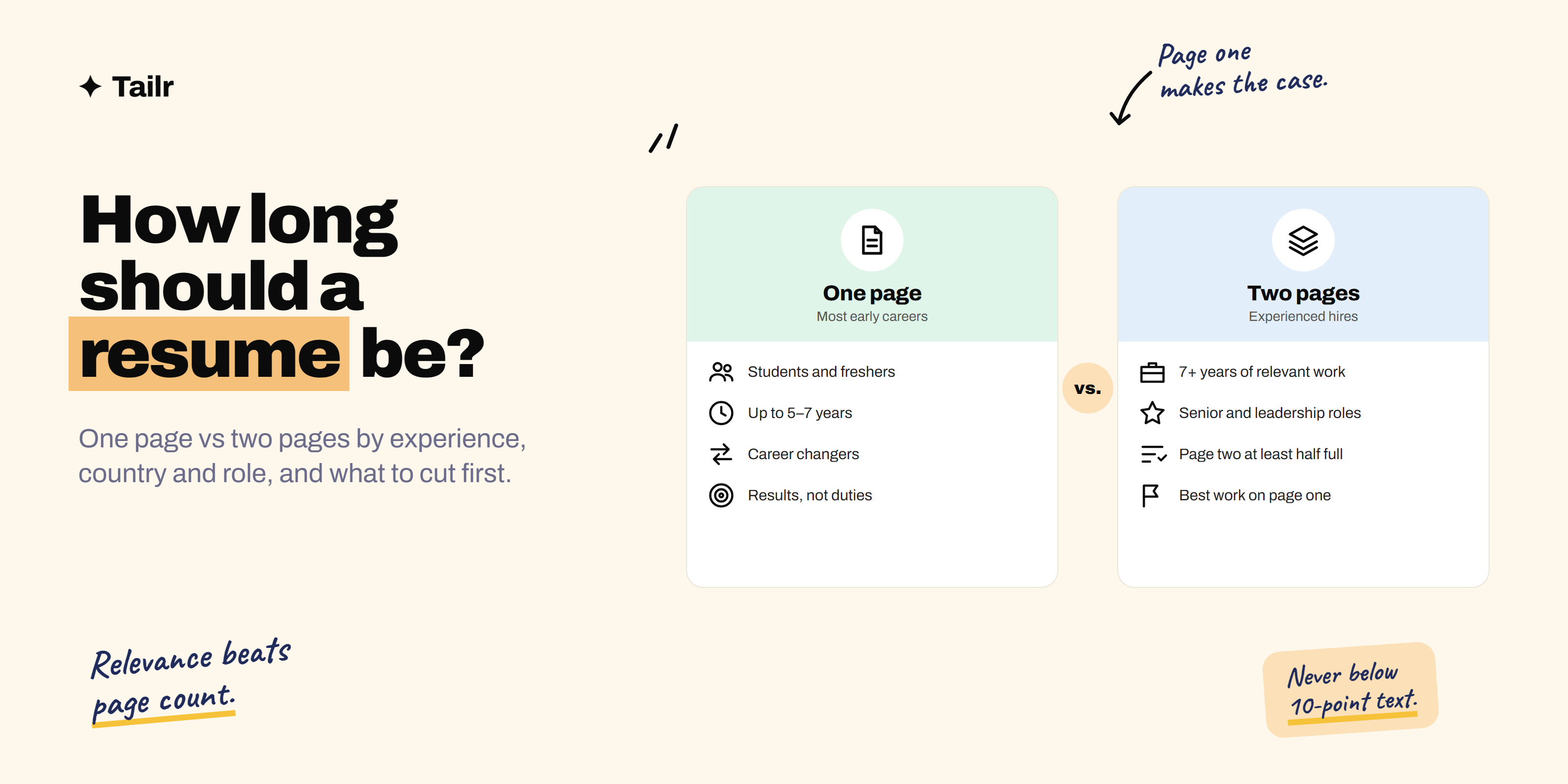
“Does my resume have to fit on one page?” is one of the most common resume questions, and the internet is full of strict rules that don’t hold up. The real answer depends on your experience, your field and where you’re applying. This guide gives you a clear recommendation by situation, explains what recruiters actually care about, and shows you exactly what to cut when your resume runs long.
The short answer: the right resume length depends on your experience:
- Students, freshers and recent graduates: one page.
- Early career (up to about 5–7 years): one page, or a full one and a half only if every line is strong.
- Experienced professionals (7+ years): two pages is normal and fine.
- Senior leaders and executives: two pages, occasionally three.
- Academic, research and some government roles: a longer CV is expected, with no strict page limit.
Whatever the length, put your most relevant experience on the first page and tailor it to the job.
What recruiters actually care about
The length debate misses the real point. Recruiters skim resumes quickly on a first pass, often in well under a minute, looking for a few things:
- Current or most recent job title and company.
- Relevant skills and experience for this role.
- Evidence of results: numbers, outcomes, achievements.
- Career progression that makes sense.
A tight one-page resume that shows those things beats a two-page resume that buries them. A two-page resume full of relevant achievements beats a one-page resume crammed with tiny text. Relevance and readability matter more than page count.
Resume length by experience level
| Situation | Recommended length | Why |
|---|---|---|
| Student or fresher | 1 page | Education, projects, internships and skills fit comfortably |
| 1–5 years’ experience | 1 page | Focus on recent roles and your best results |
| 5–10 years’ experience | 1–2 pages | Two pages if you have several relevant roles with strong achievements |
| 10+ years’ experience | 2 pages | Detail the last 10–15 years; summarise the rest |
| Senior executive | 2 pages, sometimes 3 | Board roles, major outcomes and leadership scope need room |
| Career changer | 1 page | Focus on transferable skills and relevant projects, not every past duty |
| Academic or research | Full CV, no fixed limit | Publications, grants, teaching and conferences are expected |
Resume length by country
Expectations vary by region:
- United States and Canada: “resume” means a short document, one page early in your career and two for experienced candidates. “CV” means a long academic document.
- United Kingdom, Ireland, Australia and New Zealand: “CV” is the everyday term; two pages is the standard for most experienced candidates.
- India: “resume” and “CV” are both used. One page is common for freshers; one to two pages for experienced professionals. Long, detailed CVs with personal details are increasingly outdated for private-sector jobs.
- Europe: usually up to two pages; some countries also use the Europass CV format for certain applications.
When in doubt, follow the job listing and what’s common in the company’s home country.
When one page is right
- You’re a student, fresher or recent graduate.
- You have fewer than about five years’ experience.
- You’re changing careers and most of your past roles aren’t directly relevant.
- You’re applying for a role where conciseness is part of the job, such as consulting or many startup roles.
For tips on building a strong one-pager early in your career, see how to write a resume with no experience.
When two pages are right
- You have seven or more years of relevant experience.
- You’ve had several roles with substantial, different achievements.
- You’re in a technical field where projects, tools and certifications genuinely need space.
- You’re applying for senior or leadership roles.
Rules for a two-page resume
- Page one carries the case. Your summary, current role and best achievements must all be on page one.
- Fill at least half of page two. A few lines spilling onto a second page looks unfinished. Either cut back to one page or develop the content.
- Put your name and page number on page two in case they’re printed separately.
- Don’t pad to reach two pages. Two pages are earned by relevant content, not by bigger fonts and margins.
When a longer CV is expected
- Academic and research roles: publications, grants, teaching, conferences and supervision are all expected.
- Medical and scientific roles: licences, rotations, research and publications.
- Some government applications: certain government jobs ask for detailed work histories with hours, dates and duties; follow their format exactly.
What to cut when your resume is too long
Work through this list in order. Most resumes lose half a page quickly.
- The objective statement. Replace it with a two- or three-line summary tailored to the role, or remove it. See how to write a resume summary.
- “References available on request.” Everyone knows. Delete it.
- Old or irrelevant jobs. Roles from more than 10 to 15 years ago, or unrelated ones, can become a single “Earlier experience” line or disappear.
- Duties instead of results. “Responsible for managing the team’s social media” can go; “Grew Instagram followers from 2,000 to 15,000 in a year” stays.
- Repeated bullet points. If three roles all say “worked with cross-functional teams”, keep it once, where it’s most impressive.
- Too many bullets per role. Three to five for recent roles, one or two for older ones.
- Basic or assumed skills. Microsoft Word, email, “internet research”. Keep skills that the listing asks for.
- High school details once you have a degree, and coursework once you have work experience.
- Personal details: full address, date of birth, marital status, photo, unless they’re required where you’re applying.
- Hobbies, unless they’re relevant to the role or a genuine conversation starter.
How to fit your resume on one page (without cheating)
After cutting content, these layout changes help, within limits:
- Margins: 0.5 to 1 inch is fine. Smaller looks cramped.
- Font size: 10 to 12 points for body text, 14 to 16 for your name. Don’t go below 10.
- Line spacing: single spacing with a little space between sections.
- Combine short sections: put certifications and tools under Skills.
- Shorten bullet points to one or two lines each. Long bullets are where most space goes.
- Use a single-column layout. It’s easier to read and better for applicant tracking systems. See how to tell if your resume is ATS-friendly.
Before (two lines): “Was responsible for the creation and ongoing management of weekly sales reporting for the regional team, working closely with managers to understand their needs.”
After (one line): “Built weekly sales reports used by 8 regional managers, cutting reporting time by 5 hours a week.”
Shorter and stronger. That’s the goal.
What goes on page one
If your resume runs to two pages, page one decides whether page two gets read. Here’s a reliable order for page one:
- Header: name, city, phone, email, LinkedIn URL and, if relevant, a portfolio or GitHub link.
- Summary: two or three lines tailored to the role: who you are, your strongest relevant skill, and one standout result.
- Skills: a short, scannable list of the tools and skills the listing asks for.
- Most recent experience: your current or latest role, with three to five results-focused bullet points.
- The next most relevant role, if it fits.
Page two then holds earlier roles, education, certifications, and any extras like publications or volunteering.
Freshers: swap the order so Education and Projects come straight after the summary, since they’re your strongest evidence.
Section-by-section length guide
| Section | Recommended length |
|---|---|
| Summary | 2–3 lines |
| Skills | 1–4 lines, grouped (e.g. “Tools: Jira, Figma, SQL”) |
| Recent roles | 3–5 bullet points each |
| Older roles (5+ years ago) | 1–2 bullet points each, or a single line |
| Education | 1–2 lines per degree; add projects or honours only if early career |
| Projects | 2–3 lines each, with a result or link |
| Certifications | 1 line each |
Use this as a check. If one role from eight years ago has seven bullet points, that’s where to cut.
Does length affect applicant tracking systems?
Applicant tracking systems don’t penalise two-page resumes. They read all the text you upload. What matters for them is a clean format and the right keywords. Length matters mainly to the human who reads it after the system shows them your profile. File format matters more than length for parsing; see why .docx beats PDF for resume uploads on job portals.
Common length mistakes
- Shrinking text to 8 points to force one page.
- A two-page resume with five lines on page two.
- Listing every job since school “for completeness”.
- The same resume for every application, so irrelevant experience takes space that relevant experience should have.
- Cutting results to save space while keeping duties. Do the opposite.
Tailoring keeps your resume short
The easiest way to keep a resume tight is to tailor it. When you shape your resume for one specific job, you naturally drop the experience that doesn’t matter for it, and the page count takes care of itself. You keep a longer master resume with everything, and send a focused version for each role.
Tailr does this from the job listing you’re viewing: the Chrome extension tailors your resume to that role, writes a matching cover letter and tracks every application. Our guide on how to tailor your resume to a job description shows how to do it by hand too.
Try TailrConclusion
Use one page if you’re a student, a fresher or early in your career, and two pages if you have years of relevant experience to show. Longer CVs are for academia and some government roles. Whatever the length, put your strongest, most relevant work on page one, cut duties in favour of results, and tailor each version to the job. A recruiter won’t reject you for using two pages. They’ll stop reading if the first page doesn’t show why you fit.
Frequently asked questions
01How long should a resume be in 2026?
One page for students, recent graduates and most people with under about five to seven years of experience. Two pages for experienced professionals with a lot of relevant work to show. Three or more pages only for academic CVs, some senior executive roles, and certain government or federal applications that ask for detail.
02Is a 2-page resume okay?
Yes, if you have enough relevant experience to fill two pages with strong content, usually seven or more years or several substantial roles. The second page should be at least half full and the most important information must be on the first page, because many recruiters only skim the top.
03Can a fresher have a 2-page resume?
It's usually better not to. Most freshers and recent graduates can show everything relevant on one page: education, projects, internships, skills and achievements. Going to two pages often means padding with weak content, which makes the strong parts harder to find.
04Do recruiters prefer one-page resumes?
Recruiters prefer resumes that are easy to scan and relevant to the role. For early-career candidates that almost always means one page. For experienced candidates, many recruiters are happy with two pages as long as the first page makes the case quickly and every line is relevant.
05How far back should a resume go?
Most resumes cover the last 10 to 15 years in detail. Older roles can be summarised in a single line or an 'Earlier experience' section, or left off entirely if they aren't relevant. You don't need to list graduation years if you'd rather not.
06What is the difference between a resume and a CV?
In the US and Canada, a resume is a short, targeted document of one or two pages, while a CV is a long, complete academic record. In the UK, India, Europe and much of the world, 'CV' is the everyday word for what Americans call a resume, typically two pages.