How to Write a Resume Summary (With 12 Examples)
· updated
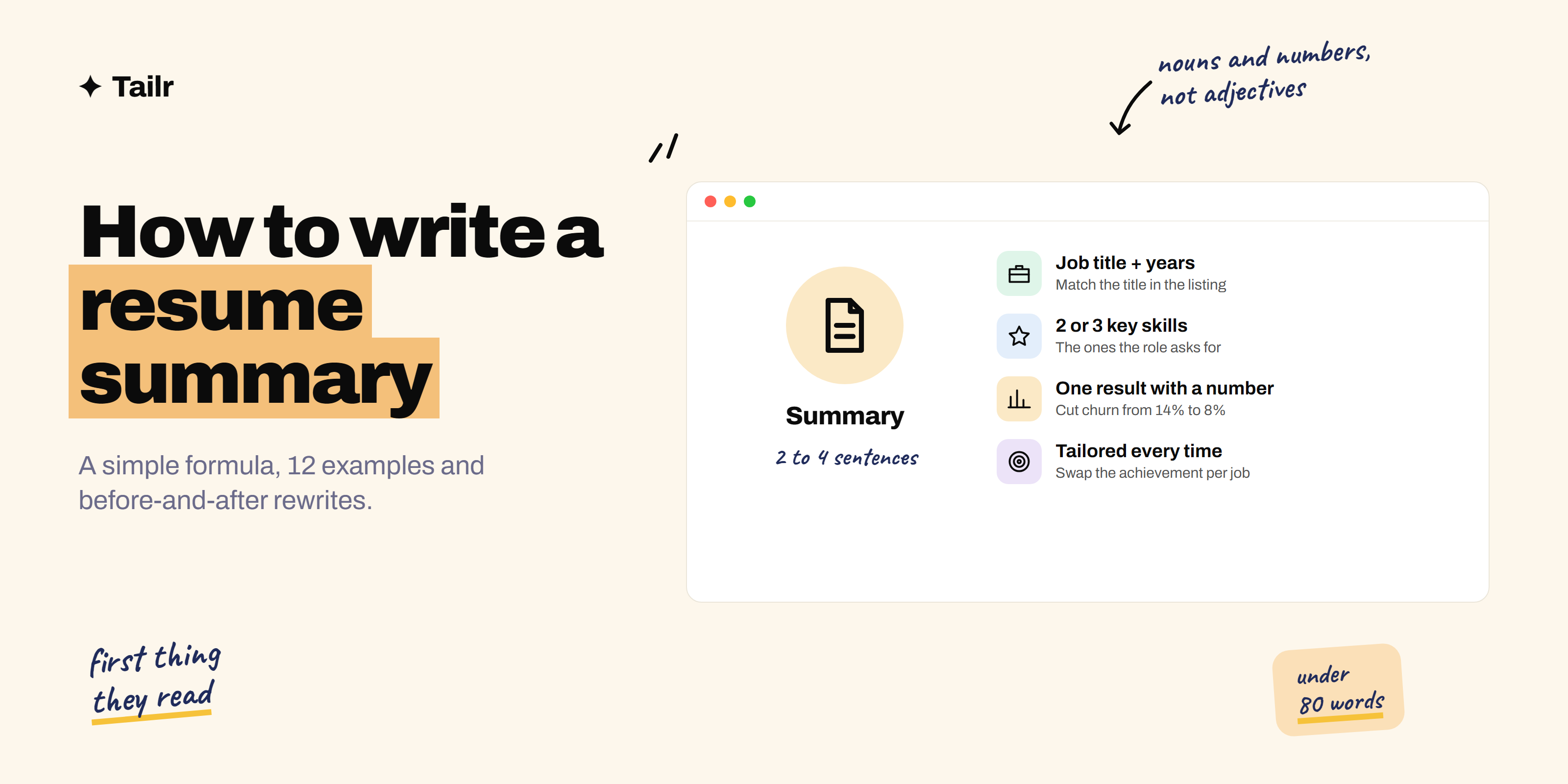
The summary is the first thing a recruiter reads on your resume, and often the only thing they read before deciding whether to keep going. Most summaries waste that spot with lines like “hardworking team player seeking opportunities”. This guide gives you a simple formula, 12 examples you can adapt, and before-and-after rewrites so yours says something real.
The short answer: A good resume summary is two to four sentences that cover:
- Who you are: your job title (ideally the one you’re applying for) and years of experience.
- What you’re good at: two or three skills that match the job listing.
- Proof: one or two measurable results.
- Optional: what you’re looking for next, if you’re switching fields.
Keep it under about 80 words, skip “I” and buzzwords, and tailor it for every application.
Why the summary matters so much
- It’s read first. Recruiters skim from the top. A specific summary earns the next ten seconds.
- It frames everything below. It tells the reader how to see your experience, which helps most when your path isn’t a straight line.
- It’s prime keyword space. Applicant tracking systems and recruiters both look for the job title and core skills. The summary is the natural place for them. See resume keywords for how to find the right ones.
Do you even need a summary?
Usually yes, but not always. Here’s a quick way to decide:
- Write one if you have a few years of experience, you’re changing fields, your job titles don’t obviously match the role you want, or you’re applying to roles where the first screen is fast and keyword-driven.
- It’s optional if you’re a student with one internship and your projects section is strong. A weak summary is worse than none, because it pushes your best material down the page.
- Skip the old-style objective (“Seeking a challenging position…”) in almost every case. It tells the reader what you want instead of what you offer.
If you’re early in your career and unsure, write one, then ask yourself whether every sentence contains a specific skill, number or result. If it doesn’t, cut it. How to write a resume with no experience covers what to lead with instead.
The resume summary formula
[Job title] with [X years] of experience in [area]. Skilled in [skill 1], [skill 2] and [skill 3]. [Achievement with a number]. [Optional: what you want next.]
That’s it. The formula is simple; the work is in choosing the specifics.
Before and after: three rewrites
Before: “Motivated and detail-oriented professional with strong communication skills looking for a challenging role in a growth-focused company.”
After: “Customer success manager with four years in B2B SaaS. Skilled in onboarding, renewals and building health scores in HubSpot. Cut churn on a 120-account book from 14% to 8% in one year.”
Before: “Passionate software developer who loves solving problems and learning new technologies.”
After: “Backend engineer with three years building Python and Go services. Experienced in Postgres, AWS and API design. Reduced p95 latency on our checkout API by 40% and led migration of six services to Kubernetes.”
Before: “Recent graduate eager to start a career in data.”
After: “Computer science graduate focused on data analysis. Comfortable with SQL, Python (pandas) and Tableau. Built a dashboard tracking 2,000+ campus housing listings that the student union now uses each semester.”
The pattern: replace adjectives with nouns and numbers. “Detail-oriented” means nothing; “cut errors in monthly reporting from 12 to 1” proves it.
Write yours in 15 minutes: a worked example
Let’s write one from scratch. Say you’re applying for this (shortened) listing:
Data Analyst, Growth. You’ll own weekly reporting on acquisition and retention, build dashboards in Looker, and partner with marketing on experiments. 2+ years with SQL and Python. Experience with A/B testing a plus.
Step 1: pull out what they care about (3 minutes). Title: Data Analyst. Must-haves: SQL, Python, Looker, reporting on acquisition and retention. Nice to have: A/B testing. The team: growth and marketing.
Step 2: list your matching evidence (5 minutes). Be honest and specific:
- Three years as an analyst at an online retailer.
- Daily SQL; Python for cleaning and automation.
- Built the weekly retention dashboard in Looker used by the growth team.
- Analysed eight email A/B tests with marketing.
- Cohort analysis that led to a loyalty email which lifted repeat purchases by 9%.
Step 3: fill in the formula (5 minutes).
“Data analyst with three years in e-commerce growth. Skilled in SQL, Python and Looker, with hands-on A/B test analysis for marketing. Built the weekly retention dashboard our growth team runs on, and a cohort analysis that lifted repeat purchases by 9%.”
Step 4: cut (2 minutes). Read it aloud. Remove anything a recruiter would skim past. Here, “hands-on” can go. That leaves about 45 words, every one doing a job.
Notice what happened: the summary now uses the listing’s own words (Looker, A/B testing, retention, growth) but every claim is true. That’s the whole skill. For a different listing, say a finance analyst role, you’d swap in your forecasting work and drop the marketing tests.
12 resume summary examples
Software engineer
“Full-stack engineer with five years building React and Node.js products. Owned the billing system end to end, handling about $3M a year in payments. Comfortable leading small projects and mentoring junior developers.”
Fresher software developer
“Computer science graduate with internship experience in backend development. Skilled in Java, Spring Boot and SQL. Built and deployed a library management app used by 300 students. Looking for a junior backend role.”
Data analyst
“Data analyst with three years in e-commerce. Expert in SQL, Python and Looker. Built a weekly cohort report that helped the growth team lift repeat purchases by 9%.”
Product manager
“Product manager with six years in B2B SaaS. Led a team of eight engineers to launch a self-serve onboarding flow that cut time-to-value from 14 days to 3. Strong in discovery, roadmapping and working with sales.”
QA engineer
“QA engineer with four years in web and API testing. Skilled in Playwright, Postman and CI pipelines. Grew automated test coverage from 20% to 75% and cut release regressions by half.”
Marketing
“Content marketer with five years in B2B tech. Grew organic traffic from 10k to 85k monthly visits in 18 months through SEO-led content. Comfortable with Ahrefs, Webflow and HubSpot.”
Sales
“Account executive with four years selling mid-market SaaS. Closed $1.4M in new ARR last year at 128% of quota. Skilled in discovery, multi-threading deals and working with solutions engineers.”
Designer
“Product designer with five years in fintech. Led redesign of a mobile onboarding flow that raised completion from 52% to 71%. Strong in Figma, user research and design systems.”
Customer support
“Support specialist with three years in SaaS. Handle 60+ tickets a day at a 96% satisfaction score. Wrote 40 help-centre articles that cut repeat questions by a fifth.”
Project manager
“Project manager with seven years delivering software projects in healthcare. PMP-certified. Delivered a 14-month EHR integration on time and 6% under budget across three vendor teams.”
Career changer
“Former high school teacher moving into instructional design. Designed 30+ units of curriculum for 150 students a year and built online courses in Articulate Rise during a certificate programme. Bringing classroom-tested skills in clear explanation and assessment.”
For more on making the jump, see how to switch careers into tech.
Returning after a gap
“Operations manager with eight years in logistics, returning after two years of family caregiving. Ran a 40-person warehouse team and cut picking errors by 35%. Recently completed a Lean Six Sigma Green Belt.”
Where it goes and how it should look
- Position: directly under your name and contact details, above experience. Don’t bury it.
- Heading: “Summary” or “Profile” is fine. Skip “Professional Summary Statement” and other long labels.
- Format: a short paragraph, not bullet points. Two to four sentences reads faster as prose.
- Font and size: the same as your body text. A bold or larger summary looks like you’re shouting.
- Bold sparingly: bolding one key number or the job title is fine; bolding half the summary cancels it out.
- Length check: if it runs past four lines on the page, it’s too long.
Summary vs skills section vs headline
These three often repeat each other, so give each a different job:
| Section | Its job | Example |
|---|---|---|
| Headline (optional, under your name) | The target role in a few words | “Backend Engineer · Python · AWS” |
| Summary | Who you are, top skills, proof | Two to four sentences with a result |
| Skills section | The full, scannable list of tools | “Python, Go, Postgres, Redis, AWS, Docker…” |
The summary picks the two or three skills that matter most and pairs them with evidence. The skills section carries the long list. Don’t paste the skills list into the summary.
Summary vs objective
| Resume summary | Resume objective | |
|---|---|---|
| Focus | What you offer | What you want |
| Best for | Anyone with relevant experience | Students, career changers |
| Length | 2–4 sentences | 1–2 sentences |
| Example | “Data analyst with three years in SQL…” | “Seeking a junior data analyst role to apply SQL skills from…” |
If you do write an objective, make it about the employer’s needs, not just yours, and keep it specific to the role.
How recruiters and ATS read your summary
Two readers see your summary, and they want slightly different things.
The recruiter skims. In a few seconds they’re checking three things: is this person’s title close to the role, do they have the must-have skills, and is there any sign they’re good at it? A summary that answers all three in the first two lines does its job even if the rest is never read.
The applicant tracking system (ATS) stores your resume and lets recruiters search and filter it. It doesn’t “reject” summaries on its own, but when a recruiter searches for “Looker” or “customer success manager”, your resume has to contain those words to show up. The summary is a natural place for the exact job title and the most important skills, written the way the listing writes them.
A few practical tips that help with both:
- Use the listing’s exact phrasing for skills you really have: “A/B testing”, not “split testing”, if that’s what they wrote.
- Spell out and abbreviate once for key terms: “search engine optimisation (SEO)”.
- Avoid text in images, tables or text boxes at the top of the resume; some systems read them badly.
- Keep it in the main body, not the header or footer, which some parsers skip.
Resume keywords goes deeper on finding and placing the right terms.
Resume summary mistakes to avoid
| Mistake | Better |
|---|---|
| “Hardworking team player” | One result that shows it |
| A generic summary for every job | Match the title and top skills in the listing |
| Six-line paragraph | Two to four sentences |
| “I am a…” | Drop the pronoun |
| Listing every tool you’ve touched | Two or three that matter for this role |
| Claims you can’t back up | Only results you can explain in an interview |
Strong verbs help too; resume action verbs has 200 grouped by skill.
How to tailor your summary for each job
Tailoring the summary is the highest-value five minutes you can spend on an application:
- Match the title. If the listing says “Customer Success Manager”, don’t call yourself an “Account Manager”.
- Mirror the top skills. Pick the two or three that appear most in the listing and that you genuinely have.
- Swap the achievement. Lead with the result closest to what this role cares about.
Do this honestly; how to tailor your resume without lying covers where the line is. If you’re applying to a lot of roles, Tailr does this from the job listing you’re viewing: it rewrites your summary and bullets to fit the role using your real experience, writes a matching cover letter, and tracks the application. How to tailor your resume to a job description walks through the full process by hand.
Try TailrRelated guides
Conclusion
A strong resume summary is short, specific and tailored: your title and experience, two or three skills from the listing, and one result with a number. Cut the adjectives, keep the proof, and rewrite it for every role you care about. It’s the smallest section on your resume and the one most likely to decide whether the rest gets read.
Frequently asked questions
01What is a resume summary?
A resume summary is a short paragraph of two to four sentences at the top of your resume that says who you are professionally, what you're good at and one or two results that prove it. It's the first thing a recruiter reads, so it decides whether they keep going.
02How long should a resume summary be?
Two to four sentences, or roughly 40 to 80 words. Anything longer starts to look like a cover letter and gets skimmed. Recruiters spend only seconds on a first pass, so every line should carry a specific skill, number or result.
03What is the difference between a resume summary and an objective?
A summary describes what you already offer: your experience, skills and results. An objective describes what you want from the job. Summaries are the modern default; a short, specific objective can still work for students or career changers with little relevant experience.
04Should I use first person in a resume summary?
Usually not. The standard style drops the pronoun, so 'Product designer with five years of experience' rather than 'I am a product designer'. Avoid third person too. What matters most is staying consistent across the whole resume.
05Do I need a resume summary if I'm a fresher?
It's optional but helpful if you write it well. Lead with your degree or focus area, name two or three relevant skills, and point to your strongest project or internship with a result. If you can't make it specific, skip it and let your projects section do the work.
06Should I change my resume summary for every job?
Yes. The summary is the easiest part of your resume to tailor and one of the most effective. Match the job title, mirror two or three of the most important skills from the listing, and pick the achievement that best fits what that role cares about.