What Does a Sales Engineer Do?
· updated
“Sales engineer” is a title that makes people on both sides nervous. Engineers hear “sales” and imagine cold calls. Salespeople hear “engineer” and imagine someone who’ll slow down the deal with caveats. The real job is neither. It’s the person in the room who can honestly tell a customer whether the product will work for them, and show it.
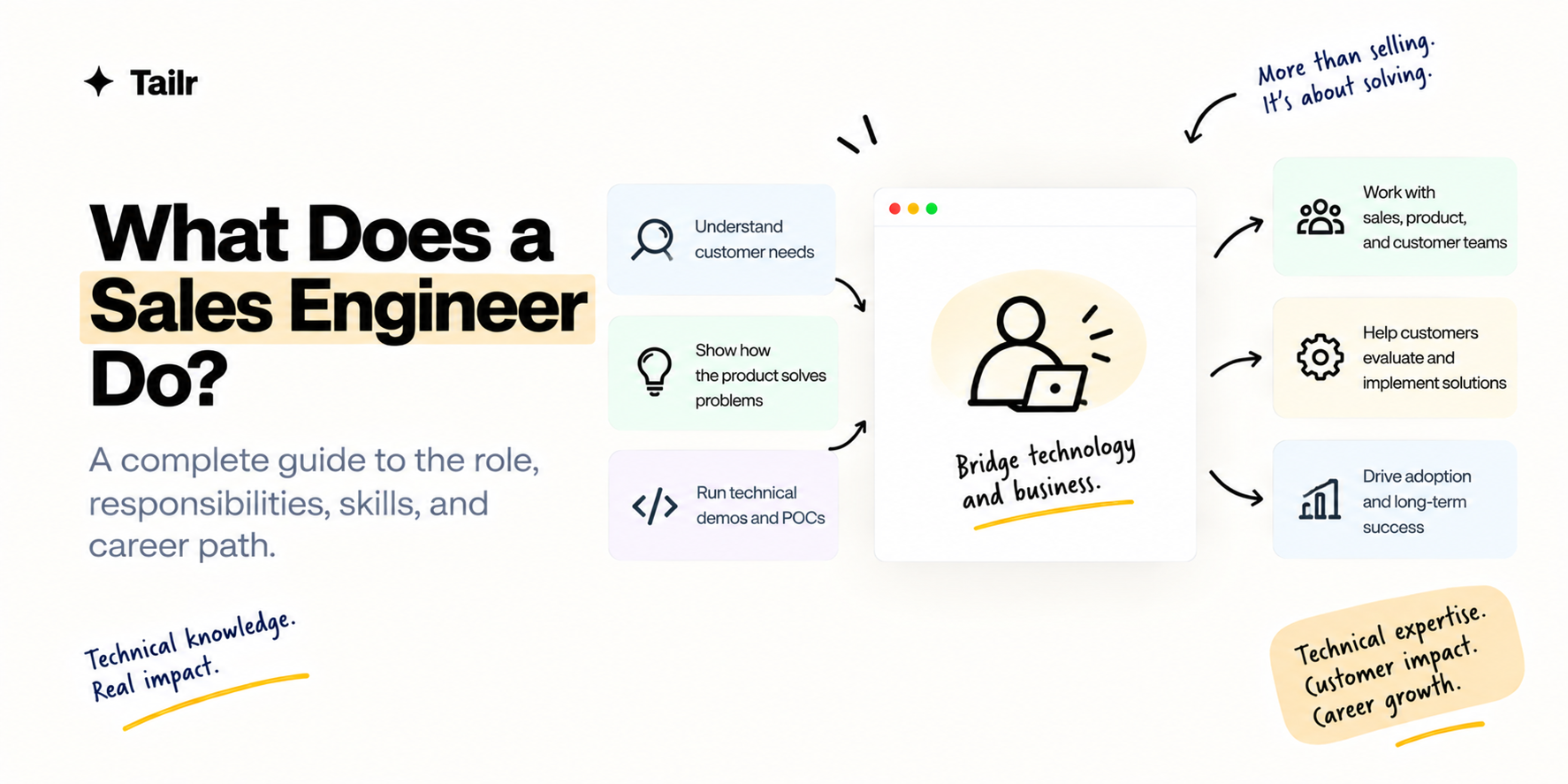
The short answer: a sales engineer is a technical specialist who works with a sales team to prove that a product will solve a customer’s problem before they buy it. They:
- Run technical discovery.
- Build and deliver demos.
- Set up and manage proofs of concept.
- Answer technical questionnaires and RFPs.
- Handle the objections a customer’s engineers raise.
The account executive owns the commercial side of the deal; the sales engineer owns the technical yes. The title exists across software, industrial equipment, medical devices, telecoms, and manufacturing, and the US Bureau of Labor Statistics puts median pay at $121,520, with software sales engineers commonly earning $180,000 to $260,000 on target in 2026.
Two kinds of sales engineer
Before going further, it’s worth separating two worlds that share a title.
Industrial and hardware sales engineers sell things like factory automation, HVAC systems, semiconductors, laboratory equipment, and medical devices. The job often requires an engineering degree because you’re specifying products against physical constraints: load, tolerance, throughput, regulatory approval. This is the group the Bureau of Labor Statistics is mostly describing.
Software sales engineers sell software to other businesses. The technical questions are about integrations, security, data, and scale rather than physics. The title is often interchangeable with solutions engineer, which we’ve covered in what a solutions engineer does. Engineering degrees are common but not required.
The rest of this post applies to both, with the differences flagged where they matter.
What sales engineers actually do
Technical discovery
Every deal starts with finding out what the customer actually has and needs. A sales engineer asks the questions the account executive can’t: what’s your current setup, what does the data look like, which systems does this need to talk to, who has to approve it, what’s failed before? In hardware, discovery might mean a site visit to see the production line. In software, it’s usually a call with the customer’s technical lead.
The output is a judgement: can we win this technically, and what would it take?
Demos
The demo is the centrepiece of the job. A good sales engineer builds one for the specific customer, using their terminology and a scenario that looks like their real problem, then delivers it live to a room that may include sceptics. In hardware, the “demo” might be a sample unit, a factory acceptance test, or a trial installation.
The skill isn’t just knowing the product. It’s holding the audience, adapting when someone asks to see something unplanned, and knowing when to stop talking.
Proofs of concept and trials
For bigger deals, the customer wants evidence on their own data or in their own facility. The sales engineer scopes the trial (what success means, how long it runs, who does what), sets it up, keeps the customer’s team unblocked during it, and reports the result against the agreed criteria. Poorly scoped trials are the most common way a deal that should take a quarter takes a year.
Questionnaires, RFPs, and specifications
Large customers send paperwork: security questionnaires, requests for proposal, technical specification sheets, compliance checklists. The sales engineer owns the technical answers. In regulated industries (medical, defence, utilities) this can be most of the job in a given month.
Objection handling
The customer’s engineers will push back. It won’t scale. It doesn’t integrate with our system. The competitor’s version does something yours doesn’t. A sales engineer’s credibility rests on answering these straight, including “we can’t do that today”. Over-promising wins the deal and loses the renewal.
Supporting the account executive
Sales engineers are usually attached to one or several account executives (AEs). Beyond the customer-facing work, they help the AE qualify deals, write the technical parts of proposals, and decide which deals are worth the effort. The best AE and sales engineer pairs work like a two-person team with clear lanes: the AE runs the buying process and the money; the sales engineer runs the technical story.
Sales engineer vs the roles around it
| Role | Owns | Quota | Typical background |
|---|---|---|---|
| Sales engineer | Technical proof during the sale | Team-based variable pay, sometimes individual | Engineering, support, implementation |
| Account executive | The deal, the relationship, the close | Individual quota | Sales |
| Solutions engineer | Same as sales engineer in software | Same as sales engineer | Same as sales engineer |
| Solutions architect | Larger-deal design documents, often post-sale too | Sometimes | Senior engineering or consulting |
| Customer success manager | The relationship after the sale | Renewal or retention targets | Account management, support |
| Forward deployed engineer | Building the product into the customer’s systems after the sale | No | Software engineering |
The cleanest way to remember it: the account executive closes, the sales engineer proves, the implementation team (or forward deployed engineer) delivers.
How pay works
Sales engineer pay has two parts, and understanding the second is essential before accepting an offer.
Base salary is fixed. In software in 2026, US bases commonly run:
- Junior (0 to 2 years): $80,000 to $100,000
- Mid-level (3 to 5 years): $110,000 to $140,000
- Senior (5 to 8 years): $140,000 to $180,000
- Principal or staff: $170,000 to $220,000
Variable pay is the sales-linked part. Around 85% of US sales engineer roles include it, usually 20% to 30% of on-target earnings (OTE). The common splits are 70/30 or 80/20, base to variable. Unlike an account executive’s commission, it’s typically tied to the bookings of the team, region, or AEs the sales engineer supports rather than to an individual number. So a $150,000 base with an 80/20 split gives an OTE of $187,500; if the team beats plan, you can exceed it.
Putting it together, software sales engineer OTE commonly lands between $180,000 and $260,000, with principal roles at $220,000 to $300,000 and up. Glassdoor’s median for the title sits around $160,000 total.
Across all industries, the Bureau of Labor Statistics reports a median of $121,520 (May 2024), with the lowest 10% under $70,580 and the highest 10% above $202,670. Industrial sales engineers usually sit lower than software ones, partly because the variable component is smaller.
Questions to ask about any offer: is the variable tied to a team or individual number? What percentage of the team hit plan last year? Is there an accelerator above 100%? Is any of it guaranteed for the first two quarters while you ramp?
Is the job growing?
Yes, modestly. The Bureau of Labor Statistics projects 5% growth for sales engineers from 2024 to 2034, faster than average across all occupations, with around 5,000 openings a year from growth and turnover combined.
In software the picture is more mixed. Products are getting more complex and buying committees larger, which creates demand for technical pre-sales. At the same time, product-led companies are pushing self-serve trials and interactive demos, and some tasks (drafting questionnaire answers, first-pass demo research) are being automated. The ratio of sales engineers to account executives is tightening at many companies, meaning fewer sales engineers covering more deals. The role isn’t going away; it’s shifting toward the higher-value work of discovery, complex trials, and technical judgement.
Skills that make a good sales engineer
Hard skills:
- Product mastery, including the limitations and the roadmap.
- Domain knowledge: the customer’s industry, systems, and vocabulary.
- Demo building and delivery, live and recorded.
- Technical writing for questionnaires, proposals, and trial reports.
- Comfort with the sales tool stack (CRM, demo environments, call recording).
Soft skills:
- Listening properly in discovery instead of waiting to pitch.
- Explaining a technical trade-off in plain language to a non-technical buyer.
- Managing several stakeholders in a room who want different things.
- Keeping ten deals moving without dropping the important one.
- Being honest when the product isn’t the right fit, which builds the trust that wins the next deal.
How to become a sales engineer
Almost nobody starts their career as a sales engineer. The usual routes:
- Technical support. You already know the product’s failure modes and how to talk to frustrated users. You’ll need to learn deal dynamics.
- Implementation or professional services. You’ve delivered the product for real customers. You’ll need to learn to scope rather than build.
- Field or application engineering in hardware. You’ve been on site solving customer problems; pre-sales is a natural next step.
- Software engineering. You’re credible with the customer’s engineers from day one. You’ll need to get comfortable presenting and with a sales culture.
- Account management or sales with a technical bent. Rarer, but works if you can prove product depth.
Most listings ask for two to five years of hands-on technical experience. In industrial fields, an engineering degree is usually required; in software, it helps but product knowledge and communication matter more. Whatever your route, the most persuasive thing you can bring to an interview is a rehearsed demo of something you know well.
Tailoring your resume for a sales engineer role
Sales engineer screeners look for three things on a resume: technical depth, customer-facing evidence, and any link to revenue. Engineers tend to show only the first. Salespeople tend to show only the third.
A field engineer’s bullet might say:
Installed and commissioned automation equipment at customer sites across the Midwest.
For a sales engineer posting, the same experience reframed:
Led on-site commissioning at 25 customer plants, ran pre-installation technical reviews with plant engineers, and supported the regional sales team on 8 expansion deals worth $3.2M.
Nothing invented; the technical reviews and the expansion deals were part of the job and simply weren’t mentioned.
Every sales engineer listing emphasises something different: one wants a specific product ecosystem, another wants enterprise demo experience, a third wants regulatory knowledge. That’s where Tailr helps: open the listing, and it rewrites your resume to lead with the experience that matches, drafts a cover letter, and keeps track of where you’ve applied. It only uses what’s genuinely on your resume, which is the right constraint for a job where you’ll be demonstrating your claims in the interview. Our guides on tailoring your resume to a job description and tailoring without lying show the method.
Conclusion
A sales engineer is the person who proves a product will work for a specific customer before they buy it: discovery, demos, trials, paperwork, and honest answers to hard technical questions. The account executive closes; the sales engineer makes closing possible. It’s a well-paid role with a variable component that rewards the team’s success without the pressure of an individual quota at most companies, and it exists in far more industries than software.
If you’re technical, enjoy people, and would rather explain and prove than build and maintain, it’s worth a serious look. When you find the right listing, make sure your resume shows the customer-facing and commercial side of what you’ve done, not just the technical side.
Try Tailr to tailor your resume to the next sales engineer listing you open.
Frequently asked questions
01What does a sales engineer do on a daily basis?
A sales engineer spends most days on a mix of discovery calls to understand a prospect's technical setup, preparing and delivering product demos, running proofs of concept, answering technical questionnaires and RFPs, and meeting with the account executives they support. Depending on the industry, that might be from an office, over video, or at the customer's site.
02Is a sales engineer a real engineer?
It depends on the industry. In manufacturing, industrial equipment, and medical devices, sales engineers often hold engineering degrees and need them to specify products correctly. In software, the title usually describes a technical pre-sales specialist who may or may not have an engineering background. Either way, the job is applying technical knowledge to help customers buy, not designing or building the product.
03How much do sales engineers make?
The US Bureau of Labor Statistics puts the median at $121,520 a year (May 2024), with the top 10% above $202,670. Software sales engineers earn more: base salaries of $125,000 to $175,000 are common in 2026, with on-target earnings of $180,000 to $260,000 once variable pay is included. Junior roles start around $95,000 to $120,000 total; principal roles reach $220,000 to $300,000 or more.
04Do sales engineers get commission?
Most do, but not like a salesperson. Around 85% of US sales engineer roles include variable pay, typically 20% to 30% of on-target earnings, and it's usually tied to the bookings of the team or region they support rather than an individual quota. The common splits are 70/30 or 80/20 base to variable. Some companies do set individual targets, so ask.
05What is the difference between a sales engineer and an account executive?
The account executive owns the deal: the relationship, the pricing, the negotiation, and the close. The sales engineer owns the technical proof: showing the product works for this customer, answering their engineers' questions, and running any trial. They work as a pair, and the sales engineer normally supports several account executives at once.
06What qualifications do you need to be a sales engineer?
In industrial and hardware fields, a bachelor's degree in engineering is usually expected. In software, companies care more about product knowledge, technical fluency, and communication than about a specific degree; common backgrounds are support, implementation, consulting, and software engineering. Two to five years of hands-on technical experience is typical before moving into the role.