What Is a Forward Deployed Engineer (FDE)?
· updated
If you’ve searched engineering jobs recently, you’ve probably noticed a title that barely existed a few years ago: forward deployed engineer. It’s showing up at AI labs, data platforms, and startups selling to big companies, often with pay that matches or beats a standard software engineering role. Here’s what the job actually is, how it differs from the roles it gets confused with, and what to do if you want one.
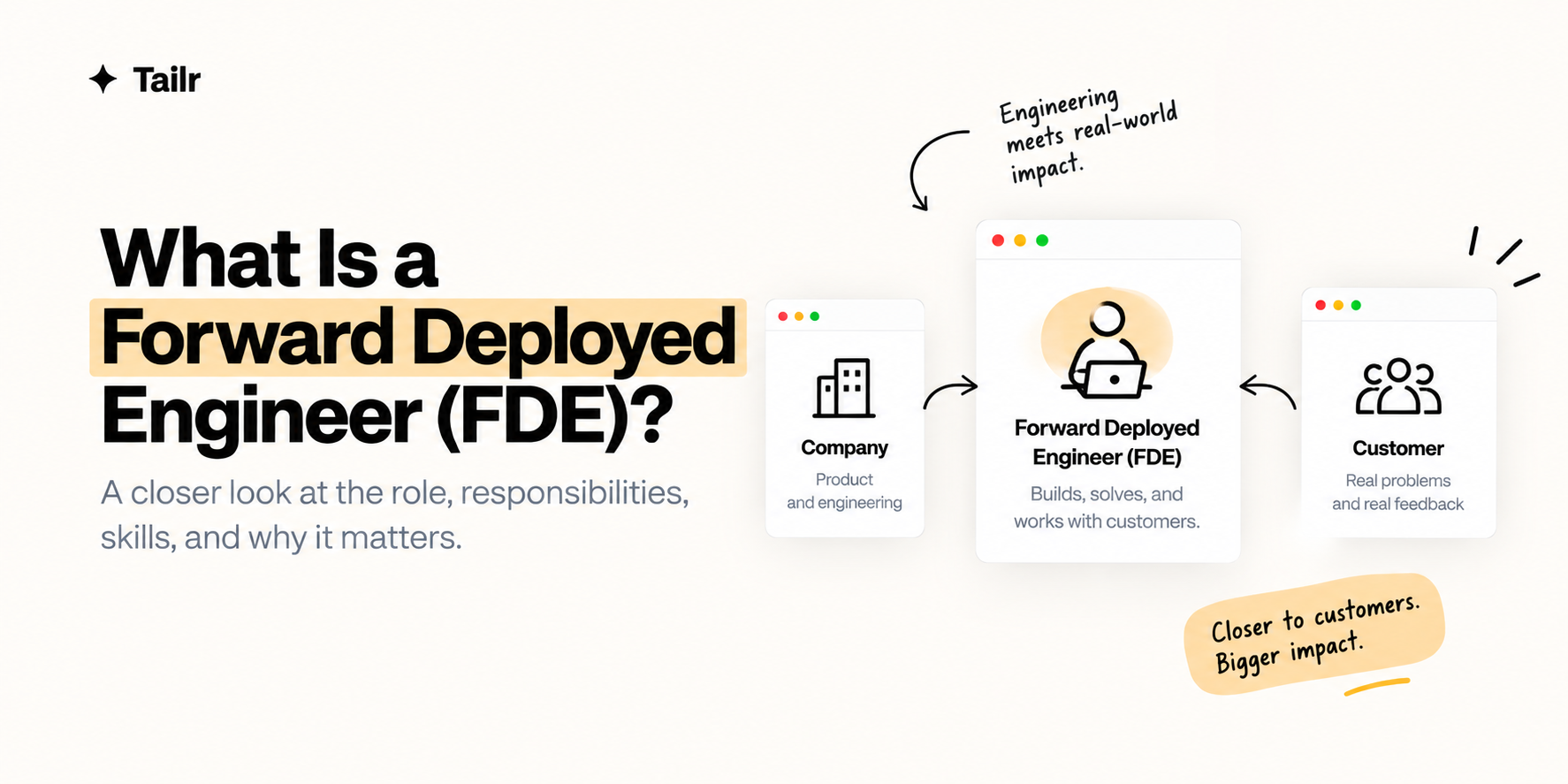
The short answer: a forward deployed engineer (FDE) is a software engineer who works directly with a customer, often inside the customer’s own systems, to get a company’s product deployed and delivering results. FDEs scope the problem with the customer, write the integrations and custom code needed to make the product work in that environment, ship it to production, and send what they learn back to the core product team. The title was popularised by Palantir and has spread quickly since 2024 as AI companies found that selling a model is easy and getting it working inside a customer’s business is not.
Where the role came from
The phrase “forward deployed” is military language. A forward deployed unit is stationed close to where the action is, rather than back at base. Palantir borrowed the term for engineers who spent their weeks at the customer’s office instead of at headquarters.
Palantir’s early customers were intelligence agencies and militaries. Those organisations don’t hand over their problems in a tidy spec. Trust has to be earned in person, and the real problem is usually different from the one in the contract. So Palantir sent engineers on site, and split its engineering org in two: product developers who build one capability for many customers, and forward deployed engineers who build many capabilities for one customer. Internally the FDEs were called “Deltas” and the product engineers “Devs”. A third role, “Echo”, sat alongside the Deltas as a deployment strategist who understood the customer’s industry.
That model stayed a Palantir quirk for over a decade. Then large language models arrived, and every company selling AI hit the same wall Palantir had hit: the product only creates value once it’s wired into the customer’s data, workflows, and permissions. So they copied the playbook.
What a forward deployed engineer actually does
Job descriptions for FDE roles are vague on purpose, because the work changes with each customer. But most weeks contain the same four kinds of task.
Discovery. You sit with the customer’s team, ask what they’re trying to achieve, and work out what’s actually blocking them. Often the stated goal (“we want an AI assistant for support”) hides the real one (“our support data lives in four systems that don’t talk to each other”). You’re expected to find that out yourself rather than wait for a product manager.
Building. You write real code: connectors to the customer’s databases and internal APIs, data pipelines, evaluation harnesses, custom prompts, small front ends. At an AI company this might mean setting up a retrieval pipeline over the customer’s documents, building an agent that calls their internal tools, and writing the tests that prove it works.
Deploying. You get the thing into production in the customer’s environment, which might be their cloud account, a private network, or a locked-down on-premise server. That involves security reviews, identity and access setup, monitoring, and a fair amount of patience.
Feeding back. You’re the person who knows exactly why the product didn’t fit. That knowledge goes back to the core engineering team as bug reports, feature requests, and sometimes pull requests. Good FDE teams shape the product roadmap more than any survey does.
The mix shifts over a deployment. Early weeks are heavy on discovery and meetings. The middle is mostly building. The end is deployment, handover, and writing up what should change in the product.
FDE vs software engineer vs solutions engineer vs consultant
The FDE title sits between several existing roles, and the differences matter when you’re deciding whether to apply.
| Role | Writes production code | Customer-facing | When they work | Sales quota |
|---|---|---|---|---|
| Forward deployed engineer | Yes, in the customer’s environment | Yes, daily | After the sale | No |
| Software engineer | Yes, in the core product | Rarely | Throughout | No |
| Solutions engineer / sales engineer | Demos and proofs of concept | Yes | Before the sale | Usually |
| Consultant / professional services | Sometimes, often config rather than code | Yes | After the sale | Sometimes (billable hours) |
The two that get confused most often are FDE and solutions engineer. A solutions engineer’s job ends when the deal closes. An FDE’s job starts there. And one analysis of around 1,000 FDE postings found that none of them carried a sales quota, which is the clearest sign that this is an engineering role with customer exposure, not a sales role with technical flavour.
Compared with a standard software engineer, the FDE gives up some depth (you rarely spend six months on one subsystem) in exchange for breadth, ownership, and a direct line to whether the work mattered.
Why the role is growing so fast
Indeed’s data, reported in 2026, showed FDE job postings rising from around 640 in April 2025 to over 5,300 in April 2026. That’s more than a sevenfold increase in a year, which is why it keeps getting called the hottest job in AI.
The reason is simple. AI products are unusually hard to deploy. A model that works in a demo can fail on a customer’s messy data, hit their compliance rules, or need access to systems that nobody has documented. Customers paying six or seven figures a year don’t want to figure that out themselves. So the vendor sends an engineer. Amazon Web Services announced a $1 billion investment in 2026 in a unit built around exactly this idea: embedding engineers with customers to get AI projects over the line.
There’s a business logic too. An FDE who gets one customer to a successful deployment turns a trial into a renewal, and what they build often becomes a product feature that every other customer gets.
Who hires forward deployed engineers
In 2026 the role shows up at roughly four kinds of company:
- AI labs and AI-first companies: OpenAI, Anthropic, Scale AI, Cohere, ElevenLabs, Sierra, Harvey, Cognition, xAI.
- Data and infrastructure platforms: Palantir (as FDSE), Databricks, Snowflake.
- Larger software companies with enterprise customers: Salesforce, Adobe, Stripe, Ramp, Rippling, Amazon Web Services, Google Cloud.
- Consulting and professional services firms that have added FDE-style titles for AI work: EY, PwC, McKinsey.
Startups that sell to enterprises, even small ones, are increasingly hiring one or two FDEs as their first customer-facing engineers. If that’s the kind of company you want, our guide to the best websites for startup jobs covers where those roles get posted.
Skills and background that get you hired
Looking across FDE postings, the technical asks are fairly consistent:
- Python appears in roughly two thirds of postings, with TypeScript, Go, or Java as the usual second language.
- SQL you can actually use under pressure: joins, window functions, CTEs, and reading someone else’s schema.
- APIs and integration work: REST, webhooks, auth flows, and connecting systems that were never designed to talk to each other.
- Cloud basics on AWS, GCP, or Azure, including networking and identity, because you’ll be deploying into the customer’s account.
- AI application skills for AI-company roles: retrieval pipelines, agents, prompt design, and evaluation.
The non-technical side matters just as much, and it’s what most rejected candidates are missing:
- Scoping before solving. Interviewers watch whether you ask what “better” means before you propose a system.
- Ownership language. Saying “I scoped, built, and shipped” rather than “we worked on”.
- Comfort with ambiguity. You’ll often be handed a goal, not a spec.
- Communicating with non-engineers. You’ll explain trade-offs to operations managers and lawyers, not just other developers.
The most common backgrounds are early-stage startup engineers who’ve shipped end to end, solutions architects who actually write code, and data engineers with production deployment experience. Most companies want two to four years of experience, though Salesforce and some startups have associate-level FDE roles.
What forward deployed engineers earn
Pay varies more than for a standard engineering role, because the title covers everything from a Big Four consultancy to an AI lab.
- A Bloomberry analysis of FDE postings put the median advertised base at around $174,000, and Glassdoor’s average sits near $155,000.
- Entry-level offers typically run $140,000 to $220,000 base, usually with equity.
- Palantir FDSE compensation is commonly reported around $215,000 total, with a wide range either side.
- Mid-to-senior roles at AI labs are reported at $350,000 to $550,000 total, and staff-level roles higher still.
Roughly 70% of postings mention equity, which can matter more than base at a fast-growing company. Treat the numbers above as US figures for 2026; they’ll be lower elsewhere and they move quickly.
Is it the right job for you?
FDE work has real upsides: fast learning, a direct line from your code to a business outcome, and a career path that leads naturally to product management, founding a company, or leading a customer engineering team. Palantir’s FDE alumni have founded a striking number of startups for that reason.
It also has downsides that job descriptions gloss over:
- Travel and on-site time. Defence and consulting FDE roles can mean three or more days a week at the customer. AI lab roles are usually hybrid with occasional visits. Ask exactly what’s expected, because mismatched expectations are a common reason people leave.
- Time pressure. The customer has paid and wants results by a date. You’ll be solving problems in weeks that a product team might take a quarter over.
- Context switching. You might change customer, industry, and tech stack every few months.
- Less deep technical work. If what you love is spending a year making one system fast, this isn’t it.
If you’d rather build for many customers than one, a core product role is the better fit. If you get energy from seeing your work used by real people the week you ship it, FDE is worth a serious look.
How to tailor your resume for an FDE role
FDE hiring managers screen for one thing above all: evidence that you’ve owned something end to end, with a customer, and can show the result. A standard engineering resume usually buries that under a list of technologies.
Take a typical bullet:
Worked on the data integration team building pipelines for enterprise clients using Python and Airflow.
Now the same experience, rewritten for an FDE posting:
Scoped and built a Python and Airflow pipeline that unified three of a retail client’s order systems, working on site with their operations team; cut their daily reconciliation from four hours to twenty minutes.
Same job. But the second version answers every question an FDE screener has: did you talk to the customer, did you own it, did it ship, did it matter.
A few more rules that apply specifically to FDE applications:
- Replace “we” with “I” wherever it’s true. The team can be mentioned, but your part must be clear.
- Name the customer-facing moments explicitly: “ran weekly working sessions with the client’s finance team”.
- Put deployment details in: cloud, on-premise, security review, who signed off.
- End bullets on a number where you honestly can.
Every FDE listing weighs these things differently. One will lead with AI and evaluation; another with SQL and data pipelines; a third with security clearance and on-site work. That’s where Tailr helps: open the listing, and it rewrites your resume to bring forward the experience that matches that specific posting, then drafts a cover letter and keeps track of where you’ve applied. It works from what’s really on your resume, which matters here, because FDE interviews will dig into every claim. Our posts on tailoring your resume to a job description and tailoring without lying cover the method in more detail.
Related guides
- How to become a forward deployed engineer (FDE) in 2026
- Top tech jobs of 2026: the fastest-growing roles
Conclusion
A forward deployed engineer is a software engineer stationed with the customer: scoping the real problem, building and deploying the product in the customer’s environment, and sending what they learn back to the product team. The role started at Palantir, and AI companies have made it one of the fastest-growing engineering titles of 2026 because their products only pay off once they’re running inside a customer’s business.
If you like ownership, ambiguity, and seeing your code used immediately, it’s a strong path with pay to match. When you find a listing worth applying to, spend the time to make your resume read like an FDE’s: customer contact, end-to-end ownership, shipped results.
Try Tailr to tailor your resume to the next FDE listing you open.
Frequently asked questions
01What does a forward deployed engineer do?
A forward deployed engineer works inside a customer's environment to get a software product actually running there. That means scoping the problem with the customer, writing integrations and custom code, deploying to production, and feeding what they learn back to the core product team. It's a hands-on engineering job with a lot of direct customer contact.
02What does FDE stand for?
FDE stands for forward deployed engineer. Some companies, including Palantir, use FDSE for forward deployed software engineer. Both describe the same idea: an engineer stationed with the customer rather than back at headquarters.
03Is a forward deployed engineer the same as a solutions engineer?
No. A solutions engineer usually works before the sale, building demos and proofs of concept to help close a deal, and is often tied to a sales quota. A forward deployed engineer works after the sale, owns production code in the customer's environment, and has no quota. There's overlap, but the FDE is much closer to a software engineering role.
04How much does a forward deployed engineer make?
In the US, a typical base salary in 2026 job postings sits around $150,000 to $175,000, with entry-level offers roughly $140,000 to $220,000 base plus equity. Senior FDEs at AI labs can earn total compensation well above $350,000. Pay varies a lot by company, location, and how much travel the role involves.
05Do you need a computer science degree to become a forward deployed engineer?
No. Companies hire for demonstrated ability to ship production software and work directly with customers, not for a specific degree. Engineers coming from early-stage startups, hands-on solutions architects, and data engineers with deployment experience are all common backgrounds.
06Which companies hire forward deployed engineers?
Palantir made the role famous and still hires FDSEs. In 2026 the biggest hirers are AI companies such as OpenAI, Anthropic, Scale AI, and ElevenLabs, data platforms such as Databricks and Snowflake, and larger software companies including Salesforce, Stripe, and Amazon Web Services. Many startups selling to enterprises now have a small FDE team too.