Top Tech Jobs of 2026: The Fastest-Growing Roles and What They Pay
· updated
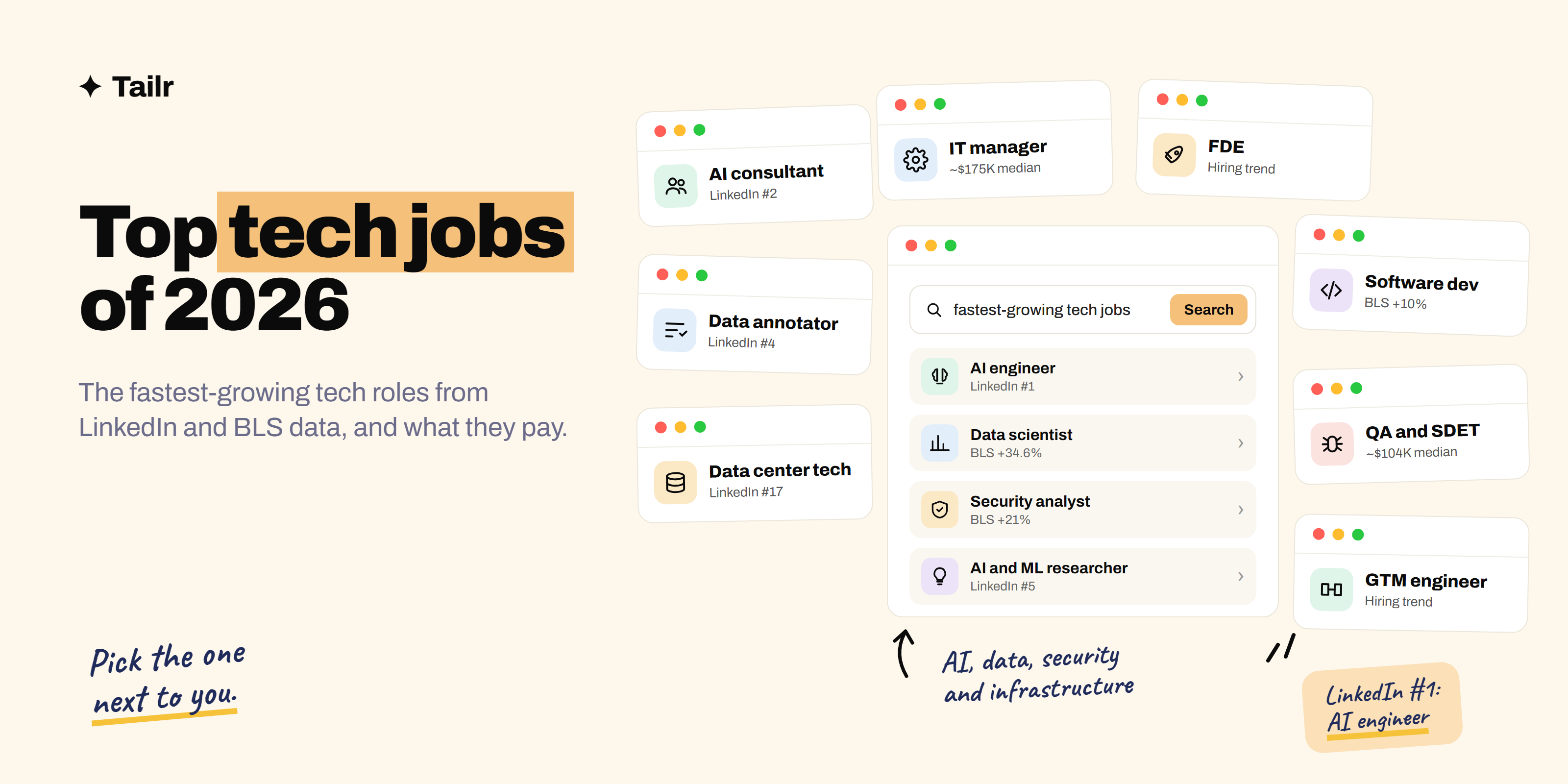
Every year brings a new batch of “hottest tech jobs” lists, most of them guesses. This one sticks to two sources that measure real data: LinkedIn’s Jobs on the Rise 2026 list, which ranks US job titles by how fast hiring grew between January 2023 and July 2025, and the US Bureau of Labor Statistics (BLS) projections for 2025 to 2035, which also publish median pay. We’ve pulled out the tech roles from both, and added two engineering titles that are growing fast in job postings but aren’t tracked yet.
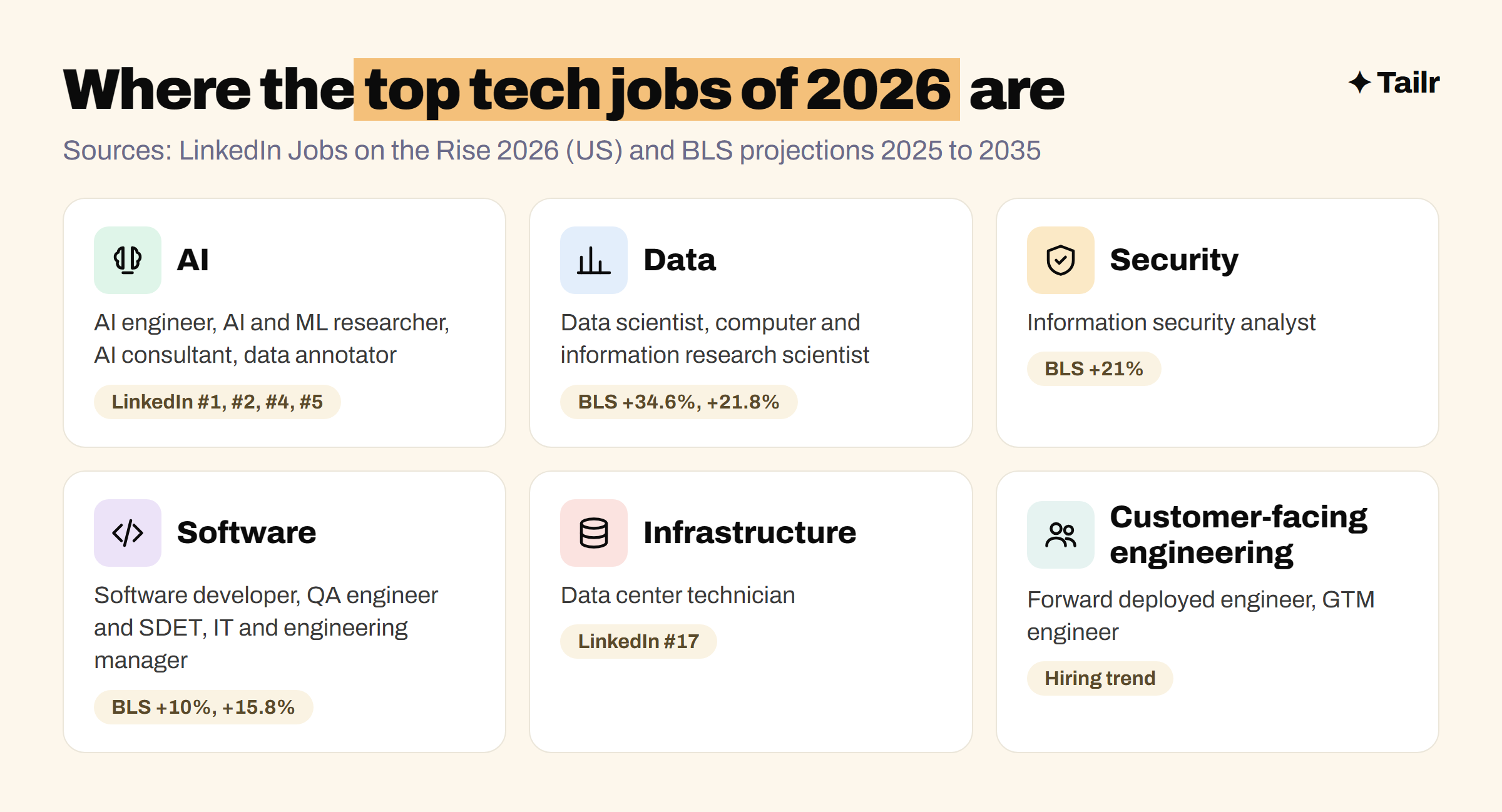
The short answer: the top tech jobs of 2026 are:
- AI engineer
- AI and machine learning researcher
- AI consultant and strategist
- Data scientist
- Information security analyst
- Data annotator and AI trainer
- Data center technician
- Software developer
- QA engineer and SDET
- IT and engineering manager (computer and information systems manager)
- Forward deployed engineer (a hiring trend, not on the official lists yet)
- GTM engineer (a hiring trend, not on the official lists yet)
AI roles lead the growth, data and security pay well and keep growing, and AI’s hardware needs are creating hands-on jobs in data centers.
What’s driving tech hiring in 2026
Four forces explain almost every role on this list:
- AI moving into real products. Companies need people to build AI systems, research better models, advise on where to use them and label the data they learn from.
- Data everywhere. Every AI system and every business decision depends on clean, analysed data.
- Security. More software, more data and more AI means more to protect.
- Infrastructure. Every model runs in a data center, and new ones are being built fast.
1. AI engineer
Source: number 1 on LinkedIn’s Jobs on the Rise 2026.
AI engineers build products on top of large language models and other machine learning models: retrieval systems, agents, evaluation pipelines and the plumbing that connects models to real data. Most come from software engineering rather than research. Pay usually tracks or beats senior software engineering; the BLS median for software developers is about $136,000.
Best for: software engineers ready to specialise. Start with what an AI engineer does and how to get started with AI engineering, and prepare with AI engineer interview questions.
2. AI and machine learning researcher
Source: number 5 on LinkedIn’s list. The closest BLS category, computer and information research scientists, is projected to grow about 21.8% with a median of about $140,000.
Researchers design and train new models, improve how they reason and run experiments that product teams later build on. Most roles ask for a graduate degree or a strong publication or open-source record.
Best for: people with deep maths and machine learning skills who like open research problems.
3. AI consultant and strategist
Source: number 2 on LinkedIn’s list.
These people help companies decide where AI is worth using, choose tools, run pilots and change how teams work. It suits consultants, product managers and operations people who understand a business deeply and can learn the technology well enough to advise on it.
Best for: consultants, PMs and ops leaders who like both the business and the tech.
4. Data scientist
Source: BLS projects about 34.6% growth from 2025 to 2035, the fastest of any tech occupation it tracks, with a median wage of about $120,000.
Data scientists build models and analyses that drive decisions: forecasting, experimentation, recommendation and risk. Not sure which data role fits you? Read data analyst vs data scientist vs data engineer, and brush up with SQL interview questions.
Best for: people with statistics, Python and SQL who like open-ended problems.
5. Information security analyst
Source: BLS projects about 21% growth, median about $129,000.
Security analysts monitor systems, investigate incidents, run vulnerability scans and harden infrastructure. Demand is steady across every industry, and many people move in from IT support or networking with a certification.
Best for: IT and systems people who like investigation.
6. Data annotator and AI trainer
Source: number 4 on LinkedIn’s list.
Annotators label text, images, audio and model outputs so AI systems can learn and be evaluated. Entry-level work is often contract-based, but specialist annotation for coding, maths, law and medicine pays far better and is growing fast.
Best for: people with domain expertise who want flexible, often remote work, and a way into AI without an engineering background.
7. Data center technician
Source: number 17 on LinkedIn’s list.
Technicians install, maintain and repair the servers, networking and power systems inside data centers. AI has set off a wave of new data center construction, and many roles need hardware skills and certifications rather than a degree.
Best for: hands-on people with IT or electrical skills.
8. Software developer
Source: BLS projects about 10% growth for software developers, QA analysts and testers from 2025 to 2035, much faster than average, with a median of about $136,000 for developers.
Software development isn’t on LinkedIn’s fastest-growing list because it’s already huge, but it’s still one of the largest sources of new tech jobs. Generalist entry-level roles are more competitive than they were, so pairing development skills with AI, data, security or a specific industry helps a lot.
Best for: anyone who enjoys building. See how to ace your technical interview.
9. QA engineer and SDET
Source: part of the same BLS group as software developers (about 10% growth), with a median of about $104,000 for QA analysts and testers.
Testing has shifted toward automation and toward testing AI features, which behave less predictably than ordinary code. SDETs who can build frameworks and test AI outputs are in particular demand. Compare the two paths in QA engineer vs SDET, then prepare with SDET interview questions.
Best for: detail-oriented people who like breaking things on purpose.
10. IT and engineering manager
Source: BLS projects about 15.8% growth for computer and information systems managers, with a median of about $175,000, the highest-paid role on its fastest-growing list.
These managers plan and run technology for an organisation or lead engineering teams. It’s a destination role, usually reached after several years as an engineer, analyst or security specialist.
Best for: experienced technologists ready to lead teams.
11. Forward deployed engineer
Source: not yet tracked by LinkedIn’s list or the BLS, but one of the most visible new engineering titles in AI company hiring.
Forward deployed engineers work directly with customers to get a product working in their systems. Read what a forward deployed engineer is and how to become one.
Best for: engineers who enjoy customers as much as code.
12. GTM engineer
Source: not yet tracked by LinkedIn’s list or the BLS, but increasingly common in startup and B2B software hiring.
GTM engineers build the automations, data pipelines and tools a sales and marketing team runs on. It’s a good bridge for technical people who like revenue work. Read what a GTM engineer is and GTM interview questions.
Best for: technical people who want to work close to sales and growth.
Comparison table
| Job | Growth signal | US median pay | CS degree usually needed |
|---|---|---|---|
| AI engineer | LinkedIn #1 | Not tracked separately | Often, or equivalent experience |
| AI and ML researcher | LinkedIn #5, BLS +21.8% | ~$140,000 | Usually, often graduate |
| AI consultant | LinkedIn #2 | Varies widely | No, but technical fluency |
| Data scientist | BLS +34.6% | ~$120,000 | Usually a quantitative degree |
| Information security analyst | BLS +21% | ~$129,000 | Often, certifications count |
| Data annotator | LinkedIn #4 | Varies widely | No |
| Data center technician | LinkedIn #17 | Varies | No |
| Software developer | BLS +10% | ~$136,000 | Often, or equivalent experience |
| QA engineer and SDET | BLS +10% | ~$104,000 | No for QA, often for SDET |
| IT and engineering manager | BLS +15.8% | ~$175,000 | Usually |
| Forward deployed engineer | Hiring trend | High, varies | Often |
| GTM engineer | Hiring trend | Varies | No |
How to use this list
A growing job isn’t automatically the right job for you. Pick from this list using three questions:
- What’s adjacent to what I do now? The fastest switches are one step over: IT support to security analyst, analyst to data scientist, backend engineer to AI engineer, manual tester to SDET.
- What can I prove in three months? One course plus two real projects beats a long certificate you haven’t finished.
- Do the listings match? Read 20 job posts for the role and count which skills repeat. That’s your learning plan.
Then apply in a focused way. When a listing asks for specific tools and outcomes, your resume should show them clearly, without inventing anything. Tailr is a Chrome extension that tailors your resume to the job listing you’re viewing, writes a matching cover letter and tracks every application, which helps when you’re applying to a new kind of role. If you’re coming from outside tech, read how to switch careers into tech and our list of non-coding jobs in tech.
Try TailrConclusion
The top tech jobs of 2026 cluster around AI, data, security and the infrastructure behind it all. AI engineers top LinkedIn’s growth list, data scientists top the BLS tech projections, IT managers earn the most, and roles like data center technician and data annotator offer ways in without a CS degree. Pick the one closest to what you already do, build proof of the core skills, and tailor every application to the listing in front of you.
Frequently asked questions
01What are the top tech jobs of 2026?
Based on LinkedIn's Jobs on the Rise 2026 list and US Bureau of Labor Statistics projections, the top tech jobs are AI engineer, AI and machine learning researcher, AI consultant, data scientist, information security analyst, data annotator, data center technician, software developer, QA engineer and SDET, and IT manager, with forward deployed and GTM engineers growing fast in hiring.
02What is the fastest-growing tech job in 2026?
Artificial intelligence engineer is number one on LinkedIn's Jobs on the Rise 2026 list for the US. In the US Bureau of Labor Statistics projections for 2025 to 2035, data scientist is the fastest-growing tech occupation, at about 34.6%.
03Which tech jobs pay the most in 2026?
Among the roles the BLS tracks, computer and information systems managers have the highest median pay at about $175,000, followed by computer and information research scientists at about $140,000, software developers at about $136,000 and information security analysts at about $129,000. AI engineers and AI researchers often earn more, but the BLS doesn't track them separately.
04Are software developer jobs still growing in 2026?
Yes. The BLS projects software developer, QA analyst and tester jobs to grow about 10% from 2025 to 2035, much faster than the average for all jobs. Entry-level competition is tougher than a few years ago, so specialising in AI, data, security or a specific domain helps.
05Which tech jobs don't need a computer science degree?
Data center technicians, data annotators, QA testers, information security analysts who come up through IT support, and GTM engineers are commonly hired without a CS degree. Certifications, hands-on projects and a portfolio of real work matter more for these roles.
06How can I move into one of the top tech jobs of 2026?
Pick the role closest to what you do now, learn its core skills with one focused course, build two or three projects that prove them, and tailor your resume to each listing using its exact keywords. Adjacent moves are fastest, such as backend engineer to AI engineer, analyst to data scientist, or IT support to security analyst.