What Is a GTM Engineer? Role, Skills, Salary and How to Get In
· updated
“GTM engineer” is one of the fastest-growing job titles in B2B software, and one of the least clearly defined. Some listings describe a sales ops person who can use Zapier. Others describe a backend engineer who happens to work on the CRM. The real job sits between those, and it’s worth understanding precisely, because it’s one of the few new roles that’s both well-paid and reachable from a non-engineering background.
The short answer: A go-to-market (GTM) engineer builds and operates the technical systems a company’s sales and marketing teams run on:
- The CRM and everything wired to it.
- Data enrichment.
- Lead scoring and routing.
- Outbound automation.
- The analytics that show what’s working.
They write code, connect APIs, and ship internal tools, so the revenue team can run plays faster and at a scale that used to need a full ops department. The role emerged around 2023 to 2024 as tools like Clay and LLM APIs made it possible for one technical person to do what previously took a team, and it’s now a standard hire at B2B SaaS companies with an outbound or product-led motion.
Where the role came from
For most of the 2010s, the technical side of sales and marketing was split three ways: marketing ops ran the automation platform, sales ops ran the CRM, and an occasional engineer got borrowed to build an integration. Nobody owned the whole system, and every “can we route leads from the webinar tool to the right rep based on company size” request took a quarter.
Two things changed. First, the tooling got programmable: enrichment platforms like Clay, workflow tools like n8n and Make, and every SaaS product shipping a decent API meant that a person with SQL and a scripting language could build what used to need a vendor. Second, LLM APIs made it cheap to do things at scale that had needed humans: researching an account, writing a first-line personalisation, classifying an inbound lead, summarising a call.
Companies noticed that one technical person sitting inside the revenue team could remove months of backlog. The title “GTM engineer” stuck because it described the job honestly: engineering, applied to go-to-market.
What a GTM engineer actually does
The work varies by company stage, but a typical week includes most of these:
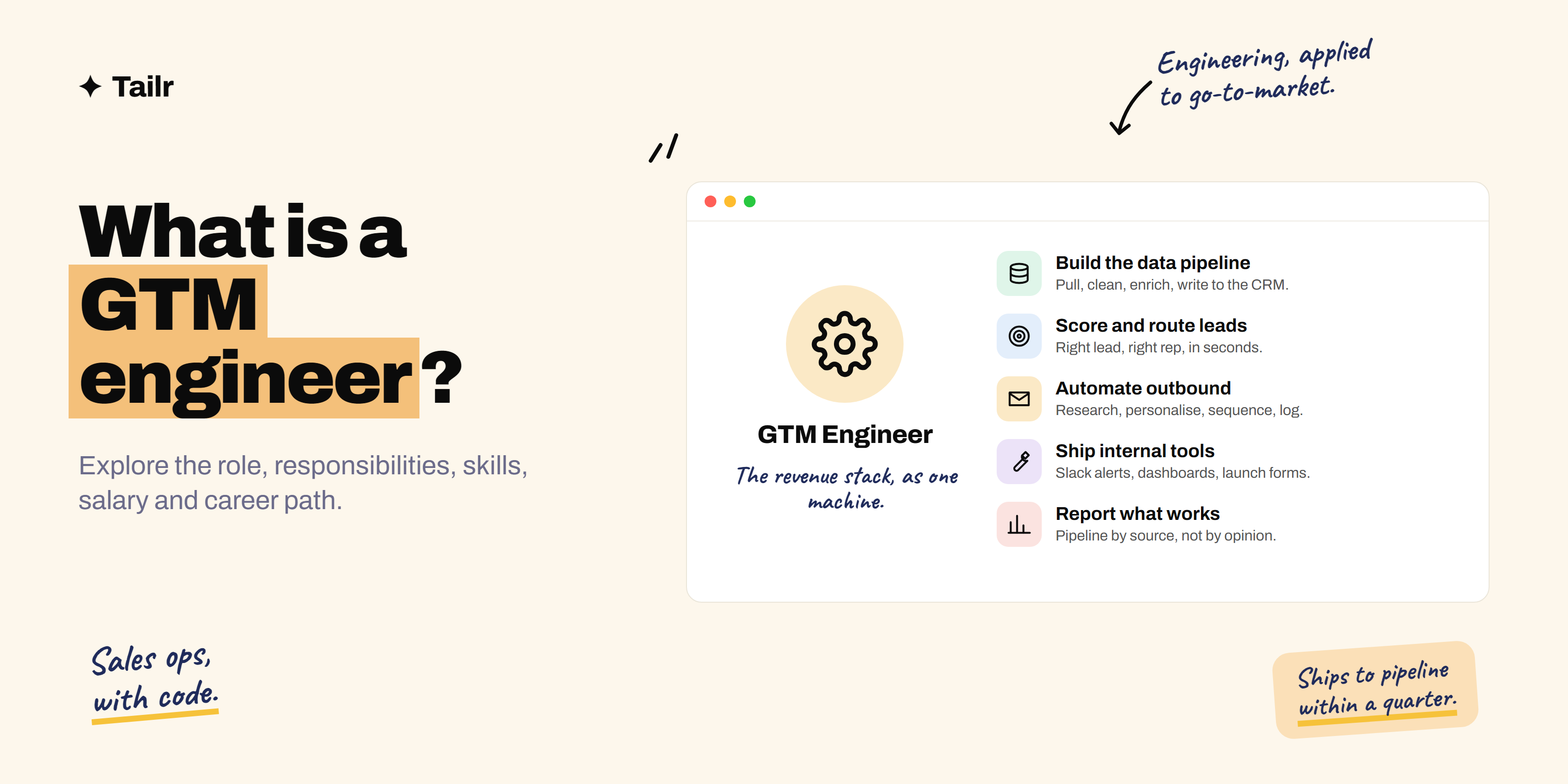
- Building and maintaining the data pipeline. Pulling accounts and contacts from sources (product usage, enrichment vendors, intent data, the website), cleaning and deduplicating them, and writing them into the CRM with the right fields. This is where SQL and Python live.
- Enrichment and scoring. Deciding what data a lead needs before a rep sees it (company size, tech stack, funding, hiring signals) and automating the lookup. Building or tuning a scoring model, often simple rules plus an LLM classifier.
- Routing and assignment. Rules that send the right lead to the right rep in seconds: territory, segment, round-robin, account ownership. Sounds simple; it’s where most revenue teams’ data problems surface.
- Outbound automation. Building sequences in tools like Outreach, Salesloft, Apollo or Instantly, and the personalisation pipeline that feeds them: research an account, generate a relevant first line, push to the sequence, log the result.
- Internal tools. A Slack bot that alerts a rep when a target account visits the pricing page. A dashboard that shows which sequences are converting. A form that lets marketing launch a campaign without filing a ticket.
- Integrations. Keeping the CRM, marketing automation, product analytics, billing, and support tools in sync. Deciding which tool is the source of truth for which field.
- Reporting. Answering “what’s actually working” with data rather than opinion: pipeline by source, conversion by segment, rep activity, sequence performance.
- Tool selection and consolidation. Evaluating vendors, retiring tools nobody uses, and making sure a change in one place doesn’t break three others.
What they usually don’t do: carry a quota, run forecasting meetings, design compensation plans, or write customer-facing product code. Those belong to sales, RevOps and product engineering.
GTM engineer vs. RevOps vs. sales engineer vs. growth engineer
| Role | Owns | Writes code? | Reports into |
|---|---|---|---|
| GTM engineer | Automations, integrations, data pipelines, internal tools for the revenue team | Yes, regularly | RevOps, growth or marketing |
| Revenue operations | Process, forecasting, territories, CRM as system of record, comp plans | Rarely; configures tools | Sales or finance leadership |
| Sales engineer | Technical side of individual deals: demos, POCs, security questionnaires | Sometimes, for demos | Sales |
| Growth engineer | Product-side experiments: onboarding, activation, pricing pages, A/B tests | Yes, product code | Product or growth |
| Marketing ops | Marketing automation platform, campaign execution, attribution | Rarely | Marketing |
The cleanest line: a GTM engineer is what you hire when RevOps has a backlog of things that need code and product engineering won’t prioritise them. If you want the sales-facing technical role instead, what does a sales engineer do covers it.
Why the role is growing
- AI made the work possible. Personalised outbound at scale, account research, inbound classification: all of these were either manual or impossible three years ago. Someone has to build and maintain the pipelines, and that person needs to understand both the tools and the sales process.
- Sales teams got leaner. Companies replaced headcount with systems, and systems need an owner.
- The tool stack got bigger. A mid-sized B2B company runs 15 to 30 revenue tools. Keeping them consistent is a real engineering problem.
- It pays for itself visibly. A GTM engineer who cuts lead response time from a day to a minute, or lifts reply rates on outbound by a few points, shows up in pipeline within a quarter. Few roles have that short a feedback loop.
Who hires GTM engineers
- B2B SaaS from Series A onward, particularly companies with an outbound sales motion, a product-led funnel that generates lots of signups, or both. This is the bulk of listings.
- Fintech, developer tools, and infrastructure companies, where the buyers are technical and personalisation needs real research.
- Agencies and consultancies that build outbound systems for clients, which are a good entry point because you see many stacks fast.
- Late-stage and public companies are starting to create the role inside larger RevOps teams, usually with a more integration-heavy remit.
Titles you’ll see for essentially the same job: GTM engineer, go-to-market engineer, revenue engineer, RevOps engineer, sales systems engineer, growth operations engineer, and occasionally “AI GTM engineer”.
Skills and background that get you hired
Job listings for the role mention APIs, SQL and Python most often, in roughly that order. The full picture:
Technical
- APIs and webhooks: reading docs, authenticating, handling pagination and rate limits, and debugging when a sync silently stops.
- SQL, well enough to join product usage data to CRM data and answer a question nobody’s asked before.
- A scripting language, usually Python or JavaScript, for anything the no-code tools can’t do.
- Workflow and enrichment platforms: Clay is the one most listings name; n8n, Make and Zapier for orchestration.
- A CRM at admin level: HubSpot or Salesforce, including objects, workflows, and the data model.
- LLM APIs: prompt design for classification and personalisation, and evaluation so you know when the output is bad.
- Enough data engineering to build something that runs every day without you: scheduling, logging, alerting, idempotency.
Commercial
- How a sales funnel works, what a rep actually does all day, and what makes a lead worth their time.
- The vocabulary: ICP, MQL, SQL (the other one), pipeline, ACV, sequence, cadence, attribution.
- The judgement to know which automation will move a number and which is a toy.
Background that works
- Sales or marketing ops who taught themselves to code. The most common path, and the one where the commercial judgement is already there.
- Software engineers who worked on internal tools, integrations or data pipelines and want a shorter feedback loop and more ownership.
- Growth or analytics people who’ve built experiments and dashboards and want to own the systems behind them.
- Founders and early employees of small startups who did everything, including the CRM.
What GTM engineers earn
Compensation is still settling because the role is new, but the range is clear enough to plan around.
- United States: mid-level base salaries cluster around $130,000 to $180,000, with senior and staff roles at $170,000 to $200,000+ base and total compensation higher at well-funded startups. Listings that emphasise AI and automation skills tend to sit at the upper end.
- Europe and UK: roughly £60,000 to £110,000 base depending on stage and seniority, with London and remote-US-company roles higher.
- India: the role is newer. Listings pay in the range of a senior RevOps or growth engineer, roughly 15 to 40 lakhs, with startups funded from the US at the top of that range and above.
Two things push pay up: a track record of pipeline impact you can quantify, and real engineering depth (you can build a service, not just a workflow). Two things hold it down: a title that’s really marketing ops with a Zapier account, and a company that hasn’t decided what it wants the role for.
Is it the right job for you?
It suits you if:
- You like building things that get used the same week.
- You’re happy being the only technical person in a room of salespeople, and translating in both directions.
- You’d rather own a system end to end than be one of forty engineers on a product.
- You find a messy CRM interesting rather than depressing.
It doesn’t suit you if:
- You want to work on the product customers see.
- You need a well-defined spec before starting; most of the work begins as “the reps keep complaining about X”.
- You dislike being measured on a business number you don’t fully control.
- You want a big engineering team around you for mentoring and code review.
How to get in
- Build two or three real systems and document them. A lead enrichment pipeline that pulls from a source, enriches with an API, scores, and writes to a CRM. An outbound sequence with LLM-generated personalisation and a feedback loop on replies. A routing rule set with tests. Put them on GitHub with a README that explains the business outcome, not just the code.
- Learn Clay properly. It’s the tool most listings name and it’s the fastest way to show you can build enrichment workflows. Their free tier is enough to learn on.
- Get admin-level on one CRM. HubSpot’s certifications are free; Salesforce’s Trailhead is free. Either is enough to talk credibly about objects, workflows and data quality.
- Get SQL and Python to a working level if they aren’t already: joins, aggregation, a script that calls an API and writes a CSV.
- Find the listings. Search for the title and its variants (revenue engineer, RevOps engineer, sales systems engineer). Startup job boards carry most of them; best websites for startup jobs covers where to look.
- Tailor the resume to each listing. GTM engineer listings vary a lot: some are Clay-and-outbound heavy, some are Salesforce-integration heavy, some want a data engineer who understands sales. Read each one and lead with what it names; Tailr does this from the listing you’re viewing.
How to tailor your resume for a GTM engineer role
The listing tells you which version of the role the company wants. If it names Clay, Instantly and personalisation, lead with outbound automation work. If it names Salesforce, integrations and data quality, lead with pipeline and CRM work. If it names SQL, dashboards and attribution, lead with analytics.
Whatever the flavour, quantify the business outcome of every system you built: “cut lead response time from 18 hours to 4 minutes”, “lifted outbound reply rate from 2% to 5% with LLM personalisation”, “consolidated 6 tools into 2, saving $40k a year”. Systems without outcomes read as hobby projects.
Tailr does this from the job listing itself: it tailors your resume to the specific GTM engineer role you’re viewing, so the tools and outcomes that listing cares about are the ones your resume leads with, and generates the cover letter to match. How to tailor your resume to a job description walks through the method. Try Tailr on the next GTM engineer listing you find.
Related guides
Conclusion
A GTM engineer is the technical owner of a company’s revenue systems: the person who makes the CRM, the enrichment, the routing, the outbound and the reporting work as one machine, with code where the tools run out. The role exists because AI and programmable tooling made it possible for one person to do what took a team, and it pays well because the impact shows up in pipeline within a quarter. If you’re in sales ops, growth or engineering and you like building things that get used immediately, it’s one of the most reachable well-paid roles in B2B software right now. Build a few real systems, learn the tools the listings name, and tailor the resume to each one.
Frequently asked questions
01What does a GTM engineer do?
A go-to-market engineer builds and runs the systems a sales and marketing team depends on: the CRM and the tools around it, data enrichment, lead routing, outbound automation, and the reporting that shows what's working. They write code, wire APIs together, and ship internal tools, so the revenue team can run plays that used to need a whole ops team or weren't possible at all.
02Is a GTM engineer the same as revenue operations?
No, though they sit next to each other. RevOps owns process, forecasting, territory design and the CRM as a system of record. A GTM engineer is more technical: they build the automations, integrations and internal tools that RevOps and sales use, and they're expected to write code, not just configure tools. Many GTM engineers report into RevOps or growth.
03What skills do you need to become a GTM engineer?
APIs and webhooks, SQL, a scripting language (usually Python or JavaScript), workflow tools like Clay, n8n, Zapier or Make, a CRM (HubSpot or Salesforce) at admin level, and enough understanding of sales and marketing to know which automations actually move pipeline. LLM APIs for enrichment and personalisation have become a standard part of the toolkit.
04How much does a GTM engineer earn?
In the US, base salaries in 2026 cluster around $130,000 to $180,000 for mid-level, with senior and staff roles at $170,000 to $200,000+ base and total compensation higher at well-funded startups. In India, the role is newer and pays in the range of a senior RevOps or growth engineer, roughly 15 to 40 lakhs depending on company stage. Job listings mention APIs, SQL and Python most often.
05Who hires GTM engineers?
Mostly B2B SaaS companies from Series A to late stage, especially ones with an outbound sales motion or a product-led funnel that needs data plumbing. The role appeared at companies like Clay's customers and early adopters of AI-driven outbound, and it's now common in listings from fintech, developer tools, and any company with a sizeable sales team and a lean ops function.
06How do I get a GTM engineer job with no direct experience?
Come from one of three directions: a sales or marketing ops role where you learned to build automations, a software engineering role where you worked on internal tools or integrations, or a growth role where you ran experiments with data. Build two or three real automations (a lead enrichment pipeline, an outbound sequence with personalisation, a routing rule set), document them, and tailor your resume to the systems the listing names.