GTM Interview Questions and Answers (Strategy, Metrics and Cases)
· updated
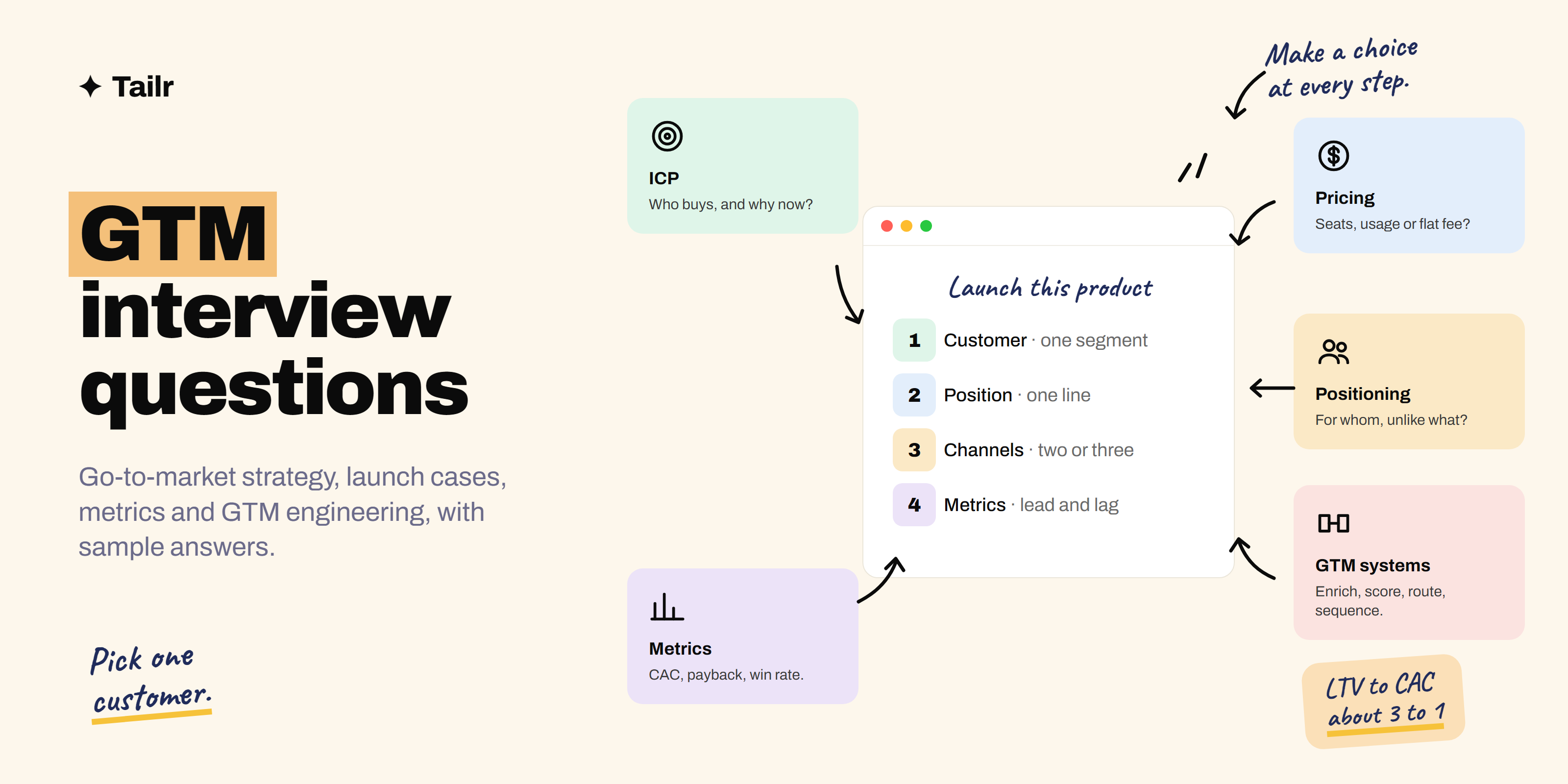
“How would you take this product to market?” It’s the question at the centre of interviews for product marketing, GTM strategy, revenue operations and the newer GTM engineer role. It sounds open-ended, and that’s the test: can you take a vague problem and turn it into a clear plan with choices and numbers? This guide covers the questions you’ll face, what a good answer sounds like, and a structure you can use for any GTM case.
The short answer: GTM interview questions fall into five groups:
- Fundamentals: what a GTM strategy is, ICPs, positioning, pricing.
- Launch cases: “how would you launch this product?” or “build a GTM plan for X”.
- Metrics: CAC, LTV, payback, pipeline, win rate, net revenue retention.
- Systems and tools: CRM, lead routing, automation (especially for GTM engineers).
- Behavioural: past launches, cross-team work, a launch that missed.
The best answers make a clear choice at every step and tie it back to revenue.
What interviewers are looking for
Whatever the title, GTM interviewers want to see that you can:
- Pick a customer. Not “everyone”, one specific segment with a painful problem.
- Explain why they’d buy. A crisp value proposition in their language.
- Choose how to reach them. Channels that match how that customer actually buys.
- Measure it. Know which numbers prove the plan is working.
- Work across teams. Sales, marketing, product and customer success all touch GTM.
Fundamentals questions
1. What is a go-to-market strategy?
“It’s the plan for how a product reaches its customers and turns into revenue: who exactly we’re selling to, the problem we solve for them, how we position against alternatives, how we price it, which channels we use to reach them, and how we’ll measure whether it’s working.”
2. How do you define an ideal customer profile (ICP)?
Start from data, not guesses: look at the best existing customers by retention, deal size and speed to close, and find what they have in common, such as industry, company size, tech stack and a trigger event like a new funding round. Then name the buyer and the user inside that company, who are often different people.
3. What’s the difference between positioning and messaging?
Positioning is the strategic choice: which category you compete in, for whom, and why you’re different. Messaging is how you say it on the website, in an ad or on a sales call. Positioning changes rarely; messaging gets tested and rewritten all the time.
4. When would you choose product-led growth over sales-led?
Product-led works when the product is easy to try alone, the price is low enough to buy without approval, and value shows up quickly. Sales-led fits complex, expensive products with several decision-makers. Many companies run both: self-serve for small teams, sales for large accounts. Our explainer on B2B vs B2C vs D2C covers how the buyer changes the motion.
5. How would you price a new product?
Mention three inputs: the value to the customer (what problem it saves them money or time on), competitor and alternative prices, and your costs. Then talk packaging: what goes in each tier and which metric you charge on, such as seats, usage or flat fee.
Launch case questions
6. How would you launch our product in a new market?
This is the core case. Use the structure below and narrate your choices out loud.
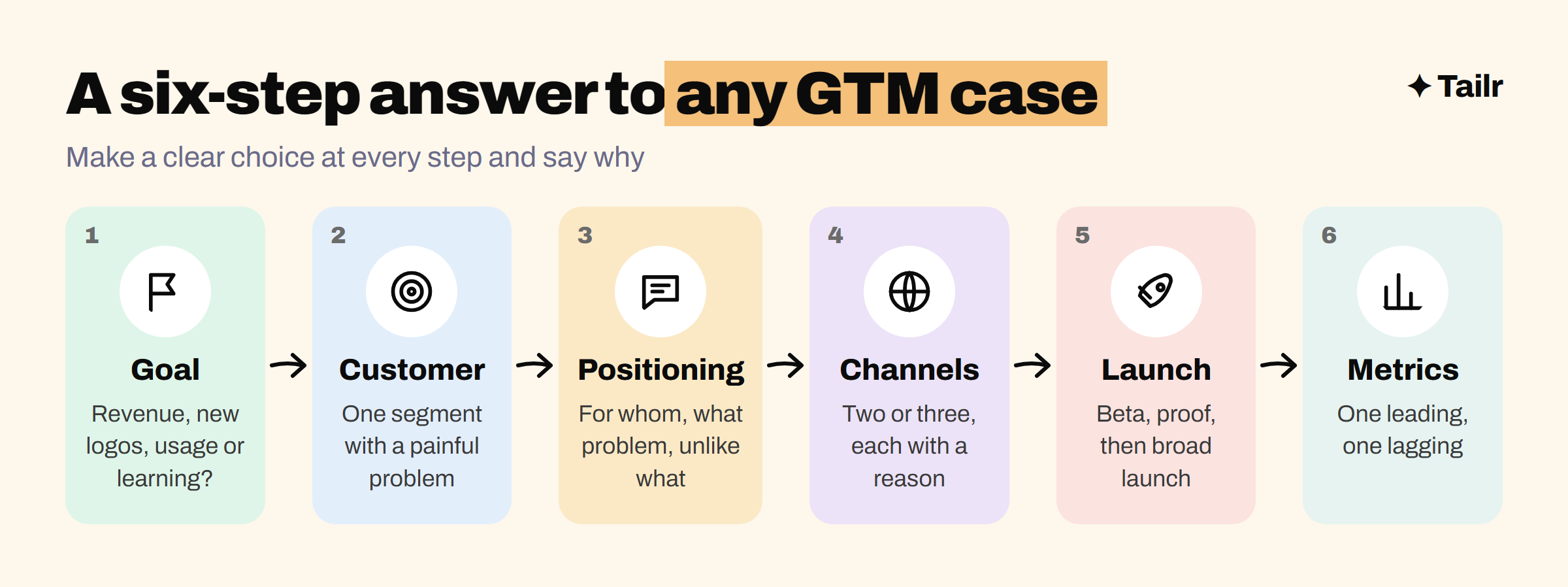
- Goal. Clarify what success means: revenue, new logos, usage, or learning.
- Target customer. Pick one segment and say why: biggest pain, easiest to reach, best fit.
- Positioning. One sentence: for [customer] who [problem], we’re the [category] that [key benefit], unlike [alternative].
- Channels. Two or three, each with a reason. Mid-market finance teams? Outbound plus partnerships with accounting firms, not TikTok.
- Launch plan. Beta customers first, then case studies, then broader launch. Include sales enablement: a one-pager, a demo script and objection handling.
- Metrics. Pick a leading metric (meetings booked, trial sign-ups) and a lagging one (new ARR, win rate).
7. A launch underperformed. How would you diagnose it?
Walk through the funnel: was it awareness (few people saw it), interest (people saw it but didn’t sign up), conversion (they tried it but didn’t buy) or retention (they bought and left)? Name the metric you’d check at each stage, then the most likely fix.
8. How would you enter a market where a strong competitor already exists?
Find the segment the leader serves badly. Maybe it’s too expensive for small teams, too complex for a specific industry, or missing a key integration. Win there first, collect proof, then expand.
Metrics questions
9. Explain CAC, LTV and payback period
- CAC (customer acquisition cost): total sales and marketing spend divided by new customers in the same period.
- LTV (lifetime value): average revenue per customer multiplied by gross margin, divided by churn rate.
- Payback period: months of gross profit from a customer needed to recover their CAC.
A commonly quoted rule of thumb for subscription businesses is an LTV to CAC ratio of about 3:1 and a payback under 12 to 18 months. Say it’s a guideline, not a law.
10. What metrics would you put on a GTM dashboard?
Pipeline created, pipeline coverage versus target, win rate, sales cycle length, average contract value, CAC payback and net revenue retention. For product-led motions, add sign-ups, activation rate and free-to-paid conversion. Our guide to product metrics like DAU, MAU, retention and churn covers the usage side.
11. Our win rate dropped from 25% to 18%. What would you look at?
Segment it: by rep, deal size, industry, lead source and competitor. A drop usually concentrates somewhere, such as a new competitor in enterprise deals, or a new lead source sending poor-fit leads. Then read lost-deal notes and talk to three reps before deciding.
GTM engineer and operations questions
These come up for GTM engineer, RevOps and sales ops roles.
12. How would you build an automated outbound workflow?
Describe the pipeline: pull target accounts that match the ICP, enrich them with firmographic and contact data (often in a tool like Clay), score them, write personalised first lines from a real signal such as a job post or funding round, push them into a sequencing tool, and log everything in the CRM. Then explain how you’d measure it: reply rate, meetings booked and pipeline created per 100 contacts.
13. How do you route inbound leads?
Score leads on fit and intent, assign by territory or account owner, and set a response-time target, since speed to lead strongly affects conversion. Mention how you’d stop duplicates and keep existing customers from being routed to new-business reps.
14. How do you keep CRM data clean?
Required fields at key stages, automated enrichment, duplicate rules, and a small number of picklists instead of free text. Then a monthly audit of the fields people actually report on.
Behavioural questions
15. Tell me about a launch you led
Use a clear story structure: the goal, your role, the decisions you made and the result. Our guide to interview answer frameworks covers the options.
16. Tell me about a time sales and marketing disagreed
Show you can find the shared goal (usually pipeline or revenue), bring data to the argument and agree a test rather than a winner.
17. Tell me about a launch that missed its target
Own it, explain what you learned, and show what you changed in the next launch.
How to prepare
- Learn the company’s GTM. Who they sell to, how (self-serve, sales-led or both), pricing, main competitors, recent launches.
- Do a practice case. Build a one-page GTM plan for their newest product.
- Know your metrics. Be able to define each one above and do the maths on the spot.
- Prepare three launch stories with numbers.
- Tailor your resume. Lead with launches, pipeline and revenue numbers, using the listing’s words: “ICP”, “pipeline”, “enablement”, “PLG”. Tailr does this from the job listing you’re viewing: it’s a Chrome extension that tailors your resume to the role, writes a cover letter and tracks your applications.
Related guides
Conclusion
GTM interviews reward structure and decisiveness. Define the goal, pick one customer, write a sharp positioning line, choose a few channels for a reason, and name the metrics that prove it’s working. Learn the core numbers, practise one full case out loud, and bring launch stories with real results. Do that, and “how would you take this to market?” stops being a vague question and becomes the easiest part of the interview.
Frequently asked questions
01What is a GTM interview?
A GTM (go-to-market) interview tests how you'd bring a product to customers and turn it into revenue. Expect questions on choosing a target customer, positioning, pricing, channels and launch metrics, often with a case where you build a go-to-market plan for a product live or as a take-home.
02How do I answer 'how would you launch this product?'
Use a simple structure: clarify the goal, define the target customer and their problem, write a one-line positioning, choose two or three channels with a reason for each, set pricing and packaging, plan the launch sequence, and finish with the metrics you'd track. Make a clear choice at each step instead of listing every option.
03What metrics come up in GTM interviews?
The common ones are customer acquisition cost (CAC), lifetime value (LTV), LTV to CAC ratio, CAC payback period, pipeline generated, win rate, sales cycle length, average contract value, net revenue retention and activation rate. Know what each measures and roughly what a healthy number looks like for the company's model.
04What roles have GTM interviews?
Product marketing managers, GTM strategy and operations roles, revenue operations, GTM engineers, growth marketers, partnerships managers and founders' office roles all face GTM questions. Sales leaders and product managers at B2B companies often get them too.
05What questions are asked in a GTM engineer interview?
GTM engineer interviews focus on building systems: how you'd enrich and score leads, automate outbound with tools like Clay and a CRM, route inbound leads, keep CRM data clean, and measure whether an automation actually created pipeline. Expect a practical exercise building or describing a workflow.
06How should I prepare a GTM take-home assignment?
Keep it to a short deck or document of about eight to ten slides: goal, target customer, positioning, channels, pricing, launch plan, metrics and risks. State your assumptions clearly, make choices rather than listing options, and include a 30-60-90 day plan. Reviewers value clear reasoning over polish.