Marketing Interview Questions and Answers: Everything You Should Know
· updated
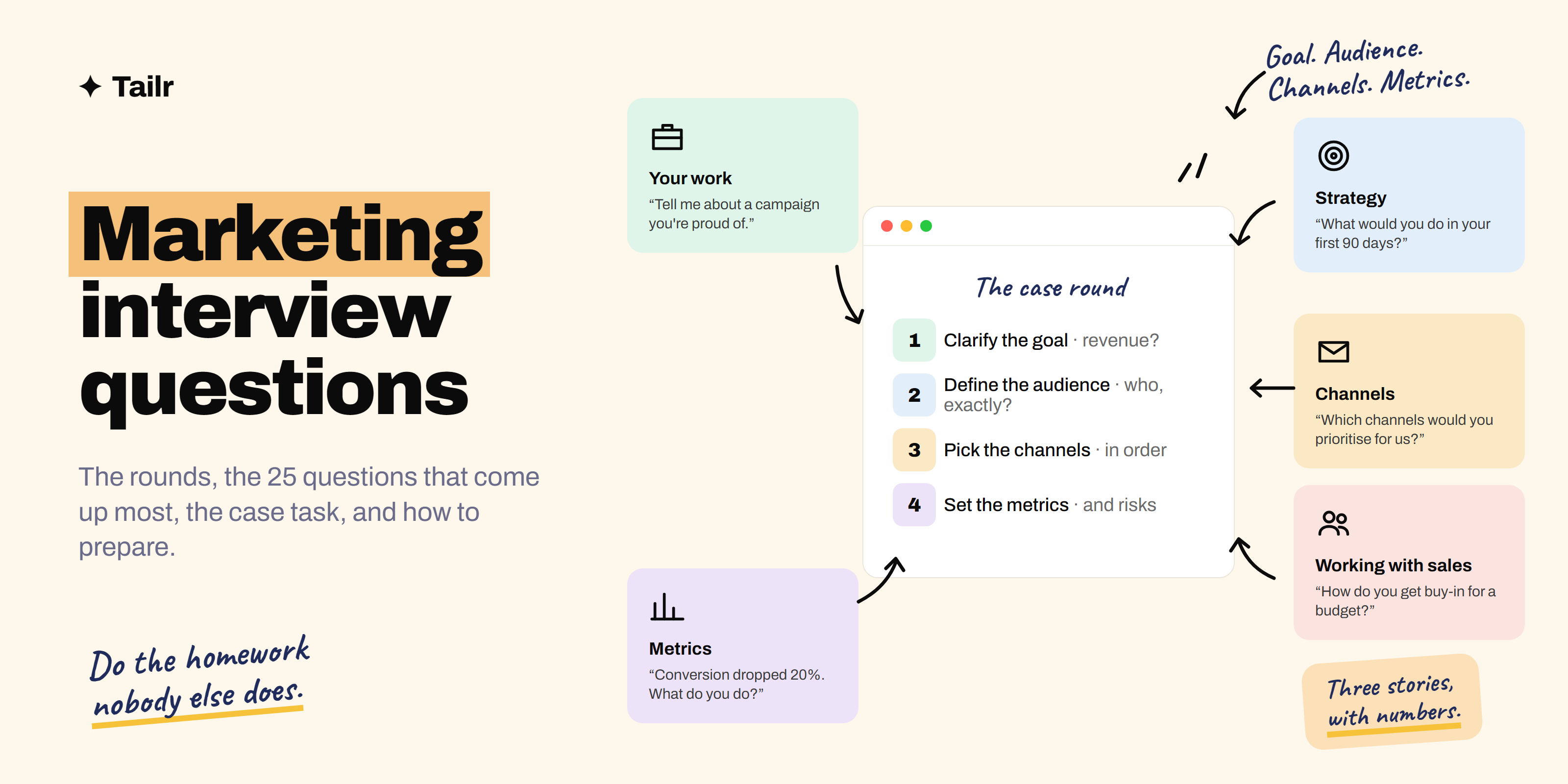
Marketing interviews are harder to prepare for than technical ones because there’s no fixed syllabus. One company wants a growth analyst who lives in spreadsheets, the next wants a brand storyteller, and both call the job “marketing manager”. This guide covers what’s common to all of them: how the rounds work, the questions that come up most, how to answer them, and how to handle the case task.
The short answer: a marketing interview usually has four stages:
- A recruiter screen.
- A hiring manager conversation about your campaigns and results.
- A case or take-home task where you plan or critique a campaign.
- A final round with cross-functional partners such as sales or product.
The questions fall into five areas: your own work and results, strategy and audience, channels and tactics, metrics and measurement, and how you work with other teams. You’ll do well if you bring three campaign stories with real numbers, have studied the company’s actual marketing before you walk in, and can structure a case answer around goal, audience, plan, metrics and assumptions.
What the interview process looks like
A typical loop for a mid-level marketing role in 2026:
- Recruiter screen, 30 minutes: background, motivation, salary expectations, logistics.
- Hiring manager interview, 45–60 minutes: your campaigns, your results, your thinking. This is the round that matters most.
- Case study or take-home, either a live 45-minute discussion or a presentation you prepare over a few days.
- Panel or cross-functional round: a product manager, a sales leader or a designer testing whether they’d want to work with you.
- Sometimes a skills test: write a landing page headline, critique an email, analyse a small dataset.
Specialist roles add their own layer: a performance marketer will be asked about bidding and attribution, a content marketer about editorial strategy and SEO, a product marketer about positioning and launches. The questions below cover the shared core.
Before the interview: do the homework nobody else does
Most candidates read the company’s About page. You can do better in an hour:
- Sign up for their emails and read the onboarding sequence. Note what’s good and what you’d change.
- Read their last ten social posts and the comments.
- Look at their ads in the Meta Ad Library and Google’s Ads Transparency Center. You’ll see which messages they’re testing.
- Use the product or book a demo. Marketers who’ve never used the product are surprisingly common.
- Read two competitors’ sites and note how the positioning differs.
- Search their brand name and see what ranks. That’s their SEO and reputation in one screen.
Now you have specific things to say in every round, and you’ll be the only candidate who does.
Questions about you and your work
1. Walk me through your background. Two minutes, not ten. Lead with what’s relevant to this role, give one or two headline results, and end with why you’re here. Practise it out loud until it’s smooth.
2. Tell me about a campaign you’re proud of. Use situation, action, result. “We were losing trial sign-ups at the pricing page. I ran a message test on the page and in the follow-up email, found that leading with the annual discount rather than the feature list lifted conversion from 3.1% to 4.4%, which was about 180 extra customers a quarter.” Have three of these ready: one about strategy, one about execution, one about a fix.
3. Tell me about a campaign that failed. They want to see that you measure honestly and learn. Say what you expected, what happened, why you think it happened, and what you changed afterwards. Don’t pick a fake failure.
4. What’s the result you’re most proud of, in numbers? Have the number ready and know how it was measured. Expect follow-ups on attribution: “how do you know it was the campaign and not seasonality?”
5. Why do you want to work here? Use the homework. “I signed up for your emails and the onboarding is strong, but I noticed the third email sends people to a generic page; I’d want to fix that kind of thing” is a better answer than anything about culture.
6. Why are you leaving your current role? Forward-looking and short. Growth, scope, a market you want to work in. Never complaints.
Strategy and audience questions
7. Who is our customer? A test of whether you did the homework. Describe the segment as specifically as you can (role, company size, the problem that triggers a purchase), then ask them how close you got.
8. How would you position our product against [competitor]? Structure: who it’s for, what job it does, what makes it different, and what proof you’d use. Acknowledge the competitor’s real strengths; a one-sided answer sounds naive.
9. If you joined tomorrow, what would you do in your first 90 days? Days 1–30: learn. Talk to customers, sales and support; audit the channels and the data. Days 31–60: pick one or two quick wins based on what you found. Days 61–90: propose the plan for the next two quarters with targets. Interviewers want to hear listening before action.
10. How do you decide what to prioritise when everything seems important? Impact against effort, tied to the business goal for the quarter. Give an example where you said no to something visible in favour of something that moved the number.
11. How would you launch a new feature or product? Goal and audience first, then the message, then the channels in order of where that audience actually is, then the timeline and the metrics you’d track in the first two weeks. Mention enabling sales and support before launch day; forgetting them is a common real-world failure.
Channel and tactic questions
12. Which channels would you prioritise for us, and why? Reason from the audience. B2B with a long sales cycle: search, LinkedIn, content, events, partnerships. Consumer with impulse purchases: paid social, creators, marketplaces. Say what you’d test first and what would make you stop.
13. How do you approach SEO? Start with what the audience searches for at each stage, map existing pages to those intents, fix technical basics, then create content that’s genuinely better than what ranks. Mention that AI-generated search answers have changed click-through rates on informational queries, and that you’d weight commercial-intent terms accordingly.
14. How do you write a good email? One goal per email, a subject line that earns the open without tricking, the value in the first two lines, one clear call to action, and a test plan. If they ask you to critique one of their emails, you already have notes from the homework.
15. How do you think about paid advertising budgets? Start small, measure cost per acquisition against the target, scale what works, kill what doesn’t within a defined window. Talk about creative testing as the main lever and about diminishing returns as spend grows.
16. How do you use AI tools in your marketing work? Be specific and honest. Drafting first versions, summarising research, generating variations for tests, analysing survey responses. Then say where you don’t: final copy without editing, anything customer-facing without a human check, anything that needs a fact verified. Interviewers are wary of both “I don’t use them” and “they do everything for me”.
Metrics and measurement questions
17. How do you measure whether a campaign worked? Against the goal you set before it launched. Name the primary metric, the guardrail metrics (did we hurt something else?), and how you separated the campaign’s effect from everything else: a holdout, a control group, a before-and-after with seasonality considered.
18. Explain CAC and LTV, and why the ratio matters. Customer acquisition cost is what you spend to win a customer; lifetime value is the profit that customer brings over their time with you. The ratio tells you whether growth is sustainable. Mention that both are easy to calculate badly: CAC often excludes salaries, and LTV often assumes retention that hasn’t been proven.
19. Our conversion rate dropped 20% last month. What do you do? Segment before you speculate. By channel, device, landing page, geography, new versus returning. Check whether anything changed: a site release, a tracking change, a competitor’s campaign, a pricing change. Find where the drop is concentrated, then form a hypothesis. Interviewers are testing whether you investigate or guess.
20. How do you handle attribution? Honestly: no model is right, and last-click over-credits the bottom of the funnel. Use a mix: platform data, a multi-touch model as a directional guide, incrementality tests for the big decisions, and asking customers how they heard about you. The candidate who says “attribution is solved with tool X” loses points with anyone who’s done it.
Working with other teams
21. How do you work with sales? Shared definition of a qualified lead, regular feedback on lead quality, listening to sales calls, and building the materials they actually use rather than the ones marketing likes making.
22. Tell me about a disagreement with a product manager or designer. Pick one where you were partly wrong. Show that you argued from data and customer evidence, listened, and reached a decision the team could live with.
23. How do you get buy-in for a budget or a new idea? A small test with a clear success metric, then the results in front of the decision-maker. Nobody funds an idea; they fund evidence.
Behavioural questions
24. Tell me about a time you had to deliver with far less budget than you needed. Marketers get this constantly. Show creativity and prioritisation, and quantify what you achieved with what.
25. Tell me about a time you changed your mind because of data. A signal of intellectual honesty. Have a real example.
For the general behavioural format, our behavioral interview questions guide covers the structure in depth, and HR interview questions and answers covers the screening round.
The case study round
The case is where marketing interviews are won or lost. Common formats:
- “Plan the launch of our product in a new country.”
- “Our blog traffic has doubled but sign-ups haven’t moved. Why, and what would you do?”
- “Here’s our home page. Critique it.”
- “You have $50,000 and one quarter. How do you spend it?”
A structure that works every time:
- Clarify the goal. Revenue, sign-ups, awareness? Over what period? Ask.
- Define the audience. Who exactly, and what do they care about?
- Choose the message. One sentence you’d want them to remember.
- Pick the channels in the order the audience actually uses them, and say why.
- Set the metrics and the checkpoints where you’d change course.
- State your assumptions and risks. What would have to be true for this to work?
Talk out loud as you go. Interviewers care about how you think far more than whether you guessed their plan. If it’s a take-home presentation, keep it to ten slides, lead with the recommendation, and put the working in an appendix.
Questions to ask them
- What does success look like in this role at six months, in numbers?
- Which channel is working best right now, and which one is underperforming?
- How does marketing get customer feedback here?
- What’s the biggest thing the team tried last year that didn’t work?
That last one tells you more about the culture than any answer about values.
Getting to the interview
Marketing job listings are unusually varied: one “marketing manager” role wants paid media and spreadsheets, the next wants content and brand. Your resume needs to lead with whichever the specific listing asks for, and with numbers attached to every campaign: conversion lift, cost per acquisition, revenue influenced, audience grown. Tailr is a browser extension that tailors your resume to the job listing you’re viewing, so a performance-heavy role and a content-heavy role each see the version of your experience that fits, and it writes the matching cover letter and tracks the application. Try Tailr on the next marketing listing you open. If you’re still building the resume itself, how to tailor your resume to a job description walks through the method.
Related guides
- 50 Group Discussion Topics and How to Score in a GD
- 30 Situational Interview Questions With Sample Answers
- 25 Interview Tricks You Should Know Before Your Next Interview
- How to Ace Your Technical Interview (With Sample Questions and Answers)
Conclusion
A marketing interview tests whether you can think commercially, measure honestly and work well with the teams around you. Prepare three campaign stories with real numbers, do the homework on the company’s actual marketing so you have specific observations, know the metrics for the role, and walk into the case with a structure you can apply to anything: goal, audience, message, channels, metrics, assumptions. Do that and you’ll be ahead of most of the field before the first question.
Frequently asked questions
01What questions are asked in a marketing interview?
Expect four kinds: questions about your own work (walk me through a campaign you ran, what did it achieve), strategy and audience questions (how would you position this product, who is the customer), channel and metrics questions (how do you measure a campaign, which channels would you prioritise and why), and a case task where you're given a product or a problem and asked to plan a campaign or critique existing marketing. Behavioural questions about working with sales and product are common.
02How do I prepare for a marketing interview?
Research the company's actual marketing: sign up for their emails, read their last ten social posts, look at their ads library, try the product. Prepare three campaign stories with numbers using a situation, action, result structure. Revise the metrics that matter for the role (CAC, LTV, conversion rate, ROAS, pipeline). And prepare a point of view on what you'd do in the first 90 days, because you'll be asked.
03What is a marketing case study interview?
A round where you're given a scenario, such as launching a product in a new market or fixing a channel whose performance has dropped, and asked to talk or write through your approach. Sometimes it's a take-home presentation. Interviewers are testing structure, prioritisation and commercial sense, not a perfect answer. Start with the goal and the audience, propose a plan, name the metrics, and state your assumptions.
04What should I say when asked why I want to work in marketing?
Connect a genuine interest to evidence. Say what you like about the work specifically (understanding why people buy, the mix of creative and analytical work, seeing a campaign move a number) and back it with something you've done, even if it was small: a side project, a student society, a volunteer campaign. Avoid generic answers about being creative or a people person.
05How do I answer marketing questions with no experience?
Use what you have: coursework, a personal project, a club you promoted, a small business you helped, or a critique of a brand's marketing you've studied closely. Show you understand the basics of audience, message, channel and measurement, and show curiosity about the company's own marketing. Fresh graduates are hired for thinking and hunger, not a portfolio of campaigns.
06What metrics should I know for a marketing interview?
Customer acquisition cost (CAC), customer lifetime value (LTV) and the ratio between them; conversion rate at each stage of the funnel; return on ad spend (ROAS); click-through rate and cost per click for paid channels; open and click rates for email; organic traffic and rankings for SEO; and pipeline or revenue influenced for B2B. Know what each one tells you and what it hides.