QA Engineer vs. SDET: Differences, Salary and Which to Choose
· updated
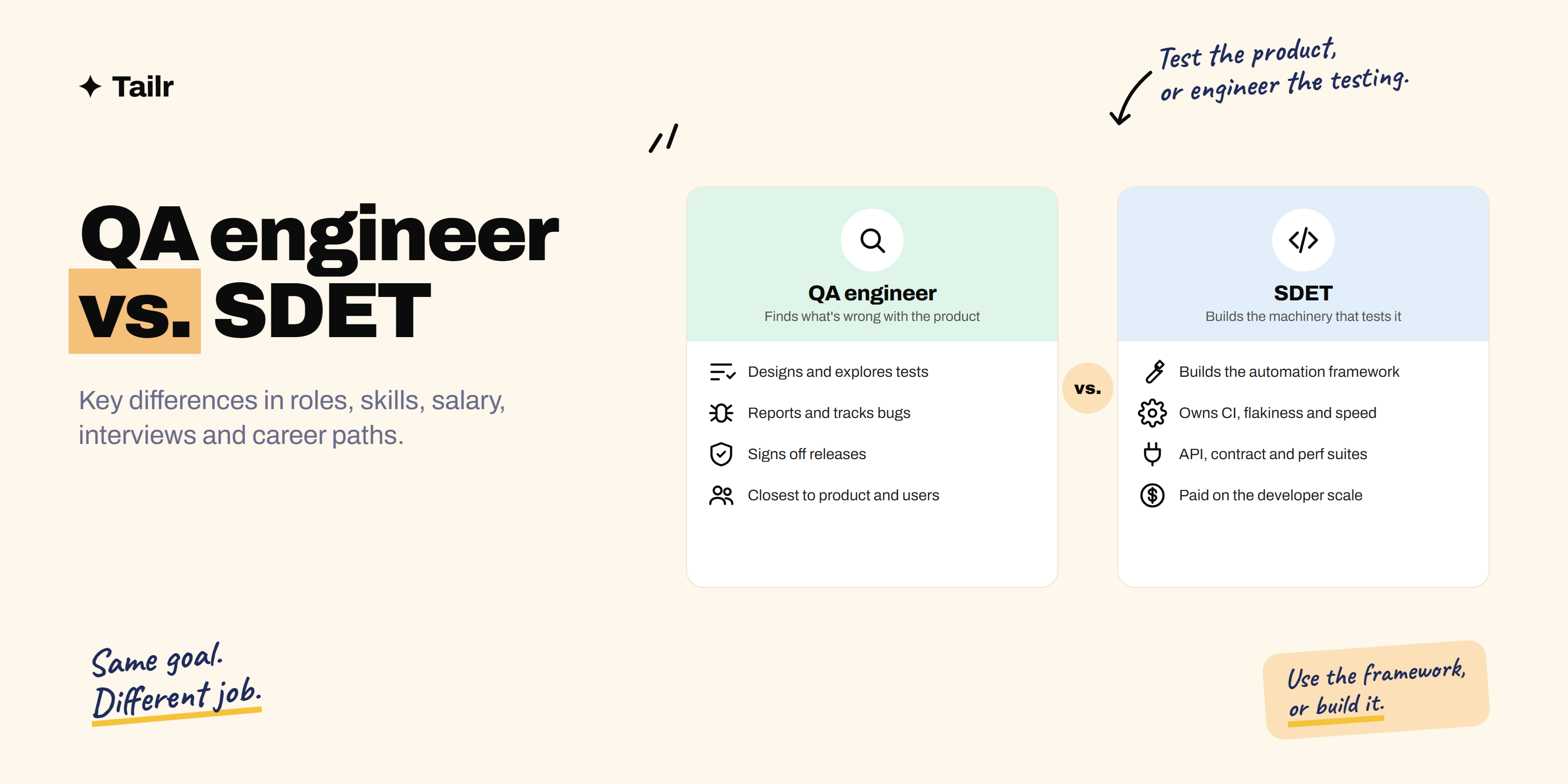
If you’re choosing between “QA engineer” and “SDET” listings, or trying to work out why two jobs that both say “testing” pay so differently, this is the comparison. The two roles share a goal and almost nothing else about the daily work. Understanding the difference is worth real money: it tells you which roles you’re qualified for now, which one to aim at, and how to describe your experience so the right one hires you.
The short answer: A QA engineer is responsible for testing the product: designing tests, exploring it, running regression, reporting and tracking bugs, and usually maintaining some automation. An SDET (software development engineer in test) is a software engineer whose product is testing infrastructure: the automation frameworks, tooling, CI integration and performance suites that the whole team uses. QA is closer to the product and the user; SDET is closer to the codebase and the pipeline. SDETs are paid on the developer scale, typically 15 to 35 percent above QA engineers at the same level. The most common route into SDET is from QA, by building rather than just using automation.
The two roles side by side
| QA engineer | SDET | |
|---|---|---|
| Core question | Does the product work, for users, in the ways that matter? | Can we answer that automatically, reliably, on every change? |
| Main output | Test plans, test cases, exploratory findings, bug reports, release sign-off | Automation frameworks, test tooling, CI pipelines, test suites other people use |
| Codes? | Some to a lot, usually scripting tests in an existing framework | Yes, daily, at developer level; builds the framework |
| Closest to | Product, users, requirements | Codebase, developers, infrastructure |
| Measured on | Defects found before release, escaped defects, coverage, release quality | Suite reliability and speed, coverage, developer adoption, flakiness rate |
| Typical background | Testing, domain expertise, sometimes non-CS degrees | Computer science or software engineering, or QA who learned to build |
| Pay scale | QA track | Software engineering track |
What a week actually looks like
QA engineer. Monday: refinement session, asking the questions that turn a vague story into testable acceptance criteria. Tuesday: exploratory testing on the new checkout flow, an hour with a charter and a notebook, five bugs logged with clear steps. Wednesday: updating the regression suite for the changed flow, half of it in the automation framework, half of it manual because the payment gateway sandbox is unreliable. Thursday: triage, arguing severity on two bugs, retesting three fixes. Friday: release sign-off, a risk summary for what wasn’t covered, and a look at production monitoring for anything that leaked.
SDET. Monday: the nightly suite had 4 percent flaky failures; root-causing the top three, which turn out to be a shared test user and a race in a polling helper. Tuesday: building a fixture library so tests create their own data via the API instead of relying on seeded environments. Wednesday: pairing with a developer to add contract tests between two services, and wiring them into the pull request pipeline. Thursday: the suite takes 40 minutes; sharding it across runners and cutting it to 12. Friday: writing the internal doc on how to add a test to the framework, because adoption by developers is the metric that matters.
Both are testing. One is testing the product; the other is engineering the testing.
Skills and tools
QA engineer
- Test design: boundary analysis, equivalence partitioning, decision tables, state models, risk-based prioritisation.
- Exploratory testing: charters, note-taking, heuristics for where bugs hide.
- Requirements analysis and the ability to turn ambiguity into acceptance criteria.
- Bug reporting that developers can reproduce without asking.
- Domain knowledge: payments, healthcare, e-commerce, whatever the product is.
- Tools: a test management tool (TestRail, Xray, Zephyr), a bug tracker (Jira), API clients (Postman, Bruno), browser dev tools, SQL for checking data.
- Automation: writing and maintaining tests in an existing framework (Playwright, Selenium, Cypress), usually in Python, JavaScript or Java.
SDET
- Programming at developer level in at least one language: Java, Python, C#, TypeScript. Clean code, design patterns, code review.
- Framework design: page objects or component models, fixtures and factories, parallel-safe test isolation, reporting, retries done right.
- UI automation (Playwright, Selenium, Cypress, Appium), API automation (REST Assured, requests, SuperTest, Karate), contract testing (Pact), performance (k6, JMeter, Gatling).
- CI/CD: GitHub Actions, Jenkins, GitLab CI; containerised test environments; test sharding; flaky-test management.
- Enough of the application stack to test below the UI: databases, queues, service boundaries.
- Observability: reading logs and traces to debug a failing test, adding test telemetry.
The overlap is automation. The difference is whether you use the framework or build it.
What each role pays
SDET roles are paid on the software engineering scale; QA engineer roles are usually on a separate, lower scale. At the same level and company, SDETs typically earn 15 to 35 percent more.
- United States: QA engineers roughly $70,000 to $110,000 base, senior QA to around $130,000. SDETs roughly $95,000 to $140,000 base, senior SDETs $140,000 to $180,000 and above at large tech companies, where the title is often just “software engineer” on a test-infrastructure team.
- United Kingdom and Europe: QA engineers roughly £35,000 to £65,000; SDETs and automation engineers roughly £50,000 to £90,000, with London and fintech at the top.
- India: QA engineers roughly 4 to 15 lakhs depending on experience; SDETs roughly 8 to 30 lakhs, with product companies and US-funded startups paying above that for senior SDETs.
Two things narrow the gap: a QA engineer with strong automation and domain expertise at a company that values both, and companies that don’t distinguish the titles. Two things widen it: companies with a rigid QA track, and SDET roles at companies that treat them as engineers first.
Career paths from each role
From QA engineer: senior QA, QA lead, test manager, head of quality. Sideways into product (QA engineers make good product managers because they’ve spent years thinking about how things fail), business analysis, or customer-facing technical roles. And into SDET, which is the most common technical move.
From SDET: senior SDET, staff or principal engineer on test infrastructure, developer productivity or platform engineering, DevOps and release engineering, or straight into software development. The programming skills transfer directly, and many SDETs move into feature development within a few years.
The SDET path has more technical ceiling; the QA path has more product and management breadth.
How the interviews differ
QA engineer interviews ask you to think. Test a login page, a lift, a vending machine. Explain severity versus priority. Write test cases for a feature described in two sentences. Find the bugs in a screenshot. Describe a bug you found that nobody else would have. There’s usually a light automation component: read this test and tell me what’s wrong with it, or write a simple script. 50 manual testing interview questions covers the round in detail.
SDET interviews are software engineering interviews with a testing lens. A coding round (data structures, a small problem in your language). A framework design round: how would you structure automation for this application; how do you make tests independent; how do you handle flakiness. An API round, often hands-on: here’s an endpoint, write tests for it. Sometimes system design for a test platform. And behavioral questions about working with developers. 50 API testing interview questions covers the API round; the coding round is the same as any developer interview.
If you can’t pass a coding interview, you can’t get an SDET job, whatever the listing says. If you can’t design tests for a login page without a spec, you’ll struggle in QA regardless of how well you code.
Which one should you choose?
Choose QA engineer if:
- You’re stronger on analysis, product sense and communication than on programming.
- You enjoy exploring a product and finding what’s wrong with it.
- You want a path into product management or leadership rather than deeper engineering.
- You have domain expertise that makes you valuable regardless of code.
Choose SDET if:
- You can code at developer level, or you’re willing to get there.
- You’d rather build tools than run tests.
- You want to be paid on the engineering scale and keep the door to software development open.
- You find flaky tests and slow pipelines interesting problems rather than annoyances.
If you’re a QA engineer thinking about the move: it’s the most common route and it works. Take ownership of your team’s framework. Build something from scratch: a fixture system, a reporting integration, a contract test setup. Learn one language properly, including testing your own code. Practise coding interviews for three months. Then apply for the SDET title, and describe your work as engineering, not testing.
If you’re a fresher: if you enjoy programming and can pass a coding round, aim for SDET or a software engineering role with test infrastructure exposure. If not, start in QA, add automation over your first two years, and reassess. Either way, don’t apply for SDET titles you can’t back with code; the interview will find out.
Tailoring your resume for each role
The same experience reads differently depending on the title you’re applying for.
For a QA engineer listing, lead with test design, exploratory findings, defects caught, releases signed off, domain knowledge, and the automation you maintain. Quantify: “found 40 percent of production-blocking defects on the team in the last year”, “cut regression cycle from five days to two”, “designed the test strategy for the payments migration”.
For an SDET listing, lead with what you built: the framework, the fixture library, the CI pipeline, the flakiness reduction, the developer adoption. Quantify in engineering terms: “built the API test framework used by 30 developers”, “cut suite runtime from 40 to 12 minutes with sharding and fixture rewrites”, “reduced flaky failures from 8 percent to under 1 percent”. Name the languages and tools in the first lines.
Tailr reads the job listing and tailors your resume to it, so a QA listing gets the test-design and defect-finding version of your experience and an SDET listing gets the framework-building version, from the same underlying work, with a matching cover letter. How to tailor your resume to a job description explains the method, and best tools for QA and software testing covers the tooling both roles use. Try Tailr on the next QA or SDET listing you open.
Related guides
- What Is Software Testing? Types, Levels and Methods Explained
- What Is API Testing? Types, Tools and How to Start
- Top QA Interview Questions (and How to Answer Them)
- Top SDET interview questions and answers
Conclusion
A QA engineer tests the product; an SDET builds the machinery that tests the product. They share a goal, some tools and the word “test”, and differ in almost everything else: what a week looks like, what skills matter, what the interview asks, and what the pay scale is. Pick the one that matches what you’re good at and want to be good at, know that QA to SDET is a well-worn path if you learn to build rather than use, and describe your experience in the language of the role you’re applying for.
Frequently asked questions
01What is the difference between a QA engineer and an SDET?
A QA engineer is responsible for testing the product: designing test cases, exploratory testing, running regression, reporting bugs, and often light automation. An SDET (software development engineer in test) is a developer whose product is test infrastructure: automation frameworks, test tooling, CI integration, performance and API test suites. QA asks 'does this work?'; an SDET builds the systems that answer that question automatically.
02Does an SDET earn more than a QA engineer?
Usually, yes. SDET roles are paid on the software engineering scale because they require developer-level coding, and typically sit 15 to 35 percent above QA engineer roles at the same level. The gap narrows for senior QA engineers with strong automation and widens at companies that treat QA as a separate, lower track.
03Can a QA engineer become an SDET?
Yes, and it's the most common route into the role. It takes real programming skill in one language (Java, Python, C# or TypeScript), experience building rather than just using an automation framework, comfort with Git and CI pipelines, and an understanding of how the application is built. Many QA engineers make the move by taking ownership of their team's framework and then applying for SDET titles.
04Is manual QA still a career in 2026?
Yes, but the shape has changed. Pure manual execution of scripted test cases is shrinking; exploratory testing, test design, risk analysis, and domain expertise are not. The QA engineers in demand can do all of those and also write or maintain automation. The ones at risk are those whose only skill is running someone else's test cases.
05Which is better for a fresher: QA engineer or SDET?
If you can code and enjoy it, aim for SDET; it pays more and the skills transfer to software engineering. If you're stronger on analysis, product thinking and communication than on programming, start as a QA engineer, add automation over the first two years, and decide then. Both are real careers; the wrong choice is picking the title without the skills behind it.
06What tools does an SDET use?
A programming language (Java, Python, C#, TypeScript), a UI automation tool (Playwright, Selenium, Cypress, Appium for mobile), an API testing library (REST Assured, requests, SuperTest), a test runner (pytest, JUnit, TestNG, Jest), Git, a CI system (GitHub Actions, Jenkins, GitLab CI), containers for test environments, and often a performance tool (k6, JMeter). Increasingly, contract testing and observability tools too.